

If You’re Struggling on Surgery Rotation: How to Salvage the Block
It’s 4:15 a.m. You’re in the resident workroom, scrolling through Epic half-asleep, trying to pre-round on patients you barely remember from yesterday’s whirlwind. Your intern just side-eyed your note, the chief hasn’t learned your name, you got snapped at in the OR for touching the sterile field, and your last eval mentioned “needs to read more” and “quiet in the OR.”
You’re halfway through the surgery block and it feels like it’s going off the rails.
You’re not gunning for ortho or gen surg. You’re just trying not to tank your MS3 year. And right now, you’re thinking: “Is it too late to fix this?”
It’s not. But you have to move deliberately. Not “try harder” in some vague way. Surgical rotations are ruthless about time, impressions, and hierarchy. You can absolutely turn a rough start into a respectable finish if you change how you operate—starting now.
Let’s walk through exactly what to do, week by week and day by day, to salvage a struggling surgery rotation.
Step 1: Diagnose the Problem – What’s Actually Going Wrong?
Before you fix anything, you need to be bluntly honest about where you’re failing. Surgery rotations usually judge you in a few predictable domains:

| Area | What Attendings/Residents Actually Notice |
|---|---|
| Work Ethic | Pre-rounding, being on time, staying engaged |
| Basic Knowledge | Common surgeries, anatomy, postop issues |
| OR Behavior | Sterility, position in room, communication |
| Notes & Presenting | Concise, organized, not missing key data |
| Initiative | Volunteering, anticipating needs, follow-through |
Now match your experience:
- Residents seem annoyed with you? Often work ethic / reliability.
- Attending tells you to “read more”? Knowledge deficit.
- You keep getting moved away from the table? OR etiquette / presence.
- You’re not getting pimped much? They may have quietly written you off.
- Feedback says “quiet” or “disengaged”? They don’t feel you’re trying.
You probably already know the truth. Pick the top 2 problem categories and focus on those. Fixing everything at once is unrealistic; fixing your biggest 2 buys you the most respect back.
Ask for a blunt mid-rotation read
Do this with a resident who’s not a jerk and sees you regularly.
You: “I feel like I’ve had a slow start on this rotation and I want to do better. Can I ask you directly—if you were filling out my eval today, what would you say I need to improve?”
Then shut up and listen. Do not defend. Do not explain. Write down what they say. That’s your hit list.
If they’re vague, push once: “That’s helpful—can you give me one or two specific examples so I know what to change this week?”
Step 2: Fix the Non-Negotiables: Time, Notes, Pre-rounds
If you’re struggling, you do not have the luxury of being “average” on the basics. You need to be rock solid on the boring stuff.
Be early. Actually early.
On surgery, “on time” is already late. You know this. Now live it.
- If residents round at 5:30 a.m., you’re in the hospital before 5.
- If a case is at 7:30, you’re in the OR by 7:00, checked in, consents checked, imaging pulled up.
If you’ve been cutting it close, this alone changes how people talk about you. I’ve watched students go from “kind of flaky” to “works hard, just quiet” in a week purely by becoming relentlessly early and consistently prepared.
Build a pre-rounding checklist you use every single morning
For each patient, you should be pulling:
- Vitals (especially overnight issues: fever, tachy, hypotension)
- I/Os: urine, drains, NG tube, ostomy output
- Pain control: what they’re on, how often using PRNs
- Labs and trends: CBC, BMP, LFTs as relevant
- Post-op day, procedure, surgeon
- Lines/tubes/drains changes (removed? added? output trending?)
Write it in the same order you’ll present. That way even if you’re tired, you sound organized.
Quick mental script for surgery presentations:
“Mr. X is a [age]-year-old [relevant comorbidities] POD# [X] from [procedure]. Overnight, [events/none]. This morning, vitals are [relevant abnormalities]. Pain is [well-controlled / poorly controlled on X]. He’s [tolerating / not tolerating] [diet]. I/Os: [urine, drains, other]. Labs show [key abnormalities/trends]. On exam: [2-3 focused findings]. Overall, he’s [improving/stable/concern for X]. I’d continue [A, B] and consider [C].”
If your presentations were chaotic before, tightening this up will be noticed within 2 days.
Step 3: Stop Flailing in the OR – How to Not Be “In the Way”
The OR magnifies weakness. If you’re already on thin ice, an attending snapping at you in front of everyone just cements the narrative. You need to make the OR safer—for the team and for your eval.
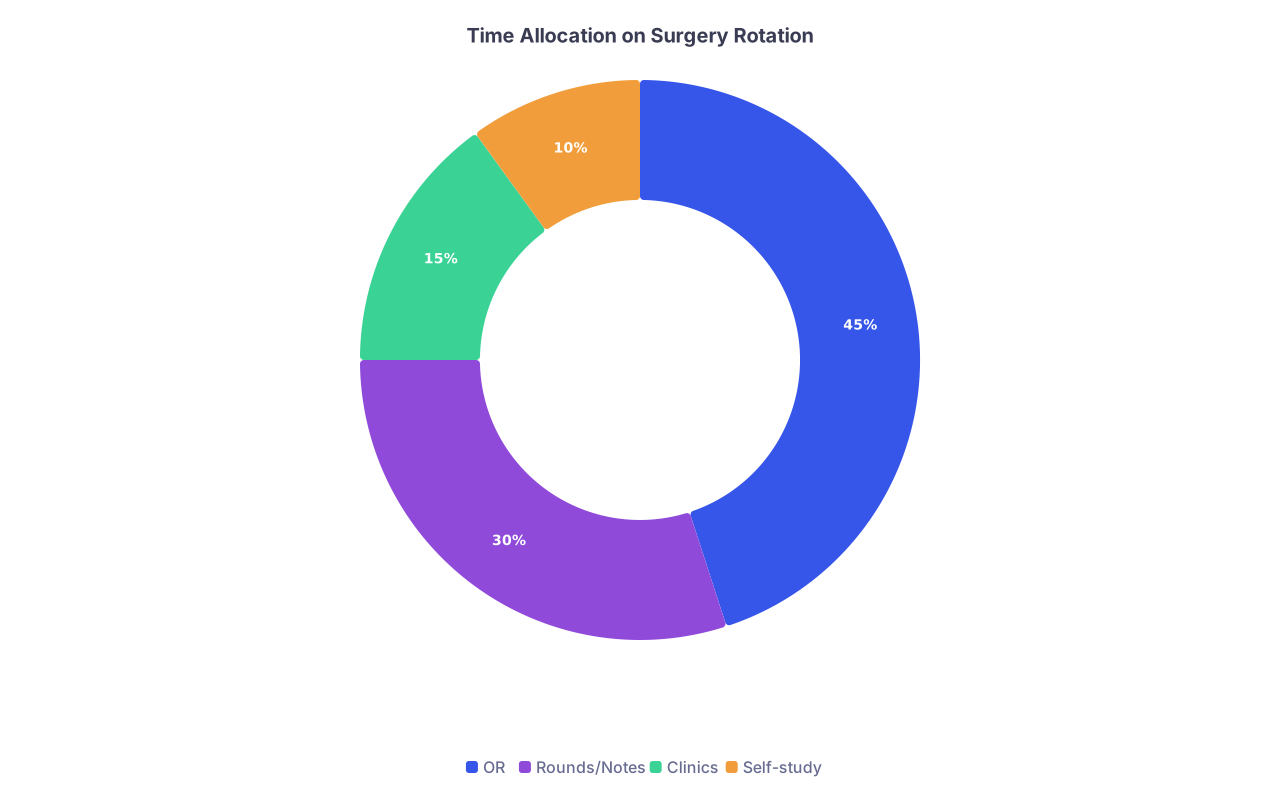
| Category | Value |
|---|---|
| OR | 45 |
| Rounds/Notes | 30 |
| Clinics | 15 |
| Self-study | 10 |
Day-of-case prep: 10 minutes that change everything
The night before or early that morning:
- Know the one-liner about the patient and surgery:
- “54-year-old M with symptomatic cholelithiasis -> lap chole.”
- “67-year-old F with colon cancer -> left hemicolectomy.”
- Read the indication + 5 key steps. Not a full chapter. Just:
- Why are we doing this?
- Basic anatomy at risk.
- Usual post-op issues.
Then build 3–4 questions you can ask that do not scream “I opened the textbook 10 seconds ago.”
Bad: “What are the complications?” Better: “For this patient with cirrhosis, which complications are you most worried about after a cholecystectomy?”
OR positioning and behavior: the unspoken rules
If you struggle in the OR, memorize this:
- If they do not tell you where to stand, ask once:
“Where would you like me to stand to be most helpful and least in the way?” - Keep your hands either clasped in front of you or lightly on the drape. Don’t hover.
- Don’t fight the resident for retraction. If they adjust your hand, say “Got it” and don’t argue with the tissue.
- If you contaminate something, say it immediately:
“I think I just broke sterility on this.”
You’ll feel stupid. It’s better than an infection and they know it.
If your big screw-up this block was breaking sterility or bumping something, own it once and then prove you learned. People remember that more than the error itself.
Step 4: Turn “Quiet and Lost” into “Engaged and Improving”
A lot of “struggling” students are not lazy or dumb. They’re just mentally underwater and it shows up as silence and passivity. On surgery, that reads as disinterest. Death sentence for evaluations.
You don’t need to become the loudest person on the team. But you do need to show your brain is on.
Use the “small but consistent” engagement strategy
Aim for 3–4 deliberate contributions per day:
- Ask one thoughtful question on rounds about a management choice.
- Ask one case-relevant question in the OR.
- Offer to follow up one task: “I can check the post-op labs on Ms. X and report back.”
- Offer to practice a skill: “If there’s downtime this afternoon, could I practice knot tying with you?”
You’re signaling: “I’m here, I care, I’m trying.” That’s what saves a borderline eval.
How to handle pimping when you’re already behind
You will get questions you don’t know. The worst move is to guess confidently and be wrong in a dumb way, then stare blankly.
Use this structure:
- Try a brief, honest attempt if you have any idea.
- If you truly have nothing, say:
- “I don’t know the answer. I think it’s related to X, but I’m not sure. I’ll look it up and get back to you.”
- Then actually follow up:
- Later that day: “Dr. Smith, earlier you asked about colon cancer staging. I read up on it—briefly, it’s based on depth of invasion (T), nodes (N), and mets (M). For this patient, they’re at least T3 by imaging.”
That sequence—admit, learn, close the loop—turns a wrong answer into evidence you’re teachable and serious. Attendings like teachable and serious.
Step 5: Academic Triage – Studying When You’re Toast
If you’re struggling clinically, you’re likely too exhausted to study properly. But surgery shelf and clinical performance are not separate in most graders’ minds. “Does not know basic postop care” hurts both.
You don’t need a heroic study plan. You need a brutally focused one.
Pick one primary question resource and stick to it
Do not dabble in five things. If you’re behind:
- UWorld surgery questions
- Or AMBOSS surgery clerkship questions
Do 20–30 questions a day, but done well:
- Do a block.
- Review every question, right or wrong.
- For each, ask: “What would this look like on my actual patient list tomorrow?”
Bedside reading > random textbook dives
Tie your studying directly to your patients.
You have a patient with SBO? That night, you read:
- Diagnosis and imaging.
- Operative vs non-operative indications.
- Expected post-op course + common complications.
You will remember 10x more because you’ll see that same NG tube and distended abdomen the next morning and it clicks. And then on rounds, you can say something useful like:
“For her SBO, if she doesn’t improve with NG decompression in 48–72 hours or if she worsens clinically, we’d be more concerned for ischemia and need to consider surgery.”
Now you sound like a functioning sub-I, not a lost MS3.
Step 6: Actively Repair Your Reputation
If you’re reading this mid-rotation, people already have opinions about you. Some are fixable. But they don’t automatically update their mental file just because you quietly improved.
You have to nudge them.
Use the “reset conversation” with 1–2 key people
Pick your senior resident or the attending who writes big evals. Ask for 5 minutes when they’re not sprinting—after cases, in the workroom, or at the end of clinic.
You:
“I wanted to check in. I know I had a rough start on this rotation and I’m working on improving my [specific stuff they mentioned: pre-rounding organization, OR comfort, reading]. I’d appreciate any suggestions on what I should focus on for the rest of the block.”
That does three things:
- Shows you’re self-aware.
- Signals you care about this rotation.
- Forces them to reconsider: “Maybe this student is trending up, not stuck.”
If they give you anything specific, implement it fast and visibly. Then, a week later, follow up:
You:
“Last week you mentioned I needed to tighten my presentations. I’ve been using a standard structure and timing my pre-rounds to be earlier. Is that closer to what you were hoping to see?”
You are handing them a narrative for your eval: “Improved significantly over the course of the rotation.” That phrase alone can save you.
Step 7: When You’ve Already Screwed Up – Damage Control
Sometimes it’s not vague underperformance. It’s a specific incident:
- You no-showed a case because you misread the schedule.
- You scrubbed and contaminated the field badly.
- You presented the wrong patient.
- You got caught on your phone in the OR.
You cannot pretend these didn’t happen. People talk. But you can control the fallout.
The script for a real apology
Short. Direct. No excuses beyond the bare minimum context.
“I wanted to apologize about this morning. I misread the OR schedule and wasn’t there when I should’ve been. That won’t happen again—I’ve set daily calendar alerts and check the updated board now. I know that affected the team and I’m sorry.”
Or:
“I’m sorry for breaking sterility earlier. I should’ve been more aware of my positioning. I’ve reviewed proper draping and how to move around the table so it does not happen again.”
Own, adjust, move on. If you keep over-apologizing beyond this, it becomes annoying and self-centered.
Step 8: Planning the Rest of the Block – A Simple Salvage Plan
Let’s be concrete. Say you’re on week 3 of a 6-week surgery block and you’re trending toward “low pass” territory. Here’s what a salvage plan looks like for the next 3 weeks.
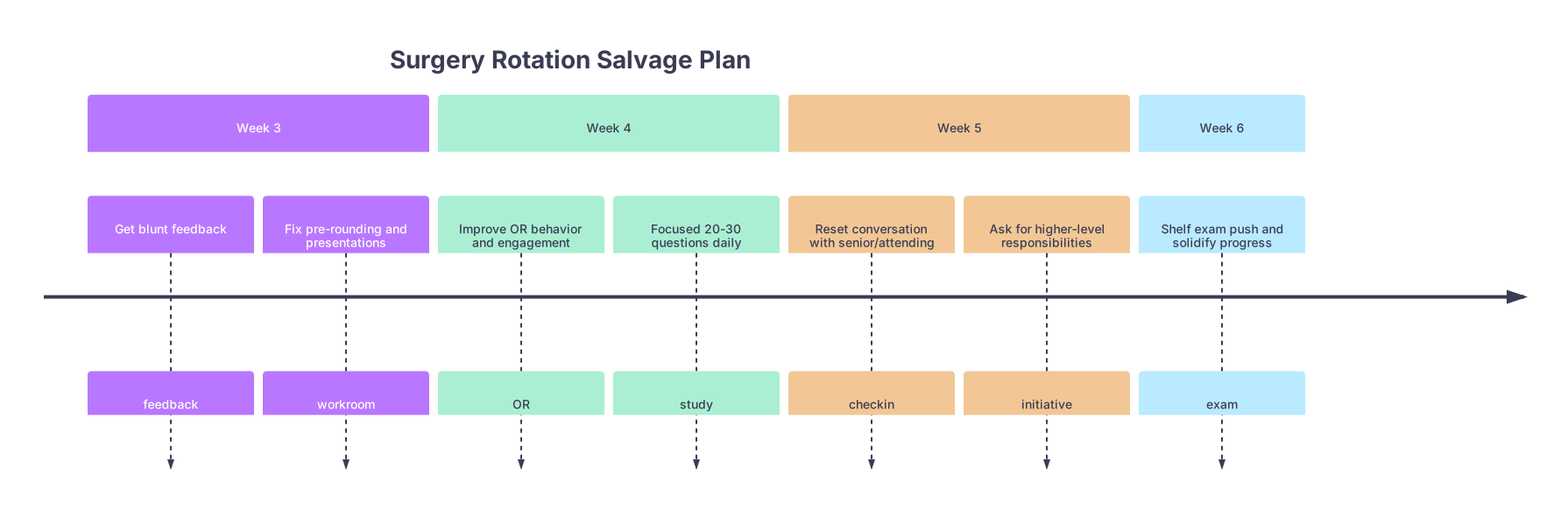
| Period | Event |
|---|---|
| Week 3 - Get blunt feedback | feedback |
| Week 3 - Fix pre-rounding and presentations | workroom |
| Week 4 - Improve OR behavior and engagement | OR |
| Week 4 - Focused 20-30 questions daily | study |
| Week 5 - Reset conversation with senior/attending | checkin |
| Week 5 - Ask for higher-level responsibilities | initiative |
| Week 6 - Shelf exam push and solidify progress | exam |
Week 3: Stabilize the floor basics
- Be early every single day.
- Use a strict pre-rounding template.
- Get mid-rotation feedback from at least one senior.
- Start 20–30 high-yield questions per day.
Week 4: Clean up your OR presence
- Read briefly the night before each case.
- Ask one thoughtful, case-specific question per OR day.
- Own any OR mistakes quickly and do not repeat them.
- Offer to help with room turnover, dressings, brief notes.
Week 5: Actively shift the narrative
- Have a reset conversation with a key evaluator.
- Volunteer for harder things: presenting a new consult, calling family with the resident, closing simple incisions if offered.
- Keep the questions and daily reading going.
Week 6: Finish with momentum
- Shelf exam focus ramps up—but do not disappear clinically.
- Ask for end-of-rotation feedback early in the week:
“I’d like to make the most of this last week—anything you still want to see from me?” - Do not mentally check out, even if you’re exhausted. How you end sticks heavily in people’s minds.
When You Hate Surgery and Just Want It Over
One more honest point: sometimes you’re struggling because you viscerally hate this rotation. The hours. The personalities. The OR. You’re not going into surgery, and you resent the whole thing.
You still need to salvage it.
Shift your mindset: you’re not doing this “for them.” You’re doing this for future you when you’re an intern in IM or EM and you’re admitting a fresh post-op with a soft belly and tachycardia and you need to not miss a catastrophe.
If you can:
- Recognize a bad abdomen.
- Manage basic post-op pain, fluids, and nausea.
- Communicate decently in a high-intensity team.
Then the month was not a waste.
You do not have to love surgery. You do have to be professional, present, and learning something.
Two Things to Remember
- Surgery rotations are impression-driven. If you change your behavior quickly and obviously—earlier, more organized, more engaged—people really do update their view of you.
- You don’t have to become the star student. You just have to demonstrate consistent effort, visible improvement, and basic reliability. That’s enough to salvage a rough block into something you can live with—and move on.


