
It’s February of third year. You just finished another grueling inpatient month, you’re half‑alive, and your school just sent the email: “Elective preferences due in 5 days.”
You open the scheduling portal. There are 50+ options. “Sub-I Medicine A,” “Acting Internship Cardiology,” “Consult Elective,” “Advanced Radiology,” “International Experience,” random away rotations, plus that shiny “Research in [Insert Famous PI’s Name].”
You’re exhausted. You just want something locked in so you can stop thinking about it. So you start clicking.
This is where people quietly wreck their letters and MSPE without realizing it.
You do not feel the damage in March. You feel it six months later when:
- Your chair’s letter sounds… polite, not glowing
- Your MSPE “Summary” reads like a weather report, not a highlight reel
- Your “home” specialty has barely seen you work in a real, high‑stakes setting
Let me walk you through the mistakes that do that to people—because I’ve seen them, and they’re ridiculously common.
Mistake #1: Treating Electives Like Vacation Instead of Audition
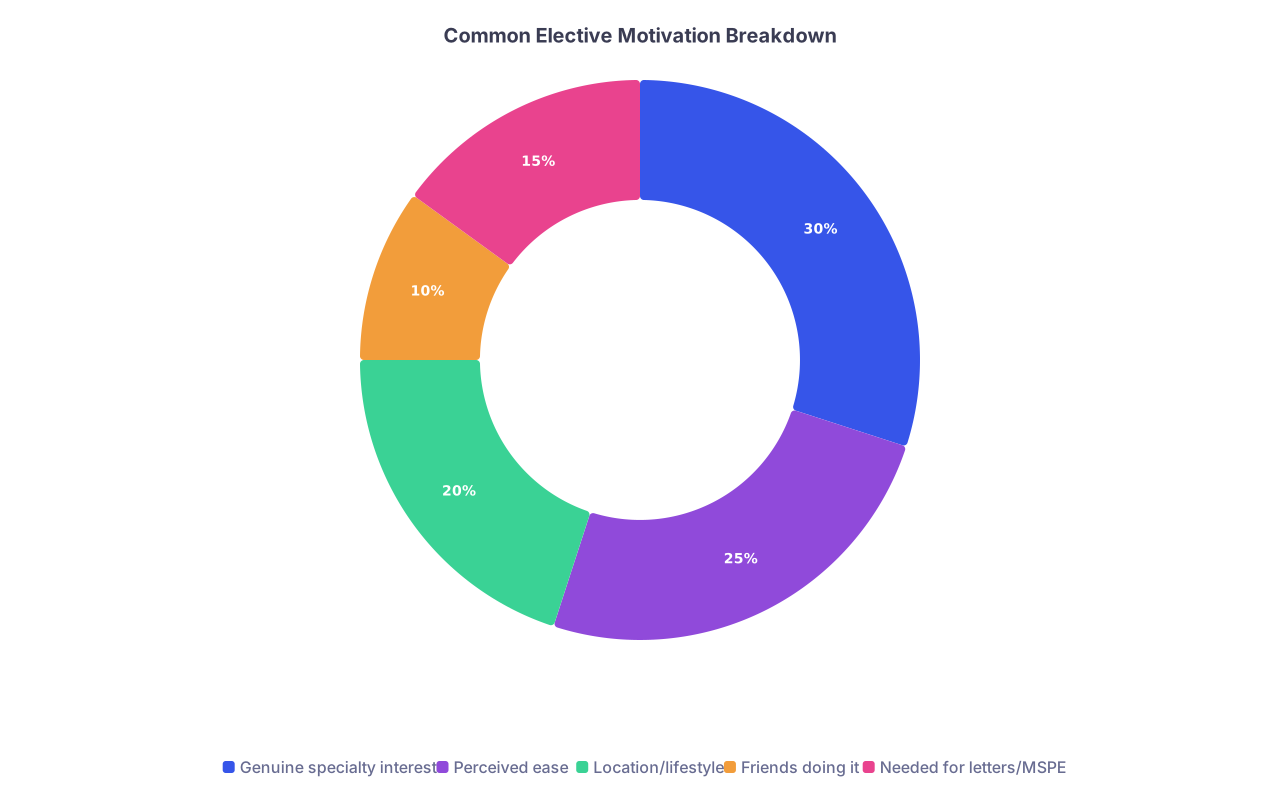
| Category | Value |
|---|---|
| Genuine specialty interest | 30 |
| Perceived ease | 25 |
| Location/lifestyle | 20 |
| Friends doing it | 10 |
| Needed for letters/MSPE | 15 |
There’s a dangerous myth floating around: “Fourth year is chill, electives are for coasting.”
If you buy that myth for the wrong rotations, you sabotage your letters.
The quiet trap
I’ve watched students choose:
- “Chill” outpatient consult electives
- Ultrasound for a month because “it’s lighter”
- Multiple radiology/derm/path electives with almost no direct patient responsibility
Then they wonder why their letters say:
“Pleasant to work with. Interested in the field. Reliable.”
That’s not a strong residency letter. That’s a Yelp review.
Programs write strong letters when they see:
- You carry a real patient load
- You make decisions (with supervision)
- You function at an intern level on a sub‑I or acting internship
If you over‑load your schedule with low‑responsibility electives, the people writing your MSPE and departmental letters simply do not have the evidence they need to call you “outstanding” or “top 10%.”
How to avoid this
Do not confuse “elective” with “easy.” For your home specialty and core fields:
Prioritize:
- Sub‑Is / Acting Internships on busy services
- Rotations where you write full notes, call consults, run list, round daily
- Services your department chair actually reads evaluations from
Limit:
- “Tourist” rotations where you shadow and never own patients
- Long strings of “easy” electives early in 4th year
You can absolutely have some lighter months. Just don’t stack them when eyes are on you and letters are being formed.
Mistake #2: Scheduling Key Electives Too Late for Letters & MSPE
You know what destroys applications? Excellent rotations that happen after letters are already submitted.
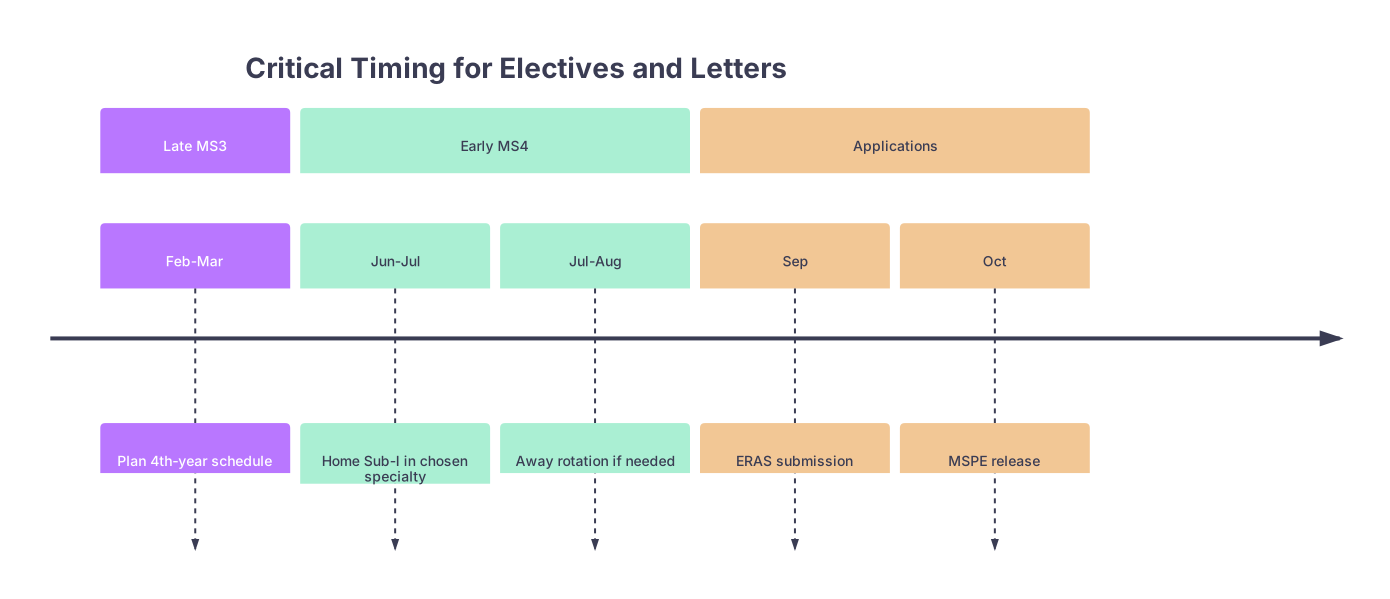
| Period | Event |
|---|---|
| Late MS3 - Feb-Mar | Plan 4th-year schedule |
| Early MS4 - Jun-Jul | Home Sub-I in chosen specialty |
| Early MS4 - Jul-Aug | Away rotation if needed |
| Applications - Sep | ERAS submission |
| Applications - Oct | MSPE release |
People underestimate the calendar every single year.
Where timing kills you
Sub-I in October or November
For most specialties, ERAS applications open in September. MSPE is released on October 1.
Your big “I worked like an intern” rotation? Nobody can talk about it in letters or MSPE if it hasn’t happened yet.Away rotations after September
Doing a dream away at [Prestige Medical Center] in October? Great learning, almost zero application benefit that cycle.Key home specialty elective after MSPE freeze
At many schools, the MSPE “closes” earlier than students think. Your shiny late elective won’t change the summary.
Practical rule
If you want a rotation to influence:
- Letters for ERAS → It should be finished by early‑mid September at the latest
- MSPE content → It should be finished by when your school freezes MSPE edits (often August/early September; ask explicitly)
Do not guess. Email your dean’s office and ask:
“By what date do my 4th-year evaluations need to be completed to be included in my MSPE and used for early letters?”
Then schedule high‑impact electives before that date. Not after.
Mistake #3: Playing the “Too Early” vs “Too Late” Game Wrong
Here’s the subtler version: you schedule the “right” electives, but at the wrong point in your readiness curve.
Too early: auditioning before you’re ready
I’ve watched students do:
- Home sub‑I in June
- Away in July at a top‑tier program
…immediately after barely finishing core clerkships.
They walk into a high‑expectation service still shaky on:
- Writing full admission/discharge notes
- Presenting efficiently
- Managing basic floor issues
And then they get labeled “okay, but not at the level we look for in our residents.”
That label sticks.
Too late: no time to fix your narrative
Opposite mistake:
- Coast through early 4th year on easy rotations
- Realize in August you need strong evals
- Scramble into a sub‑I in September
Now:
- Letters are rushed
- MSPE is basically already finalized
- Any “improvement” narrative doesn’t get captured on paper
Safer pattern
For most students (not all, but most), something like this is safer:
- Late MS3:
- Do a strong inpatient rotation to sharpen basics (medicine, surgery, etc.)
- Early MS4 (June–August window):
- 1st: Home sub‑I when you’re warmed up but not exhausted
- 2nd: Away rotation (if your specialty needs it)
- 3rd: Another demanding elective or consult month at home
The key:
Don’t let your very first “act like an intern” experience be at the program of your dreams when you’re still clumsy with pre‑rounding and orders.
Mistake #4: Ignoring Who Actually Writes and Influences Letters
People act like any attending can write the same letter. That’s naïve.
Some rotations are disproportionately powerful because of who is watching you and how their opinion flows into your MSPE and departmental letter.

Where students go wrong
- Choosing niche electives with peripheral faculty who never sit on the residency selection committee
- Avoiding core departmental services where the clerkship director or vice chair for education actually sees them
- Doing letters‑critical rotations at sites where attendings barely use the evaluation system or write one‑liners
Result: you get lovely but generic letters that carry little weight in your own department’s selection meeting.
What you should be asking
Before you lock an elective, send a short, targeted email to:
- Your specialty advisor
- Or the clerkship director
- Or a senior resident you trust
Questions that actually matter:
- “Which rotations does the department pay the closest attention to when writing the chair’s letter?”
- “For students interested in [specialty], which services and sites tend to generate the strongest, most detailed letters?”
- “Are there attendings or services I should especially try to work with if I want to be known to the residency leadership?”
You’re not asking for favoritism. You’re asking where serious observation and detailed feedback actually happen. Those aren’t always the same rotations as “coolest” or “chillest.”
Mistake #5: Overloading on Away Rotations (or Choosing the Wrong Ones)
Away rotations are seductive. New city, new hospital, chance to impress. Also a great way to burn yourself out and get mediocre letters if you do it badly.
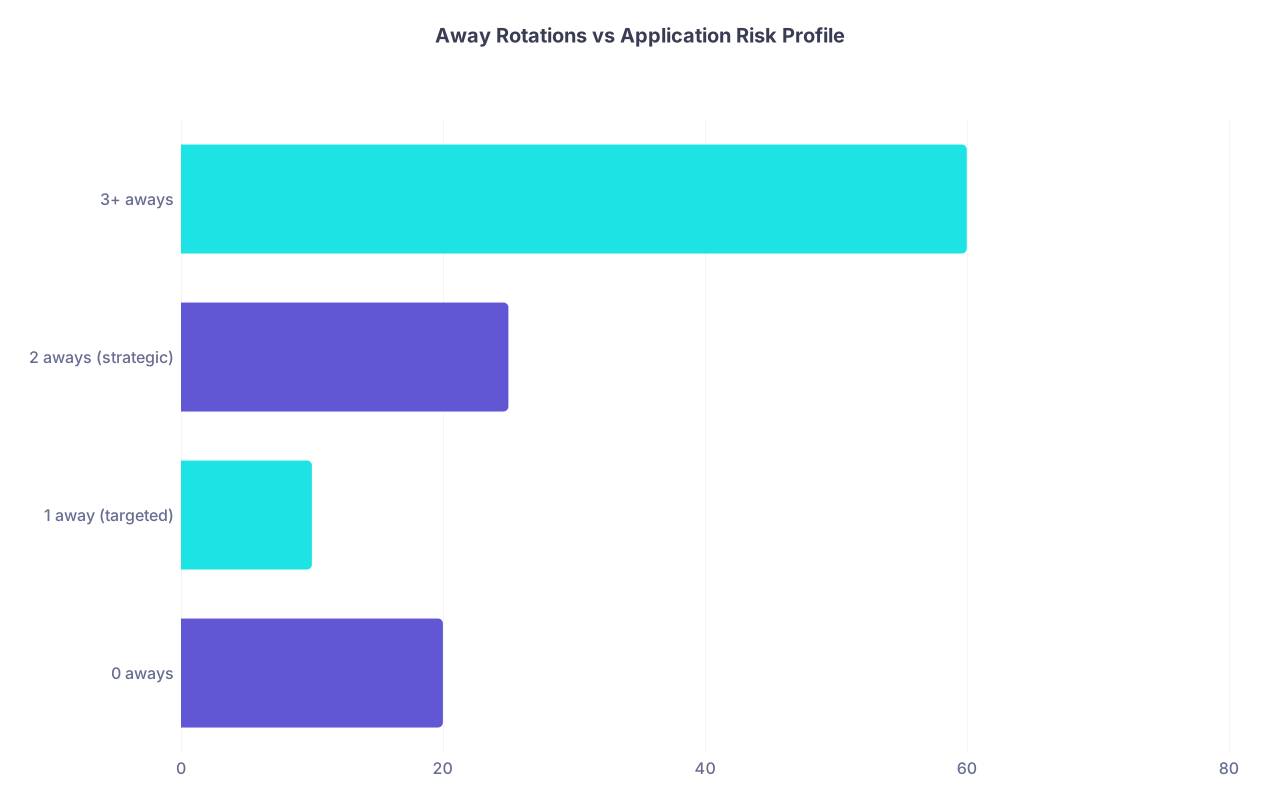
| Category | Value |
|---|---|
| 0 aways | 20 |
| 1 away (targeted) | 10 |
| 2 aways (strategic) | 25 |
| 3+ aways | 60 |
(Values here reflect approximate “risk level” not actual data—but the pattern’s real.)
Common away mistakes
- Doing 3+ away rotations in ultra‑competitive places back‑to‑back
- You’re exhausted by the second one
- You look progressively worse, not better
- Using aways to “explore” rather than to audition
- Exploring is fine… if it’s not during prime application season
- Choosing aways purely by brand name, not fit
- You show up at a malignant program with terrible teaching
- You get a lukewarm letter that says nothing
And here’s the ugly truth: a mediocre away letter from a flashy institution can hurt you more than a strong home letter from a place people know and trust.
Saner away strategy
For fields where aways matter (ortho, derm, EM, neurosurg, some IM subspecialties, etc.):
- 1–2 well‑chosen aways is usually enough
- Schedule them after you’ve done:
- A strong home sub‑I or heavy inpatient month
- Choose places where:
- Your board scores and CV are realistically competitive
- Residents actually seem happy (yes, stalk them on social media, forums, etc.)
- Prior students from your school didn’t get torched in evals
Do not collect aways like Pokémon. Each one is a high‑stakes audition where the default letter is “fine but not special.”
Mistake #6: Building a Schedule That Hides Your Red Flags Instead of Addressing Them
I see this pattern over and over. Students with:
- A weak medicine clerkship eval
- Or a fail/remediation in surgery
- Or a poor Step score
Then 4th‑year schedule: pure escapism.
Radiology. Path. Global health. Lifestyle electives. Maybe a consult service where you never touch an admission.
Here’s the problem:
Your MSPE and transcript already show the red flag. Your goal isn’t to hide it. You can’t. Your goal is to demonstrate growth afterward.

How this hurts your MSPE
MSPE writers look for arcs:
- “Struggled early, then improved substantially on later inpatient rotations.”
- “Demonstrated marked growth in clinical reasoning by 4th year.”
If your post‑red‑flag schedule never shows you on a high‑responsibility service again, the narrative becomes:
- “Struggled… and we have no evidence it ever really got better.”
That’s death for competitive spots, and a real handicap even for mid‑tier programs.
What you should do instead
If you’ve got a blemish, be deliberate:
- If medicine clerkship was weak:
- Do an internal medicine sub‑I with a strong team
- Ask explicitly for feedback midway, then show change
- If surgery evals were rough:
- Do a non‑malignant surgical sub‑I or ICU month and lean in hard
Ask your dean/mentor:
“I had X issue during Y rotation. Which 4th-year electives will give me a chance to show improvement that can be captured in my MSPE or a letter?”
You’re not trying to erase the red flag. You’re trying to put a clear “recovery” chapter right after it.
Mistake #7: Failing to Align Electives With Your Stated Career Interest
Another subtle but lethal error: your schedule doesn’t match your story.
You claim deep passion for internal medicine, want academic cardiology one day. Then your 4th‑year electives:
- Derm
- Radiology
- Anesthesia
- Two months of “Sports Medicine”
- One random medicine sub‑I in September
Residency committees are not stupid. They look at patterns. When your electives look like:
- “Wide sampling of cool stuff, but no clear commitment,”
they translate that to: - “Will they actually show up for this field? Do they really care?”
Your MSPE summary often includes a line like:
“Elective choices reflected an interest in [field].”
If they can’t say that honestly, they either:
- Don’t mention it
- Or they mention that your interests were “broad” → code for unfocused
Fix this
Ask yourself:
“If a PD only saw my transcript, would they instantly know what I’m serious about?”
For your target field, you want:
- At least 2–3 clearly related electives/sub‑Is
- Something that shows depth (ICU, consult service, subspecialty)
You can still explore, absolutely. But build a core that clearly signals: “This is my lane.”
Mistake #8: Not Understanding How Elective Evals Feed Into the MSPE
Students tend to see each eval as a standalone blurb. That’s not how MSPE writers use them.
| Rotation Type | Impact on MSPE Summary | Likely to Influence Chair Letter | Typical Detail Level |
|---|---|---|---|
| Home Sub-I (core service) | Very High | Very High | High |
| Away rotation in specialty | High | Moderate–High | High |
| Niche/light elective | Low–Moderate | Low | Variable |
| ICU / high-acuity service | High | High | High |
| Non-clinical (research) | Moderate (paragraph) | Moderate (if mentor is known) | High (if productive) |
How MSPE writers actually think
When I’ve sat with people compiling MSPEs, they:
- Scan for patterns across multiple rotations
- Pull representative quotes from key services
- Pay attention to who said what (chiefs, PDs, known tough graders)
If your strongest performance is:
- A single, short elective with a generous grader on a low‑acuity service
it often loses out to more “trusted” data from big core services and sub‑Is.
So yes, that glowing review from “Selective in Art of Bedside Medicine” is nice—but it won’t outweigh “Above expectations” on medicine sub‑I from the program director.
When you plan electives, you’re planning what kind of data your MSPE will have available—and from whom.
Mistake #9: Scheduling Your Life Like You’re a Robot
Last one, and it’s not soft. It’s tactical.
If you cram:
- Back‑to‑back heavy sub‑Is
- An away in an unfamiliar city with terrible call
- Another ICU month immediately after
You might think you’re “showing work ethic.” In reality?
- You show up tired
- You make more mistakes
- Your evals dip from “Outstanding” to “Good” purely from fatigue
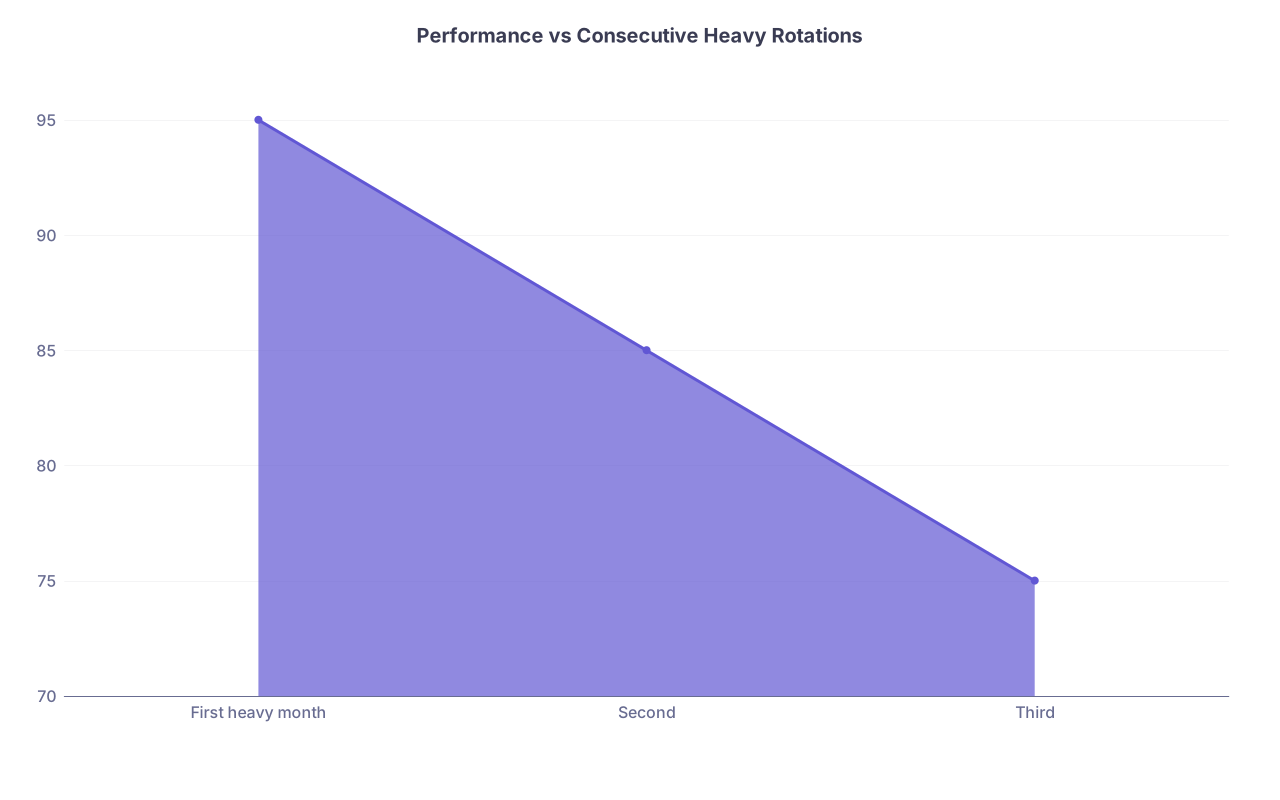
| Category | Value |
|---|---|
| First heavy month | 95 |
| Second | 85 |
| Third | 75 |
(Again, conceptual numbers—but the drop-off is real.)
Why this matters for letters
Most attendings do not know, or care, that:
- You’re on your third month of 80‑hour weeks
- You just moved back from an away rotation
They see this month’s performance. They evaluate this month. If that’s when you’re cracked, they write what they see.
Smarter pacing
You’re human. Not a scheduling spreadsheet.
Try to:
- Avoid 3 consecutive high‑intensity inpatient months
- Put a slightly lighter but still respectable elective between big pushes
- Time your absolute max‑effort month when:
- You’re physically recovered
- Not right after a major exam or relocation
Ask yourself before locking the sequence:
“Realistically, during which month am I most likely to be crushed and sloppy?”
Don’t put your most important letter source there.
Quick Visual: A Safer 4th-Year Structure (Example)
This isn’t a template for everyone, but to give you a feel:

| Step | Description |
|---|---|
| Step 1 | June: Home Sub-I in Target Specialty |
| Step 2 | July: Away Rotation 1 |
| Step 3 | Aug: ICU or Heavy Consult Month |
| Step 4 | Sep: Lighter but Relevant Elective |
| Step 5 | Oct-Nov: Exploration / Interviews |
| Step 6 | Dec+: Flex, Research, Second Interests |
You’d then adjust depending on your specialty, Step timing, and whether you even need aways.
FAQs
1. If I can only do one sub-I, where should it be?
Do it at your home institution, on a core service that your specialty leadership actually watches—usually general medicine/surgery or the main inpatient service of your field. Home programs and MSPE writers trust that data more than a single away with unknown grading culture. If you’re trying to match at your home program, that home sub‑I is often the most influential rotation you’ll ever do.
2. Are “easy” electives always a bad idea?
No. The mistake is stacking them at the front of 4th year or using them to avoid growth. One or two lighter electives:
- After your key letters are written
- Or between intense rotations to prevent burnout
can actually protect your performance. Just don’t let your transcript read like you spent your audition year hiding from responsibility.
3. What if I still don’t know my specialty when elective requests are due?
Then build flexible but defensible choices. Prioritize:
- A strong medicine sub‑I (almost every specialty respects it)
- ICU or another high‑acuity rotation
- A couple of broad electives that are useful in multiple fields (radiology, anesthesia, EM)
Avoid overspecializing in something you’re not committed to yet. And talk to your dean early—undecided isn’t a crime, but drifting is.
4. Should I pick electives based on which attendings “give good evals”?
Not primarily. Chasing “easy A” attendings is a short‑sighted play. You want:
- Attendings who actually teach
- Services that give you autonomy
- Rotations that MSPE writers and PDs respect
A tough but fair grader who sees you own patients and improve is worth more than a lenient attending on a fluff elective. The former can write a specific, credible letter. The latter becomes white noise.
5. How many away rotations is “too many”?
For most specialties, more than two is usually overkill and high risk. One well‑chosen away is often enough; two if:
- Your home program is weak in your field
- Or you’re region‑switching and need exposure elsewhere
Once you hit three or more, fatigue, variable grading standards, and the risk of a bad fit start outweighing any marginal benefit. At that point, you’re gambling your energy and letters for bragging rights, not strategy.
If you remember nothing else:
- Schedule high‑responsibility core electives early enough that they shape your letters and MSPE.
- Choose rotations where the right people can see you work and say something specific, not just “pleasant.”
- Use electives to show growth and commitment, not to hide from your weak spots or burn yourself out before it counts.