
You are on night float, it is 2:17 a.m., and you just admitted a 56‑year‑old with decompensated cirrhosis, AKI, and spontaneous bacterial peritonitis. Your brain is fried, your sign‑out list is a mess, and somewhere at the bottom of your backpack is an Anki deck you have not touched in four days.
You keep telling yourself: “I’ll get serious about Step studying next month.” You also keep realizing that by “next month,” you will have forgotten half of what you saw on the wards this week.
This is where most people blow it. They separate “ward brain” and “Anki brain.” They read about vasopressors in some generic deck, then fail to connect it to the crashing septic patient they actually saw. You are going to do the opposite: use the ward to drive your Anki deck, and use Anki to lock in every high‑yield, real patient detail you touch.
Let me break this down specifically.
The Core Idea: Ward-Driven, Precision Anki
The concept is simple: every interesting patient becomes 3–15 ultra‑targeted, Step‑relevant Anki cards. Not fluffy, not narrative, not “I should remember this someday.” Sharp, focused questions designed so that 6 months from now, when you see “fever + ascites + PMN > 250,” your hand automatically reaches for cefotaxime and albumin.
You are not trying to “cover all of medicine” with your deck. That is what big premade decks do. Your goal is different:
- Use the clinic/wards to tell you what actually matters.
- Capture it as small, ruthless questions.
- Review them on a schedule that matches exam timing and your rotation sequence.
Think of your ward patients as a curated syllabus, filtered by reality and attending preferences.
Step 1: Decide What “Precision” Actually Means
Precision Anki is not “I make my own cards” or “I add facts from UWorld sometimes.” Precision means:
- Every card has a specific trigger in your memory: a patient, a lab, a management decision, or a teaching point from rounds.
- Every card is tightly scoped: one concept, one key move, one diagnostic threshold—not an entire UpToDate page.
- Every card is exam-relevant: if you saw it on a ward and it is not Step‑worthy, you do not make a card.
Your mental checklist before making a card from a patient should be:
- Does this concept show up in:
- UWorld or NBME style questions?
- First Aid / BnB / Online MedEd / Boards and Beyond?
- Did I see an attending, resident, or consultant actually change management because of this fact?
If yes to either, it is prime Anki material.
If you are unsure, check quickly:
- Search UWorld explanations or an Anki premade deck (AnKing, Lightyear, etc.) for that diagnosis.
- If it appears repeatedly, you should build your version of the card.
Step 2: Build a Ward → Card Workflow You Can Actually Maintain
You will not pull out your laptop during rounds and craft perfect cards. That is fantasy. You need a two‑stage system:
- Capture quickly on the wards
- Convert to cards in one focused block later
2A. On the wards: the capture phase
During the day, your only job is to capture “card seeds,” not full cards.
Use one of these:
- A dedicated note in Apple Notes / Google Keep: “Card Seeds – IM rotation”
- A small pocket notebook
- A pinned message in a WhatsApp/Telegram chat to yourself
- Obsidian/Notion mobile if you already live there
Your entry format should be fast and dirty. Something like this:
- “Mr K – SBP: ascitic PMN > 250; treat with 3rd gen ceph + albumin; ppx with norfloxacin; dx paracentesis before abx”
- “Ms L – NSTEMI: indications for urgent cath vs early invasive; GRACE/TIMI scores?”
- “Post‑op POD#5 fever – think PE vs anastomotic leak; what labs/imaging discriminate?”
Aim for:
- 3–10 seeds per call shift
- 5–15 seeds per normal day on busy rotations
You are not summarizing the whole disease. You are grabbing the moments where you felt uncertain, where your senior corrected you, or where management hinged on one lab/result.
2B. End of day or post‑call: the conversion phase
Once a day (or realistically, every 1–2 days on heavy rotations), you sit down for 30–45 minutes and convert seeds → cards.
Non‑negotiable rules during this phase:
- Only make cards from your seed list.
If a concept is not important enough to have been captured, it probably should not be in your precision deck. - Limit yourself to 10–25 new cards per session.
You can blow up your review load very fast. Do not. - For each patient seed, pull up:
- The original note or EMR
- First Aid section for that disease
- One trusted resource (UpToDate / BnB / OME)
You are aiming to turn a vague seed like:
“Mr K – SBP: ascitic PMN > 250; treat with 3rd gen ceph + albumin; ppx with norfloxacin; dx paracentesis before abx”
into 4–7 clean cards.
Step 3: Card Types That Actually Work for Clinical Content
You should not get fancy. Cloze deletions and basic Q→A will carry you. The skill is how you phrase them.
3A. Diagnosis thresholds and criteria
These are exam gold and show up in wards constantly.
Example from SBP patient:
Front: “Ascitic fluid PMN cutoff that defines spontaneous bacterial peritonitis (SBP)?”
Back: “PMN count ≥ 250 cells/mm³.”Front: “First diagnostic test in suspected SBP in cirrhotic patient with fever/abdominal pain?”
Back: “Diagnostic paracentesis (before antibiotics).”Front: “Most common organism causing SBP in cirrhotics?”
Back: “E. coli (also Klebsiella, Streptococcus species).”
Each card is crisp. One concrete threshold, not a paragraph.
3B. “What is the next best step?” cards
These map directly to both wards and Step 2/3 style questions.
Example (post‑partum hemorrhage, OB):
Front: “Hemodynamically stable patient with uterine atony after vaginal delivery. Next best step in management?”
Back: “Uterine massage + IV oxytocin.”Front: “Uterine atony with continued heavy bleeding after oxytocin and uterine massage. Next pharmacologic step (no HTN, no asthma)?”
Back: “Methylergonovine (contraindicated in hypertension).”
Here you are encoding the decision tree that you just watched your attending run through in their head.
3C. “Red flag vs not” discriminator cards
These come from admissions and triage decisions you see every day.
Example (chest pain):
Front: “Pleuritic, sharp chest pain, worse with inspiration, improved by leaning forward. EKG with diffuse ST elevation and PR depression. Most likely diagnosis?”
Back: “Acute pericarditis.”Front: “In pericarditis, EKG change that differentiates it from ST elevation MI?”
Back: “Diffuse concave ST elevation with PR depression (vs localized ST elevation and reciprocal changes in MI).”Front: “Troponin mildly elevated in pericarditis. Need for emergent cath?”
Back: “No, unless features suggest acute coronary syndrome (focal ST changes, typical ischemic chest pain pattern, hemodynamic instability).”
3D. “Classic ward screw-ups” as cards
Anytime someone almost made a mistake—or your senior tells you “do NOT do X in this situation”—you immortalize it.
Example (AKI in cirrhosis):
Front: “Cirrhotic patient with ascites and rising creatinine. Why should you avoid NSAIDs?”
Back: “NSAIDs inhibit prostaglandin‑mediated afferent arteriolar dilation, worsening renal perfusion and precipitating/hepatorenal syndrome.”Front: “Initial diagnostic step to distinguish prerenal azotemia vs hepatorenal syndrome in cirrhosis?”
Back: “Volume challenge with IV albumin; check response in creatinine and urine output.”
These are exactly the “gotcha” items NBMEs like to test.
Step 4: Map Patients to Systems and Deck Structure
If you are using a big premade deck (AnKing etc.), do not fight it. You are building a small overlay that rides on top.
Structure your precision deck something like this:
| Deck Name | Purpose |
|---|---|
| 00_Algorithms_And_EKG | Cross-system patterns, EKGs |
| 01_Cardiology_Ward_Patients | Cards from real Cardiology pts |
| 02_Pulmonology_Ward_Pts | Cards from real Pulm pts |
| 03_GI_Hepatology_Ward_Pts | SBP, varices, pancreatitis |
| 04_Renal_Ward_Patients | AKI, dialysis, electrolytes |
| 05_OBGYN_Ward_Patients | L&D, postpartum, gyn onc |
You do not need 30 subdecks. Focus on what you actually see.
Then tag your cards aggressively:
patient:SBP_MrKrotation:IMconcept:diagnostic_thresholdconcept:next_best_step
Why? Because three months later, when you are studying for shelves/Step 2, you can:
- Filter
rotation:IM+concept:next_best_step - Or pull everything from
patient:PE_MSJto review before another pulmonary month
Visual: How a Patient Becomes Cards

| Step | Description |
|---|---|
| Step 1 | See patient on wards |
| Step 2 | Capture card seeds in notes |
| Step 3 | Review chart & resources post-call |
| Step 4 | Create focused Anki cards |
| Step 5 | Tag by rotation, patient, concept |
| Step 6 | Daily reviews on Anki |
| Step 7 | Improved recall on wards & exams |
Step 5: Integrate With Premade Decks and Question Banks
If you try to replace large decks entirely with your own cards, you will miss content. If you only use premade decks, you will never deeply own the material. The trick is integration.
5A. Use UWorld as a “stress test” for your ward cases
Workflow:
- You have a real patient (say, DKA admission).
- You make 5–10 precision cards about:
- Diagnostic criteria / anion gap / serum osmolality
- Fluids and insulin protocol
- Potassium management nuances
- Then you do 5–10 UWorld questions tagged “Endocrine” that session.
- Any concept in UWorld that you missed or that extends your patient case gets:
- A tweak to an existing card
- Or 1–2 additional cards
For example, UWorld might remind you about:
- When to switch from IV insulin to subcutaneous
- Cerebral edema risk in kids with aggressive correction
You plug those into your DKA patient tag.
5B. Align with First Aid / BnB headings
For each ward patient, quickly map them onto standard review resources.
Example:
- Patient: “Cirrhotic with SBP”
- First Aid section: “Gastrointestinal – Cirrhosis and its complications”
- BnB videos: “Cirrhosis and Portal Hypertension”
If your patient’s management is not covered in those sections at all, you are probably dealing with something too esoteric or subspecialized for Step. That seed may not become a card.
Step 6: Card Quality: How to Make Them Hurt (In a Good Way)
Most students write weak cards. Too much text, too vague, no retrieval demand.
You want cards that are:
- Atomic (one idea)
- Concrete (numbers, drug names, exact orders)
- Ward‑anchored (you see the patient’s face when you answer)
6A. Examples: Weak vs strong cards
Weak:
- Front: “Spontaneous bacterial peritonitis”
Back: “Ascites fluid infection in cirrhotic patients. Treat with 3rd gen cephalosporin. PMN > 250…”
Strong set:
Front: “Diagnostic PMN cutoff for SBP in cirrhotic ascites?”
Back: “≥ 250 cells/mm³.”Front: “First‑line empiric IV antibiotic for SBP?”
Back: “Third‑generation cephalosporin (e.g. cefotaxime).”Front: “Adjunct to reduce renal impairment and mortality in SBP treatment?”
Back: “IV albumin.”Front: “Secondary prophylaxis after SBP episode?”
Back: “Oral fluoroquinolone (e.g. norfloxacin) or TMP‑SMX.”
You will answer those in under 5 seconds and they will stick.
6B. Use image occlusion sparingly but smartly
On radiology‑heavy or EKG‑heavy rotations, capture single, classic findings.
Example:
You see a chest CT with the “reverse halo” sign.
Take a screenshot, drop into Anki Image Occlusion, mask the finding, and ask:“Finding indicated by masked area? Most likely diagnosis in immunocompromised patient?”
This gives you visual pattern recognition tied to clinical context.
Step 7: Scheduling Reviews Without Drowning
Precision decks can still blow up and bury you if you are careless.
7A. Simple scheduling rules
- Cap new precision cards per day: 20–30 total.
- Keep your daily reviews (all decks) under 250 cards.
If you are creeping over 300 consistently, you are adding too much or suspending too little.
Use this hierarchy:
- Precision ward deck reviews (these are gold)
- Question bank review cards
- Premade deck cards
If you have to cut something on a brutal call week, you protect #1.
7B. Syncing with rotation and exam timelines
Try something like:
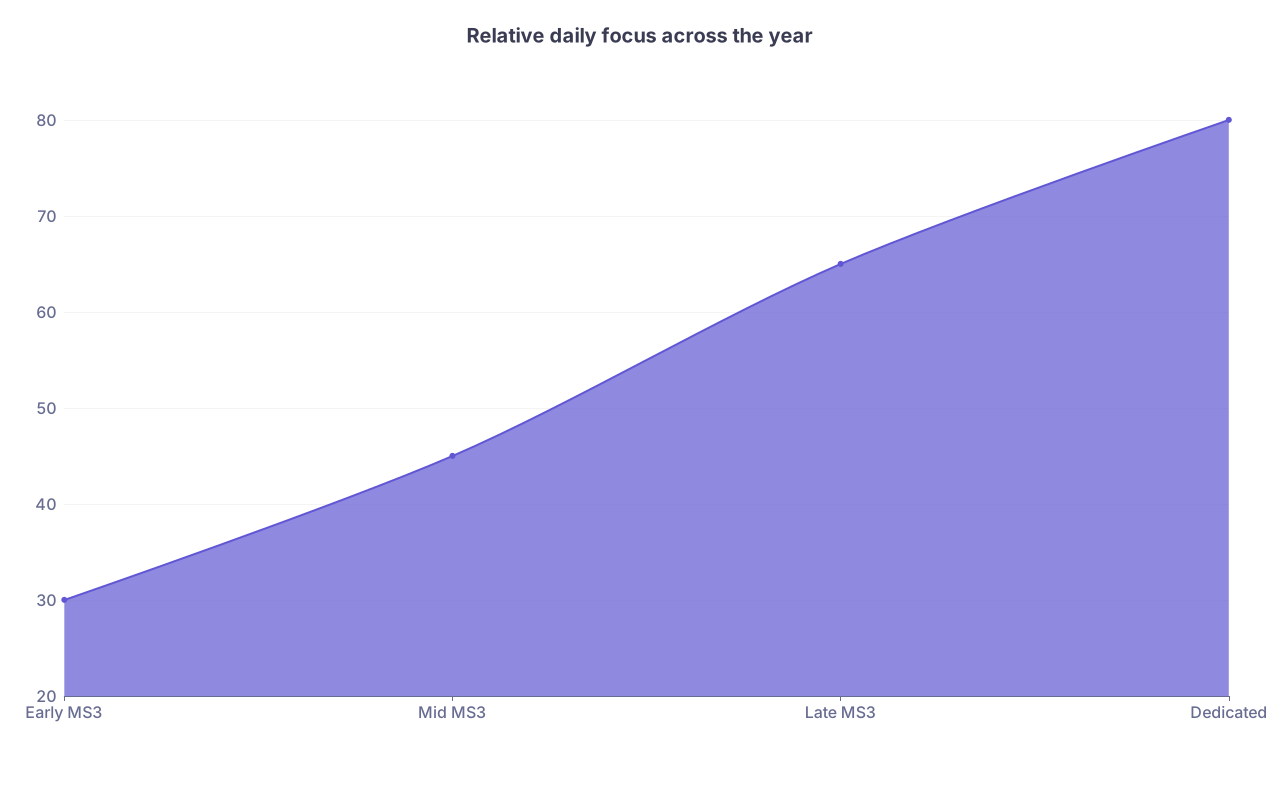
| Category | Value |
|---|---|
| Early MS3 | 30 |
| Mid MS3 | 45 |
| Late MS3 | 65 |
| Dedicated | 80 |
Interpretation (no need to be mathematically exact):
- Early MS3: 30% of your total “study energy” into ward‑driven precision cards
- Mid MS3: 45%
- Late MS3: 65% (less novelty on wards, more exam alignment)
- Dedicated: 80% exam‑focused (precision cards + question-derived cards)
The precise number does not matter. The direction does. As you get closer to shelves/Step, those ward‑rooted cards become your high‑yield differentiator.
Step 8: Using Patients to Build Algorithms in Your Deck
Some of the highest‑value cards are not about single facts, but short algorithms that you compress into 2–4 cards.
Example: “Upper GI bleed in a cirrhotic”
From one real admission, you can generate:
Front: “Initial stabilization steps for suspected variceal upper GI bleed?”
Back: “Two large‑bore IVs, type & cross, resuscitate with fluids/blood, protect airway if altered, NPO.”Front: “Pharmacologic therapy started before endoscopy in suspected variceal bleed?”
Back: “IV octreotide (or terlipressin where available) + IV antibiotics (e.g. ceftriaxone).”Front: “Timing of endoscopy in variceal upper GI bleed?”
Back: “Within 12 hours after stabilization.”Front: “Secondary prophylaxis after acute variceal bleed?”
Back: “Nonselective beta‑blocker (e.g. nadolol, propranolol) + endoscopic band ligation at intervals.”
You build this from watching one GI fellow manage one bad bleed. That patient becomes an algorithm in your head.
Step 9: Common Mistakes Students Make (And How to Avoid Them)
I have watched a lot of students try to do “ward Anki” and fail in predictable ways.
9A. Trying to turn the EMR into Anki
Copy‑pasting giant problem lists, full medication lists, or echo reports and turning them into cloze cards is useless. The EMR is a legal and billing document, not a study guide.
Fix: Strip cases down to:
- Chief complaint
- 1–2 key labs/imaging findings
- The decision that actually mattered
Then build atomic cards from that.
9B. Making vanity “my patient” cards without exam value
You do not need an Anki card for every rare autoimmune encephalitis you see. Your memory of the chaos will not translate to Step points.
Fix: Cross‑check with:
- UWorld coverage
- First Aid headings
- Attending emphasis (did they say “this is bread and butter” or “this is rare as hell”?)
9C. Overloading cards with management nuance beyond Step level
ICU attendings love edge‑case management. You will hear:
- “We switched from norepinephrine to vasopressin at X dose”
- “We are choosing this particular ventilator mode because…”
Not all of that belongs in your deck.
Fix: Anchor to Step‑relevant level:
- First‑line vasopressor in septic shock? (norepinephrine)
- When to add vasopressin? (if MAP goal not reached with norepinephrine alone)
- Broad vent strategy for ARDS: low tidal volume (6 mL/kg ideal body weight), permissive hypercapnia, etc.
Leave the microtitration strategies out until residency.
Step 10: Example: A Full Patient → Deck Walkthrough
Let me give you one complete example so you can see the flow.
The patient
- 64‑year‑old man with history of long‑standing HTN, diabetes, smoking
- Presents with sudden right‑sided weakness, facial droop, slurred speech
- CT head: no hemorrhage
- MRI: ischemic stroke in left MCA territory
- Not a candidate for tPA (unknown time of onset, woke up with symptoms)
- Started on dual antiplatelet therapy, high‑intensity statin, BP management
Ward “card seeds” you capture
On your phone note after rounds:
- Left MCA stroke: deficits vs ACA/PCA
- tPA criteria and major contraindications
- Time window for mechanical thrombectomy
- BP targets in ischemic stroke (acute vs long term)
- Secondary prevention – dual antiplatelet duration?
Conversion to precision cards
You sit down that night:
Front: “Typical deficits in left MCA stroke (dominant hemisphere)?”
Back: “Contralateral hemiparesis and hemisensory loss (face/upper limb > lower limb), aphasia (Broca, Wernicke, or global), possible contralateral homonymous hemianopia.”Front: “Time window for IV alteplase (tPA) in acute ischemic stroke with clear onset time?”
Back: “Within 3–4.5 hours of symptom onset (depending on patient factors).”Front: “Two absolute contraindications to IV tPA in acute ischemic stroke?”
Back: “Any intracranial hemorrhage on imaging; active internal bleeding. (Others: recent major surgery, very high BP >185/110 uncontrolled, etc.).”Front: “Time window and indication for mechanical thrombectomy in ischemic stroke?”
Back: “Up to 24 hours from last known well in select patients with large vessel occlusion (usually ICA or proximal MCA) and salvageable tissue on perfusion imaging.”Front: “Immediate BP goal in acute ischemic stroke not receiving tPA?”
Back: “Permissive hypertension; do not lower BP unless >220/120 mmHg, or evidence of another indication (e.g. aortic dissection, MI, HF).”Front: “Acute ischemic stroke receiving tPA: BP goal before and during/after infusion?”
Back: “Before: <185/110 mmHg. During/after: <180/105 mmHg.”Front: “Secondary prevention after non-cardioembolic ischemic stroke: antiplatelet strategy?”
Back: “Dual antiplatelet therapy (aspirin + clopidogrel) for 21–90 days, then single antiplatelet long term.”Front: “Statin therapy after ischemic stroke?”
Back: “High‑intensity statin (e.g. atorvastatin 40–80 mg) for most patients regardless of baseline LDL.”
You tag them:
patient:L_MCA_Stroke_64Mrotation:Neuroconcept:stroke_management
Now, when you encounter a UWorld stroke question, your brain has an actual human scenario to attach it to. And when you see another stroke patient two months later, the recall feels like cheating.
FAQ (Exactly 5)
1. Should I stop using premade decks if I start a precision ward deck?
No. That would be a mistake. Keep premade decks as your backbone for broad content exposure. Your precision ward deck sits on top, targeting real decisions and thresholds you actually saw. When your time is limited, favor reviews of your precision deck first, then premade.
2. How many cards per patient should I aim for?
Typically 3–15 cards per patient, depending on complexity and exam relevance. One straightforward COPD exacerbation may only yield 3–5 good cards. A complicated DKA admission or variceal bleed might generate 10–15 cards, especially if your attending walked through stepwise management in detail.
3. What if my rotation is very specialized (e.g., transplant hepatology)?
Filter harder. Ask: “Is this concept directly testable on Step 2 CK or shelf exams?” If you are unsure, cross‑check with First Aid and UWorld. Core cirrhosis, SBP, variceal bleed? Definitely. Very specific immunosuppression regimens post‑liver transplant? Maybe 1–2 cards about general principles, but not a detailed protocol.
4. How do I handle cards about dosing and drug regimens that vary by hospital?
Stick to standardized, exam‑level information. Step exams rarely test exact mg/kg dosing, but they absolutely test first‑line drug classes, the right drug in a class (e.g. norepinephrine as first‑line in septic shock), and key contraindications. If your hospital uses an unusual regimen that does not match guidelines or common board teaching, do not build cards around the idiosyncrasy.
5. I fall behind on reviews during heavy call weeks. Do I suspend or delete cards?
Do not delete. If your review pile explodes, use Anki’s tools: temporarily suspend low‑yield or very niche cards, or reduce new card introductions to zero until you catch up. When forced to triage, keep reviewing your precision ward deck and question‑derived cards. Premade “extra” cards can wait; the reality‑anchored ones cannot.
Key points:
- Use real patients as a filter: if a concept changes management or shows up in UWorld/First Aid, convert it into a small, sharp Anki card.
- Separate capture from creation: jot raw “card seeds” on the wards, then batch‑convert into high‑quality cards in short, focused sessions.
- Protect your precision deck: cap daily new cards, prioritize its reviews, and let it integrate with (not replace) your big premade and question‑based decks.