
The biggest mistake students make with EMRs is thinking, “I’m just a student, my notes and orders don’t really matter.” That attitude is how you miss a critical drug interaction or accidentally pend 80 redundant labs.
Let me be clear: your EMR skills can make you the most useful student on the team—or a liability people avoid assigning work to.
You do not need to master every feature of Epic, Cerner, Meditech, or whatever Frankenstein system your hospital uses. You do need a focused, high-yield core: order sets, smart phrases, and safety checks. Those three buckets are where students can add real value without overstepping.
We will walk through what actually matters on the wards. Not the fantasy EMR training you got in orientation. The stuff interns expect you to know and attendings silently judge you on.
1. Core Mindset: You’re Practicing on a Live Patient, Not a Sandbox
Before features and shortcuts, fix the frame in your head.
You are not “playing” with the chart. You are working inside the legal medical record of a real human being. Everything you touch has consequences—clinical, legal, and workflow.
Three mindset rules:
Assume everything you do is visible and traceable
Every click is logged. Who opened what, when, from which workstation. Who placed which order, even if it is “for signature.” Do not “test” orders on live patients.Student orders are educational, not operational—until cosigned
Student-entered orders (often “pended” or “proposed”) are not active until a resident/attending signs them. But they shape the team’s thinking, and if wrong, they waste time and breed distrust.Your job is to lower everyone’s cognitive load, not add noise
Good EMR work: clean notes, correct orders, clear med rec, usable sign-outs.
Bad EMR work: cloned garbage notes, 40-line smart phrases that obscure the actual plan, random orders that need to be deleted.
You are there to make clinical reasoning and team communication easier. Every EMR action should be evaluated against that.
2. High-Yield Order Set Skills: How to Stop Being Useless in Admit Workflow
Order sets are the backbone of efficient inpatient care. On most rotations, if you do not know how to pull and adapt the right admission order set, you are dead weight on a busy call shift.
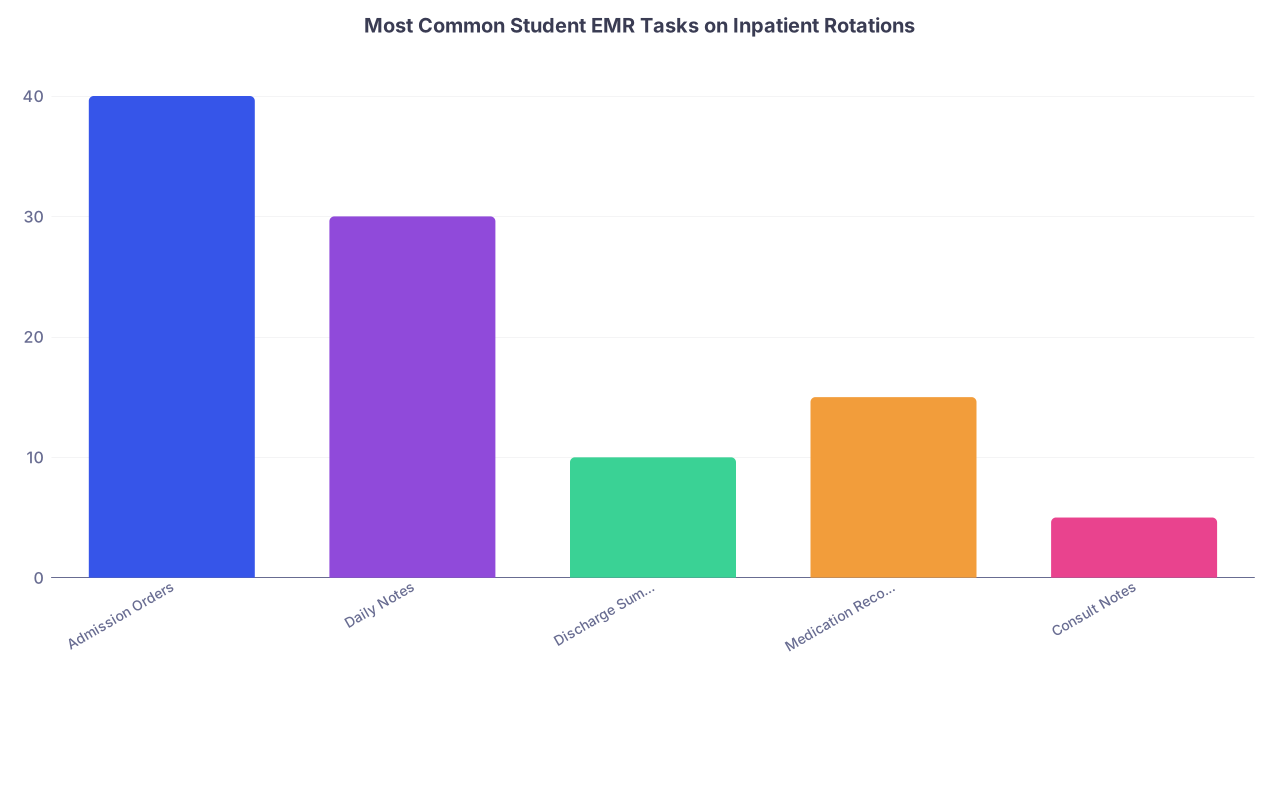
| Category | Value |
|---|---|
| Admission Orders | 40 |
| Daily Notes | 30 |
| Discharge Summaries | 10 |
| Medication Reconciliation | 15 |
| Consult Notes | 5 |
2.1 The Minimum Competence Standard
By the middle of your first core clerkship, you should be able to:
- Open the correct admission order set for the service (medicine, surgery, OB, psych, etc.).
- Quickly deselect irrelevant default orders.
- Add must-have condition-specific orders that are often missing by default.
- Queue up core safety orders (DVT prophylaxis, GI prophylaxis when appropriate, bowel regimen, pain and nausea control, diet, nursing instructions).
If you cannot do those things, you are not “early in training.” You are behind.
2.2 Picking the Right Order Set (Without Asking Every Time)
Most EMRs have dozens of order sets whose names are frustratingly similar. Stop randomly guessing.
Common patterns:
- “Adult Inpatient – Admission – Medicine”
- “Adult – ED to Inpatient – Sepsis”
- “Post-Op – General Surgery – Orders”
- “OB – Labor Admission”
- “Psych – Adult Inpatient Admission”
Ask your intern once:
“On this service, what admission order set do you usually start with for medicine admissions from the ED?”
Write it down. Use it consistently. Do not ask the same question every call night.
Then learn how to favorite it so you are not re-searching it 40 times a week.
2.3 Editing Default Orders: Where Students Actually Help
The order set is not a checklist you blindly click through. You are expected to think.
Key categories you must actively review on every admit:
Diet
- NPO? NPO except meds? Renal? Cardiac? Diabetic?
If you are admitting someone with an upper GI bleed and you leave them on “Regular diet,” that is not “just an order.” It signals you did not understand the clinical situation.
- NPO? NPO except meds? Renal? Cardiac? Diabetic?
DVT prophylaxis
- Intermittent pneumatic compression vs heparin vs enoxaparin vs none.
- You should know absolute contraindications: active bleeding, platelets extremely low, immediate post-op neurosurgery, etc.
If you are unsure, you still pended something but flag: “I pended SCDs only given platelets 18 and recent GI bleed.”
Labs & monitoring
- Stop the reflex “daily CBC/BMP for everyone forever.”
Ask yourself: “What are we following?” AKI? Sepsis? Electrolytes on diuretics?
Pend labs for 2–3 days ahead when it makes sense (e.g., daily BMP on a DKA patient for 2 days), but not indefinitely.
- Stop the reflex “daily CBC/BMP for everyone forever.”
Pain / nausea / bowel regimen
- Default postop sets are often aggressive or poorly tuned.
- Check for opioid-naïve vs chronic opioid user.
- Make sure there is a bowel regimen with every standing opioid. A simple “senna + docusate” or similar. If you forget this regularly, your patients will remind you. Unpleasantly.
Nursing orders
- Input/output monitoring.
- Telemetry indications.
- Wound care instructions.
Learn common phrases your service likes: “Strict I/Os and daily weights for HF” or “Neuro checks q2h x 12h, then q4h x 24h.”
The intern cares about walking up to the computer, seeing a reasonable order set pended, and only having to tweak a few things. That makes you “the good student.”
2.4 Diagnosis-Linked Orders: Admit Like You Understand the Problem
When you pend admission orders, pair them mentally with the admitting diagnosis.
Some quick patterns:
- New CHF exacerbation: IV diuresis, sodium/fluid restriction, daily weights, BMP q12–24h initially, telemetry, home ACE/ARB/BB adjustments.
- DKA: Insulin drip protocol order set, ICU vs stepdown level of care, BMP q2–4h, frequent glucose checks, NPO until gap closes, electrolyte replacement protocols.
- CAP pneumonia: Antibiotics per local guidelines (e.g., ceftriaxone + azithro), blood cultures (if indicated), sputum cultures (if useful), O2 status monitoring, incentive spirometry.
You do not need to know every detail initially. But you should at least recognize which condition-specific orders are “must-have” so you can say, “I started the CHF order set and added daily weights and fluid restriction; can we confirm diuretic dosing?”
That is exactly how you learn and how you signal you are thinking.
3. Smart Phrases & Templates: Powerful, Dangerous, and Overused
Smart phrases (Epic), dot phrases, templates—whatever your system calls them—are how you can document faster, more consistently, and more dangerously if you do it badly.

| Step | Description |
|---|---|
| Step 1 | Open Note |
| Step 2 | Insert Base Smart Phrase |
| Step 3 | Auto-populate Data Fields |
| Step 4 | Edit HPI & Exam |
| Step 5 | Write Assessment & Plan |
| Step 6 | Delete Irrelevant Autofill |
| Step 7 | Final Review & Sign |
3.1 The Three Templates Every Student Should Build
By mid-MS3, you should have three “core” smart phrases:
- Daily inpatient SOAP note template
- Admission H&P template
- Discharge summary skeleton (or at least your part of it if the system uses structured tools)
Stop using the bloated institutional default with 4 pages of autopopulated vitals and 10 problem lists copied from 2014.
A lean daily SOAP template might include:
- One-line summary at the top
- Subjective: symptoms, overnight events, ROS targeted
- Objective: vitals trend, physical exam by system, key labs/imaging (summarized, not pasted wholesale)
- Assessment: problem-based, each with a short one-liner
- Plan: bullets under each problem, including diagnostics, therapeutics, monitoring, and disposition considerations
Your template should force you to think, not just dump data.
3.2 Smart Phrases that Auto-Pull Data: Use with a Scalpel, Not a Bulldozer
Yes, you can auto-pull:
- Latest vitals
- Problem list
- Med list
- Labs
- Imaging reports
- Past medical/surgical history
The danger is autopopulating everything, then scrolling past it without really reading. That is how outdated problems get perpetuated and false information stays in the chart for months.
Good strategy:
- Use targeted autopull. Example:
.lastlabbasicinstead of “all labs since admission.” - In the Assessment/Plan, rewrite key labs/imaging in your own words:
“Cr improved from 2.1 → 1.4 today; K 3.2 this AM (repleting). CXR yesterday with new right lower lobe infiltrate.”
That proves you actually looked and processed.
If someone can read your A/P without scrolling 4 screens of raw data, you are documenting like a clinician, not a scribe.
3.3 Smart Phrases for Counseling, Procedures, and Recurrent Phrases
High-yield area: recurring counseling and instructions that must be complete and consistent.
Examples:
- DVT prophylaxis counseling
- Central line insertion note skeleton
- Foley placement/removal notes
- Discharge instructions for heart failure (daily weights, salt restriction, when to call)
- Diabetic foot care counseling
Build phrases that include all the elements you always forget: risks, benefits, alternatives, patient questions, understanding.
Example structure for a procedure note template:
- Indication
- Consent (including capacity, alternatives, risks/benefits)
- Time-out performed
- Sterile prep and technique
- Stepwise description
- Complications
- Patient tolerance & post-procedure plan
You then customize, not reinvent.
3.4 The Cardinal Sin: Copy-Forward Without Verification
This is where I have seen students get burned in very real ways.
- List “chest pain” as active when it resolved 3 days ago.
- Document a normal neuro exam on a patient who is now clearly weak.
- Show “no Foley” when patient has had one placed overnight.
- Still say “Cr 1.0” when it is 2.3 this morning.
If your note contradicts current reality, faculty notice. Sometimes they say nothing and quietly downgrade you. Sometimes they call you out in front of the team. Sometimes it becomes part of a QI review.
Rule: If you did not ask, see, or check it TODAY, do not document it as if you did.
Copy-forward is acceptable for structure, but not for content that can change. Be especially wary of:
- Physical exam
- Assessment and Plan
- Active issues list
- Devices/tubes/lines
- Code status
You are training your brain to be lazy or precise. The EMR makes both easy. Choose which clinician you are becoming.
4. Safety: How Not to Harm People with a Mouse Click
Everyone loves the productivity side of EMR. Fewer people talk about the safety traps students walk into.
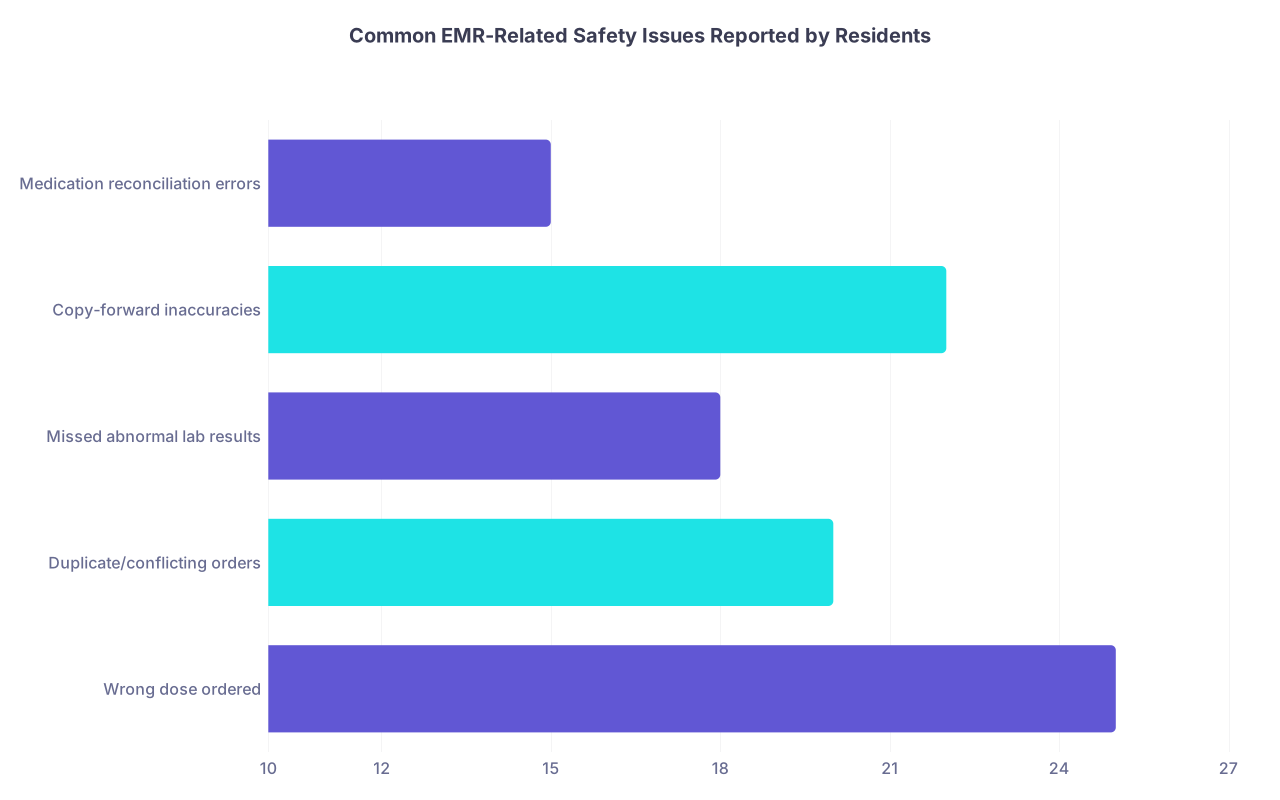
| Category | Value |
|---|---|
| Wrong dose ordered | 25 |
| Duplicate/conflicting orders | 20 |
| Missed abnormal lab results | 18 |
| Copy-forward inaccuracies | 22 |
| Medication reconciliation errors | 15 |
4.1 Medication Orders: The Highest-Risk Clicks You Will Make
Three specific danger zones for students:
Dosing
- Pediatric vs adult dosing.
- Renal/hepatic adjustments.
- PRN frequency vs max daily dose.
Example: pended morphine 4 mg IV q2h PRN in a frail, opioid-naïve 80-year-old with CKD. That is not “a little off.” That is dangerous.
Route/formulation
- ER vs IR formulations.
- IV vs PO vs subQ.
- Crushed vs non-crushable (enteric-coated, extended-release).
Always double-check that you are not pended an ER med via NG and that you picked the correct route.
Allergy and interaction overrides
- You see a warning. You click through because “the system always does that.”
Do that enough, and one day you will override a real, relevant allergy.
If you do not fully understand an alert, stop and ask before overriding.
- You see a warning. You click through because “the system always does that.”
Your interns are faster at med orders because they know the pitfalls. You are slower, so you must be more deliberate.
4.2 Results Management: The “Silent Failures” Students Miss
You will often be first to see new labs and imaging because you are neurotic and constantly refreshing the chart. Good. That can save lives.
But only if you:
- Actually interpret the result in context.
- Communicate clearly and quickly.
- Document significant changes appropriately.
High-yield habits:
- When a critical lab results (K 6.3, troponin skyrocketing, Hgb 5.8), use a structured pattern:
“Dr. X, Ms. Y’s BMP just returned: K is 6.3 (up from 4.8). She is on telemetry, denies chest pain, EKG last night without peaked T waves; do you want a stat EKG and hyperkalemia protocol?” - Do not assume “the team will see it.” Someone has to own it.
If you see something alarming and decide “I’ll tell them on rounds,” you have already failed.
4.3 Order Reconciliation and Discharge: Where Details Really Matter
Students often get tasked with “help with meds for discharge.” It sounds low risk. It is not.
Common problems:
- Accidentally continuing inpatient-only meds (e.g., sliding scale insulin from hospital protocol in a non-diabetic).
- Failing to restart critical home meds (ACE inhibitors, anticoagulation, antiepileptics).
- Duplicating meds (home metoprolol + new inpatient order both continued).
- Wrong dose/formulation on discharge (e.g., continuing high inpatient opioid doses or ER vs IR mismatch).
You are not signing the final list, but your accuracy determines how much clean-up the resident has to do. If they repeatedly find that your reconciliations are sloppy, they will stop trusting you with anything important.
Good pattern:
“At discharge, these are the big changes: stopped HCTZ due to hyponatremia, started lisinopril 10 mg daily, adjusted metoprolol from 25 BID to 50 XL daily. Apixaban held during hospitalization for procedure; I pended resuming 5 mg BID—can we confirm that plan?”
You are showing you understand the reasoning, not just clicking buttons.
5. Workflow Integration: How to Use EMR to Look Like a Junior Resident
The whole point of “high-yield” EMR skills is this: you want interns to forget you are a student when they delegate work.

5.1 Pre-Rounds: Extract Useful Data Fast
Before seeing your patients in the morning, your EMR routine should be:
- Skim overnight notes/events.
- Review vitals trend, I/O (if relevant), oxygen requirements.
- Check labs/imaging after midnight.
- Jot down changes in your own words on your pre-round note or list.
- Update your problem-based A/P before rounds.
Do not spend twenty minutes formatting your note while missing that the patient spiked a fever and had blood cultures drawn at 3 AM.
5.2 On Rounds: Drive the EMR, Do Not Just Stand There
If your team uses “COWs” (computers on wheels) or a fixed workstation during rounds, offer:
“Do you want me to pull up the labs and imaging while we present?”
If you are the one controlling the EMR view:
- Have today’s vitals, last 24-hour I/O, and key labs one click away.
- Be ready to open imaging, micro, meds quickly when asked.
- Avoid flipping rapidly between random tabs like you are lost.
Residents remember the student who made EMR navigation feel smooth.
5.3 After Rounds: Clean Documentation, Clear Orders
Your post-round EMR tasks usually include:
- Finalizing your notes with updated plan and attending input.
- Pended new orders that were requested (labs, imaging, consults, med changes).
- Updating problem lists or adding brief sign-out summaries if your institution uses student-contributed sign-out.
Do not write the note first and then try to retrofit the plan from memory. That is how you contradict the attending or omit major decisions.
Do it in this order:
- Immediately after rounding on a patient, open orders and queue what you can (label them clearly in your task list so you know they are “post-rounds pending”).
- Then fix your note while the encounter is fresh, especially the A/P.
- Double-check one last time late afternoon for any new labs/imaging that should be acknowledged in your note or at least known before sign-out.

6. System-Specific Tips Without Being System-Specific
Every institution has its quirks, but some patterns are universal.
| EMR System | Typical Student Struggle |
|---|---|
| Epic | Bloated smart phrases, copy-forward abuse |
| Cerner | Confusing order sets, multiple pathways to same order |
| Meditech | Navigation, finding old notes and labs |
| Allscripts | Reconciliation workflows, med history complexity |
| Custom/In-house | Lack of training, inconsistent templates |
Regardless of vendor, do this in week one of each rotation:
- Ask your senior: “What are the 2–3 order sets you use most often on this service?”
- Ask: “What smart phrases do people here actually like for daily notes or consults?”
- Watch an intern place a full admission order set and discharge in real time. Copy their approach.
Then spend 20–30 minutes on your own in the sandbox or on a test patient (if available) just practicing:
- Starting an admission order set and trimming it.
- Inserting and editing your smart phrases.
- Completing a discharge med reconciliation.
You will save yourself hours later.
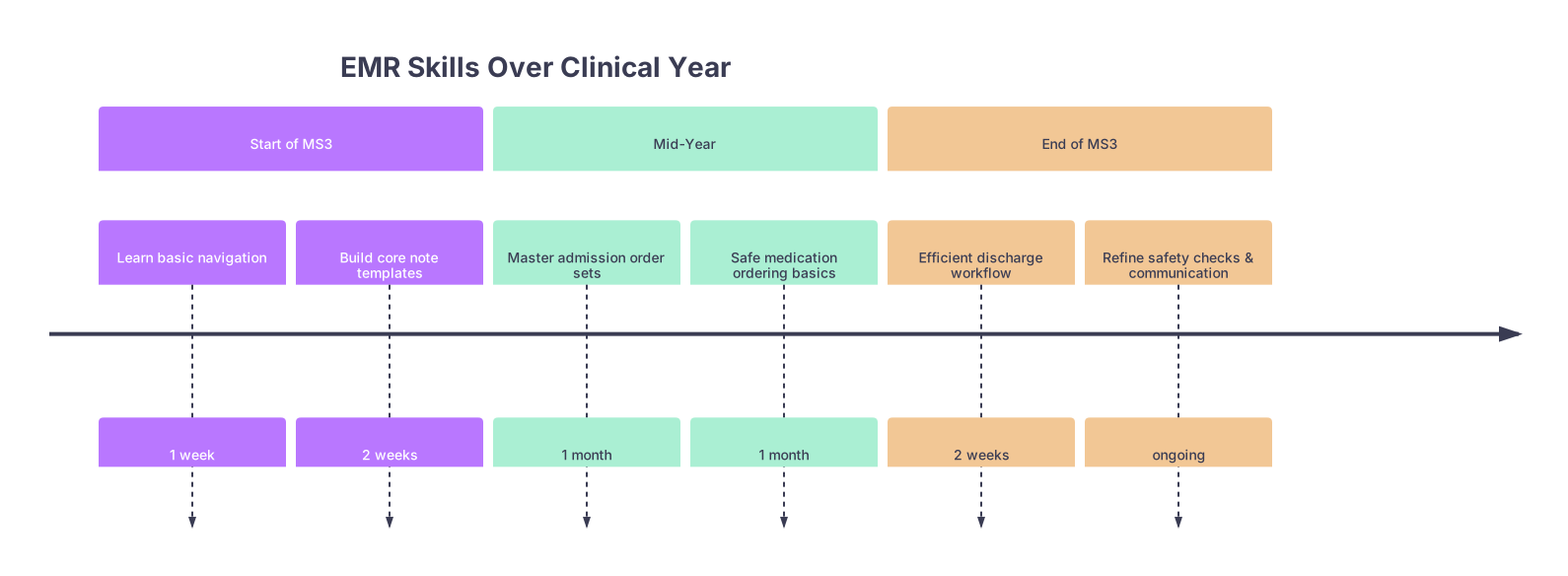
| Period | Event |
|---|---|
| Start of MS3 - Learn basic navigation | 1 week |
| Start of MS3 - Build core note templates | 2 weeks |
| Mid-Year - Master admission order sets | 1 month |
| Mid-Year - Safe medication ordering basics | 1 month |
| End of MS3 - Efficient discharge workflow | 2 weeks |
| End of MS3 - Refine safety checks & communication | ongoing |
7. How to Practice EMR Skills Deliberately (Without Hurting Anyone)
Most students “learn” EMR passively. They watch interns click fast and hope osmosis works. It does not.
Deliberate practice ideas:
- After a real admission, re-open the chart later and ask yourself: “If I built this admission order set from scratch, what would I include?” Compare to the final signed orders.
- Before morning rounds, write a one-sentence assessment for each active problem in your head or on your list. Then check how your intern/attending framed it in their notes.
- When you see an alert or warning you do not understand, write it down and ask about it later rather than ignoring it forever.
You are training not just EMR speed, but clinical reasoning structure.

Key Takeaways
- EMR work is not “busywork.” Your order sets, smart phrases, and safety checks shape real care and how your team perceives you.
- High-yield skills are narrow but deep: clean admission order sets, lean and accurate smart phrases, and ruthless attention to med safety and result follow-up.
- The student who can build reasonable orders, write concise problem-based notes, and spot dangerous results before anyone else very quickly stops feeling like “just a student” to the team.