
Eight weeks is not long. That’s the truth. If you walk into a summer research internship acting like you have a year, you’ll waste half of it by week 2.
So here’s the right goal: do not try to “have a research experience.” Try to finish one useful thing.
That one thing might be an abstract. A poster. A cleaned dataset. A figure that makes it into a manuscript. A methods section draft. A completed chart review. A literature review with a submission target. That counts. It absolutely counts.
What does not count? Vague promises. A project that “might become a paper someday.” A mentor saying, “Let’s see where this goes.” I’ve seen students burn an entire summer on that sentence.
If you’re in an 8-week internship, your job is to be brutally practical. Choose feasibility over prestige. A small project with a real deliverable beats a glamorous project that never gets past a folder of half-named Excel files. Every time.
The students who get output from short internships usually do three things well:
- They narrow the question fast.
- They pick projects with existing data or low setup friction.
- They protect the timeline like it matters. Because it does.
That’s the mindset shift. Stop asking, “What would be impressive?” Start asking, “What can actually be finished before this ends?”
Pick the right project fast: choose a project that can actually finish in 8 weeks
Your first 48 hours matter more than people admit. This is when you decide whether you’re joining a real project or boarding a sinking ship with a nice title.
Here’s what a good 8-week project looks like:
- Existing data already available
- A narrow, answerable question
- A mentor who replies
- Minimal approval delays
- A defined endpoint, like an abstract submission or summer symposium poster
Here’s what a bad 8-week project looks like:
- New prospective data collection
- “We’re still figuring out the question”
- Multiple departments involved, nobody in charge
- IRB not started
- The mentor is brilliant but impossible to reach
That last one hurts people all the time. A famous mentor with no time is often worse than a less famous mentor who actually reviews drafts.
Project types are not equal on a short timeline. If you only have 8 weeks, this is the rough ranking of what’s usually most finishable:
Most realistic
- Retrospective chart review with approved access
- Database study with a clean dataset
- Literature review or narrative review
- Case series with identified cases
- Quality improvement write-up if the data already exist
Usually risky
- Prospective observational studies
- New survey studies that still need design, approval, and distribution
- Basic science projects dependent on experiments working perfectly
- Big multi-author projects with fuzzy ownership
My rule is simple: if the project needs new data collection, complicated approvals, or too many people to move in sync, it’s probably too slow.
If you’re offered options, choose the least glamorous project with the clearest finish line. That’s not selling out. That’s understanding how time works.
And if nobody is offering structure, ask directly:
- “What output is realistic in 8 weeks?”
- “Is there an abstract deadline?”
- “Do we already have data access?”
- “Who will review my drafts, and how quickly?”
Those questions make you sound organized, not difficult. Good mentors like hearing them. Badly run projects get exposed by them.
Build an 8-week output plan: what to do each week so you end with something tangible
An 8-week internship needs a week-by-week plan. Not a general intention. A plan.
Here’s the version I’d use.
Week 1: lock the scope
By the end of week 1, you should know:
- the exact research question
- the dataset or source material
- the target deliverable
- who your supervisor is
- the next meeting date
You should also have a one-page project summary or at least a written email recap. This prevents the classic summer problem where everybody thinks the project is one thing, but nobody is actually working on the same thing.
A strong week 1 deliverable:
- final research question
- inclusion/exclusion criteria
- draft data fields
- target conference or poster date
Weeks 2–3: collect or extract what you actually need
This is where students often overbuild. Don’t. You do not need every possible variable if three-quarters of them won’t matter.
If you’re doing a chart review, build the data sheet early and test it on a handful of records first. I’ve seen students spend days extracting data into a messy spreadsheet, then realize halfway through they forgot to define one core outcome clearly. Brutal waste.
Deliverables for this stage:
- data dictionary
- cleaned extraction sheet
- first batch of completed records
- list of missing variables or access issues
Weeks 4–5: analyze enough to answer the question
This is where perfectionism starts killing momentum. You do not need endless exploratory analysis. You need analysis that supports the stated question.
Try to have something visible by the end of week 4:
- one summary table
- one figure
- one result that answers the primary question
Visible progress matters. It helps your mentor engage. It also tells you whether the project is real.
If analysis is delayed because someone else runs stats, don’t sit there refreshing your inbox. Draft the introduction. Build the methods. Create table shells. Write the abstract background and objective. Keep moving.
Weeks 6–7: draft the output
At this point, you should be writing, not “still gathering thoughts.”
Best targets:
- abstract draft
- poster skeleton
- manuscript outline
- methods and results draft
- figure legend and table titles
A lot of students wait for “final analysis” before writing a word. Bad move. Start earlier. The methods section doesn’t need p-values to exist.
Week 8: submit, present, or hand off cleanly
Your internship should not end with “I think we’ll continue this later” and no documents organized. That’s how work disappears.
By the end of week 8, aim for one of these:
- abstract submitted
- poster presented
- complete manuscript draft section sent to mentor
- final cleaned dataset with codebook
- results slides ready for internal presentation
And if the project isn’t fully done? Fine. But there should be a clear package someone can continue. Clean files. Named versions. A summary of where things stand. Not chaos.
Protect your output: how to communicate with your mentor, team, and site coordinator
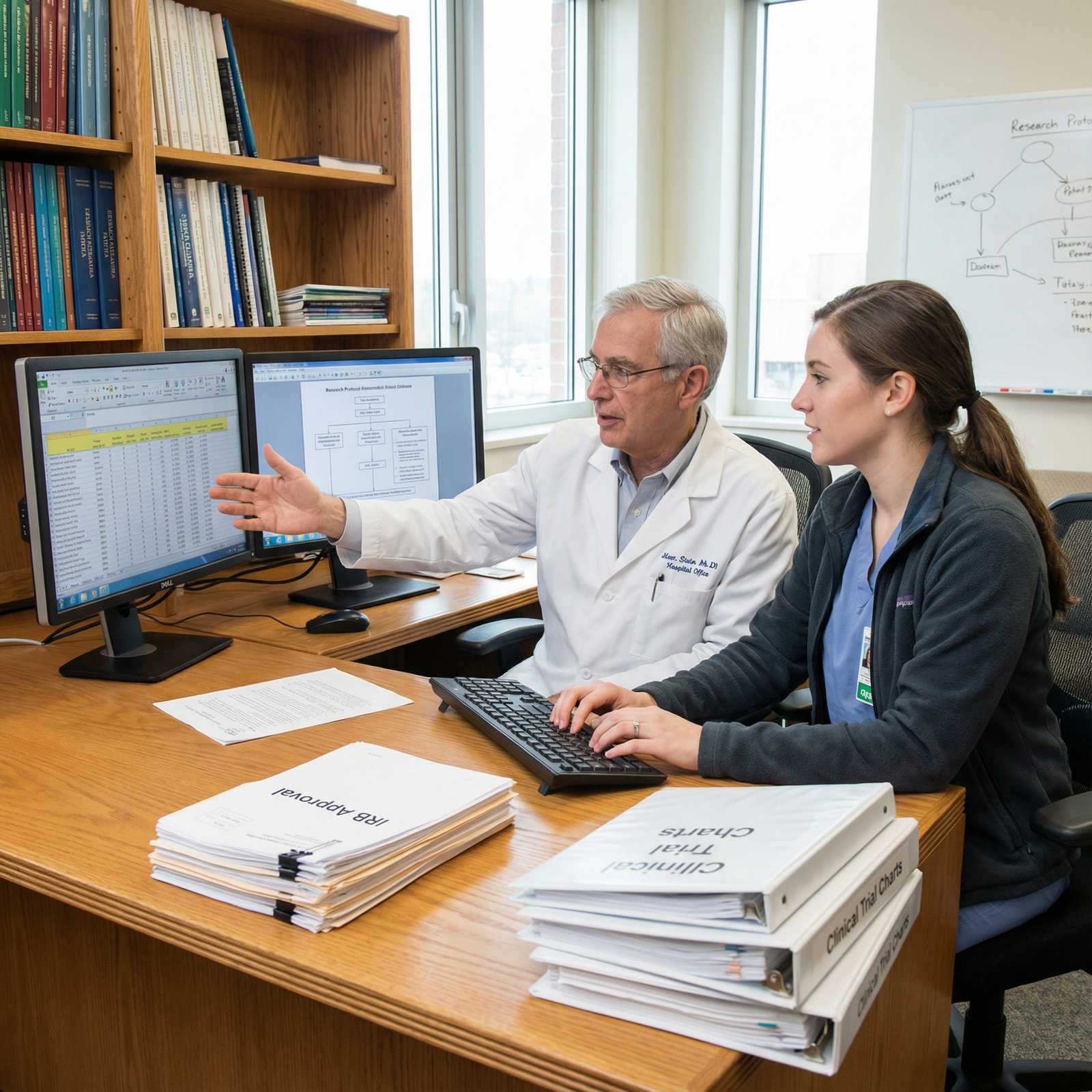
A short internship gets destroyed by slow communication more often than by lack of talent.
You can be hardworking, smart, and motivated. Doesn’t matter. If nobody answers your email for six days at a time, your timeline collapses.
So don’t be passive.
At the start, ask:
- “What’s the main deliverable?”
- “How often should we check in?”
- “Who gives feedback if you’re away?”
- “What turnaround time should I expect on drafts?”
Then make your updates easy to process. Busy mentors don’t want a 700-word diary entry. Send something like this once a week:
Subject: Week 3 research update
- Completed: extracted 42 charts, cleaned variables, drafted methods section
- Current blocker: missing access to lab values field
- Proposed next step: continue extraction with available fields and finalize abstract outline
- Request: can you review the attached methods draft by Thursday?
That format works. It’s clear. It moves the project.
If feedback is slow, ask for a date. Not “just checking in,” which invites more vagueness. Ask:
“Could you let me know by Friday whether this abstract direction works?”
And if you’re blocked, shift to independent tasks:
- organize references
- draft intro/methods
- build figure templates
- clean the dataset
- prepare a poster outline
You always want motion. Even partial motion.
The worst position is, “I’m doing a lot but nothing is moving.” That usually means nobody has defined the next concrete step. Fix that immediately.
Turn a small summer into a strong application asset

An 8-week internship can absolutely help your application. But only if you frame it correctly.
Do not oversell it. That backfires. People can smell inflation.
Instead, be precise:
- What was the question?
- What did you personally do?
- What did the project produce?
- What happened next?
Good application language sounds like this:
- “Conducted retrospective chart review of X patients and drafted abstract on postoperative outcomes.”
- “Cleaned dataset, performed literature synthesis, and prepared poster presented at departmental summer symposium.”
- “Drafted methods and results sections for manuscript currently under senior author review.”
That works because it’s concrete.
If the project is incomplete, say so honestly. There is nothing wrong with:
- “Abstract submitted; manuscript in preparation”
- “Poster presented; full manuscript development ongoing”
- “Completed data extraction and preliminary analysis for senior team review”
That is much better than pretending you “published research” when what you really did was attend meetings and rename files.
In interviews, your short internship can still sound strong if you focus on judgment and execution. For example:
“I realized early that 8 weeks wasn’t enough for a broad prospective project, so I narrowed the scope to a retrospective analysis with an existing dataset. That allowed me to finish the extraction, generate one key figure, and submit an abstract before the program ended.”
That answer shows maturity. It shows you understand constraints. Residency programs actually like that. Medicine is full of constraints.
High-value outputs from a short internship include:
- one abstract submitted
- one poster presented
- one figure or table finalized
- one manuscript draft section completed
- one literature review completed for mentor revision
That may sound small. It isn’t. Finished work beats imaginary future work every time.
Common mistakes that waste an 8-week internship
The biggest mistakes are predictable. That’s the good news. You can avoid them.
1. Choosing a project that’s way too broad
If the project sounds like it needs a semester-long planning meeting, it’s wrong for 8 weeks.
2. Waiting too long to ask for help
If you’re confused in week 2 and stay quiet until week 5, the summer is basically over.
3. Never defining the deliverable
“Helping with research” is not a deliverable. An abstract draft is.
4. Ignoring authorship and ownership
You don’t need a dramatic negotiation on day 1, but you do need clarity on who’s writing what and what the likely output will be.
5. Spending too much time polishing format
I’ve seen students fuss over poster fonts while the results section is still thin. Backwards. Content first.
If the project stalls, do something practical:
- simplify the question
- narrow the dataset
- switch the target to an abstract or poster
- split the project into a short-term deliverable and a later manuscript extension
That’s how you rescue a summer.
Here’s the final truth: output from an 8-week internship does not come from grinding every waking hour. It comes from scope control. Clear deadlines. Good follow-up. Less fantasy, more finishing.
If you’re about to start one of these internships, make your first move today: ask what single deliverable you can realistically complete by the end of week 8. Then build everything around that answer.