
The way most premeds and medical students approach research time is statistically inefficient.
The hidden math of research time in medicine
Medical trainees routinely invest 300–1,000+ hours into research without any structured model of “return on investment.” The data from match reports, publication databases, and trainee surveys all converge on one blunt conclusion: research output is not linearly related to time spent.
Two students can both log 500 hours:
- Student A: 1 middle-author abstract, no pubs
- Student B: 3 first-author papers, 2 posters, 1 oral presentation
Same hours. Completely different outcomes.
The difference is not work ethic. It is how those hours are allocated, the type of projects selected, and the “throughput” of each lab or mentor. Once you treat research like a system with input and output metrics, patterns become obvious and actionable.
This article quantifies those patterns for premeds and medical students and offers a data-driven way to decide where your next research hour should go.

Defining “return” on research hours
Before analyzing anything, we need a clear metric. For medical trainees, “return” on research time has three main components:
Quantitative academic output
- Peer‑reviewed publications (weighted by authorship position and journal impact)
- Abstracts, posters, oral presentations
- Grants, awards, conference travel scholarships
Match‑relevant signaling
- Alignment with target specialty (e.g., neurosurgery vs primary care)
- Strength and credibility of letters of recommendation
- Name recognition of institution / PI
Skill and network capital
- Data analysis skills, coding, methodology competence
- Mentorship connections, collaborative network
- Probability of future projects and “spin‑offs”
For this analysis, we will build a primary metric and then layer in modifiers:
Core metric: Publications per 100 hours (P/100h)
Then adjust by:
- First‑author equivalence weight
- Specialty relevance factor
- Lab throughput multiplier
A simple weighting model
To create a numerical “research yield score,” we can assign weights:
- First‑author original article: 1.0
- Second/third author original article: 0.6
- 4th+ author original article: 0.3
- Review article / book chapter (substantive): 0.5–0.8 depending on workload
- Case report: 0.3
- Abstract/poster only (no full paper): 0.15
- Oral presentation at major meeting: add 0.1–0.2 on top of existing product
These numbers are not absolute truths. They are working coefficients to compare trajectories.
Example: A student has
- One first‑author original article
- One third‑author original article
- Two posters (no full papers)
Weighted output:
- 1 × 1.0 = 1.0
- 1 × 0.6 = 0.6
- 2 × 0.15 = 0.3
Total = 1.9 “equivalent pubs”
If that came from 350 hours total, then:
- Equivalent P/100h = 1.9 / 3.5 ≈ 0.54
This student is yielding about 0.54 equivalent publications per 100 hours.
Now compare that to another student with:
- Four 5th‑author original articles (0.3 each)
- Six posters (0.15 each)
Weighted output:
- 4 × 0.3 = 1.2
- 6 × 0.15 = 0.9
Total = 2.1 equivalent pubs
If they spent 800 hours:
- Equivalent P/100h = 2.1 / 8 = 0.26
Different headline numbers (10 total “products” vs 4), but on a per‑hour basis the first student is twice as efficient.
This type of numerical lens is what should drive your project selection.
What the data shows from match and publication trends
The AAMC and NRMP data over the last decade show several consistent patterns:
Median “number of research experiences” for matched U.S. MD seniors:
- Internal Medicine: ~4 experiences, ~9–12 abstracts/pubs/presentations
- General Surgery: ~5, ~12–15
- Dermatology, Neurosurgery, Plastics: often 5–7 experiences, 18–30+ products
The relationship between total products and match probability is strongly positive at the low end, then plateaus.
- Going from 0 to 3 products matters a lot.
- Going from 3 to 10 matters, especially for competitive fields.
- Going from 20 to 35 has diminishing marginal benefit for most applicants.
This suggests:
- There is a threshold zone where returns per extra hour are very high (getting first few solid outputs).
- After that threshold, the marginal return of each additional hour declines unless the project is unusually leveraged (e.g., high‑impact, highly visible).
Typical time‑to‑output benchmarks
We can estimate average time investment per type of product for trainees, based on survey data, lab expectations, and typical timelines.
These are ballpark ranges for a reasonably efficient, mentored student:
Case report
- Time: 20–60 hours
- Yield: 0.3 (paper) + possibly 0.15 (poster)
- Rough equivalent: 0.45 / 40h ≈ 1.1 eq pubs per 100 hours
Chart review / retrospective study
- Time: 120–300 hours (IRB, data extraction, analysis, manuscript)
- Yield: 1–2 papers + 1–3 abstracts/posters
- Middle case: 1.2 papers (weighted) + 1 poster = 1.35 eq pubs
- Rough equivalent: 1.35 / 2.1 ≈ 0.64 eq pubs per 100 hours
Prospective clinical trial (student‑level involvement)
- Time: 150–400 hours over 1–3 years
- Yield: 0.2–0.5 “paper credit” if not leading, maybe 0.1–0.2 from abstracts
- Rough equivalent: often 0.15–0.3 eq pubs per 100 hours for junior trainees
Basic science bench research
- Time: 300–800+ hours per meaningful authorship
- Yield: 0.3–1.0 eq pubs depending on role and lab productivity
- Wide range: 0.15–0.5 eq pubs per 100 hours in real trainee scenarios
Systematic review / meta‑analysis
- Time: 150–350 hours
- Yield: often 1 first‑author paper; sometimes 1–2 abstracts
- Middle case: 1.0 + 0.15 = 1.15 eq pubs
- Rough equivalent: 1.15 / 2.5 ≈ 0.46 eq pubs per 100 hours
Pattern:
For a student whose main goal is match‑relevant output, retrospective clinical work and well‑scoped reviews often produce stronger “return per hour” than prospective trials or bench work, unless the latter are in extremely efficient labs.
Lab throughput: the multiplier that usually gets ignored
Not all labs translate the same number of hours into output. Three factors dominate:
PI’s publication velocity
- A PI with 10–15 papers per year across multiple trainees and collaborators has demonstrated throughput.
- A PI with 1–2 papers every few years, mostly basic science, is higher risk for your limited timeline.
Project fragmentation vs integration
- Some labs structure tasks so that each student owns an analyzable “unit” that can become a paper.
- Others use students for low‑yield tasks (pure data entry, animal husbandry) with little chance of authorship.
Pipeline maturity
- Joining a project post‑IRB with data already collected vs starting from brainstorm/IRB from scratch.
- Projects already in revision vs just at idea stage.
From an efficiency perspective, your per‑hour return is:
ROI = (Equivalent pubs × specialty relevance factor × lab multiplier) / hours invested
Where:
- Specialty relevance factor: 1.0 if directly aligned with your target specialty, 0.7 if tangential, 0.4 if unrelated.
- Lab multiplier: 0.5–1.5 based on track record and structure.
Example comparison: two offers
You are an M2 considering two projects:
Project A – Dermatology retrospective study
- First‑author role estimated
- Time: 180 hours
- Expected yield: 1 paper (1.0) + 2 posters (0.3) = 1.3 eq pubs
- Specialty relevance factor: 1.0 (you want Derm)
- Lab multiplier: 1.2 (PI publishes 12–15 papers/year)
ROI_A = (1.3 × 1.0 × 1.2) / 180 ≈ 1.56 / 180 ≈ 0.0087 eq pubs per hour
Scaled: 0.87 per 100 hours
Project B – Basic science cardiology lab
- Middle author expected
- Time: 350 hours
- Expected yield: 0.6 eq paper + maybe 1 poster (0.15) = 0.75
- Specialty relevance factor: 0.6 (you do not plan on Cardiology)
- Lab multiplier: 0.9
ROI_B = (0.75 × 0.6 × 0.9) / 350 ≈ 0.405 / 350 ≈ 0.00116 eq pubs per hour
Scaled: 0.12 per 100 hours
From a purely output‑centric, specialty‑aligned standpoint, Project A is about 7x more efficient than Project B for this student.
Yet many students choose B because it “sounds cool” or is at a prestigious basic science institute. That may be defensible if your primary goal is skill development or PhD‑level training, but from a match‑driven lens the numbers are unforgiving.

Time budgeting across premed and medical school
Research output accumulates over several distinct phases. The return on each marginal hour changes depending on where you are in the training pipeline.
Premed stage: building the foundation (low pressure, moderate stakes)
Typical constraints:
- 5–15 hours/week available for research over 1–3 years.
- Less pressure for first‑author originality; proof of sustained involvement matters.
For premeds, the data suggests:
- Any peer‑reviewed output is a positive differentiator (most applicants report some experience, but relatively fewer have publications).
- Admissions committees often do not differentiate strongly between first vs middle author at this stage, but they do notice productivity clusters.
Strategic implications:
- Target projects with shorter time‑to‑product, such as:
- Case reports and small case series
- Retrospective chart reviews
- Clearly scoped systematic reviews with experienced mentors
- Aim for 1–2 substantive products rather than 5–6 marginal or unpublished “works in progress.”
A reasonable efficiency target:
- 0.4–0.7 equivalent pubs per 100 hours for a motivated premed with a good mentor.
If you have 300 hours to realistically invest over two years, this range suggests a feasible output of 1.2–2.1 equivalent pubs, which could look like:
- 1 middle‑author original article (0.6)
- 1 case report (0.3)
- 2 posters (0.3)
Total = 1.2 (on the low end)
or - 1 first‑author review (0.8)
- 1 co‑author original article (0.6)
- 2 posters (0.3) Total = 1.7
Early medical school (M1–M2): leverage your hours
By M1–M2, your signal matters more for future specialty competitiveness.
In the absence of specialty certainty, the data supports:
- Building transferable output (internal medicine, surgery, pediatrics) that demonstrates productivity.
- Prioritizing projects likely to reach completion before ERAS submission.
Time windows:
- M1–M2 summers: 8–10 weeks of nearly full‑time research (300–400 hours).
- Longitudinal during the year: 3–6 hours/week (150–250 hours/year).
For a student targeting moderately competitive specialties (e.g., EM, anesthesiology, mid‑tier IM), a realistic cumulative investment might be:
- 400–600 total hours over M1–M3
- Target outcome: 2–4 equivalent pubs
- Implied yield: 0.33–1.0 eq pubs per 100 hours
Students who exceed 1.0 consistently usually benefit from:
- Highly productive mentors
- Projects already partially complete
- Strong statistical or writing skills that reduce friction
Late medical school (M3–M4): diminishing returns and rescue efforts
During M3–M4, clinical demands cut available research time sharply. The “return curve” also changes:
- Work that will not be submitted and accepted before ERAS has reduced immediate value.
- Letters of recommendation and perceived commitment to a specialty start overshadowing raw publication counts.
At this stage:
- High‑yield efforts: finalize manuscripts, push under‑review projects to acceptance, convert posters into papers, and obtain strong letters that reference your contributions quantitatively (“she independently managed data from 500 patients and drafted the first version of the manuscript”).
- Low‑yield efforts: starting brand‑new, long‑horizon basic science work unless it clearly will not distract from clinical performance and Step exams.
Empirically, spending 200 hours in M3 on a project that may publish after you match has a lower short‑term ROI than spending the same time:
- Raising a draft from “in progress” to “submitted”
- Converting one accepted abstract into a full manuscript
- Co‑writing a concise review with an efficient mentor
Time-management metrics: tracking your real ROI
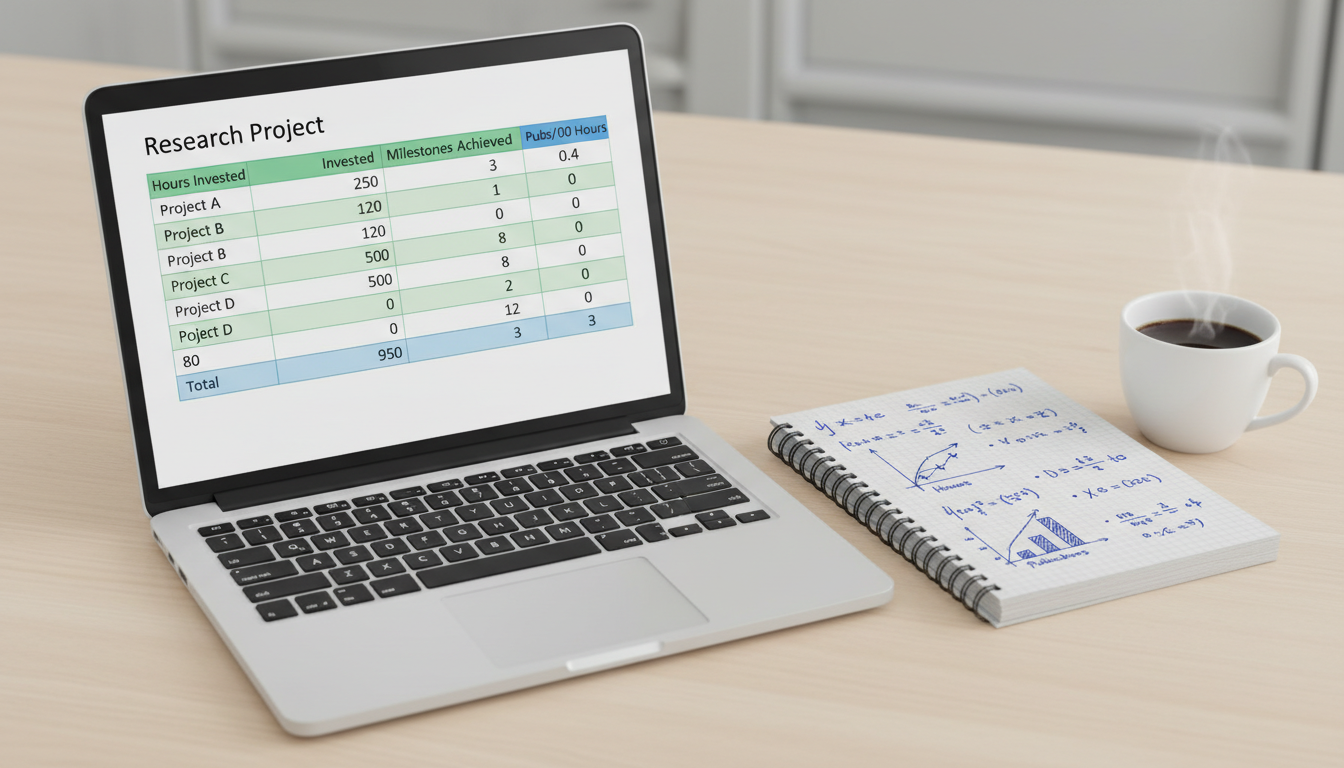
Students rarely quantify their research hours. That is a missed opportunity.
Tracking only three metrics can change decision‑making:
Hours logged per project
- Use a simple spreadsheet with date, hours, task (lit review, data extraction, analysis, writing, meeting).
Milestone velocity
- Time from:
- Start → IRB submission
- IRB approval → data complete
- Data complete → first full manuscript draft
- Draft → submission
- Submission → acceptance
Labs with consistent long delays at each step depress your ROI even if your hourly work is strong.
- Time from:
Output converted per project
- Number and type of:
- Publications
- Abstracts/posters
- Oral presentations
- Apply your weighting scheme to see equivalent pubs per 100 hours.
- Number and type of:
After 6–12 months, patterns emerge:
- Some projects yield 0.8–1.0 eq pubs per 100 hours.
- Others hover at 0.1–0.2 or stall indefinitely.
The rational move is to reallocate future hours away from chronically low‑velocity projects unless there are compensating benefits (e.g., unique mentorship, technical skills you need for long‑term goals).
Common inefficiencies and how the data reframes them
Analyzing patterns from student trajectories reveals several recurring inefficiencies.
1. Over-investing in low-chance, long-horizon projects
Features:
- No clear timeline to IRB, data, or manuscript.
- PI is frequently “too busy to meet” and has multiple half‑finished projects.
- Student is performing generic tasks with no clear authorship path.
Typical outcome:
- 100–300 hours logged.
- No publications before residency application.
- Maybe a line on the CV as “research assistant” with no tangible metrics.
From a data perspective, these projects have near‑zero P/100h. You can justify a small initial “exploration” investment (20–40 hours), but continuing beyond that without visible progress is rarely rational.
2. Fragmented commitment across too many projects
Students often join 4–6 projects simultaneously, contributing small amounts to each.
Outcome pattern:
- Each project receives 30–80 hours, never enough for ownership.
- Authorship often falls to others with larger contributions.
- Posters may emerge, but few full manuscripts with significant roles.
If each project yields 0.15–0.3 eq pubs and you split 400 hours across five projects, you might end up with:
- 5 × 0.25 = 1.25 eq pubs → 0.31 per 100 hours
Compare this to committing 300 hours to two high‑yield projects (0.6–0.8 each) and 100 exploratory hours: easily 2.0–2.5 eq pubs in the same total time.
3. Undervaluing writing time and overvaluing “just helping out”
The data shows that:
- Hours spent drafting and revising manuscripts correlate most strongly with first‑ or second‑author positions.
- Hours spent in generic data collection or clinic shadowing for research correlate weakly with authorship.
If your weekly research time is 5 hours:
- Allocating 3–4 of those to writing/analyzing and only 1–2 to data acquisition, after an initial collection phase, often multiplies your ROI.
- Volunteering for “just help with recruitment” without a clear downstream writing role tends to dilute ROI unless the PI is extremely structured.
From a numerical perspective, ask:
“How many hours of this specific task usually produce one line on a CV with my name on a manuscript?”
Tasks with answers like “probably 10–20 hours” are high‑value. Tasks with answers like “maybe 100–150 hours, if things work out” should be limited.
A practical framework for your next 500 research hours
Suppose you are an M1 with 500 hours that you can plausibly devote to research over the next 18–24 months, and you are interested in a moderately competitive field (e.g., radiology, EM, anesthesiology). Here is a data‑driven allocation:
Exploration / sampling (50–75 hours)
- 2–3 labs or mentors.
- 15–25 hours per setting to:
- Attend meetings
- Read prior work
- Contribute to a small task
- Goal: estimate each environment’s lab multiplier and milestone velocity.
Core high-yield projects (300–350 hours)
- 1–2 retrospective clinical projects where you can be first or second author.
- 1 systematic or scoping review aligned with your developing interests.
- Target combined yield: 2–3 equivalent pubs → ~0.6–1.0 P/100h.
Conversion and polish (75–100 hours)
- Turning abstracts into full manuscripts.
- Responding to reviewer comments.
- Preparing for oral presentations.
Optional stretch (remaining hours)
- Join one more project if and only if:
- IRB is already approved,
- Data is partly collected,
- Your role in writing is defined,
- The PI’s last 2–3 student collaborators all published.
- Join one more project if and only if:
Measured this way, a realistic outcome from 500 well‑allocated hours is:
- 2–4 peer‑reviewed papers (some first/middle author)
- 2–5 posters or oral presentations
- At least one strong research letter quantifying your contribution
That trajectory is far stronger than the common pattern of 500 unstructured hours spread across vague “experiences” that yield one abstract and a generic letter.
Key takeaways
- Research productivity in medicine is quantifiable: track equivalent publications per 100 hours and compare projects by that metric, adjusted for specialty relevance and lab throughput.
- Time‑to‑output varies dramatically by project type and environment; retrospective clinical projects and well‑scoped reviews often outperform prospective and bench work for short‑term match goals.
- Your next research hour should go where the data shows the highest return: projects with clear authorship paths, strong mentors, and proven pipelines from student effort to published output.