As a US citizen IMG interested in addiction medicine, research during residency can be one of the most powerful ways to differentiate yourself, deepen your clinical understanding of substance use disorders, and open doors to leadership roles and future fellowship opportunities. While many international graduates worry that their pathway limits access to research, the reality is that with strategy, persistence, and mentorship, you can build a strong research portfolio—even in a busy training environment.
This guide breaks down how to approach research during residency as a US citizen IMG focused on addiction medicine, and how to turn resident research projects into a long‑term academic trajectory.
Understanding the Research Landscape in Addiction Medicine
Addiction medicine sits at the intersection of internal medicine, psychiatry, public health, and behavioral science. As an American studying abroad returning for residency training, you’re entering a specialty that is:
- Rapidly evolving: New treatments, medications, and care models are constantly being tested.
- Heavily outcomes-focused: Research often centers on relapse rates, overdose prevention, health services utilization, and mortality.
- Policy-relevant: Substance use research influences legislation, public health strategy, and healthcare systems.
- Interdisciplinary: Projects commonly involve psychiatry, internal medicine, emergency medicine, social work, and community organizations.
For a US citizen IMG, this has several implications:
Plenty of questions still unanswered
Stigma, access to care, telemedicine, criminal-legal system involvement, and social determinants of health all provide fertile ground for meaningful research.Multiple entry points into research
You can participate in:- Clinical outcomes research (e.g., impact of medications for opioid use disorder in primary care clinics)
- Quality improvement (QI) projects (e.g., ED buprenorphine initiation protocols)
- Implementation science (e.g., scaling contingency management across clinics)
- Medical education research (e.g., improving substance abuse training for residents)
Strong alignment with health equity and public service
Addiction medicine research often serves marginalized populations, which resonates well with mission-driven programs and academic residency tracks.
Understanding this landscape helps you position yourself not just as a resident, but as a future leader in addiction medicine scholarship.
Choosing the Right Residency Environment for Research
Your ability to do research during residency is closely linked to the environment you match into. As a US citizen IMG, strategic planning during the residency application process can make a major difference.
1. Look for Programs with Addiction Medicine Infrastructure
Even if you’re not applying directly to addiction medicine (most fellowships are entered after primary specialties like internal medicine, psychiatry, or family medicine), you should look for:
- Existing addiction medicine fellowship programs
- Dedicated addiction consult services (e.g., inpatient addiction teams)
- Substance use disorder clinics (methadone, buprenorphine, naltrexone, alcohol use disorder clinics)
- Affiliated public health or behavioral health departments
Programs that already have these components are more likely to have active research and mentors in the field.
2. Identify Programs with an Academic Residency Track
Search for programs advertising:
- Research track or academic residency track
- Protected research time during PGY-2 or PGY-3
- Required resident research projects or a scholarly activity curriculum
- Access to institutional review board (IRB) support and biostatistics
As an American studying abroad, you may worry about being competitive for these academic programs. To strengthen your application:
- Highlight any prior research (even if non-addiction related)
- Emphasize your interest in substance use and health disparities in your personal statement
- Secure letters of recommendation that speak to your academic potential
- Mention specific faculty at that institution whose work you admire
3. Ask Direct Questions During Interviews
When you interview (in-person or virtual), ask targeted questions to assess research support:
- “How are residents supported in research during residency?”
- “What proportion of residents complete scholarly projects or publications?”
- “Is there a formal mentorship program for research and academic career development?”
- “Are there opportunities to collaborate with addiction medicine faculty or public health researchers?”
You’re not just trying to impress the program; you’re screening for a good academic fit that will support your addiction medicine goals.
Getting Started with Research During Residency
Once you’re in residency, time quickly becomes your scarcest resource. Your approach to research must be deliberate, especially if you’re balancing overnight calls, clinic, and exams.
Step 1: Clarify Your Research Goals
Before saying “yes” to any project, define what you want:
- Goal: Addiction medicine fellowship
- Aim for at least 1–3 relevant projects, ideally leading to:
- Abstracts/posters at major meetings (e.g., ASAM, APA, SGIM)
- A manuscript (case report, review, or original research)
- Aim for at least 1–3 relevant projects, ideally leading to:
- Goal: Academic career in addiction medicine
- Look for:
- Longitudinal projects
- Multi-author collaborative work
- Mentors with track records of federal or foundation funding
- Look for:
- Goal: Strengthen clinical expertise and CV
- Focus on:
- Quality improvement and curriculum projects
- Shorter, clearly defined research roles
- Focus on:
Write down your goals early in PGY-1; revisit them each year.
Step 2: Identify Mentors in Addiction Medicine
As a US citizen IMG, you may not have an established academic network in the US. You can build one systematically:
Start with your own institution
- Ask your program director, chief residents, or faculty:
- “Who is doing research in addiction medicine or substance use disorders here?”
- Look at the hospital or university website:
- Search terms: “addiction medicine,” “substance use disorder,” “opioid,” “harm reduction,” “alcohol,” “overdose.”
- Ask your program director, chief residents, or faculty:
Expand beyond your department
- Public health, psychiatry, emergency medicine, and family medicine often host addiction researchers.
- Collaborating across departments can give you access to larger datasets and multi-disciplinary projects.
Cold-email potential mentors
- Briefly introduce yourself:
- US citizen IMG
- Specialty and year
- Interest in addiction medicine and research
- 2–3 specific questions or a request for a short meeting
- Attach a CV highlighting any prior research or relevant experiences.
- Briefly introduce yourself:
Use national organizations
- Attend (or virtually attend) conferences by:
- American Society of Addiction Medicine (ASAM)
- American Academy of Addiction Psychiatry (AAAP)
- Specialty societies with addiction subgroups (e.g., SGIM)
- Approach speakers or email them later asking about potential collaboration.
- Attend (or virtually attend) conferences by:
Step 3: Start with Feasible, High-Yield Projects
In residency, your first research experiences should be:
- Clearly scoped (not a 5-year RCT)
- Methodologically manageable
- Likely to produce something tangible (poster, presentation, publication)
Examples of feasible starter projects in addiction medicine:
Retrospective chart review
- Example: “Characteristics and outcomes of patients started on buprenorphine in the emergency department of our hospital over the last 3 years.”
- Feasibility: Uses existing data; ideal for first projects.
- Output: Poster, possible manuscript.
Quality improvement project
- Example: “Improving screening for alcohol use disorder on inpatient admissions using an EHR prompt.”
- Feasibility: Often aligns with institutional priorities; may count as required QI.
- Output: Resident research project, local presentation, maybe publication.
Case report or case series
- Example: “Atypical presentation of precipitated withdrawal in a patient transitioning from methadone to buprenorphine.”
- Feasibility: Minimal data collection; good first publication.
Education-focused project
- Example: “Evaluating the impact of a new substance abuse training module on resident prescribing practices for naltrexone and buprenorphine.”
- Feasibility: Can often be embedded in your teaching or curriculum duties.
- Output: Med-ed conference presentation, education journal submission.
Start small, succeed, and build from there.
Turning Resident Research Projects into an Academic Trajectory
Once you’ve gained initial momentum, the key is consistency and strategic alignment with your long-term addiction medicine goals.
1. Develop a Thematic Focus
Rather than doing unrelated one-off projects, aim to develop a recognizable focus area over your residency years. Examples:
- Health services research: Access to medications for opioid use disorder (MOUD) in primary care.
- Emergency medicine interface: ED-initiated buprenorphine and linkage to care.
- Stigma and health equity: Racial and socioeconomic disparities in addiction treatment.
- Medical education: Substance abuse training for residents and medical students.
A clear theme helps:
- Clarify your personal “academic brand”
- Attract mentors and collaborators with similar interests
- Strengthen your application for addiction medicine fellowship and academic jobs
2. Learn the Basics of Research Methods and Statistics
As an American studying abroad, your prior curriculum may or may not have emphasized research methods. During residency:
- Seek workshops or short courses on:
- Study design (cohort, case-control, randomized trials, implementation science)
- Basic statistics (p-values, confidence intervals, regression)
- Critical appraisal of addiction medicine literature
- Use free resources:
- Online courses (e.g., Coursera, edX, university open courses)
- Recorded lectures from national societies
- Ask your mentor if you can attend:
- Research-in-progress meetings
- Department journal clubs focused on substance use
You don’t need a PhD in biostatistics, but understanding the fundamentals makes you a more effective collaborator and future PI.
3. Make Research a Scheduled Part of Your Life
Without structure, research during residency gets squeezed out by clinical demands. Protect your time:
- Block research hours in your calendar (e.g., Saturday mornings, 2 evenings per week).
- Use elective time:
- Ask for a “research elective” focused on addiction medicine.
- Combine with an academic residency track if your program offers one.
- Break work into small tasks:
- One day: refine research question
- Next: draft IRB protocol
- Next: data abstraction template
- Next: 500 words of introduction
Consistent small steps over 6–12 months yield publications.
4. Aim for Multiple Types of Output
Well-structured research during residency can yield several forms of academic output:
- Abstracts for conferences (local, regional, national)
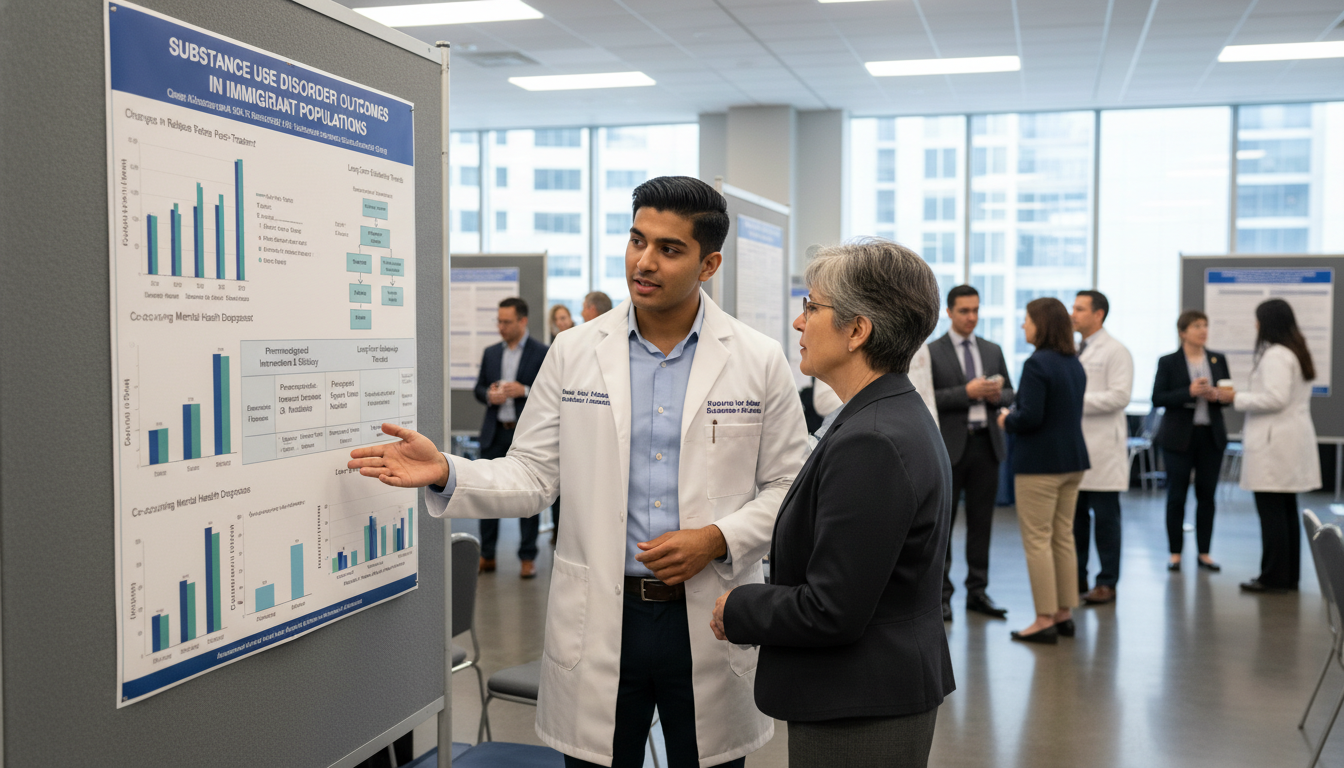
- Poster or oral presentations
- Manuscripts (case reports, narrative or systematic reviews, original research)
- Educational products (curricula, workshops, online modules)
Each of these helps build your CV and demonstrates progression from idea to dissemination—especially important when applying for an addiction medicine fellowship.

Positioning Yourself for an Addiction Medicine Fellowship
If your goal is an addiction medicine fellowship, your research experiences during residency can strongly influence how competitive you are—especially as a US citizen IMG.
What Fellowship Programs Look for
Addiction medicine fellowship programs generally value:
- Demonstrated commitment to substance use disorders (clinics, consult services, advocacy, teaching)
- Scholarly productivity:
- Any completed or in-progress addiction medicine projects
- Presentations at regional or national meetings
- Peer-reviewed publications (not a strict requirement but a major plus)
- Ability to work in multidisciplinary teams
- Clear career vision (clinical educator, academic researcher, policy leader, etc.)
How to Use Research to Strengthen Your Application
Align your projects with fellowship themes
- For example, a fellowships with strong health services research focus will appreciate projects examining MOUD implementation or treatment retention.
Involve future letter-writers in your research
- A mentor who knows you scientifically and clinically can write a powerful letter explaining your potential as an academic addiction specialist.
Present at addiction-focused conferences
- ASAM or AAAP presentations on your resident research projects signal seriousness and investment in the field.
Highlight research in your personal statement
- Connect the dots:
- Why addiction medicine?
- What research questions matter to you?
- How your research during residency prepared you for advanced training.
- Connect the dots:
Be honest about the scope of your role
- It’s acceptable if you were not the PI; explain your contribution:
- Data collection
- Analysis
- Drafting sections of the manuscript
- Presenting findings
- It’s acceptable if you were not the PI; explain your contribution:
Common Pathways for US Citizen IMG Applicants
Many US citizen IMG residents match into:
- Internal medicine, family medicine, psychiatry, or emergency medicine
- Community-based programs with varying research infrastructure
From there, you can:
- Seek collaboration with nearby academic centers
- Use tele-mentoring relationships with addiction researchers
- Build a strong research narrative over PGY-2 and PGY-3 focused on substance use
Programs increasingly recognize that strong fellows may come from diverse training settings, as long as they show clear commitment and potential.
Practical Tips and Common Pitfalls for US Citizen IMGs
Practical Tips
Leverage your unique perspective
- As an American studying abroad, you may bring:
- Cross-cultural insights on substance use
- Language skills
- Comparative understanding of international treatment systems
- These can become research angles (e.g., comparing treatment models in the US and your medical school country).
- As an American studying abroad, you may bring:
Document everything
- Keep an updated CV:
- Add projects as “In Progress” once formally underway.
- Include submitted abstracts and manuscripts with status notes.
- Maintain a list of:
- Posters
- Talks
- Teaching sessions about addiction medicine
- Keep an updated CV:
Be realistic about bandwidth
- One well-completed project is better than five abandoned ones.
- Before committing, ask:
- Is there a clear timeline?
- What is my defined role?
- Is this realistically achievable with my schedule?
Ask for authorship expectations upfront
- Clarify:
- Who will be first author?
- What contributions are expected for co-authorship?
- Avoid misunderstandings later.
- Clarify:
Use research to improve your clinical skills
- Choose projects that will deepen your understanding of:
- MOUD (methadone, buprenorphine, naltrexone)
- Harm reduction
- Co-occurring psychiatric and medical conditions
- Social determinants impacting recovery
- Choose projects that will deepen your understanding of:
Common Pitfalls to Avoid
Waiting until late in residency
- If you only start thinking about research in late PGY-3, it’s harder to generate measurable output before fellowship applications.
- Aim to get involved by mid‑PGY-1 or early PGY-2.
Taking on overly ambitious projects
- Multi-site trials or complex qualitative studies may be unrealistic without infrastructure.
- Start modestly and scale up.
Neglecting IRB and regulatory steps
- As a resident, it can be tempting to skip “administrative” aspects.
- Proper IRB approval is not optional; it’s foundational to ethical research and publication.
Assuming IMG status is a barrier
- Being a US citizen IMG may create some initial perception challenges, but strong research productivity and clear commitment to addiction medicine can outweigh this.
- Focus on building a portfolio that speaks for itself.
Frequently Asked Questions (FAQ)
1. As a US citizen IMG, will programs take my research interests seriously?
Yes—if you demonstrate consistency and follow-through. Programs care more about your current and future contributions than where you attended medical school. Having concrete examples of research during residency, clear goals in addiction medicine, and at least one completed project or presentation shows that you’re serious and capable. Your status as an American studying abroad becomes less relevant when your CV clearly reflects growth and productivity.
2. Do I need publications to get into an addiction medicine fellowship?
Publications help but are not strictly mandatory. What fellowship programs want to see is:
- Genuine commitment to addiction medicine
- Some form of scholarly activity (e.g., resident research projects, QI, posters, talks)
- Evidence that you can participate in and complete academic work
That said, even one publication—case report, review, or original data—can significantly strengthen your application, especially if your overall profile is borderline or if you’re coming from a less research-intense residency.
3. How can I do research if my residency program has limited academic resources?
You still have options:
- Identify addiction medicine faculty at nearby academic centers and ask about collaboration.
- Partner with public health departments or community organizations providing addiction services.
- Focus on pragmatic, low-resource projects:
- Chart reviews
- QI initiatives
- Educational interventions
- Seek virtual mentorship through professional organizations (ASAM, AAAP) and online networks.
Many impactful addiction medicine studies begin in community hospitals, especially those serving high-need populations.
4. Should I prioritize research or clinical experiences during residency if I want an academic career?
You need both, but in different proportions at different stages:
- Early residency:
- Focus on becoming a strong clinician while initiating one or two manageable research projects.
- Mid to late residency:
- Maintain excellent clinical performance but gradually increase your research involvement.
- Use elective time strategically for research blocks or addiction-focused rotations.
For an academic addiction medicine career, fellowship programs want to see that you can deliver high-quality patient care and also contribute to the evidence base through research. Well-chosen and completed research during residency signals that you’re on that trajectory.
By approaching research during residency with intention, structure, and a clear focus on addiction medicine, you can transform your years as a US citizen IMG trainee into a launchpad for a meaningful, impactful academic career. Your work can shape how substance use disorders are understood, treated, and prevented—both for individual patients and at the systems level.