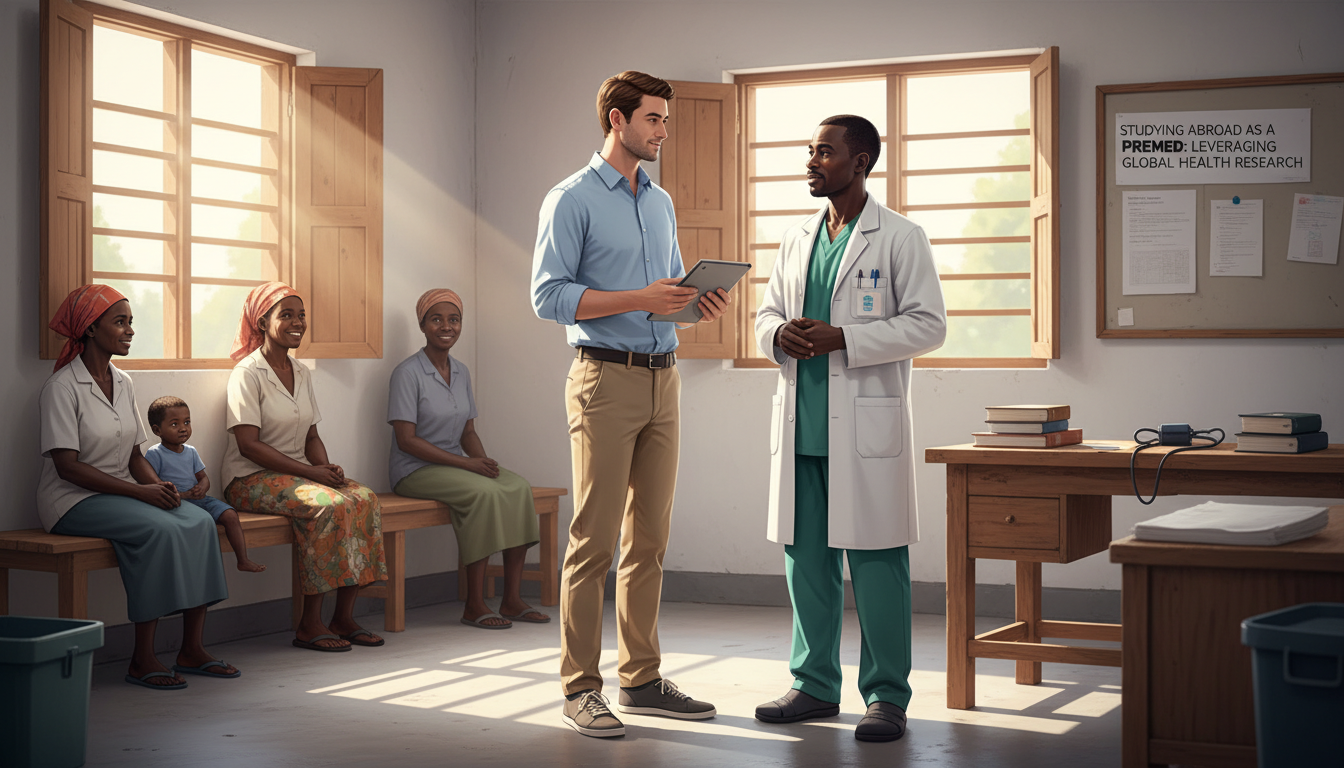
It’s March of your sophomore year. Your school just opened applications for summer and semester-abroad programs. Friends are talking about Barcelona and Sydney. You, however, keep staring at a flyer that says “Global Health Field Research – East Africa” and wondering:
“Will this actually help me get into medical school, or will adcoms think I just wanted cool travel photos?”
You like the idea of global health. You also know you’re supposed to be doing research. But you’re not sure how to put those pieces together so that this isn’t just a glorified vacation, but a serious, ethical global health research experience that carries real weight on your med school application.
If you’re in that spot, this is for you.
We’re going to walk through what to do before you apply, while you’re abroad, and after you get home so that studying abroad genuinely strengthens your premed profile—especially from a research in medicine perspective.
Step 1: Decide If Studying Abroad for Global Health Research Makes Sense For You
Before you click “apply,” you need to answer three blunt questions:
Can you afford the timing cost?
You’re competing with students who will use that same summer/semester for:- MCAT prep
- Scribing or CNA work
- Lab research at home institutions
- Shadowing and volunteering
If your GPA is shaky (say, <3.4 for MD aspirations or <3.2 for DO) or you have no consistent clinical experience yet, a research-heavy abroad program might not be the right move this year. Fix the foundation first.
What’s your research baseline now?
- No research at all? Studying abroad can be a strong first exposure if the program is legit.
- Some lab experience but no ownership or global focus? An abroad project can show growth and breadth.
- Already publishable work or sustained lab involvement? You’ll want to choose a program that offers serious, IRB-approved research—not just data entry.
Do you actually care about global health, or does it just sound cool?
It’s fine if your interest is new. But if you’re only attracted to “travel + medicine = vibes,” that will show later in your essays and interviews. Find at least one concrete issue you’re curious about, like:- Maternal health outcomes
- Infectious disease control
- Access to mental health care
- Impact of climate change on health
If, after those questions, you still feel drawn to global health research abroad, you’re in a good place to move forward.
Step 2: Choose Programs That Are Real Research, Not Medical Tourism
Not all “global health research” programs are created equal. Some are ethically solid, faculty-led, and integrated with local partners. Others are basically: “Let undergrads do things they’d never be allowed to do at home,” which is a huge red flag.
Here’s a practical filter you can use.
2.1 Non-negotiable features of a legit program
Look for:
Clear research goals and methods
The description should say what kind of research you’ll do:- Quantitative surveys
- Qualitative interviews or focus groups
- Chart reviews
- Implementation or health systems research
If it just says vague things like “engage with healthcare systems and collect data,” push for specifics.
Faculty supervision with real global health experience
You want a named faculty member who:- Has publications in global/public health or related fields
- Has existing partnerships in that region
- Is accessible to undergrads (office hours, pre-trip prep, post-trip debrief)
Ethical review and approvals
Ask:- “Is the research IRB-approved through our institution or a local institution?”
- “Who is the principal investigator (PI)?”
- “What is the role of local collaborators?”
If there’s no mention of IRB/ethics review or local partners, that’s a problem.
No promises of direct clinical care
As a premed, you should not be doing:- Diagnosing
- Prescribing
- Performing procedures
You can observe, help with logistics, data collection, education, and research. If a program sells you hands-on clinical work beyond your training, step away.
2.2 Questions to email the program director (copy-paste and tweak)
Email the director or coordinator with questions like:
- “What specific research projects are students typically involved in?”
- “How is authorship or acknowledgment handled if a manuscript is submitted with student contributions?”
- “What training in research ethics and local culture is provided prior to departure?”
- “How many hours per week are spent on research activities vs coursework vs cultural excursions?”
- “Can you share a recent example of a student’s project and how they used it in applications afterward?”
Good programs will answer clearly. If the answer feels like a sales pitch, not a direct response, be cautious.

Step 3: Structure Your Premed Timeline Around Study Abroad
Now you’ve identified a promising program. Before committing, fit it into your larger premed plan.
3.1 If you’re early premed (freshman/sophomore)
You have more flexibility. Studying abroad between sophomore and junior year often works well:
Use freshman year to:
- Stabilize GPA with foundational sciences
- Try some local volunteering or shadowing
- Join a research lab if possible
Then use summer after sophomore year for:
- Global health research abroad (4–8 weeks)
- Followed by continued remote work with the project in the fall
MCAT and heavy clinical experiences can still come later.
3.2 If you’re a junior or about to take the MCAT
You need to be more surgical.
Don’t drop a semester of core premed classes for study abroad unless:
- There’s a clear plan for completing requirements
- You’re not planning to apply right away (e.g., taking a gap year)
If you plan to take the MCAT:
- Avoid doing a heavy research-abroad program in the 3–4 months right before your exam.
- A shorter global health program the summer after junior year can pair well with MCAT taken in spring.
3.3 If you’re planning a gap year
This opens up prime real estate.
- You can:
- Study abroad for a semester or full year doing global health research
- Then spend the following year as a research assistant or coordinator on related work
On applications, this tells a clear story: you didn’t just travel; you built a trajectory in research in medicine.
Step 4: Make Your Time Abroad Count as “Real Research”
Once you’re in the program, how you behave and what you focus on will determine whether this becomes a bullet point or a central pillar of your application.
4.1 Before you leave: do your homework
Two to four weeks before departure:
Read 3–5 papers related to the project/region
At minimum:- One paper about the disease/issue you’re studying
- One paper about health systems or barriers in that specific country/region
- One methods paper on the technique you’ll be using (e.g., qualitative interviews, cross-sectional surveys)
Clarify your role with the PI
Ask:- “What specific piece of the project will I own or be primarily responsible for?”
- “What outputs are realistic for undergrads (poster, abstract, internal report)?”
- “How will we maintain contact after I return?”
You’re signaling that you’re not just there to show up and go along with the flow; you want to contribute in a defined way.
4.2 On the ground: track your work like you’re going to write about it later
While abroad:
Keep a research log (Google Doc, Notion, notebook):
- Dates and hours worked
- Specific tasks (e.g., “Conducted 5 structured interviews with community health workers,” “Cleaned and coded 60 survey responses,” “Helped pilot test mobile data collection app”)
- Observations that may matter later (“Clinic visits surge on market day because people are already in town”)
Ask for responsibility, not heroics:
- Offer to help design or revise survey questions
- Volunteer to help with preliminary data analysis under supervision
- Ask to contribute to debrief sessions with local partners
Protect ethical boundaries:
- If you’re asked to do something beyond your training (place IVs, interpret scans), say:
“I’m not qualified to do that independently, but I’d like to observe and learn if that’s acceptable.” - Respect consent, privacy, and local norms. This matters as much as the research itself.
- If you’re asked to do something beyond your training (place IVs, interpret scans), say:
4.3 After you return: turn experiences into outputs
Do not treat your flight home as the end of the project.
In the 3–6 months after returning:
Stay involved with the project remotely:
- Data cleaning
- Basic analysis
- Literature review
Aim for at least one of these:
- Abstract submission to a student research day at your university
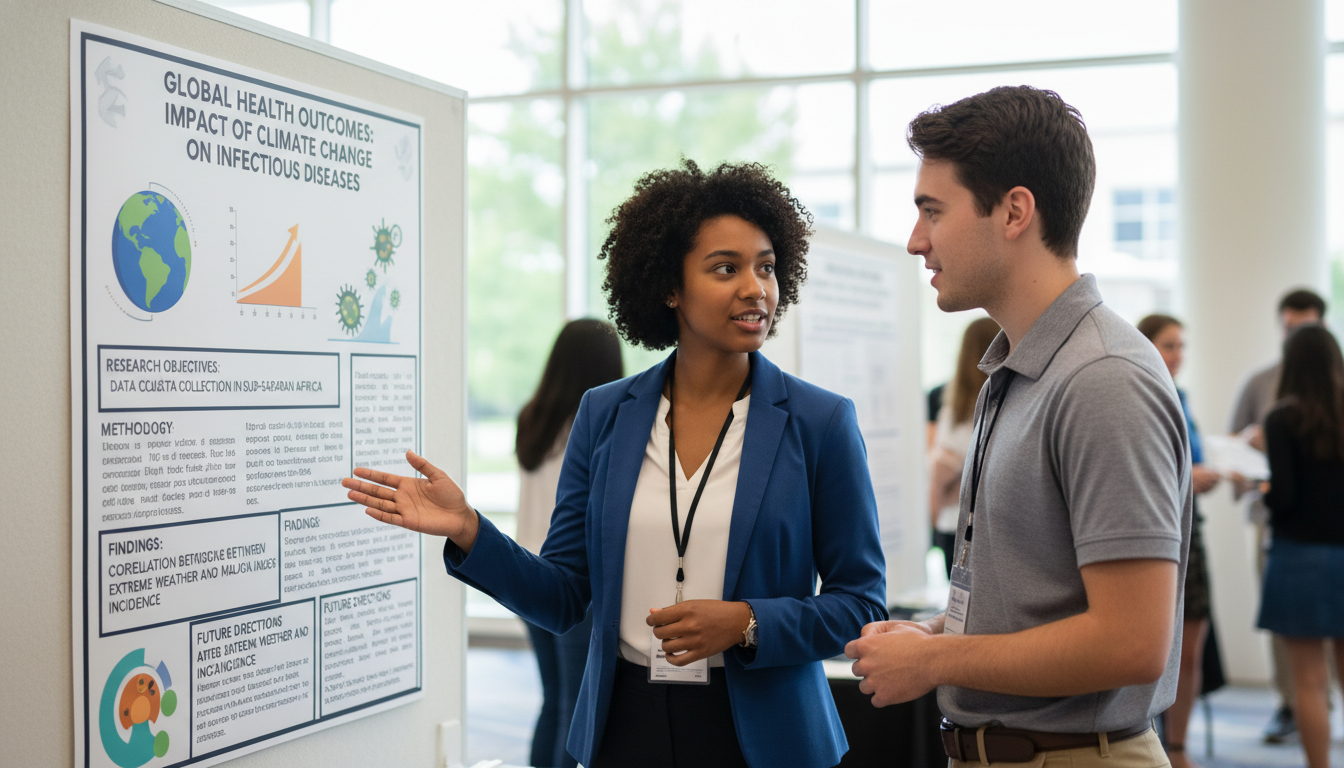
- Poster presentation at a regional conference (APHA, global health conferences, state public health meetings)
- Co-authorship on a paper, if timing and contributions align
Even if nothing gets published, showing continuity (not just a one-off 4-week stint) is what makes admissions committees see this as serious research experience.
Step 5: Translate Global Health Research into Application Gold
Med schools won’t see your plane tickets. They’ll see how you write and talk about the experience.
Here’s how to frame it strategically in AMCAS/AACOMAS, secondaries, and interviews.
5.1 On your primary application (AMCAS/AACOMAS)
You’ll likely list this in multiple sections:
Research Experience entry
Emphasize:- The research question: “Evaluated barriers to antenatal care utilization in rural clinics in [Country].”
- Your methods: “Administered structured surveys, participated in coding qualitative interview data, assisted in preliminary analysis.”
- Outputs: “Co-authored institutional poster,” “Contributed to draft manuscript,” etc.
Global/Community Service or Volunteering entry (if applicable)
If part of the program included health education or community partnership, list it as service too, being clear where the line is between research activities and service.Most Meaningful Experience
If this was formative, you can choose it as a Most Meaningful Experience. Focus on:- How it changed your understanding of health systems, inequity, or your role as a future physician
- Specific patient or provider interactions that crystallized that learning
- How it shaped your future plans (e.g., interest in primary care, infectious disease, health policy)
5.2 On secondaries about diversity, global health, or service
Common prompts this experience can address:
- “Describe a time you worked with a diverse population.”
- “Discuss an experience that exposed you to health disparities.”
- “How will you contribute to the diversity of our class?”
Key tips:
Don’t center yourself as the savior. Focus on:
- What you learned from local providers, community health workers, or patients
- How you recognized your own limitations and positionality as a visiting student
Show humility and respect:
- Avoid language like “primitive,” “third world,” or “backwards.”
- Use neutral, accurate language: “resource-limited,” “under-resourced,” “low-income setting.”
5.3 In interviews: the 90-second story you need ready
You should be able to answer, smoothly and concretely:
- “Tell me about your global health experience.”
- “What did you actually do day-to-day?”
- “How did this shape your interest in medicine?”
Structure your response:
Context (1–2 sentences):
“After my sophomore year, I spent 8 weeks in [Country] through a faculty-led global health research program focused on maternal health.”Your role (2–3 sentences):
“I helped administer surveys to pregnant patients at two rural clinics, then worked on cleaning and coding the data. I also joined weekly meetings with local midwives and our research team to discuss preliminary findings and adjust our survey instruments.”Insight and impact (2–3 sentences):
“It changed how I think about access—not just insurance, but transportation, cultural beliefs, and trust in the system. It also pushed me to get serious about research methods; I continued working on the project after returning and presented a poster at our university’s research day.”
You want to sound like someone who didn’t just travel, but who grew as a future physician and researcher.
Step 6: Avoid Common Pitfalls That Hurt Applicants
Several patterns trip up premeds who studied abroad for global health research. You can sidestep them if you know what to watch for.
6.1 The “exoticizing” trap
If everything you say could be summarized as “look how different and shocking everything was,” you’re in trouble.
Avoid:
- Overdramatic descriptions of poverty without reflection
- Photos or stories that feel like “poverty tourism”
- Framing the whole experience as “I went to help them,” rather than “I went to learn and collaborate”
Better framing:
- “Working alongside local nurses who managed high patient loads with limited resources showed me how much can be accomplished with systems thinking and community trust.”
6.2 The “just a tourist” problem
You don’t want adcoms to suspect you chose abroad research to dodge more rigorous experiences at home.
That happens when:
- You have only 1–2 short abroad experiences and almost no domestic clinical exposure
- You can’t articulate what you did in research terms (hypothesis, methods, results, limitations)
Solve it by:
Pairing global health abroad with:
- Ongoing clinical volunteering at home
- A local research experience (lab, public health, clinical) before or after
Describing your abroad work using the language of research in medicine:
- “Our primary outcome measure was…”
- “We used a cross-sectional design with convenience sampling…”
- “Limitations of our study included selection bias and language barriers…”
6.3 The “I did procedures abroad” ethical red flag
If you performed unsupervised clinical procedures or tasks far beyond your training, don’t brag about it.
Instead:
- Reflect honestly (if asked) that:
- You now recognize these are roles that should be filled by trained professionals
- You’ve since become more aware of ethical concerns in short-term global health work
- The experience pushed you to seek ethical, sustainable global health opportunities
Step 7: If You Can’t Go Abroad, Still Leverage Global Health Research
Maybe money, time, visas, or family responsibilities make studying abroad unrealistic. You can still build a global health research niche.
You can:
Join a global health research lab at your home institution that:
- Analyzes datasets from other countries
- Studies migrant/refugee health locally
- Looks at global disease trends using secondary data
Work on remote collaborations:
- Many PIs have overseas partnerships but do analysis Stateside
- You can contribute to literature reviews, data analysis, and manuscript prep
Take course-based global health research:
- Some schools have class-based projects (e.g., mapping TB incidence, evaluating vaccine campaigns in different countries)
- Treat those mini-projects with seriousness, and ask to expand them into independent research
Med schools care less about your passport stamps and more about your depth of understanding and sustained engagement with global health issues.
Concrete Next Step for Today
Open a blank document and create three headings:
- “My current research/clinical foundation”
- “What I specifically want from global health research”
- “Questions I must answer before choosing a study abroad program”
Spend 15–20 minutes filling these in honestly. Then draft an email to a trusted premed advisor or a global health faculty member sharing this document and asking: “Can we meet to talk through whether and how a study abroad global health research program fits into my premed plan?”
That one conversation can save you a lot of unfocused effort—and help turn an abroad opportunity into a strategically powerful step toward medical school.