
The standard premed research advice breaks down the moment you’re an international student aiming for a US MD.
1. Understand Your Real Constraints (So You Don’t Waste Years)
(See also: Working Full‑Time During Premed: Low‑Intensity Research Options for more details.)
If you’re an international undergraduate outside the US (or in the US on a visa), you do not have the same research access as a US citizen at a big R1 university. Pretending you do is how people lose 2–3 years wandering.
You’re dealing with some or all of these:
- No built-in premed advising or premed office
- Limited or no wet-lab infrastructure at your home university
- Visa/work restrictions if you’re in the US (F‑1, J‑1, etc.)
- Professors who don’t understand US med school expectations
- Time zone and distance barriers for US-based research
- Financial limits on unpaid or low-paid research experiences abroad
So first, calibrate your goals to your starting point:
Ask yourself:
Are you studying:
- Outside the US/Canada?
- In the US as an international on F‑1 or similar?
- In a country with limited research culture or funding?
What do you * already* have access to?
- Any professors publishing in PubMed-indexed journals?
- A statistics department, computer science lab, or engineering group?
- Any alumni from your school who matched to US residencies or went to US MD/DO?
What is your timeline?
- Applying straight from undergrad (aggressive and risky for internationals)
- Planning 1–2 gap years
- Open to doing a master’s or research year first
Once you’re honest about those three, the research strategy becomes about leverage, not perfection.
Your goal is not “do research like a Harvard premed.”
Your goal is: build a believable and traceable story that you can do and communicate research at a high level.
That requires three deliverables:
- Real, sustained involvement (≥ 6–12 months in at least one project or lab)
- Something concrete to point to (poster, presentation, abstract, paper, thesis, database, tool)
- Strong letters from research mentors who understand what US med schools need
Everything that follows is about engineering those three outcomes from your specific situation.
2. If You’re Abroad: Building a Research Base at a Non-US University
If you’re doing your undergrad in India, Nigeria, Brazil, Pakistan, Turkey, etc., you’re not doomed. But you cannot rely on random lab hunting and hope.
Step 1: Map Your Local Research Landscape
You need a quick but systematic scan:
Go to your university website → departments:
- Biology
- Biochemistry
- Public health / community medicine
- Computer science / data science
- Electrical/biomedical engineering
- Psychology or neuroscience
For each department:
- Identify faculty with recent PubMed-indexed publications
- Note anyone with:
- International collaborations (US, UK, Canada, EU)
- MD/PhD or training abroad
- Keywords like “clinical trial,” “systematic review,” “machine learning,” “epidemiology”
You’re not just looking for “prestige.” You’re looking for faculty who actually publish and understand the game.
If your school has almost nothing, expand:
- National research institutes nearby (e.g., ICMR labs in India, INSERM in France, MRC in UK, NIH equivalents)
- Teaching hospitals or academic hospitals that publish
- Regional universities with better research output where you could volunteer or do a project over summers
Step 2: Target the Right Type of Work for Your Situation
If your infrastructure is weak or labs are overfull, prioritize work that:
- Is analysis-heavy rather than equipment-heavy
- Can be done partly remote or with minimal lab access
- Leads more quickly to outputs
Good categories:
- Retrospective chart reviews at teaching hospitals
- Epidemiology / public health surveys
- Systematic reviews and meta-analyses
- Basic biostatistics projects using public datasets
- Small clinical outcomes projects under a physician mentor
Not ideal as your only research:
- Pure bench work where you mostly wash glassware for a year with no authorship
- Extremely long projects that realistically will not finish before you apply
- “Shadow research” where you’re never included in writing or analysis
Step 3: Email Strategy That Actually Works Abroad
Professors everywhere ignore generic “I am passionate about research” emails.
Use a tight structure:
Subject: Undergraduate student interested in [specific project area] – potential contribution
Email body (adapt to your situation):
Dear Dr. [Name],
My name is [Name], and I am a [year] undergraduate student in [major] at [University]. I’m very interested in [specific area, e.g., “diabetes outcomes in low-resource settings”], and I read your recent paper “[title]” in [journal].
I noticed that you used [method / dataset / approach]. I have basic experience in [list any skills: R, Python, Excel, survey design, literature review methods], and I am very motivated to learn more.
I’m writing to ask whether you might have any ongoing or upcoming projects where a student could help with [data cleaning, data extraction, literature screening, survey administration, basic analysis, etc.]. I’m able to commit approximately [X] hours per week for at least [6–12] months.
My long-term goal is to apply to US medical schools, which value sustained research and strong mentorship. I would be grateful for any opportunity to contribute meaningfully to your work and to learn how rigorous research is done.
I’ve attached my CV and an unofficial transcript for reference. I would be happy to meet at your convenience to discuss whether there might be a fit.
Sincerely,
[Name]
[Program, Year]
Send 10–20 of these, tailored. Follow up once after 10–14 days. Do not apologize for being interested. You’re offering committed labor.
Once you get in:
- Stay at least 9–12 months if possible
- Push (politely) to be part of drafting or revising the manuscript, not just data collection
- Ask early: “What would I need to do to be considered for authorship on this project?”
That single question signals seriousness and often changes your PI’s expectations of you.

3. If You’re in the US as an International Undergrad
You have better infrastructure, but new problems: visa limits, intense competition, and sometimes subtle bias (“we’ll invest in citizens who will stay”).
Step 1: Use Your University’s Built-in Systems Aggressively
Do all of these within your first year or as soon as you’re reading this:
- Sign up for:
- Office of Undergraduate Research mailing lists
- Any “research for credit” programs
- Honors thesis or capstone info sessions
- Search faculty profiles in:
- Biology, chemistry, neuroscience
- Public health, psychology
- Computer science (for ML/AI in health)
- Bioengineering
Flag labs that:
- Take undergrads regularly
- Have MD or MD/PhD faculty with hospital appointments
- Publish in clinical or translational journals
Step 2: Pick the Right Lab Type (for an International Aiming at MD)
You want at least one of:
Clinically adjacent lab
Example: Cardiology outcomes lab, oncology outcomes, health services research, neuroimaging of psychiatric disorders, health disparities researchData-heavy lab
Example: Biomedical informatics, EMR data, machine learning on health data, epidemiology
These are ideal for you because:
- Less visa friction (often can be done as “volunteer” for credit or experience)
- Easier to keep contributing remotely during summers or study abroad
- Projects can move to abstract/poster within 6–12 months if the PI is efficient
Wet lab is fine if you love it, but make sure:
- The lab actually publishes regularly
- Undergrads in that lab have prior posters or co-authored papers
- You’re not doing only maintenance tasks for years
Step 3: Ask Directly for the Experience You Need
After a few months in the lab, have a short, clear conversation:
“One of my long-term goals is to apply to US medical schools, and I know they value evidence of research productivity. Over the next year, I’d really like to work toward something concrete like a conference poster or abstract, even if it’s a small part of a bigger project. What would you recommend I focus on to make that possible?”
Strong PIs will respond with structure:
- “Work on this dataset”
- “Help with this analysis and we can aim for a poster”
If they instead say variations of “maybe in 3–4 years” or keep you at dishwashing level, quietly start finding a new lab while doing the minimum to exit gracefully.
4. Remote and “Portfolio” Research: When Local Options Are Weak
If your local environment is very constrained, or you want to stack your profile, remote and self-initiated projects can be powerful, if done correctly.
Option A: Remote Collaborations with US or European Labs
This is difficult but not impossible.
How to increase your odds:
Build one solid home base first. You will be taken more seriously if you can say, “I currently work with Dr. X on Y, and I’m looking to expand my exposure.”
Target:
- Assistant/associate professors at US institutions
- People publishing heavily but maybe not at top-5 institutions
- Labs doing:
- Systematic reviews
- Retrospective database analyses
- Public dataset work (e.g., NHANES, SEER, UK Biobank)
Email with a concrete proposal, not just “can I join”:
“I’ve completed [X] (e.g., a small retrospective study / a systematic review / basic R analysis course). I’m looking to support ongoing work remotely through [data extraction, coding, basic stats, literature review]. Would there be any part of your current projects where a motivated student could help under your supervision?”
Expect a lot of no’s. You’re aiming for 1 yes.
Option B: Structured Online Research Programs (Be Careful)
There are paid research mentorship programs that pair students with PIs or postdocs remotely. Some are reputable, some are predatory.
If you consider them:
- Check:
- Do mentors have real academic affiliations and PubMed track records?
- Are previous students on real posters/papers (search names on Google Scholar)?
- Is authorship clearly defined in writing?
Use this only as a supplement, not your only experience. Med schools often view paid “research experiences” with skepticism unless output is objectively strong.
Option C: Self-Directed Projects That Actually Count
Some self-initiated work can be taken seriously if done with rigor and supervision. For example:
- A systematic review with a clinician or faculty mentor as co-author
- A public dataset analysis (COVID data, WHO data, cancer registry data) with clear statistical methods and pre-specified plan
- An undergraduate thesis with a formal advisor and defense process
Non-ideal:
- You alone, “researching” by Googling and writing an essay
- Unsupervised “projects” that never get external review or feedback
You want external validation:
- Poster at a local or international conference
- Abstract accepted to a student research day
- Submission to an indexed journal (even if it’s a student journal or low-impact journal)
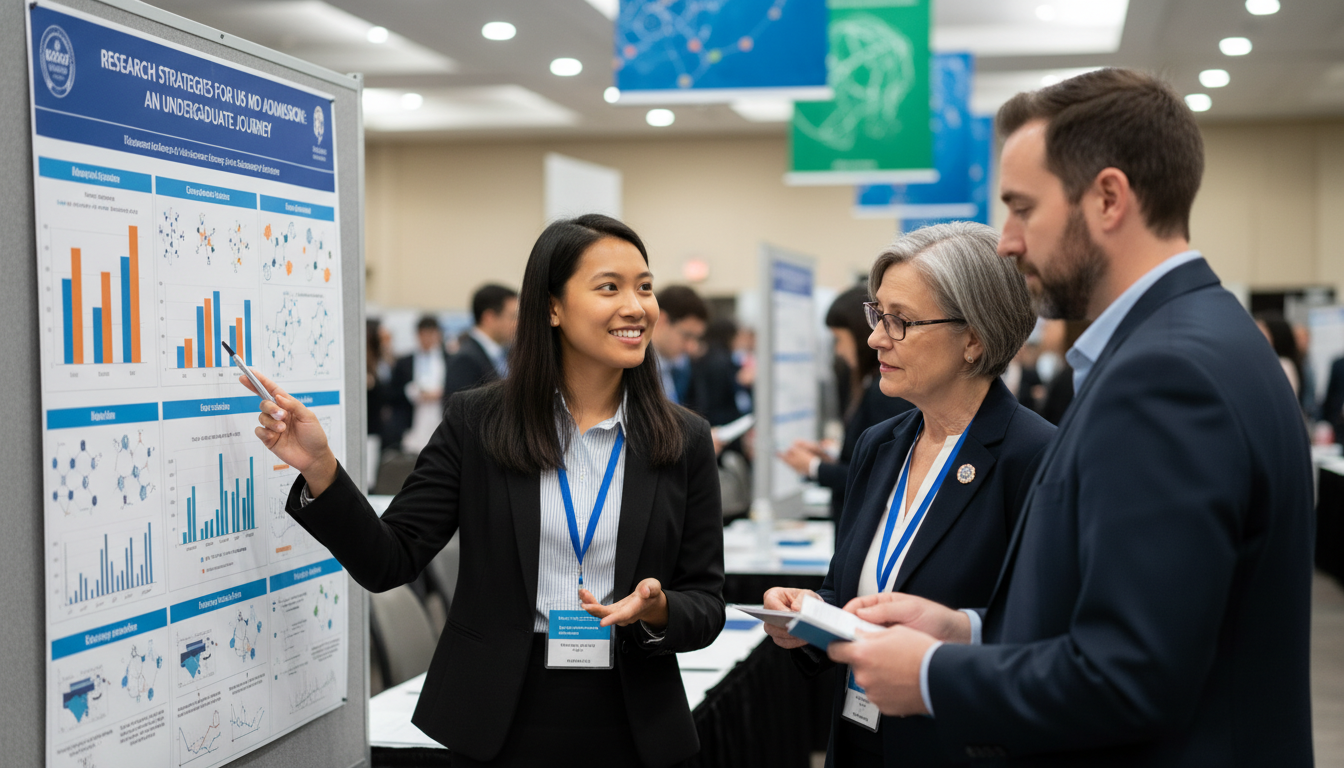
5. Making Your Research Matter for US MD Admissions
Many international applicants do research but fail to translate it effectively on their application.
Step 1: Depth Beats Random Activity
US MD committees would rather see:
- 1–2 multi-year projects
- With:
- Clear roles
- Evolving responsibility
- Output (poster/paper/thesis)
Than:
- 8 random short-term “research” experiences that look like you tried everything but committed to nothing.
As an international, you must fight the stereotype that you’re “checking boxes.” Depth is your counterargument.
Step 2: Build at Least One “Flagship” Project
Your flagship project is the one you talk about in:
- Your primary “most meaningful” experience description (AMCAS)
- Secondaries when asked about research
- Interviews when they say, “Tell me about a project you worked on”
For that one project, you should be able to answer:
- What was the research question, and why did it matter?
- What was the study design (cohort, case-control, RCT, systematic review, etc.)?
- What was your role, specifically?
- What were the main findings?
- What would be the next step or follow-up study?
Practice this as a 2–3 minute narrative. Not a monologue, but a tight, clear story.
Step 3: Secure Letters That Translate Across Borders
If your main research is outside the US, med schools will rely heavily on how credible your letter writers sound.
You want at least one letter from:
- A supervisor who:
- Has an MD, PhD, or equivalent
- Has a publication record
- Can credibly evaluate your academic and research potential
Help your letter writer by providing:
- Your CV
- A short paragraph on your US MD goals
- A bullet list of:
- Projects you worked on
- Skills you used (e.g., R, SPSS, Python, REDCap, literature search, consent procedures)
- Any output (abstracts, thesis, ongoing manuscripts)
You can say:
“US medical schools place significant weight on letters that comment on research thinking, independence, and potential to succeed in a rigorous academic environment. It would be extremely helpful if you could address these aspects where you feel it’s appropriate.”
For US-based research mentors, this will feel normal. For non-US mentors, you’re giving them a roadmap.
6. Strategic Timing: Research vs MCAT vs Everything Else
You do not need to finish a first-author paper before you submit your AMCAS.
You do need to show:
- Ongoing projects at time of application
- At least some tangible progress (submitted abstract, presented poster, manuscript in preparation with a clear role)
If you’re 12–18 months before planned application:
- Lock in at least one serious research role
- Define with your PI what you can reasonably finish in that time
- Time your MCAT prep so you’re not starting new research projects during your heaviest study period
If your research life is chaotic and your MCAT tanks, you’ve hurt your chances more than a missing publication ever would.
7. Putting It All Together: Sample Paths
Scenario A: Student in India at a Non-Research-Heavy College
Year 1–2:
- Map local universities and teaching hospitals
- Cold email 15–20 faculty doing any clinical or public health research
- Land a spot helping with a retrospective chart review in internal medicine
- Learn basic Excel and then R or SPSS
Year 3:
- Take on a more defined subproject (e.g., outcomes in a specific disease subgroup)
- Present at a local or national conference
- Start a systematic review with your mentor on a related question
Year 4:
- Write senior thesis on your retrospective project
- Submit the systematic review to a journal (even if R&R at time of application)
- Secure detailed letter from your mentor emphasizing your analytic skills, initiative, and reliability
Result: 2–3 solid experiences, one flagship project, at least one tangible academic output. That’s usable for US MD.
Scenario B: International on F‑1 at a Mid-Tier US University
Year 1:
- Join a clinically adjacent outcomes research lab
- Volunteer 5–8 hours/week, start with data cleaning and chart review
Year 2:
- Take on an independent question within the lab’s dataset
- Present a poster at university research day
- Learn basic stats in R or Stata
Year 3:
- Co-author a manuscript (even as middle author)
- Start honors thesis based on your lab work
- TA for a stats or research methods course if allowed
Year 4:
- Finish thesis, present again
- Ask PI for a detailed letter focusing on your growth, independence, and communication skills
- Apply with “manuscript in preparation” or “submitted”
Result: Clear trajectory, US-based letters, multiple outputs, and sustained commitment.
FAQ (Exactly 3 Questions)
1. Do I absolutely need a publication to get into a US MD program as an international?
No. A publication helps, but it’s not mandatory. Many successful international applicants have strong, sustained research with posters, theses, or in-progress manuscripts instead of finished publications. What matters more is: depth of involvement, clear understanding of your project, and strong letters. A shallow first-author paper in a questionable journal will not rescue a weak profile.
2. Will doing research in a non-US country count less for US medical schools?
Not automatically. Committees know that research ecosystems differ globally. If your work is rigorous, sustained, and well-supervised—and if your mentor can credibly attest to your abilities—it can be just as valuable. You may face more questions about methods and rigor in interviews, so you must know your study inside out. Having at least one US-based or internationally recognized collaboration strengthens the impression, but it’s not essential.
3. How should I list research that hasn’t produced a paper or poster yet?
You still list it on AMCAS as an experience, clearly describing your role, skills, and progress. Be honest about the stage: “data collection ongoing,” “analysis in progress,” or “manuscript in preparation.” Then emphasize concrete tasks you’ve done: managing a REDCap database, performing regression analysis, conducting structured interviews, writing the methods section draft. Vague descriptions (“helped with research”) sound weak; specific process-focused details sound credible.
Key points to remember:
- As an international aiming for US MD, design your research path around leverage, not imitation of US citizens at elite schools.
- Depth, clarity of role, and strong letters will matter more than chasing a perfect publication record.
- One flagship, well-understood project with clear output is far more powerful than a scattered list of minor, short-term “research” activities.