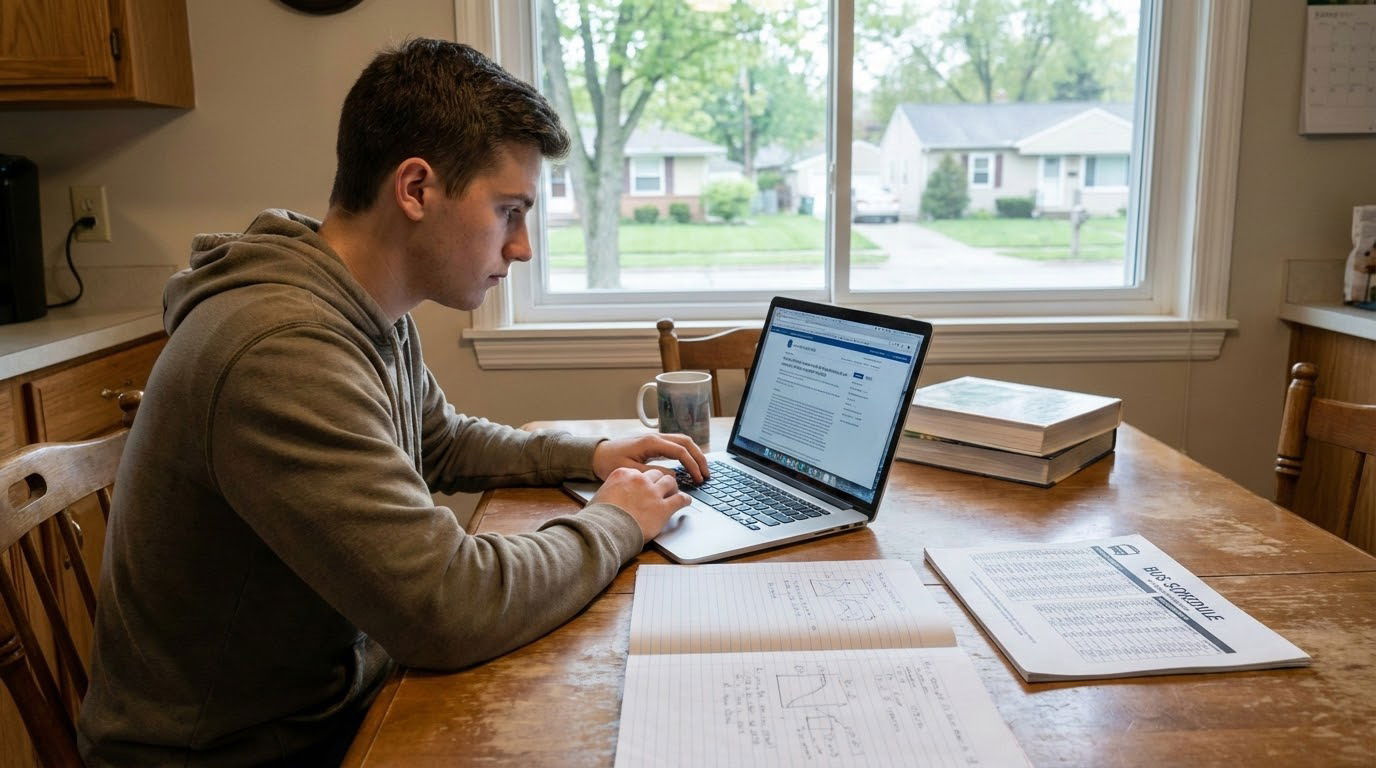
The biggest myth about premed research is that you must live next to a big hospital to have a real shot. You do not.
If you're a commuter student with no nearby hospital, you are not doomed—you just have to play a different game.
(See also: Working Full‑Time During Premed: Low‑Intensity Research Options for more details.)
This is the situation: you live at home, you commute to a college that might not be attached to a medical center, you don't have a car or you live in an area where the nearest hospital is 45 minutes away, and every premed around you won't shut up about their “clinical research at Big Academic Hospital.”
You feel behind. Maybe trapped. Maybe angry.
Good. Use that. But then stop spiraling and start strategizing.
Here is exactly how to find meaningful, defensible research experiences when geography is against you.
Step 1: Get Very Clear on What “Counts” as Research
Most commuter students under-pressure themselves here by thinking way too narrowly.
Medical schools broadly accept any systematic attempt to answer a question as research, as long as you can describe:
- a question or hypothesis
- a method
- your role
- what you learned or produced
That means:
- Bench/lab work (classic pipettes, gels, cell culture)
- Clinical research (chart review, survey studies, QI projects)
- Public health research (community surveys, epidemiology)
- Social science research (education, psychology, sociology related to health)
- Data analysis projects (database work, bioinformatics, stats projects)
- Remote/literature-based projects (systematic reviews, meta-analyses, scoping reviews, structured narrative reviews)
You do not need:
- an MD/PhD supervisor at an elite hospital
- published papers (nice, not mandatory)
- to physically be inside a hospital to do clinically relevant work
Your constraint is not “no hospital.” Your constraint is limited physical proximity. That shifts your strategy:
- Heavier use of remote work
- More flexible supervisors (often PhD or MPH)
- More data- and literature-based projects instead of wet lab
Once you accept that, doors appear that you were not even looking for.
Step 2: Squeeze Your Own Campus for Every Drop of Research
Most commuter students underestimate how much is hiding right under their noses.
2.1. Audit Your Campus for All Possible Research Channels
Make a one-page map of potential opportunities at your college:
Check:
- Department websites (biology, chemistry, psychology, sociology, public health, math/stats, computer science)
- Faculty profiles (look for “research interests,” “publications,” “ongoing projects”)
- Your school’s:
- Office of Undergraduate Research
- Honors college
- Pre-health advising office
- Career center postings
Look for faculty whose work intersects anything even loosely health-related:
- Psychology: anxiety, addiction, sleep, behavior change
- Sociology: health disparities, immigration, poverty
- Computer science: machine learning, natural language processing for medical texts, data science
- Math/Stats: biostatistics, modeling, survey design
- Biology: genetics, microbiology, neuroscience
You’re not hunting for perfect medical research. You’re hunting for a serious research mentor who:
- publishes
- has active projects
- has a track record of working with undergrads
If your school has anyone doing human- or health-related work, they’re your starting point.
2.2. How to Reach Out as a Commuter With Constraints
Your email has to be honest and specific. For example:
Subject: Undergraduate student interested in remote/commuter-friendly research
Dear Dr. [Name],
My name is [Name], and I’m a [year] majoring in [major] and commuting from [area]. I’m very interested in getting involved in research related to [their topic: e.g., behavior change and sleep].
I live off campus and don’t have easy access to a laboratory setting, but I can reliably commit [X] hours per week to data entry, literature review, data analysis, or other tasks that can be done remotely or in your office during set times.
I’ve attached my resume and a brief paragraph about my background and interests. If you have any ongoing projects where a motivated student could help, I would be grateful for the opportunity to learn from your team.
Thank you for your time and consideration,
[Name]
[Email]
[Phone]
You’re not pretending you can be on campus 40 hours a week. You’re presenting yourself as reliable within realistic limits.
Once someone bites, clarify logistics right away:
- Days you’re typically on campus
- Times you’re free before/after classes
- Ability to work nights/weekends from home on remote tasks
A mentor can work around your commuter reality if they understand it and like your initiative.
Step 3: Use Remote and Hybrid Research to Your Advantage
No hospital nearby actually pushes you toward areas that are exploding right now: data-driven and remote-collaboration research.
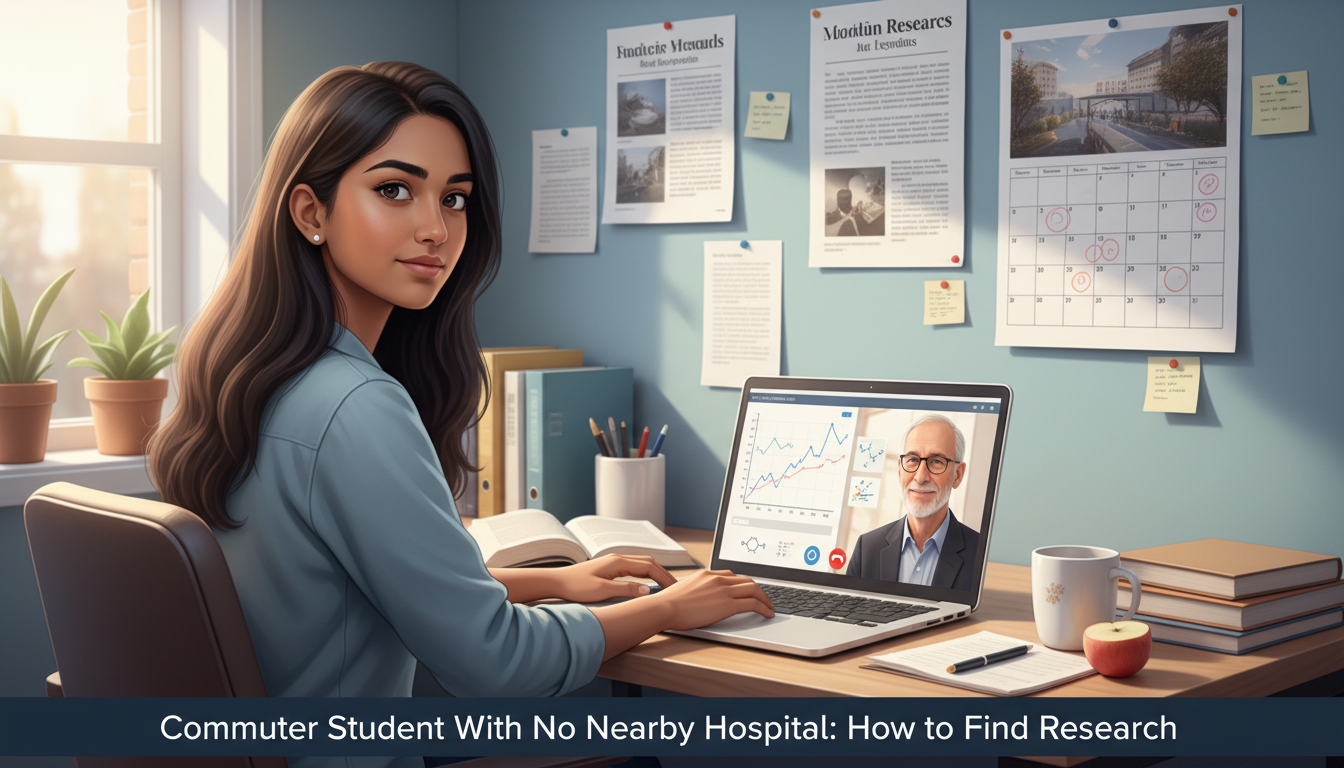
3.1. National and Remote Research Programs You Can Join from Anywhere
Look for:
- Multi-institutional collaborative groups that accept remote undergrads
- Public health or education research networks
- Faculty at other institutions who are open to remote assistants
Places to search:
- Twitter/X and LinkedIn: search “undergraduate research assistant,” “remote research assistant,” “medical student research,” “pre-med research opportunity”
- University department pages at big-name institutions—many list “open positions” including remote data/lit review help
- Nonprofit organizations working in health policy, global health, or public health often have:
- survey projects
- report-writing
- data collection via public databases
Your message to an external mentor needs to be sharper:
Dear Dr. [Name],
I’m an undergraduate premed student at [College], commuting from [City] with limited access to a local hospital system. I’ve become particularly interested in [their topic: e.g., health policy and Medicaid expansion].
I noticed your work on [specific paper or project]. I’d like to ask if you ever work with remote undergraduate assistants for tasks like data extraction, literature review, or basic data analysis.
I can commit [X] hours/week consistently for at least [Y] months. I’ve attached my resume and a short paragraph on my background and skills (including [any relevant skill: R, Excel, SPSS, literature review experience]).
If there’s any possibility of contributing to your work in a small way, I’d be eager to learn more.
Sincerely,
[Name]
You might need to send 20–30 of these. That’s normal. You only need one yes.
3.2. Types of Remote-Friendly Research You Should Actively Seek
These are your best bets as a commuter:
- Chart review projects (if you can get institutional access through a remote appointment)
- Survey-based studies (online data collection and analysis)
- Systematic or scoping reviews
- Meta-analyses
- Database-based projects using:
- SEER
- NHANES
- CDC databases
- Open-source EHR datasets
If your mentor says, “We need someone to screen abstracts, extract data, and help organize references,” that’s a yes. You can talk about this in applications just as convincingly as bench work.
Step 4: Turn Class Projects Into Real Research (Strategically)
You’re already doing work for grades. Some of it can be upgraded into research if you’re deliberate.
4.1. Identify “Upgrade-able” Courses
Classes that often produce research-worthy projects:
- Research methods (psych, sociology, public health)
- Statistics / biostatistics
- Capstone seminars
- Honors thesis courses
- Independent study credits
What to do:
At the start of the semester, tell the professor:
- You’re premed
- You have limited hospital access
- You really want to turn your project into something that could be poster-level
Ask:
- “Are there ways to structure my project so it could be presentable at a local or regional conference?”
- “Could I continue working on this with you for credit or as an independent study?”
Choose topics with:
- Clear, focused questions
- Feasible data collection (online surveys, existing datasets, archival data)
- Real-world health relevance
Example: In a stats class, instead of a generic project on “study habits,” you design a project on:
“Association between perceived sleep quality and GPA among commuter vs. non-commuter students at [Your College].”
You gather data via an online survey, clean it, analyze it properly, and with your professor’s help, submit a poster to:
- Your college’s research day
- A regional undergraduate research conference
- A discipline-specific meeting (APA for psych, APHA for public health, etc.)
That becomes real research experience.
Step 5: If There’s No Hospital, Build the Clinical Angle Yourself
You don’t have to step inside a hospital to do clinically relevant work. You just have to anchor your questions to patients, healthcare systems, or health outcomes.
5.1. Partner with Community Organizations
Look around your area for:
- Free clinics or FQHCs (federally qualified health centers)
- Community health centers
- Mental health nonprofits
- Substance use recovery programs
- Homeless shelters
- Faith-based health outreach programs
Your angle:
“Could we systematically look at a question your organization cares about, collect data, and analyze it to improve services?”
Examples:
- Tracking no-show rates and reasons for missed appointments
- Surveying clients about barriers to medication adherence
- Evaluating the impact of a new education session or text reminder system
- Measuring changes in health knowledge before vs. after an intervention
You then bring this project back to a campus or remote mentor for:
- study design help
- IRB guidance
- data analysis support
- poster-writing mentorship
This is powerful on an application because it is not just research—it’s service, systems thinking, and initiative.
5.2. Quality Improvement (QI) Without a Big Academic Center
QI projects are research-adjacent and often easier to get approved and implemented. Even small clinics or community groups can do QI.
A basic QI cycle (PDSA: plan–do–study–act) can be:
- Plan: Identify a problem (high no-show rates for diabetes group visits)
- Do: Implement a low-cost intervention (reminder calls or texts)
- Study: Track attendance before vs. after for 3 months
- Act: Decide whether to keep or modify the intervention
You keep logs, design forms, help analyze the numbers. Then you help write it up as a:
- Poster for a primary care or public health conference
- Internal report for the clinic
- Undergraduate research presentation
You talk about this in interviews as: “I led a small quality improvement project at a community clinic…”
That sounds very different from “I had no hospital so I couldn’t do anything.”
Step 6: Summer = Your Window for In-Person Labs and Hospitals
Your commuter reality during the year doesn’t have to define your summers. Those 8–10 weeks are a totally different game.
6.1. Look for Funded or Housing-Provided Summer Programs
Programs that often help with housing or stipends:
- NIH summer internships
- NSF REUs (Research Experiences for Undergraduates)
- AAMC Summer Undergraduate Research Programs (SURPs) at med schools
- Public health summer programs (CDC, state health departments, schools of public health)
These are competitive, but your story is compelling:
- You’re a commuter
- You didn’t have access to a hospital during the year
- You still managed to do X, Y, Z research tasks
- You’re hungry for immersive lab or clinical exposure
Even one such summer experience can “balance” your portfolio in the eyes of admissions committees.
6.2. Local-ish Options If You Can Commute Further in the Summer
When classes are out, you might be able to:
- Take a longer bus/train ride
- Borrow a family car
- Work 2–3 long days per week instead of short daily shifts
Tell potential mentors explicitly:
“During the summer, I can be onsite 2–3 full days a week and make a longer commute work. During the academic year, I’d shift to mostly remote tasks plus occasional in-person meetings.”
That kind of hybrid plan is appealing to mentors who want continuity beyond just one summer.
Step 7: Packaging Your Story So It Sounds Strategic, Not Deficient
You might do all this work and still worry: “Will med schools look down on this because I didn't have a hospital?”
They will not—if you frame it correctly.
You want to be able to say:
“Because I lived at home and commuted to a campus without an attached hospital, I had to be strategic about research. I focused on remote-friendly projects and community-based work. I learned to design surveys, extract data, collaborate over Zoom, and present findings at [conference]. These constraints forced me to become resourceful rather than just plugging into an existing pipeline.”
Focus on:
- Skills: literature review, data management, basic stats, presenting
- Outcomes: posters, abstracts, reports, even small internal presentations
- Growth: how you learned to ask better questions, interpret data, see limitations
When you own your constraints and show how you worked through them, you don’t sound like a victim of circumstance. You sound like a problem-solver.
Concrete 90-Day Action Plan for a Commuter With No Hospital
If you want something you can actually follow, here’s a tight 3-month plan.
Weeks 1–2: Recon and Outreach
- Identify 10–20 faculty on your campus with research interests remotely related to health or human behavior.
- Send personalized emails to at least 10 of them.
- Simultaneously identify and email 10–20 external faculty whose work you genuinely find interesting and who might accept a remote assistant.
Goal: 2–3 conversations, 1 committed project.
Weeks 3–4: Lock in One Main Project
- Meet with interested faculty. Be direct: “I can commit X hours per week; I'm especially interested in doing work that could eventually lead to a poster or manuscript.”
- Choose the project with:
- The clearest timeline
- The most structured supervision
- The possibility of concrete output in 6–12 months
Weeks 5–8: Build Skill and Deliver Value
- Ask your mentor what tools they use (EndNote, Zotero, Excel, SPSS, R, REDCap).
- Spend 1–2 hours/week outside of project time learning those tools via tutorials.
- Take on unglamorous but critical tasks: reference management, data cleaning, organizing survey responses.
You’re making yourself indispensable.
Weeks 9–12: Push Toward Output
- Ask: “What are realistic goals for what we could present or write up together in the next 6–12 months?”
- Volunteer to:
- Draft methods sections
- Create tables/figures
- Prepare a poster draft
- Submit an abstract to your school’s research day
By the end of 90 days, you want to be embedded in one project and able to answer, in detail, “Tell me about your research” if someone asked you tomorrow.
FAQs
1. Is it better to do non-medical research on my campus or wait until I can get “real” medical research at a hospital?
Do the non-medical research now. A year of serious psychology, sociology, or data science research is far more valuable than a hypothetical hospital project that might never materialize. Medical schools care that you understand how research works: generating questions, using methods, analyzing data, understanding limitations. You can learn all of that in non-medical settings. Later, if you add even one summer or short-term clinically oriented project, your profile looks strong and well-rounded.
2. How many hours per week of research do I need for it to “count” on an application?
There’s no magic number, but aim for 5–10 hours/week during active periods, sustained over 6–12 months. It is better to have one long-term, continuous commitment where your responsibilities grow than three short 4-week experiences where you mostly watched. As a commuter, it’s completely acceptable to do something like 5–7 hours/week remote plus 2–3 hours in-person when possible. Focus more on continuity and outcomes (poster, abstract, clear role) than raw hour counts.
3. What if I’ve already reached junior year and still have no research—am I too late?
You’re not too late, but you need to be decisive. It’s realistic to start research in junior year and still have something meaningful to put on your med school application if you:
- Start now, not “after this busy week,”
- Prioritize one project over trying to dabble in many, and
- Consider delaying your application by a year if you want time to see a project through to a poster or publication.
Plenty of strong applicants take an extra year precisely to solidify research and clinical experiences. That’s not a failure; it’s a strategic timeline choice.
You may not live next to a gleaming academic hospital. That’s fine. You’re learning to build a research path under constraints, and that skill will serve you for the rest of your career.
Once you’ve carved out one solid project and maybe navigated your first abstract or poster, you’ll be ready for the next challenge: leveraging those experiences into strong letters of recommendation and compelling application stories. But that’s a problem for the next phase of your journey.