Why Research During Residency Matters for Caribbean IMGs in Family Medicine
As a Caribbean IMG in a family medicine residency—or planning to apply—you may wonder how much “research” really matters in a broad, outpatient-focused specialty. After all, family medicine is often seen as clinic- and community-centered, not research-heavy like cardiology or oncology.
For a Caribbean medical school graduate, research during residency can be a strategic differentiator that:
- Strengthens your CV for fellowships (sports medicine, geriatrics, palliative, addiction, academic medicine)
- Enhances your credibility if you trained at SGU, AUC, Ross, Saba, or another Caribbean school
- Offsets concerns about board scores or school reputation
- Prepares you for an academic residency track or faculty role
- Helps you stand out for leadership roles in quality improvement (QI), population health, and practice transformation
Whether you’re still in a Caribbean medical school thinking ahead about residency, or you just started your intern year in a family medicine residency, you can build a meaningful research and scholarship portfolio—even in a busy FM schedule and even if your program is community-based rather than large and academic.
This guide breaks down exactly how.
Understanding “Research” in Family Medicine Residency
Family medicine research looks different from bench science or large RCTs. As a Caribbean IMG, it’s crucial to understand the types of scholarly work that are realistic and valued in FM.
1. Clinical Research
Clinical family medicine research often focuses on:
- Chronic disease management (diabetes, hypertension, COPD)
- Preventive care (screening, immunizations, lifestyle interventions)
- Mental health in primary care
- Women’s health and reproductive care
- Geriatrics and multimorbidity
- Substance use disorders and MAT (medication-assisted treatment)
Examples:
- Retrospective chart review comparing blood pressure control before vs. after implementing a new hypertension protocol
- Study on depression screening outcomes in a primary care population
2. Quality Improvement (QI) and Practice-based Research
In family medicine, QI projects are often the most accessible and impactful scholarly work, particularly for Caribbean IMGs at community hospitals.
Common QI themes:
- Improving diabetic A1c control
- Increasing colorectal or cervical cancer screening rates
- Reducing unnecessary antibiotic prescribing
- Increasing vaccination rates (flu, COVID-19, pneumococcal, HPV)
- Improving follow-up after hospital discharge
These projects can often be:
- Completed within 6–12 months
- Turned into posters or presentations
- Converted into short papers or “brief reports” for publication
3. Population Health and Community-based Research
Family medicine is deeply tied to community health. Research may involve:
- Social determinants of health (housing, food insecurity, transportation)
- Community partnership projects
- Outreach clinics and free clinics
- Health education interventions for specific populations (e.g., Spanish-speaking diabetics, refugee populations)
4. Educational Research
If you’re drawn to teaching or an academic residency track, consider education-focused projects, such as:
- Evaluating a new curriculum for residents
- Studying outcomes of a new OSCE or simulation in outpatient care
- Improving feedback systems or mentorship models
5. Scholarship Beyond Classic “Research”
Residency programs, credentialing committees, and fellowship directors recognize a broad definition of “scholarly activity.” This is important if you are coming from a Caribbean medical school and may not have extensive pre-residency research.
Valued forms of scholarship include:
- Case reports and case series
- Clinical images and “image in medicine” articles
- Narrative reviews or practice updates
- Clinical guidelines or care pathways developed locally
- Posters at regional or national conferences
- Grand rounds or CME-quality presentations
For a Caribbean IMG, each of these is an opportunity to demonstrate academic engagement and counter any implicit bias related to where you trained.

How Research Helps Caribbean IMGs Before and After the FM Match
You may already be in a Caribbean medical school thinking about your residency application strategy. Or you may have already achieved an SGU residency match (or from another Caribbean school) in family medicine and are now thinking ahead to your career.
In both phases—pre-match and post-match—research plays a key role.
Before the FM Match: Strengthening Your Application as a Caribbean IMG
When applying for a family medicine residency from a Caribbean medical school, you can use research and scholarly work to:
Offset perceived weaknesses
- If your Step scores are average or you have a gap year, research signals productivity and resilience.
- Being able to list posters, abstracts, or manuscripts gives programs tangible evidence that you can contribute academically.
Target academic-leaning programs
- Programs with an academic residency track often favor applicants who have at least some scholarly experience.
- Even small projects (case reports, QI posters) from your Caribbean med school or early electives can help.
Show long-term commitment
- If your CV shows progressive engagement—from research in Caribbean medical school to efforts during clinical rotations—you appear focused and intentional.
After the FM Match: Maximizing Residency Years for Long-term Goals
Once you’ve matched—whether it’s an SGU residency match or another Caribbean medical school residency outcome—your approach changes from “getting in” to positioning yourself for the next step.
Research during residency can:
- Support applications to fellowships:
- Sports medicine
- Geriatrics
- Palliative care
- Addiction medicine
- Behavioral medicine
- Obstetrics/women’s health
- Open doors in academic medicine:
- Chief resident positions
- Junior faculty roles
- Academic career development tracks
- Improve your job marketability:
- Group practices looking for a “quality champion”
- FQHCs / community health centers seeking leaders in population health
- Hospital-owned practices needing physicians for QI committees
If you are a Caribbean IMG, these achievements can reassure employers or committees who may have limited familiarity with Caribbean schools and might initially prioritize US grads.
Getting Started: First 6–12 Months of Family Medicine Residency
The first year of family medicine residency is intense: inpatient rotations, night float, clinics, EMR learning, and adapting to the US health system. Still, if you approach research strategically, you can lay a foundation without burning out.
Step 1: Clarify Your Goals
Ask yourself:
- Why do I want to do research during residency?
- To strengthen my CV for fellowship
- To prepare for an academic residency track
- To improve patient care in my clinic
- To maintain a scholarly identity after Caribbean medical school
- How many projects can I realistically handle?
- 1 major QI project
- 1–2 smaller case reports or posters
Write down your priorities. For a Caribbean IMG in FM, focus on depth and completion over quantity.
Step 2: Map Your Program’s Research Landscape
Early in PGY-1:
- Identify faculty with research or QI experience:
- Ask chief residents who is “research-friendly”
- Look at your program’s website for faculty CVs or bios
- Understand program requirements:
- Many family medicine residencies require at least one QI or scholarly project
- Some have a built-in curriculum or protected time
- Learn about institutional resources:
- Office of research or scholarly activity
- Biostatistician or QI specialist
- Medical librarian who helps with literature searches
As a Caribbean IMG, don’t assume smaller or community-based programs lack research. They often have practice-based projects waiting for a motivated resident.
Step 3: Start Small and Strategic
Begin with projects that:
- Have clear timelines (6–12 months)
- Use existing data (EMR chart reviews, clinic reports)
- Directly relate to your daily work (e.g., diabetes control in your continuity clinic)
Good “starter” projects for PGY-1:
- A case report on an unusual presentation seen on inpatient or clinic rotation
- A QI project on improving hypertension follow-up scheduling
- A brief literature review and presentation for resident conference (which can later be turned into a manuscript)
Step 4: Find a Mentor (or Two)
A strong mentor is especially crucial for Caribbean IMGs, who may need additional networking support.
Look for someone who:
- Has a track record of publications or QI outcomes
- Responds reliably to emails and feedback requests
- Understands your background as an IMG and your time constraints
- Is willing to involve you in pre-existing or ongoing projects
If your program is small:
- Seek co-mentors: one FM faculty member + one specialist (e.g., endocrinologist for diabetes project)
- Ask your program director to connect you with faculty at affiliated academic centers
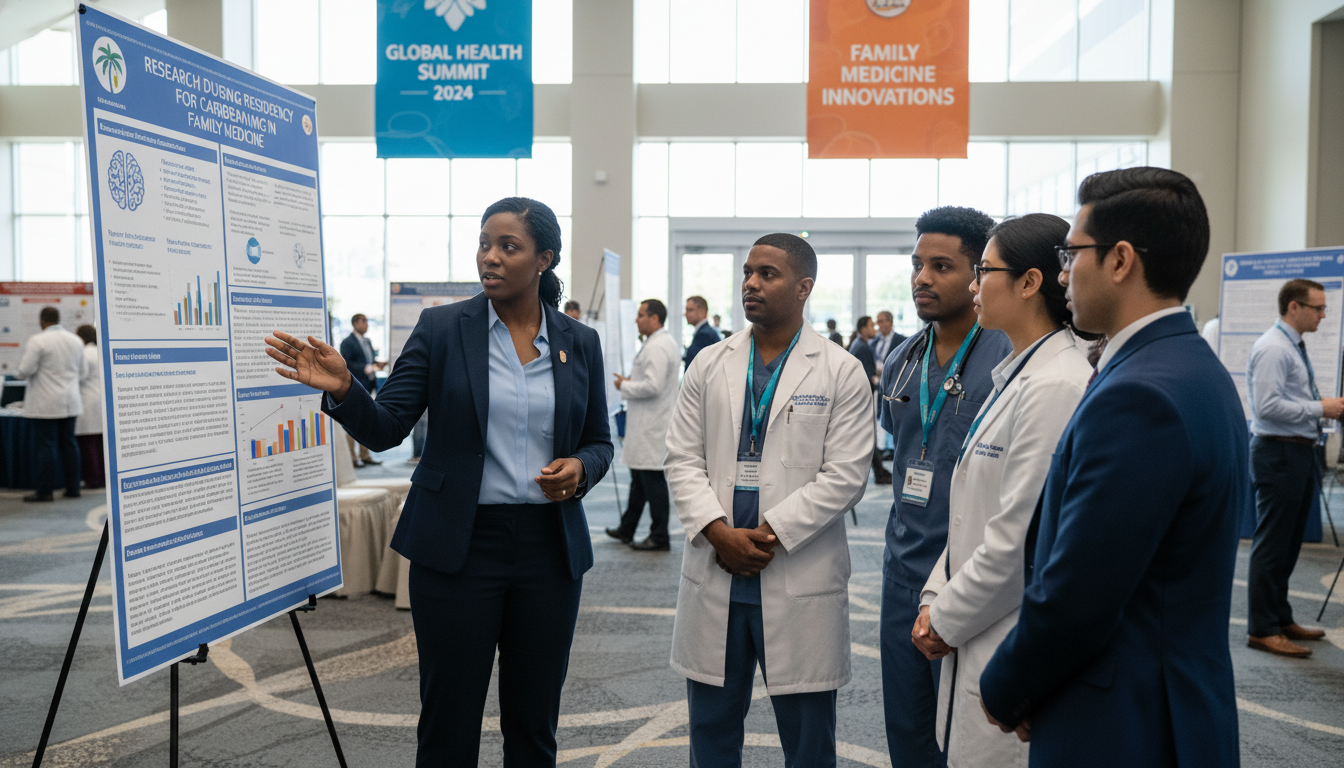
Practical Project Ideas: Resident Research That Fits a Busy FM Schedule
Below are realistic resident research projects specifically suited to family medicine and to residents from Caribbean medical schools, including those in community-based programs.
1. Diabetes Care Improvement in a Residency Clinic
Type: QI / practice-based research
Why it’s strong for FM & IMGs:
- High prevalence condition
- Clear metrics (A1c, blood pressure, statin use, ACE/ARB use)
- Data usually accessible through EMR
Possible project:
- Aim: Increase the percentage of patients with diabetes who have an A1c < 8% from 50% to 65% in 12 months.
- Interventions:
- EMR reminders for A1c orders
- Nurse-led diabetes education sessions
- Group visits or telehealth follow-up
- Outcomes:
- Pre- and post-intervention A1c control rates
- Rates of annual foot and eye exams
This can become:
- A poster at a family medicine conference
- A brief report for a primary care journal
- A strong example of resident research projects that tie directly to population health
2. Hypertension Management in Underserved Populations
Type: Clinical + QI
Focus:
- Underserved, immigrant, or minority populations—often similar to communities where many Caribbean IMGs plan to practice.
Possible project:
- Compare blood pressure control before vs. after implementing home BP monitoring plus telehealth follow-up.
- Examine differences by language or insurance status.
3. Screening and Prevention Projects
Examples:
- Increase colorectal cancer screening from 55% to 70% in eligible adults.
- Improve depression screening rates using PHQ-9 in the primary care clinic.
- Enhance HPV vaccination rates in adolescents.
Why this works:
- Aligns with core family medicine competencies.
- Data are often easily extractable.
- Abstracts on prevention and screening are consistently accepted at FM conferences.
4. Case Reports from Inpatient or ED Rotations
As a busy resident, you will inevitably encounter rare or educational cases:
- Atypical presentation of myocardial infarction in a young woman
- Unusual endocrine disorders
- Rare infectious diseases, especially with travel history to Caribbean or Latin America
- Complex multimorbidity in elderly patients
Steps:
- Get attending approval and ensure HIPAA compliance.
- Review the literature and highlight what is new or educational.
- Write a concise case report with a discussion section that emphasizes:
- Clinical reasoning
- Practical takeaways for family physicians
Case reports are excellent for Caribbean IMGs who want early publications while learning how the US system works.
5. Educational Scholarship within the Residency Program
For those considering an academic residency track or faculty career:
Potential projects:
- Design a new simulation for managing diabetic emergencies in outpatient settings; evaluate resident confidence before and after.
- Study the impact of a new orientation curriculum for incoming PGY-1s (board-style questions, EMR training, US health system).
- Develop a curriculum on caring for immigrant or Caribbean populations, and measure its influence on resident cultural competence.
Turning Resident Research into Career Capital for Caribbean IMGs
Doing the work is only half the battle. To fully leverage research during residency, you must disseminate and document your scholarship.
1. Presenting at Conferences
Target venues relevant to family medicine and primary care:
- AAFP National Conference or FMX
- State or regional Academy of Family Physicians meetings
- STFM (Society of Teachers of Family Medicine)
- NAPCRG (North American Primary Care Research Group)
- OMT or osteopathic-specific conferences if you’re at a DO-affiliated program
Benefits:
- Networking with academic leaders and fellowship directors
- Adding “presented at national conference” to your CV
- Reducing the perceived gap between your Caribbean medical school background and US trained peers
2. Publishing Your Work
Journals to consider:
- Family Medicine
- Journal of the American Board of Family Medicine (JABFM)
- Journal of Family Practice
- Family Practice Management or similar practice-focused outlets
- QI-focused journals (e.g., BMJ Open Quality, Journal for Healthcare Quality)
- Regional or state medical journals
For Caribbean IMGs, even one or two publications during residency can significantly change how your application is perceived for fellowships or academic jobs.
3. Building an Academic Narrative on Your CV
Organize your CV to highlight:
- “Scholarly Activity” section:
- List projects with your role (PI, co-investigator, lead resident)
- Include conference presentations, posters, and manuscripts
- “Quality Improvement and Leadership” section:
- Document clinic-level changes you led
- Note if your project was adopted as a standard pathway or protocol
In interviews:
- Be ready to explain your projects in clear, practical terms:
- What problem you addressed
- What you did
- What changed
- How this experience shapes your practice as a family physician
4. Positioning Yourself for an Academic Residency Track or Fellowship
If you’re interested in an academic path:
- Identify programs or institutions with an academic residency track:
- These often feature additional scholarly activities, teaching roles, and mentorship.
- During PGY-2:
- Increase your involvement in resident teaching (junior residents, students)
- Aim for at least one completed QI project plus one publication or accepted manuscript
- During PGY-3:
- Apply for fellowships early
- Request letters of recommendation that explicitly mention your research and scholarship
Research during residency shows fellowship directors that you can balance clinical demands and academic work, which is especially reassuring when your MD or MBBS is from a Caribbean medical school.
Common Barriers for Caribbean IMGs—and How to Overcome Them
1. Time Constraints
Strategies:
- Align your research with residency requirements (e.g., required QI project).
- Choose projects that use clinic or EMR data you’re already working with.
- Set micro-goals:
- Week 1–2: Finalize project idea with mentor
- Week 3–4: Complete literature review
- Month 2–3: Obtain necessary approvals
- Month 4–6: Implement intervention or data collection
2. Limited Research Infrastructure
If you’re in a smaller, community-based residency:
- Focus on QI and practice-based projects, which often do not need extensive external funding.
- Utilize existing hospital reporting tools (e.g., monthly diabetes metrics).
- Seek mentorship outside your immediate program (university affiliates, virtual mentorship programs through AAFP or STFM).
3. Imposter Syndrome as a Caribbean Graduate
It’s common to feel that you’re “behind” US grads, especially in academic spheres.
Counter this by:
- Starting with achievable projects and building momentum.
- Reminding yourself that real-world practice improvement is as valuable as traditional bench research.
- Recognizing that many programs genuinely value the unique perspectives Caribbean IMGs bring, especially in caring for diverse and underserved communities.
Putting It All Together: A Sample 3-Year Research Roadmap for a Caribbean IMG in FM
PGY-1
- Identify mentor.
- Complete 1 case report from inpatient or ED rotation.
- Design 1 QI project in your continuity clinic (e.g., diabetes, hypertension, screening).
PGY-2
- Implement QI project interventions.
- Collect and analyze pre/post data.
- Present preliminary results at a regional or state family medicine conference.
- Start a second, smaller project (e.g., brief educational study or another QI cycle).
PGY-3
- Finalize data, write manuscript or brief report from QI project.
- Present at a national meeting (AAFP, NAPCRG, or STFM).
- Use these experiences to build your case for:
- Fellowship in sports medicine, geriatrics, palliative, addiction, or OB.
- Academic residency track positions or junior faculty jobs.
By graduation, you can realistically have:
- 1–2 published or in-review papers
- 2–4 posters or oral presentations
- A clear scholarly theme (e.g., chronic disease management in underserved populations)
For a Caribbean IMG, this is a powerful counterbalance to any perceived disadvantages of being a non-US graduate and strongly supports your long-term career goals.
FAQs: Research During Residency for Caribbean IMGs in Family Medicine
1. Do I need research to match into family medicine as a Caribbean IMG?
No, research is not strictly required for a family medicine residency match. Many FM programs prioritize clinical skills, communication, and fit. However, some programs—especially those with an academic residency track—do value prior scholarly activity. Even a few small projects (case reports, QI posters) completed during or after Caribbean medical school can strengthen your application.
2. Is quality improvement considered “research” on my CV and for fellowships?
Yes. Most FM residencies and many fellowships view substantial QI projects as legitimate scholarly activity, particularly if:
- You use structured methods (PDSA cycles, defined metrics).
- You present the work at conferences or publish a brief report.
- The project leads to measurable changes in clinical care.
You should list these under “Scholarly Activity” or “Research and Quality Improvement” on your CV.
3. How can I find a research mentor if my residency program is small or community-based?
Consider:
- Asking your program director to connect you with research-inclined faculty at affiliated hospitals or universities.
- Reaching out to prior faculty or mentors from your Caribbean medical school who collaborate with US institutions.
- Using professional organizations (AAFP, STFM, NAPCRG) to identify mentors through formal mentorship programs or conference networking.
Be proactive: send a concise email describing your interests, background as a Caribbean IMG, and the type of project you hope to do.
4. What if I don’t publish anything by the end of residency—does that hurt my career?
Not necessarily. Many excellent family physicians have no publications. However:
- If you’re aiming for certain fellowships or an academic residency track, publications can significantly help.
- Even without formal publications, well-executed resident research projects and conference presentations still add real value.
If you’re late in residency, consider:
- Completing a strong QI project you can present regionally.
- Writing at least one case report or short review paper with a mentor. Both are achievable in a relatively short time and can still positively influence your post-residency opportunities.
By viewing research during residency as a practical, patient-centered extension of your family medicine training—not just an academic checkbox—you can turn your years as a Caribbean IMG in FM into a platform for leadership, fellowship, and lifelong scholarly growth.