Understanding Research During a Preliminary Medicine Year as an IMG
For many international medical graduates (IMGs), the preliminary medicine year (prelim IM) is both an opportunity and a pressure cooker. You are adapting to a new healthcare system, proving your clinical abilities, and simultaneously trying to position yourself competitively for a categorical residency or fellowship. In that context, “research during residency” can feel like one more overwhelming expectation.
Yet, for IMGs especially, thoughtfully chosen resident research projects can:
- Strengthen your CV for categorical Internal Medicine, Neurology, Anesthesiology, Radiology, or other advanced positions
- Demonstrate academic potential and commitment to evidence-based practice
- Create strong mentorship relationships
- Help you explore whether an academic residency track or future fellowship is right for you
This IMG residency guide will walk you through how to realistically and strategically engage in research during a very busy preliminary medicine year—without burning out.
1. Why Research Matters for IMGs in a Preliminary Medicine Year
1.1 The unique situation of an IMG in prelim IM
As an international medical graduate, you often start with several disadvantages:
- Less familiarity with the U.S. research culture and expectations
- Limited pre-existing U.S. academic network
- Visa-related constraints and time pressure
- Sometimes fewer publications from medical school compared with U.S. students, depending on your school’s structure
At the same time, program directors in many specialties increasingly value scholarly activity, especially for competitive categorical or advanced positions. For an IMG, strong research during residency can:
- Offset lower Step scores or lack of home-program connections
- Show persistence and adaptability in a new system
- Provide U.S.-based letters of recommendation from research mentors
1.2 How research fits into a one-year preliminary medicine program
A preliminary medicine year is often intense, with:
- Heavy inpatient rotations
- Night float and call responsibilities
- Limited elective time
Unlike a categorical three-year Internal Medicine program, you have:
- Less time to plan and complete long-term projects
- Uncertainty about where you will be the following year
Despite this, prelim IM residents can successfully complete meaningful research by:
- Choosing appropriately sized projects (e.g., case reports, QI projects, retrospective chart reviews)
- Starting early and being strategic
- Aligning scholarly work with daily clinical experiences
In other words, you do not need a randomized controlled trial to build a strong research profile during this single year.

2. Types of Research and Scholarly Work Feasible in Prelim IM
2.1 Clinical research (retrospective and observational)
For a busy preliminary medicine year, retrospective chart reviews and observational studies are the most realistic paths, because:
- Data already exist in the EMR
- No need to recruit patients prospectively (which takes time you don’t have)
- IRB approval is often simpler and faster
Examples for a prelim IM resident:
- Outcomes of patients with heart failure admitted with COVID-19
- Predictors of readmission in patients with diabetic ketoacidosis
- Incidence and predictors of in-hospital falls on medicine floors
You can often piggyback on an attending’s ongoing project rather than starting from zero.
2.2 Quality improvement (QI) projects
QI projects are particularly well-suited for a preliminary year:
- Frequently supported or even required by the residency program
- Directly tied to patient care and hospital priorities
- Often exempt from full IRB review or require only a simpler process
- Easier to present as posters at local, regional, or national meetings
Examples:
- Reducing unnecessary daily lab draws in stable inpatients
- Improving vaccination documentation in discharge summaries
- Increasing guideline-concordant VTE prophylaxis rates on the medicine service
QI work can be turned into:
- Posters or platform presentations
- Short publications in QI-focused journals
- Components of an academic residency track application later on
2.3 Case reports and case series
Case reports are classic “entry-level” projects and are ideal early in a preliminary medicine year:
- Very feasible with a single interesting patient
- Limited time requirement compared to full research studies
- Good way to learn the structure of academic writing and the submission process
Look for:
- Rare diseases or unusual presentations (e.g., atypical vasculitis manifestation)
- Unexpected side effects of commonly used medications
- Novel diagnostic or therapeutic challenges
If you identify two or more similar cases, you can upgrade to a case series, which is more publishable and often viewed as stronger than a single case report.
2.4 Education and curriculum research
If you enjoy teaching, medical education projects can be powerful:
- Developing or evaluating a new simulation scenario for codes or sepsis
- Creating a teaching tool for EKG interpretation and measuring its effect on interns’ performance
- Assessing resident satisfaction with a new night float structure
These projects are particularly helpful if you’re considering:
- An academic Internal Medicine career
- Future chief residency
- Fellowship with a strong educational focus
2.5 Systematic reviews, narrative reviews, and meta-analyses
These are time-flexible and can be started early, then completed in pieces:
- You don’t need direct patient data
- Work can be done from home on lighter call days or during off-rotation periods
- Ideal if you cannot access institutional data easily as a new IMG
They are especially attractive if you already have a research mentor (even outside your hospital) willing to supervise.
3. Getting Started: Strategic Steps for IMGs
3.1 Start early—ideally before day 1
If possible, begin your planning:
- After Match Day but before residency starts
- During orientation or the first few weeks, when workloads are just ramping up
Concrete actions:
Read your program’s website and handbook for any mention of:
- Resident research track
- Ongoing projects
- Required QI activities
Email the program’s research director or chief residents:
- Introduce yourself as an IMG interested in research
- Ask about standing projects that need help
- Inquire about prior residents’ publications or presentations
Even if nothing is formalized, this signals your interest and can open doors early.
3.2 Identify mentors strategically
For an IMG new to the system, mentorship is crucial. Target:
- Attendings you work with on wards who show an academic interest
- Faculty frequently presenting at grand rounds or involved in resident teaching
- Hospitalists or subspecialists known to publish regularly
When you meet a potential mentor:
- Prepare a brief explanation of your interests and long-term goals
- Ask specific questions:
“Do you have any ongoing or planned projects where a preliminary medicine resident could contribute meaningfully this year?”
Look for mentors who:
- Have a track record of publishing
- Are responsive to emails
- Give specific timelines and expectations
- Express willingness to help you get a presentation or publication out of the work
As an IMG, a U.S.-based mentor who can write strong letters for your future applications can be just as valuable as the research itself.
3.3 Match project size to your real schedule
Throughout your preliminary medicine year, your schedule will fluctuate:
- Heavy rotations (ICU, night float, busy wards)
- Slightly lighter times (electives, ambulatory, consult services)
Plan accordingly:
- During heavy rotations:
- Work on small, well-defined tasks: literature review sections, data cleaning, drafting case reports.
- During lighter blocks:
- Tackle more demanding tasks: data collection, analysis sessions, manuscript writing.
A realistic plan for a single-year prelim IM resident might be:
- 1–2 case reports
- 1 QI project (with at least a poster or internal presentation)
- Optional: contribution to a retrospective study or a review article
3.4 Understand IRB and institutional processes
Many IMGs are unfamiliar with the U.S. IRB process. To avoid delays:
- Ask your mentor or research office:
- How to access IRB templates
- Whether your project qualifies as QI vs research
- Typical review timelines
You don’t have time for a 6–9 month IRB process in a prelim year, so:
- Prefer existing IRB-approved projects you can join
- Choose QI or educational projects that may require simpler review
- If starting a new project, aim for designs that are low-risk and straightforward
4. Practical Execution: Balancing Research and Residency Life
4.1 Time management tactics that actually work
Research during residency fails most often due to time mismanagement, not lack of ability. As an IMG prelim resident, consider:
Protected micro-blocks:
- 20–30 minutes early morning on call-free days
- 1–2 hours on designated weekend half-days off
Task chunking:
- Break big goals into mini-tasks (e.g., “write the introduction paragraph on problem X” instead of “write the paper”).
Weekly planning:
- Every Sunday, choose 2–3 concrete research tasks for the week, not 10 vague goals.
Use tools:
- Reference managers (Zotero, Mendeley, EndNote Basic)
- Cloud storage (Google Drive, OneDrive) to work from anywhere
- Shared documents for team collaboration
4.2 Surviving busy rotations
On ICU or heavy ward blocks:
Set minimal, “maintenance-level” research goals:
- Reply to mentor emails within 48 hours
- Read 1–2 new papers relevant to your project per week
- Keep a list of ideas, cases, or QI issues you notice
Communicate honestly with your mentor:
- “This month I’m on ICU nights; I expect to have limited time. Can we set small goals and then ramp up next month?”
Programs and faculty know prelim residents are stretched; reliability and communication matter more than trying to appear superhuman.
4.3 Choosing roles within a research team
To get meaningful credit as a prelim IM resident, clarify your role early. Typical roles:
- Data collection and abstraction
- Literature review and reference management
- Drafting sections of the manuscript (introduction, methods, discussion)
- Creating conference posters or slide decks
For authorship and future letters, it’s stronger if you:
- Are responsible for at least one major part of the project
- Attend regular project meetings
- Volunteer to present findings internally (e.g., noon conference)
As an IMG, you should aim for visible contributions that you can later describe concretely in your personal statement and interviews.
4.4 Presenting your work
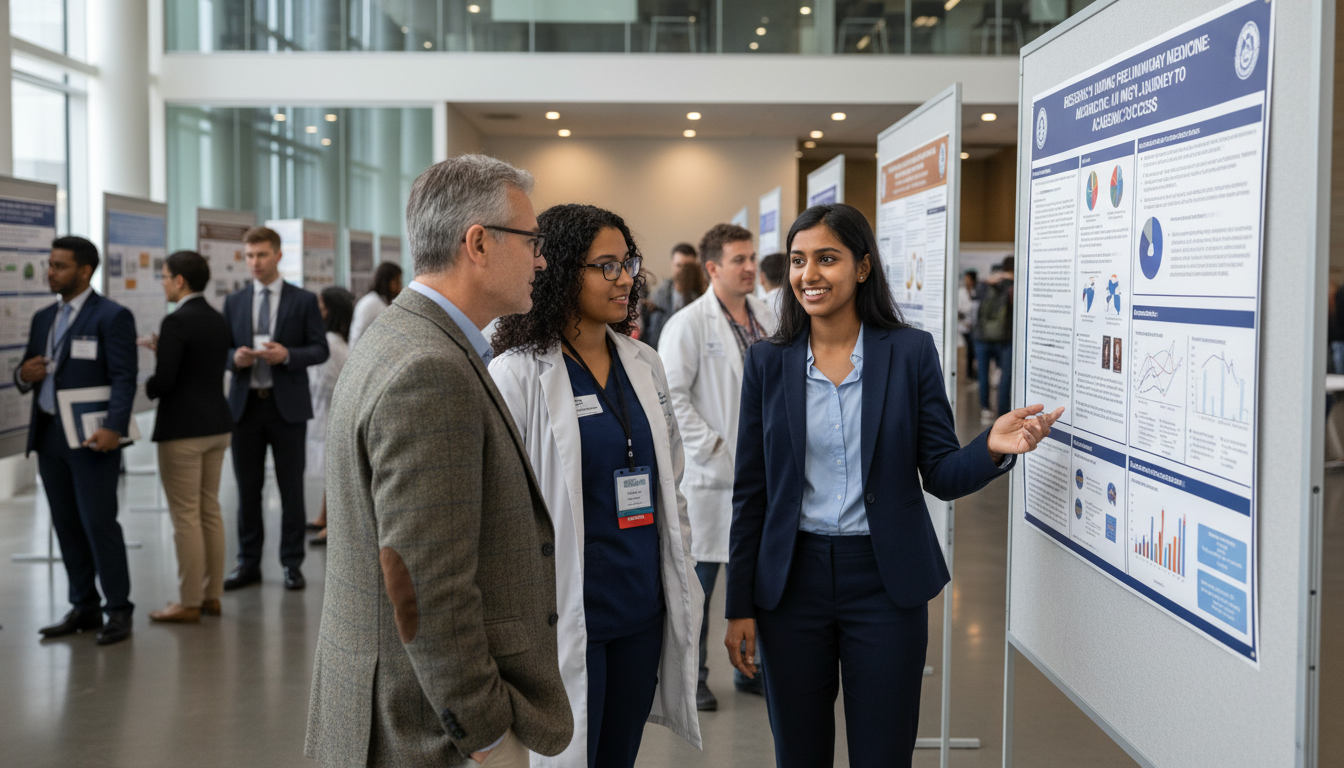
Even if a full manuscript isn’t ready, many prelim residents can:
- Submit case reports or QI projects to local institutional research days
- Present at regional ACP, society-specific, or hospitalist meetings
- Create posters that provide lasting evidence of your scholarly activity
This is important because:
- Conference abstracts often have shorter timelines than full publications
- Presentations look strong on ERAS for your next application cycle
- You can discuss them in interviews for categorical or advanced positions
5. Aligning Research with Your Career Goals After Prelim Medicine
5.1 For those aiming for categorical Internal Medicine
If your goal is to match into categorical IM after your preliminary medicine year:
- Choose projects close to core internal medicine topics:
- Cardiology, pulmonary/critical care, hematology/oncology, infectious diseases, hospital medicine, etc.
- Highlight:
- Resident research projects in IM that show your ability to think critically about complex patients
- QI projects that demonstrate commitment to systems-based practice and patient safety
Program directors in categorical IM will appreciate:
- Demonstrated curiosity about medicine beyond daily note-writing
- QI or outcomes studies that show your ability to improve the system, not just work within it
5.2 For those entering advanced specialties (e.g., Neurology, Radiology, Anesthesia)
Many IMGs use prelim IM as a prerequisite year for:
- Neurology
- Anesthesiology
- Radiology
- Physical Medicine and Rehabilitation
- Radiation Oncology
- Dermatology, Ophthalmology, etc.
If this is your path:
Whenever possible, align at least one project with your target specialty:
- Example: For Neurology—stroke outcomes in patients admitted through medicine.
- For Anesthesiology—perioperative medicine consult outcomes.
- For Radiology—diagnostic yield of certain imaging modalities for common medicine complaints.
Seek mentors connected to those departments:
- Some programs welcome prelim residents joining research meetings or journal clubs in the advanced specialty.
This alignment strengthens your future applications by providing:
- Specialty-relevant publications or abstracts
- Potential letters from faculty in the target field
- A coherent narrative about your interests
5.3 Considering an academic residency track or academic career
If you’re contemplating an academic residency track or eventual faculty role:
- Prioritize:
- Projects that can realistically lead to publication
- Multi-step involvement (idea → protocol → data → analysis → manuscript)
- Ask your mentor:
- “Are there opportunities to continue this line of work if I match into a categorical program here or elsewhere?”
An academic residency track after your preliminary year typically values:
- Demonstrated perseverance and completion of at least one project
- Some understanding of research methodology and statistics
- Clear mentorship relationships
6. Common Pitfalls for IMGs and How to Avoid Them
6.1 Overcommitting to too many projects
One frequent mistake is saying “yes” to everything:
- Multiple small projects with no clear timeline
- Vague “helping out” roles with no authorship agreement
- Joining studies mid-way without understanding your exact responsibilities
Instead:
- Prioritize 1–3 meaningful projects over many superficial ones
- Clarify early:
- Task list
- Expected time commitment
- Authorship position or method of credit
6.2 Ignoring institutional support
Many hospitals have:
- A research office or clinical and translational science center
- Biostatisticians for consults
- Grant or abstract preparation workshops
- Library staff to assist with literature searches
As an IMG, it’s easy to assume these are “for others,” but they’re typically open to all residents. Ask:
- “Are there resident research resources I can access?”
- “Does the institution provide poster printing support?”
6.3 Waiting too long to start writing
Another trap is waiting for “perfect data” or “the right time”:
- Months pass, rotations change, motivation fades
- By the time you begin ERAS for your next step, nothing is ready
To avoid this:
- Start drafting early, even if data are incomplete:
- Outline the introduction and background
- Prepare methods sections in advance
- Set internal deadlines ahead of conference or ERAS timelines
6.4 Not leveraging cases and observations from daily work
Many residents miss chances for straightforward scholarly output. As an IMG prelim resident:
- Keep a “research notebook” (physical or digital) where you jot:
- Interesting or puzzling cases
- System issues or near-misses that could be QI projects
- Clinical questions that required deep literature searches
Discuss these regularly with a mentor to identify:
- Possible case reports
- QI interventions
- Short educational pieces
FAQs: Research During Residency for IMGs in Preliminary Medicine
1. Is it realistic to publish during a one-year preliminary medicine residency?
Yes, it is realistic—if you choose appropriately sized projects and start early. Many prelim IM residents successfully complete case reports, QI projects, or small retrospective studies within one year. Large prospective trials are unlikely, but abstracts, posters, and at least one manuscript submission are achievable for a motivated resident with good mentorship.
2. How important is research for an IMG applying to categorical IM or advanced specialties after prelim IM?
For IMGs, research is often more important than for U.S. graduates because it helps offset other disadvantages (like limited U.S. clinical experience or lower name recognition of your medical school). While not mandatory for every specialty, resident research projects strengthen your profile, demonstrate initiative, and can provide strong letters. In more competitive fields (e.g., Dermatology, Radiology, Anesthesiology, some IM fellowships), research is a major plus.
3. What kind of research should I prioritize if I have very limited time?
If time is tight during your preliminary medicine year, prioritize:
- Case reports or small case series from unique patients you encounter
- A single well-defined QI project that aligns with hospital priorities
- Joining an existing retrospective study that already has IRB approval
These formats have the highest yield for your level of training and time constraints.
4. Will research experience during my prelim IM year help if I apply to an academic residency track later?
Yes. Programs with an academic residency track look favorably on applicants who have:
- Completed at least one project from start to finish
- Demonstrated sustained interest in scholarly work
- Shown they can balance clinical duties and academic commitments
As an IMG, this shows that you can thrive in a U.S. academic environment and that you are prepared for the demands of an academic career.
Research during a preliminary medicine year is challenging, but absolutely possible—and especially impactful for international medical graduates. With early planning, strategic mentorship, realistic project selection, and consistent small steps, you can emerge from your prelim IM year with tangible scholarly achievements that meaningfully advance your career.