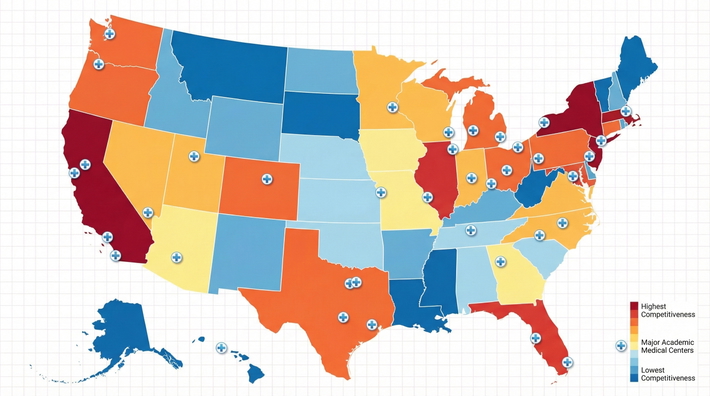
A border-state residency looks smart on paper. Often, it is smart. Better patient mix, more regional connections, cheaper housing than the big-city flagship across the river, and access to two job markets instead of one. That is the seductive pitch.
The trap is simple: training near a state line does not mean your career moves cleanly across it. I have seen applicants rank a program because they assumed, incorrectly, that rotating in State B or moonlighting there would make post-graduation licensing easy in State B. Then graduation comes. Job offer in hand. Credentialing clock running. And suddenly they are stuck dealing with extra verification, a jurisprudence exam, delayed board responses, or a state that treats their pathway very differently than they expected. Bad surprise. Completely avoidable.
This article is for that exact problem. The real question is not just "Do I like this program?" It is: Will this program make my future licensing path easier or unexpectedly harder?
Educational disclaimer: This article is for general educational purposes only and is not legal, financial, tax, or individualized licensing advice. State medical board rules, employment contracts, compensation timing, and credentialing requirements change regularly, so confirm details directly with the relevant board, employer, and qualified legal or professional advisors.
For broader residency decision-making, pair this issue with your usual framework for how to build a rank list, how moonlighting policies affect training, how physician credentialing timelines work, and regional job-market planning after residency.
Border-State Residencies: Why They're Attractive and Why Licensing Gets Complicated
Let me define "border-state residency" practically, not academically. It usually means one of three things:
- The residency hospital sits near a state line.
- The patient catchment area spills heavily across two states.
- The program routinely sends residents across the border for rotations, electives, moonlighting, continuity sites, or affiliated hospital coverage.
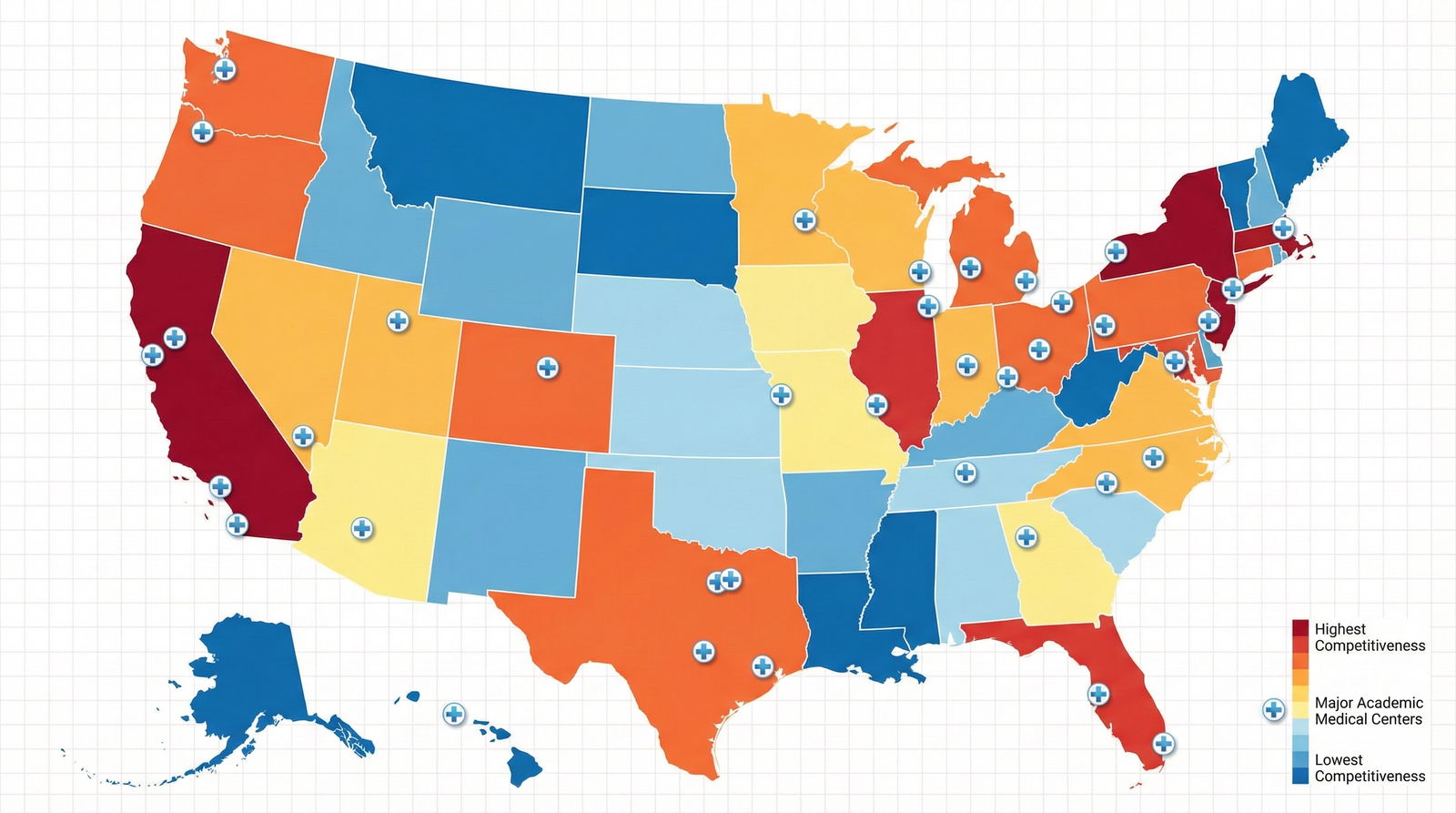
Think Kansas City. Philadelphia-South Jersey. Cincinnati-Northern Kentucky. DC-Maryland-Virginia. The geography creates a false sense of administrative unity. Clinically, the region feels like one ecosystem. Legally, it is not.
Why are these programs attractive? Because they often give you more of what actually matters in training:
- Broader patient population
- Different referral patterns and pathology
- Exposure to urban, suburban, and rural care models
- Potentially lower cost of living
- Networking across two state markets
- More fellowship and attending job visibility
That is real upside. I like border-state programs for exactly those reasons. They can be strategically excellent.
But the licensing side gets messy because residency training location is not a magic key that unlocks practice rights next door. Your resident training authorization, your permanent physician license, your DEA registration, and your hospital privileges are all separate layers. Related, yes. Interchangeable, no. That distinction wrecks assumptions every year.
The worst version of this mistake is very common: a resident trains in State A, rotates regularly in State B, perhaps even moonlights there under a tightly defined arrangement, and then assumes permanent post-training work in State B will be straightforward. Sometimes it is. Sometimes it absolutely is not.
So the lens for the rest of this article is blunt and practical: if there is any chance you want to practice in the neighboring state after residency, you need to investigate that now, before you rank the program. Not as a casual afterthought. As part of your actual strategy.
Map the Licensing Landscape Before You Rank the Program
Here is where applicants get sloppy. They use the word "license" to refer to everything. That is wrong. You need to separate four things.
1. Training authorization This is what allows you to function as a resident physician under that state's rules and your institution's GME structure. Depending on the state, this may be a training license, resident permit, institutional permit, or another limited authorization.
2. Full state medical licensure This is what lets you practice medicine in that state as an independently licensed physician, subject to that board's requirements. This is the one that matters for your attending job options.
3. DEA registration Federal authority to prescribe controlled substances. Necessary in many jobs. But it does not replace state licensure, and it does not give you rights across state lines.
4. Hospital credentialing and privileging A hospital or clinic decides whether to credential you and what privileges you get. Even with a valid state license, credentialing can still delay your start date. Plenty of new grads learn this the hard way.
Those four pieces intersect, but they are not the same process. A border-state residency often creates overlap in the training environment, while the post-graduation requirements stay stubbornly separate.
Usually, the state where your residency is physically based becomes your first licensing anchor. Your training records, postgraduate year documentation, institutional contacts, and often your first full license application will center there. That is fine if you plan to stay. If your likely future job is across the border, you need to study that neighboring state's board requirements now, not in your PGY-3 spring panic.
One major variable is the Interstate Medical Licensure Compact, or IMLC. If your state and your target neighboring state both participate, that can streamline multi-state licensure. Streamline does not mean automatic. It means potentially faster and less annoying if you otherwise qualify.
That "if" matters. The IMLC does not rescue poor planning. You still need to verify:
- Whether your principal state of license qualifies
- Whether your training and exam history satisfy eligibility
- Whether there are disciplinary or documentation issues
- Whether the target state imposes separate administrative steps
And if the neighboring state is not in the IMLC, expect the full state-specific application pathway. Primary source verification. Identity paperwork. Training verification. Exam history. Sometimes redundant documentation that feels lifted from the year 1998. Because, frankly, parts of this process are still built like it is 1998.
Then there are the timeline killers:
- Jurisprudence exams
- Fingerprinting and criminal background checks
- Notarized forms
- Specific postgraduate training year minimums
- Source verification through FCVS or direct board processes
- Delays in board meetings or staff review cycles
- Rules about supervision, collaboration, or restricted initial practice settings
These are not exotic edge cases. They are ordinary bureaucratic speed bumps that become major career problems when ignored.
A practical example: I have watched graduating residents accept a job in a neighboring state with an aggressive start date because "everyone from our program goes there." Then they discover the state requires an extra layer of verification from a prior internship site, or a jurisprudence test with limited scheduling windows, or direct medical school transcript transmission through a slow registrar. The job is still there. But the onboarding slips. Income slips. Sometimes credentialing committees defer the file to the next cycle. That is a very expensive lesson.
So before you rank a border-state program, ask one question with zero romance attached: If I want to work across the border after graduation, what will the paperwork actually look like?
If you are comparing training formats, it also helps to review resident training licenses versus full licenses and the physician onboarding process after Match.
The Licensing Traps That Catch Border-State Graduates
The first trap is psychological: cross-border exposure creates false confidence.
You rotate in the neighboring state. You admit patients from there every night. The faculty work in both systems. The hospital branding crosses the metro area. Everything feels integrated. So you assume future eligibility is basically built in.
No. That is how people get burned.
A cross-border rotation may mean only that your program has arranged a compliant educational structure for residents. It does not mean the neighboring state will treat your later full-license application as simpler, faster, or guaranteed. Educational access is not the same thing as independent practice rights.
The second trap is state-specific training documentation. Different boards care about different details, and they care in maddeningly specific ways:
- Exact postgraduate year dates
- Program director attestation language
- ACGME status during all training years
- Breaks in training
- Leaves of absence
- Whether all rotations were under approved supervision
- Whether postgraduate training was completed in the format the board recognizes
Most residents assume "I finished residency" is the relevant fact. Boards often want the paperwork architecture underneath that sentence.
Third trap: accepted postgraduate years are not always harmonized the way you think. Some states are comfortable with one year of GME for a certain type of licensure pathway; others want more. Some require full completion of residency for particular categories or endorsements. Some distinguish sharply between unrestricted licensure, temporary authority, and training-limited practice.
Fourth trap: supervision restrictions and temporary licenses. A neighboring state may let fellows, moonlighters, or newly graduated physicians work under narrow conditions while a full file is pending. Or it may not. Some states are generous with temporary practice mechanisms. Others are rigid. If your job plan depends on "I can probably start while paperwork is pending," that is not a plan. That is wishful thinking dressed up as strategy.
Fifth trap: telemedicine assumptions. Residents and even attendings still say absurd things like, "I am physically in State A, so I can follow patients in State B." No. In most cases, the patient's location drives the licensure issue. Telemedicine across state lines is a licensing matter, not a vibes matter. If your future practice model includes virtual care across the regional catchment area, you need to understand both states' rules.
Sixth trap: extra exams or cumbersome verification late in the game. This is where people become genuinely angry, and they should. A desired neighboring state may require:
- A jurisprudence exam
- FCVS participation or equivalent file creation
- Primary-source documentation from every training site
- Prior license verifications from every state ever touched
- Verification of all name changes
- Older exam transcripts sent directly
- Additional explanations for gaps, leaves, or disciplinary questions
None of this is glamorous. All of it matters.
Seventh trap: assuming federal or institutional privileges travel across state lines. They do not. A federal employer, VA affiliation, or large regional health system may create more flexible practice structures in some settings, but it does not erase underlying licensure rules for ordinary practice arrangements. Same goes for hospital badges and EHR access. Those are operational permissions, not broad legal authority.
Here is the blunt version: if a program casually says, "Our residents are all over both states," that tells you almost nothing. Ask how many graduates obtained a full unrestricted license in the neighboring state. How long it took. Whether any offers were delayed. Whether moonlighting required a separate process. Whether fellows had smoother pathways than general graduates. Those details matter. The slogan does not.
How to Evaluate a Border-State Program Like a Licensing Strategist
This is the section where you stop being a passive applicant and start acting like someone protecting a future career.
Your due diligence has to involve four groups:
1. GME leadership
Ask them directly:
- Do residents commonly seek full licensure in the neighboring state after graduation?
- Does the institution support cross-state paperwork during training?
- Are there known delays or recurring problems with either board?
- Does the program advise residents on timing for applications?
If the answers are vague, that is data. Bad data.
2. Program coordinator or program administrator
Program coordinators often know the real story. Not the polished story. The real one.
Ask:
- How often do graduates practice across the border?
- How early do they start the licensing process?
- Which documents tend to slow people down?
- Has the program had difficulty verifying rotations, training dates, or supervision for another board?
- Are moonlighting permissions different by state?
A seasoned coordinator who says, "Start six months earlier for State B because they always ask for extra verification," is gold. That is the person you trust.
3. Recent alumni
This is the highest-yield source. Ask graduates from the last two to three years:
- Where did you end up practicing?
- How long did your license take in each state?
- Did anything surprise you?
- Did credentialing lag behind licensure?
- Would you choose the same program again if your goal was to work across the border?
Alumni will tell you what institutions often gloss over. I have had alumni flatly say, "Training there was great, but getting licensed next door was a pain and delayed my start." That one sentence may be more useful than the entire interview day.
4. Hospital credentialing office or physician onboarding team
If accessible, ask whether newly graduating residents entering the neighboring state commonly face delays. Credentialing is where licensure theory meets payroll reality.
Then do your own board review. Yes, manually. Yes, it is annoying. Do it anyway.
Look up both state medical board websites and verify:
- Postgraduate training minimums
- Exam attempt limits
- Exam validity windows
- Time limits for completing licensing sequence
- Requirements for international graduates, if relevant
- Endorsement rules
- Temporary license availability
- Background check process
- Jurisprudence test requirements
- FCVS usage or alternatives
This matters even more if you have anything nonstandard in your file. A leave of absence. A transfer. Research years. A combined program. Older exam dates. Prior training in multiple institutions. Every "small complication" becomes more significant when boards get picky.
One more piece applicants underestimate: where graduates actually go. Not where the program claims it has reach. Where people really land.
If a border-state program sits near State B but 90% of graduates still stay licensed and employed in State A, ask why. Maybe State A has stronger jobs. Fine. But maybe State B is bureaucratically painful, and the program quietly knows it. That is the kind of pattern you want to see before you sign up.
And do not forget opportunity cost. A program may look perfect because it gives you a convenient commute, strong clinical volume, and regional prestige. But if it forces a miserable licensing workaround for the state where you actually want to build your career, that convenience can evaporate fast.
Convenience during residency is nice. Flexibility after residency is better.
For related due diligence, compare notes with questions to ask on residency interview day, how to assess program coordinator support, and how fellowship or attending job geography should affect ranking.
Red Flags vs Green Flags in Border-State Residency Selection
Let me make this easy.
Red flags
These should make you nervous:
- Coordinators give fuzzy answers about cross-state licensure.
- No clear alumni track record in the neighboring state.
- Graduates report repeated credentialing delays.
- The program cannot explain moonlighting rules across the border.
- Interstate electives exist, but nobody can describe the licensing mechanics.
- Staff speak in assumptions: "It should be fine," "I think it works," "Most people figure it out."
- There is a history of late verification forms or poor administrative support.
I do not care how charming the interview day was. If the infrastructure is sloppy, that sloppiness becomes your problem later.
Green flags
These are what strong programs look like:
- Transparent alumni outcomes by state
- Clear guidance on when to start each licensure process
- Familiarity with both state boards' expectations
- Documented support for interstate rotations and moonlighting
- Coordinators who can name common delays and how residents avoid them
- Graduates who obtained cross-state licensure without chaos
- Efficient credentialing handoff into regional health systems
That is what competence looks like. Not branding. Competence.
Prestige matters less here than applicants want to admit. If you plan to stay in the region long term, licensure convenience is not some minor administrative detail. It is part of your career architecture. A slightly less famous program with reliable two-state positioning may be the superior choice over a flashier name that traps you in one state's paperwork ecosystem.
Applicants get seduced by reputation and ignore friction. That is dumb. Friction costs time, flexibility, and sometimes jobs.

Build Your Final Ranking Strategy: Fit First, Licensing Risk Second, Flexibility Always
Here is my ranking framework.
First: fit. You still need a program that trains you well, supports you, and does not make your life miserable. Clinical quality, culture, case volume, supervision, fellowship access, call structure, and personal geography still matter most. A border-state licensure advantage does not rescue a bad residency.
Second: licensing risk. Once the true training fit programs are identified, sort them by how much future friction they create. If you are likely to practice in the neighboring state, this factor moves up sharply. If your spouse works across the border, if your family is rooted there, or if the job market you want is concentrated there, then this is not secondary trivia. It is central.
Third: flexibility. The best program is often the one that preserves options. Options to stay. Options to cross the border. Options to moonlight legally. Options to join a regional system without a six-month paperwork detour.
Rank programs by total opportunity cost, not name recognition alone. Ask yourself:
- Will this program train me well?
- Will it keep my likely practice geography open?
- Will it help or hinder post-graduation licensure?
- If my life plans change, does this program leave me boxed in?
Before you submit your rank list, do three final things:
Final-step checklist
- Verify licensure requirements in both states directly from the boards.
- Confirm whether the neighboring state participates in the IMLC and whether you would qualify.
- Ask the program for actual alumni examples, not general reassurance.
- Clarify moonlighting and cross-border elective rules.
- Identify common onboarding delays for graduates entering the neighboring state.
- Decide which backup state works for you if your preferred path stalls.
That is the move. Practical. Slightly cynical. Correct.
A border-state residency can be a brilliant strategic choice. But only if you treat licensure as part of the program, not as an afterthought that future-you will magically handle. Choose the residency that keeps your career mobile, your paperwork predictable, and your options broad. Geography is convenient. Flexibility is power.
Key Takeaways
- A border-state residency can be strategically excellent, but only if you verify how training location interacts with future licensure in both states.
- The safest approach is to rank programs with a licensing lens: confirm board requirements, IMLC relevance, alumni outcomes, and credentialing delays before you commit.