The biggest mistake international trainees make is pretending they have “plenty of time” to figure out returning home. You don’t. If you think you might go back, your planning window starts now, not in your PGY-3 exit interview.
This is a guide for you if:
- You’re an IMG/US-trained doc who expects to go back to your home country after US residency/fellowship, or
- You’re not sure yet, but returning is a real possibility.
I’m going to walk you through what actually matters: visas, licensing, recognition of your US training, exams you’ll need again (yes, again), and how to not tank your career by ignoring the rules back home.
Step 1: Get Brutally Clear on Your “Return Type”
Before anything else, you need to answer: In what capacity are you returning? Because the plan for “go home and be an attending in a tertiary hospital” is very different from “open a small private clinic in my hometown.”
Think in three buckets:
- Academic/tertiary hospital consultant
- Private practice / group practice
- Public/government system physician (civil service, national health service, etc.)
Why it matters: each of these has different requirements, different leverage for your US training, and different gatekeepers.

Quick sanity check with your home country
Within your first year in the US (yes, that early), you should:
Identify the national medical council / regulator in your home country.
Find the specific page for “foreign postgraduate training recognition” or “specialist registration.”
Email or call (yes, actually call) and ask:
- Is US residency recognized as equivalent to local specialist training?
- Is US fellowship recognized?
- Do I need to complete any local residency years or exams to be eligible as a specialist?
- Are there deadlines for recognition (e.g., must apply within X years of completion)?
- Is board certification required or just completion of training?
Write the answers down. Screenshots, PDFs, emails saved to a folder. Policies change. You want proof of what you were told.
Step 2: Map Out Recognition of US Training vs Local Requirements
The key question: Will your US training make you a specialist back home, or will you come back as “just another generalist with fancy experience”?
Here’s how this often plays out (example patterns, not universal):
| Region/Country Type | US Residency Recognition | US Board Cert Recognition | Extra Local Steps Commonly Needed |
|---|---|---|---|
| Western Europe (e.g., Germany) | Partial / Case-by-case | Rarely | Local exams, language, adaptation year |
| Gulf Countries (e.g., UAE, Qatar) | Generally favorable | Favored for senior posts | Prometric-style exams, credentialing |
| South Asia (e.g., India, Pakistan) | Variable by specialty | Sometimes preferred | National specialty exams, local registration |
| East Asia (e.g., Japan, Korea) | Limited / complex | Limited | National exams, often full local pathway |
| Latin America (e.g., Brazil) | Mixed by country | Unclear / case-by-case | Convalidation, national exams |
The pattern is simple: many places love the prestige of “US trained” but don’t automatically give you the license and status you think that implies.
Your job is to understand:
- Do you come back as:
- Full specialist?
- Provisional / limited specialist?
- Non-specialist with “foreign training” that you still must convert?
If conversion is required (very common), find out:
- What exam(s) will you need?
- How often are they offered?
- Are they in English or the local language?
- Do you have to complete any local internship or residency rotations?
- Is there an age or time-since-graduation limit?
Here’s where people get burned: they finish US residency at 34, come back at 35, and find out their home country exam has a “within 10 years of graduation” rule. They graduated med school at 24. Do the math.
Step 3: Visa, Timing, and the “Too Long in the US” Problem
Everybody obsesses over getting into the US. Fewer people think about the exit strategy.
(See also: Two-Body Problem: Coordinating Couples Match Across Regions for strategies.)
If you’re on J‑1:
- You already owe two years in your home country (or another qualifying country) after training, unless you get a waiver.
- If you know you’re going home anyway, the J‑1 can actually be aligned with your plan. You fulfill your home-country service requirement in a structured way.
- But you still need to ask your home regulator: does this J‑1 “home return” time count toward anything (consultant experience, seniority, civil service credit)? Or is it just “oh that’s nice, anyway start at step one”?
If you’re on H‑1B:
- You’re not forced to leave, which sounds great—but it also makes it easy to drift.
- If you overstay in the US for too long after training, your connection to your home system weakens. Networks fade, guidelines and systems change, exam eligibility windows close.
- Decide: do you want one US attending job before going back, or are you actually not planning to return? Be honest with yourself. That decision determines whether you keep investing in your home-country plan or let it go.
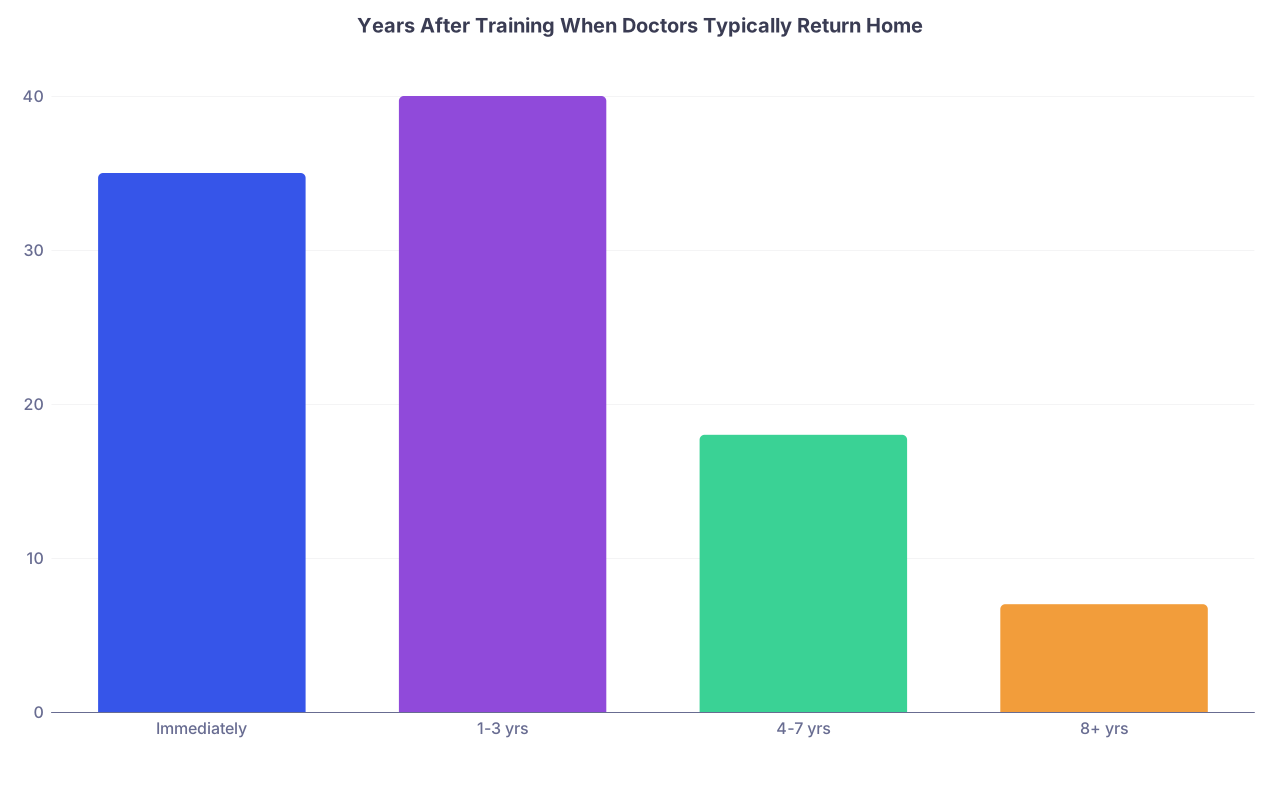
| Category | Value |
|---|---|
| Immediately | 35 |
| 1-3 yrs | 40 |
| 4-7 yrs | 18 |
| 8+ yrs | 7 |
If you might return, don’t let yourself drift into the “8+ years later” category unless you’ve checked that:
- You’re still exam-eligible
- Your med school and training documents are still easily retrievable
- You understand any penalty for late recognition
Step 4: Build Your Home-Country CV While You’re Still in the US
Here’s what too many people do: they train in the US like they’re going to be US attendings forever. Then at the end they realize their home country wants different things.
You need to optimize your US time for what your home system respects.
You should find out:
- Do academic centers at home value:
- Research? PubMed-indexed? Local journals?
- Teaching experience?
- Specific procedural skills?
- Do public hospitals value:
- Years of service?
- Government exam scores?
- Rural posting experience?
Then you reverse-engineer your choices in the US:
If research publications impress back home:
- Get on papers. Any papers. Case reports, QI projects, retrospective charts—doable even in busy residencies.
- Make sure your name is on PubMed. Administrators love sending those links to their boards.
If procedural volume matters:
- Choose electives and fellowships where you actually get hands-on numbers, not just observer status.
- Keep detailed procedure logs. Many regulators ask for case numbers on paper; if you can export from your US system, even better.
If teaching matters:
- Get official teaching roles: resident educator, small group leader, simulation teaching.
- Ask for letters that explicitly say you taught and mentored.

Language and documentation
If your home country isn’t English-speaking, do not wait until the end to handle:
Language proficiency proof (if required)
Translations of:
- US training certificates
- Board certification
- Procedure logs
- Letters of good standing / experience certificates
Use certified translators recognized by your home country, not just any random website.
Step 5: Exams: The Second Round You Didn’t Plan For
A lot of doctors are shocked they have to take more exams to practice at home after “surviving USMLE.” That shock doesn’t help you. Planning does.
You’re likely to face one or more of these:
- General medical council licensing exam (equivalent of national medical licensing)
- Specialty board exam (local)
- Language exam (if records or interactions must be in local language)
You should:
- Identify which exams apply to your scenario.
- Get syllabus + sample questions 2–3 years before you plan to return.
- Decide: prepare while still in the US or after you go back?
There’s no universal right answer, but:
If the exam is mostly knowledge/theory-heavy and in English:
- It’s usually easier to prep while you’re still in training/reading constantly.
If it’s heavily focused on local guidelines, drug names, or language:
- You may do better studying once you’re physically back, surrounded by that system.
What you absolutely don’t do: arrive home, take six months to recover, then realize the exam is only offered once a year and you already missed the registration window.
Set a realistic timeline:
- “I’ll return in mid-2028.”
- “I’ll sit the exam in late 2028 or early 2029.”
- “I need to start studying by mid-2027 to avoid panic mode.”
Backwards planning is boring. It’s also how you don’t end up stuck in limbo as a locum or junior doctor because you fumbled a deadline.
Step 6: Keep a Foot in Both Worlds (Networking and References)
You need two networks:
- Your US network (for letters, credibility, collaboration)
- Your home-country network (for jobs, insider policies, and reality checks)
Here’s what this looks like in practice while you’re still in the US:
Once a year, go home and:
- Visit 1–2 major hospitals you’d consider joining.
- Meet department heads, not just your old classmates.
- Tell them plainly: “I’m training in the US, planning to return around [year], what would make me competitive for a position here?”
Keep a running list of key people:
- Dean or medical director back home
- Department head of your specialty
- At least one younger attending who has returned from abroad recently (they know the newest rules and landmines)
Back in the US:
- Collect formal documentation as you go:
- Letters of good standing from each program
- Final evaluation letters with explicit start/end dates
- Board certification proof
- Any teaching awards, chief resident appointments, committee roles
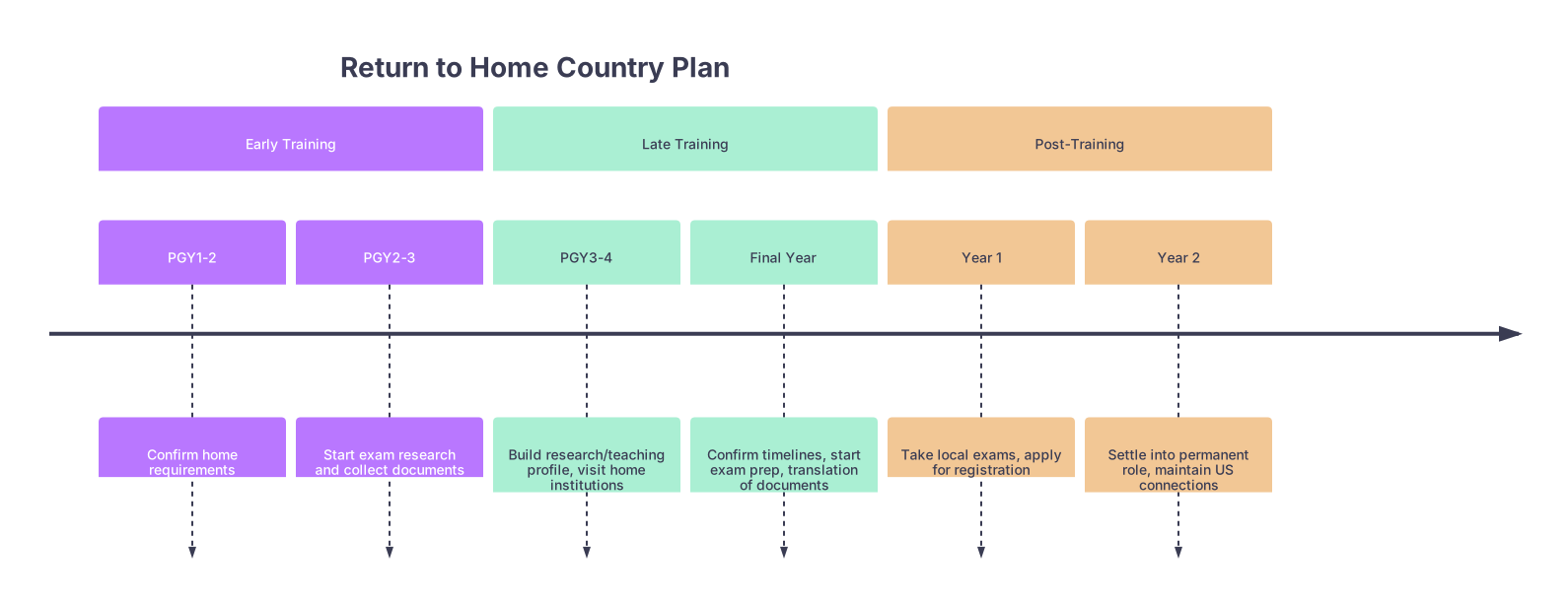
| Period | Event |
|---|---|
| Early Training - PGY1-2 | Confirm home requirements |
| Early Training - PGY2-3 | Start exam research and collect documents |
| Late Training - PGY3-4 | Build research/teaching profile, visit home institutions |
| Late Training - Final Year | Confirm timelines, start exam prep, translation of documents |
| Post-Training - Year 1 | Take local exams, apply for registration |
| Post-Training - Year 2 | Settle into permanent role, maintain US connections |
People underestimate how often foreign regulators ask for “proof of continuous good standing” or detailed training verification. Chasing US GME offices for old letters after you’ve left is a special kind of misery. Do it while your name is still fresh.
Step 7: Choosing US Training That Actually Helps You Back Home
If you’re still applying for residency or fellowship, you should be asking: “Will this program’s strengths translate to my home market?”
Some practical filters:
- Brand vs substance:
- A big-name but very niche fellowship might impress your friends, but not qualify you for any defined role back home.
- A solid, mid-tier program with strong procedural volume may be much more valuable.
(See also: Managing Kids and Schooling While Moving to a New Residency Region.)
Subspecialty choices:
- Ask yourself: does this subspecialty exist as a job description back home?
- Interventional pain? Advanced heart failure? Complex IBD?
- If your system only has “cardiologist,” your hyper-specialized HF training might not fit any box.
- Ask yourself: does this subspecialty exist as a job description back home?
Duration:
- Very long training paths (residency + 2–3 fellowships) push your age and graduation timeline right up against exam limits and seniority structures back home.
- Don’t train 10+ years in the US if your home country caps entry to certain posts at a given age or years post-grad.
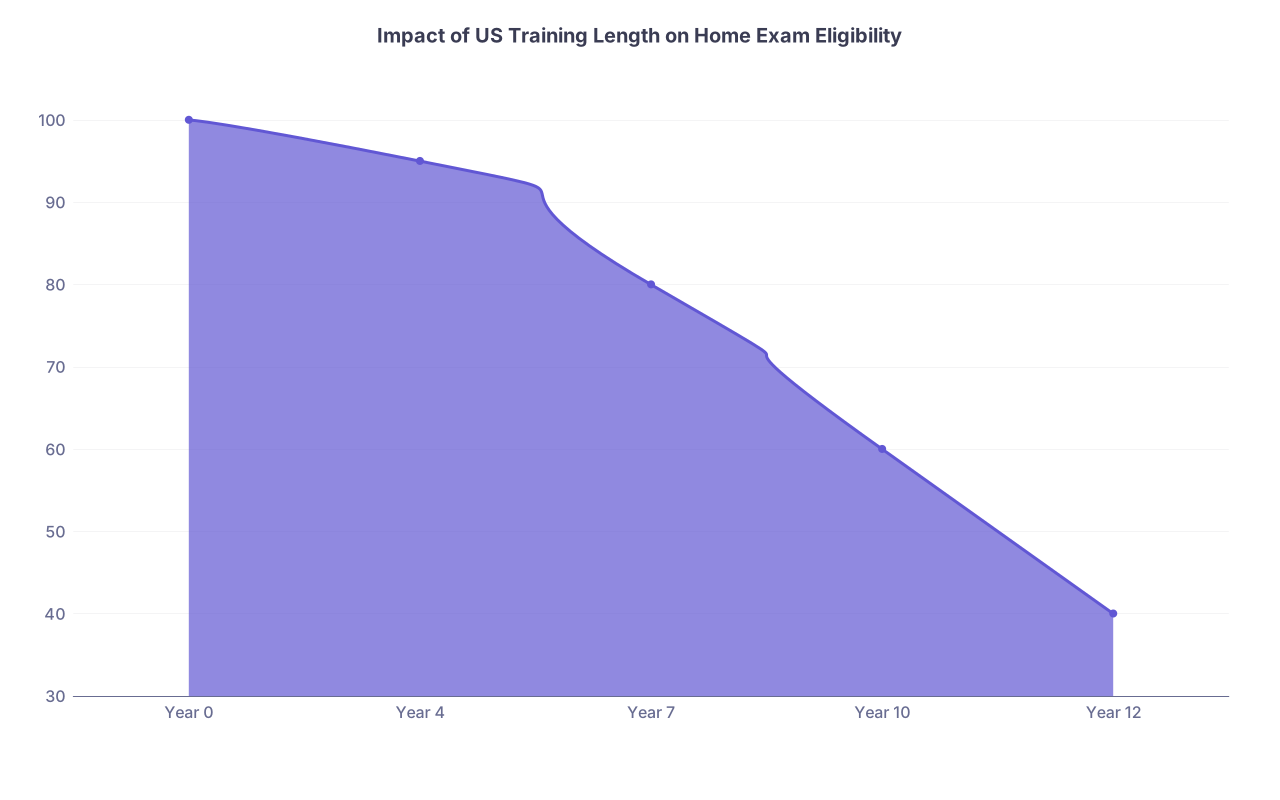
| Category | Value |
|---|---|
| Year 0 | 100 |
| Year 4 | 95 |
| Year 7 | 80 |
| Year 10 | 60 |
| Year 12 | 40 |
(The numbers are illustrative, but the trend is real: your leverage often declines, not increases, after a certain point.)
Step 8: Money, Lifestyle, and the Emotional Reality of Going Back
Ignoring money is how smart physicians end up stuck. You need a rough financial plan:
- What will you earn as a US attending vs back home consultant?
- How many years of US attending salary would change your long-term position back home meaningfully?
- Are there return incentives (government schemes, university recruitment, tax benefits) for foreign-trained clinicians?
Sometimes, doing 3–5 years as a US attending before returning makes sense financially. Sometimes it complicates your home-country process and isn’t worth the extra cash. Run numbers, not vibes.
And yes, the emotional side matters:
- Re-integration shock is real.
- Hierarchies may be harsher back home than in the US.
- You may have more responsibility with fewer resources.
- Family will expect you to be instantly “successful” since you were “trained in America.”
Prepare mentally for:
- System frustrations (paper charts, stockouts, slow admin, corruption in some places).
- Different medico-legal climates.
- Being “the US-trained person” everyone tests or resents or idealizes.
If you know this is coming, you don’t interpret every annoyance as a personal attack. It’s just part of the re-entry tax.
Step 9: Concrete 12–24 Month Checklist Before You Return
Here’s what I’d want on my desk 1–2 years before I plan to leave the US:
Written confirmation of:
- Home-country exam requirements and dates
- Eligibility windows (age, year of graduation, etc.)
- What my US training counts as (specialist, partial, generalist)
Documents in hand:
- Original diplomas (med school, residency, fellowship)
- Board certificates
- Detailed training transcripts / logbooks if available
- Letters of good standing and employment verification
- Translations where needed
Professional positioning:
- At least 1–2 ongoing collaborations that can continue after I return (research, guidelines, teaching)
- One or two home-country mentors who know my timeline and career goals
- A short list of hospitals/centers I’d realistically join
Exam status:
- Registered for any required home-country exams OR
- Clear decision to sit them immediately after return with a planned study period

What you absolutely do not do: book a one-way ticket home and hope the system will be “so happy to have you” that they’ll waive the rules. They will not.
Step 10: How to Keep US Doors Open After You Go Back
Even if you’re committed to your home country, it’s smart to not slam the US door shut completely. The world is too unstable for that kind of rigid thinking.
Ways to keep optionality:
Maintain:
- Active US board certification (do the MOC/CME, as painful as it is).
- A US address/mail forwarding solution.
- A US bank account if legally allowed.
Stay visible:
- Co-author papers with US colleagues.
- Participate in virtual grand rounds or teaching sessions.
- Attend at least one international conference every 1–2 years.
Keep your immigration options realistic:
- Save all your US work documentation (contracts, pay stubs, W‑2s, etc.).
- If you ever want to return under O‑1 or similar, that paper trail matters.
You may never need the US again. Or you might. The small effort to preserve that option is absolutely worth it.
Final Takeaways
If there’s even a 30% chance you’ll return to your home country, plan for it like it’s 80%. You can always relax your plan later; you can’t go back and fix expired eligibilities or missing documents.
Don’t train in the US like an American lifer if your credential gatekeepers are sitting in Delhi, Lagos, São Paulo, or Manila. Shape your research, procedures, fellowships, and roles around what they respect and recognize.
Your power move is boring: early emails to regulators, careful exam timelines, document hoarding, and yearly check-ins with future employers back home. Do those consistently, and returning after US training becomes an advantage, not a career reset.