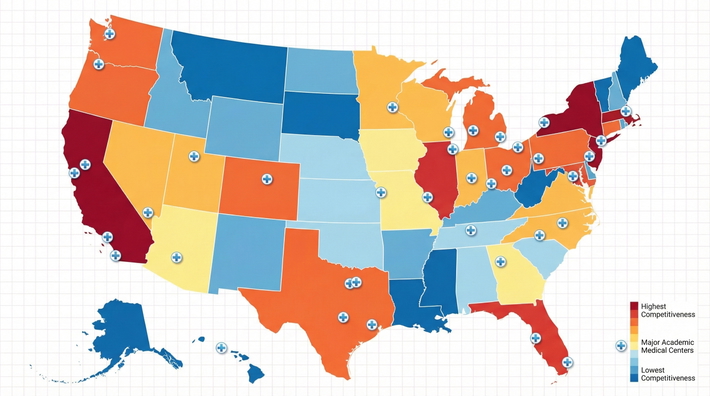
Do You Really Need ‘Regional Ties’ to Match? What the Evidence Says
The obsession with “regional ties” in residency is massively overstated—and often misunderstood. Programs use it as a lazy proxy. Applicants treat it like gospel. The data? A lot more nuanced, and it does not justify the panic I see every application season.
Let me be blunt: you do not need regional ties to match. But in certain contexts, they change your odds in a measurable, non-trivial way. The problem is that most advice online takes a tiny kernel of truth, strips out all nuance, and turns it into “You’ll never match in the Northeast without ties.”
That’s not how this works.
What Programs Actually Care About (Versus What They Say)
Programs love to talk in vague, fuzzy language: “We value fit,” “We like people committed to our region,” “We prefer candidates with ties.” That doesn’t mean regional ties are at the top of the list.
Look at what consistently predicts matching across specialties: board scores (where still used), clerkship performance, letters, school reputation to some extent, and perceived commitment to the specialty. Geography is downstream of those.
When program directors are surveyed about what matters, “geographic ties” usually shows up as:
- A secondary factor for screening
- A “tiebreaker” between similar applicants
- A way to reduce flight risk for less geographically desirable locations
Notice what it’s not: the primary driver of ranking.
The NRMP’s Program Director Surveys make this crystal clear. Factors like Step scores, grades in core clerkships, MSPE, letters, and interview performance consistently outrank geography. Regional ties slot into that second tier of “nice to have” or “helps us interpret your application.”
Where it bites you is not usually in the rank list. It’s in getting the interview invite.
Programs in competitive cities—Boston, NYC, San Diego—are drowning in apps. They often look for any signal that you might actually come. Regional ties become a crude filter: “No ties? Okay, you better be obviously stellar or show a clear reason to be here.”
But that’s different from “no chance.”
What the Data and Match Patterns Actually Show
Nobody has a giant randomized trial of “with ties vs no ties,” but you can see patterns in where residents end up.
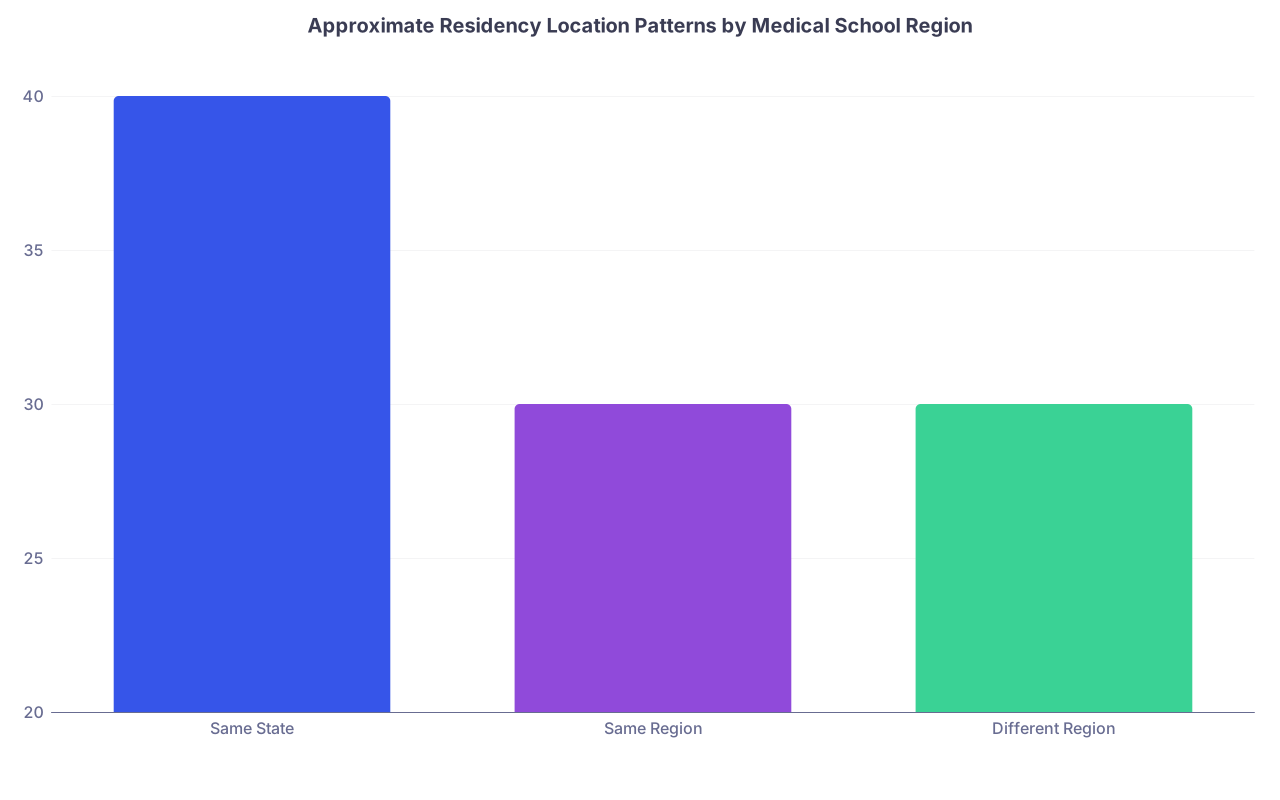
| Category | Value |
|---|---|
| Same State | 40 |
| Same Region | 30 |
| Different Region | 30 |
A few broad truths from match outcomes, program rosters, and published analyses of GME distribution:
- A large fraction of residents stay in the same state or same region as their medical school.
- But a solid chunk—easily 30% or more—train in a different region entirely.
- Certain specialties and cities draw nationally, and their resident lists prove it. Look at IM at MGH, UCSF, Penn, or large academic EM programs: tons of people from “no obvious geographic connection.”
If regional ties were a hard requirement, you wouldn’t see:
- A California student matching psych in Boston with zero New England background
- A Midwest MD/DO matching EM in Arizona after a couple away rotations
- An East Coast IMG matching FM in the rural Midwest with no family or school nearby
I’ve watched all three happen, repeatedly.
Geographic clustering is partly preference, partly inertia, partly real constraints (family, partner, visas, debt). It is not proof that “programs won’t rank you without ties.”
The better way to frame it: regional ties shift probabilities, not possibilities.
Where Regional Ties Actually Matter a Lot
Here’s where I stop being contrarian and admit: in some situations, regional ties are absolutely a big deal, and ignoring that is delusional.
There are three high-yield buckets.
1. Less Desirable or Overshadowed Locations
Programs in:
- Rust Belt mid-size cities
- Isolated Midwest locations
- Rural South
- Smaller community hospitals overshadowed by nearby “big name” centers
…worry about one thing: retention and buy-in.
They’ve been burned by candidates who treated them like backup plans, then bolted for a different city or left the region after training. So they lean harder on regional ties as a risk filter:
- “Grew up 45 minutes away”
- “Partner already works in town”
- “Family all in this state”
- “Med school in this region + clear statement of wanting to stay”
In these programs, genuine ties can massively boost your odds compared with an equally qualified but clearly coastal-elite tourist.
2. Residency in Strongly “Closed” Regions
Some regions are just more insular. The South, parts of the Midwest, and specific states with heavy in-state preference (Texas is the poster child) show strong regional loyalty.
You’ll see patterns like:
- Majority of residents from the same state or adjacent states
- Heavy representation of local medical schools
- Repeated language on websites: “We’re committed to serving our region”
Here, not having explicit ties won’t kill you, but having them is like swimming with the current instead of against it. Especially if your app is middle-of-the-pack.
3. When Your Application Is Otherwise Borderline
If your application is:
- Average or slightly below in scores
- From a less-known school
- Light on research for research-heavy urban centers
Then regional ties can be the difference between “trash pile” and “let’s at least look at this person.”
They do not turn a 195 Step 1 and failed clerkships into a Yale match. They can turn “probably no interview” into “sure, may be a good local fit” for community or mid-tier programs.
Where Regional Ties Are Overrated or Almost Irrelevant
Now the other side.
1. Top National Academic Programs
The big academic IM, neuro, EM, gen surg programs in major hubs want one primary thing: top-tier talent that will match their brand and outputs. Publication history, letters from known faculty, advanced degrees, serious leadership. That kind of thing.
If you’re a research-heavy MD/PhD with 260+ Step 2, EM scholarship, and strong letters, they are not obsessing over whether you have “ties to the city.” You’re the person they want regardless.
Do they like evidence that you’re actually serious about them? Yes—signals like away rotations, couples match plans, or mentor connections matter. But “Aunt lives in Brooklyn” isn’t moving the needle here.
2. Truly National or Lifestyle-Driven Specialties
Derm, plastics, ENT, rad onc—these are competitive enough that:
- Your stats
- Your letters
- Your research
- Your perceived “match” to the field
…dwarf geography.
Look at their rosters. You’ll see people from everywhere, training everywhere, with no obvious geographic consistency.
Programs might care a bit more if you’re applying to a small-city derm program, but the main filter is “Can this person survive and excel here?” not “Did they grow up within a 3-hour drive?”
3. EM and Surgical Subspecialties With Heavy Away Rotation Culture
In EM, ortho, neurosurg, urology—your away rotations are your real regional ties.
You show up, work like a resident, prove you can hack their workflow and culture. That letter and face recognition are worth more than any generic statement of “I enjoy the Pacific Northwest and would love to settle here.”
No family nearby? No local med school? If you killed it on your away, that is your tie.
“Regional Ties” vs “Regional Story”: Not the Same Thing
This is where I see a lot of applicants screw up.
They treat “regional ties” as:
- Birth certificate
- High school
- College
- Med school
- Parents live there
If they don’t have those, they assume they’re dead in the water. That’s lazy thinking.
Programs are actually looking for a regional story—a believable explanation for why you’d come and why you’d stay. The forms that can take are much broader:
- Your partner already matched there or has a job in the region
- You’re in a couples match and most of your partner’s interviews are in that area
- You did multiple rotations in that city/region and keep coming back
- Your long-term career goal aligns with the region (rural primary care, underserved inner-city, academic subspecialty in a city full of relevant patients and mentors)
- You’ve spent repeated summers, months, or years there (military childhood, previous degree, prior career)
What programs are really allergic to is tourist energy: “I’m applying to 18 random cities I barely know, I just want ‘big city vibes’ and a cool restaurant scene.” They worry you’ll bail the second you get bored or homesick.
A believable regional story—communicated clearly in your personal statement and interviews—often beats some flimsy “My cousin lives 2 hours away” claim.
How Programs Infer Regional Interest (Even If You Say Nothing)
You might think, “I’ll just be honest and see what happens.” Fine, but recognize how programs read your file.
They infer your geographic interest from patterns:
| Signal Type | Strong Interest Example |
|---|---|
| School History | College and med school in same region |
| Rotations | Multiple electives in same city/region |
| Application Spread | Heavy concentration of programs in one area |
| Personal Statement | Clear, specific reasons for that region |
| Life Circumstances | Partner, kids, or family already living there |
If you:
- Apply to 65 programs across every time zone,
- Do 3 aways in three different regions,
- Never mention any regional motivation in your essays,
…then claim at interview “This city has always been my dream,” it rings hollow.
On the flip side, you can manufacture a coherent signal even without traditional ties:
- Concentrate a meaningful chunk of your applications in one region
- Do at least one rotation there if the specialty culture allows it
- Phrase your personal statement as: “Here’s the kind of community and system I want to work in” and make sure that lines up with those programs
- Be explicit on interview day: “My partner’s job / our families / our long-term goal is to settle in this region”
That is often enough.
Cold-Region Myths: “You Can’t Match in X Without Ties”
Let’s call out two of the most persistent myths.
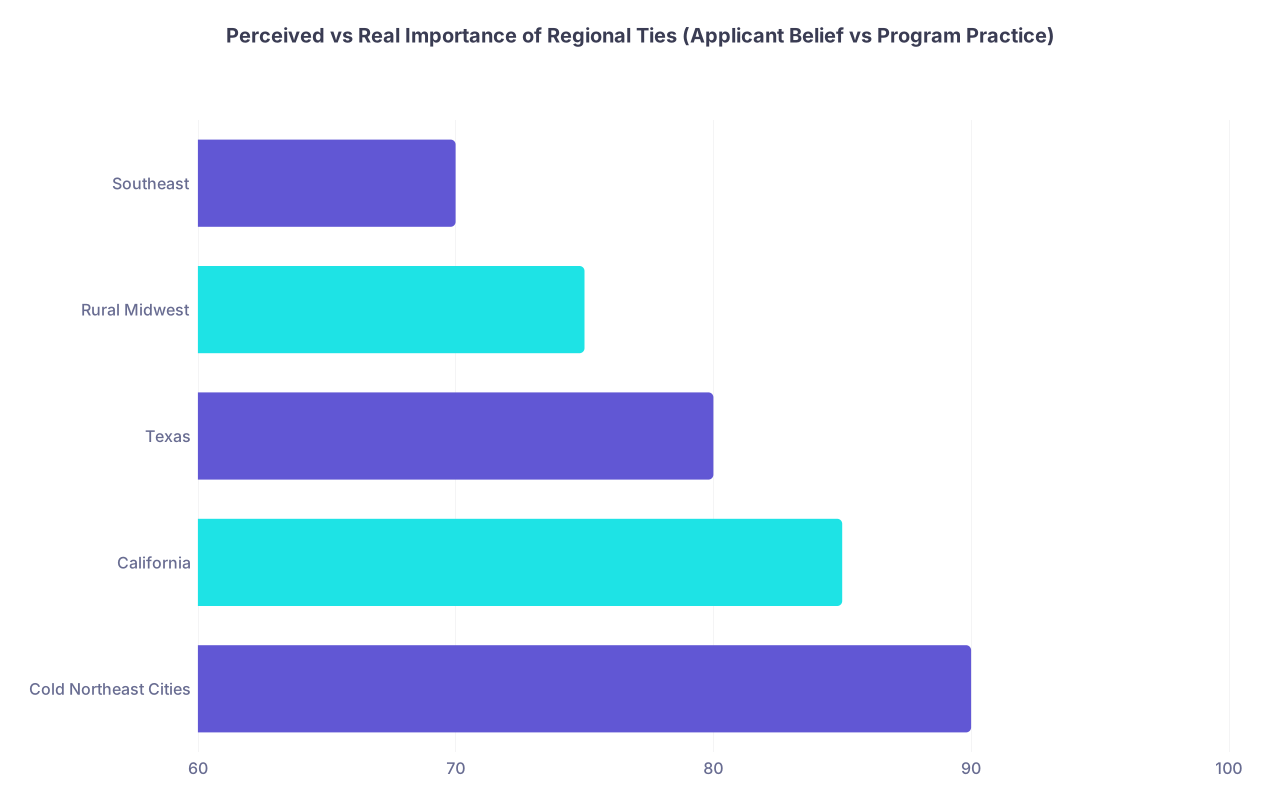
| Category | Value |
|---|---|
| Cold Northeast Cities | 90 |
| California | 85 |
| Texas | 80 |
| Rural Midwest | 75 |
| Southeast | 70 |
Those percentages might match anxious applicant beliefs. Reality is lower and more variable.
Myth 1: “Northeast academic IM/EM requires regional ties”
Nonsense. Look at any major Northeast academic program’s resident list. You’ll see:
- West Coast and Southern med schools
- IMGs from all over the planet
- DOs from the Midwest and Rocky Mountain regions
What they do often want is:
- Strong academic signals
- Tolerable winters
- Evidence you understand urban, high-volume, often underserved populations
Regional ties help a bit. They’re not a barrier to entry.
Myth 2: “You can’t touch California without ties”
California is competitive because:
- Limited number of spots relative to applicant demand
- Desirable lifestyle and geography
- High cost of living (which select for people who can handle it)
Ties help. No question. But people match into CA year after year from zero-tie backgrounds, powered by:
- Strong scores and letters
- A targeted, CA-heavy application list
- One or two away rotations
- A coherent explanation: “I want to live and work near X because of Y”
Programs do like “likely to stay,” but they’re not running a background check on where you went to kindergarten.
Smart Ways to Mitigate Weak or No Regional Ties
Assume you’re starting with basically nothing: no family, no prior schooling, no long stays in the target region. Here’s how you stop this from hurting you more than it has to.

| Step | Description |
|---|---|
| Step 1 | Pick Target Region |
| Step 2 | Apply Heavily There |
| Step 3 | Schedule One Rotation There |
| Step 4 | Highlight Region Fit in Personal Statement |
| Step 5 | Explain Long Term Plans in Interviews |
| Step 6 | Follow Up With Region Focused Emails |
You’re manufacturing a cohesive pattern, not faking a biography.
Couple of specific moves:
- Don’t randomly shotgun every major city. Pick 1–2 priority regions and go heavy there.
- If you do an away, treat it like an audition not just for that program, but the entire region.
- Use specific language: mention types of patient populations, training style, family plans, cost of living considerations—concrete things, not vague “I like the culture.”
- If you’re a weaker applicant, lean into regions where fewer people are fighting to go. That’s how you convert “no ties” into “we’d be lucky to have someone who actually wants to come here.”
The Verdict: Do You Need Regional Ties?
No. You don’t need regional ties to match, even in a different region. But you ignore geography at your own risk.
Three takeaways and then you can stop doomscrolling:
Regional ties are a modifier, not a gatekeeper. They matter more for interview offers and for less-desirable or insular locations, and far less for top national programs and highly competitive specialties where merit dominates.
What programs truly want is a plausible regional story, not a birthplace. You can create that through rotations, application patterns, and clear explanations of why that region fits your life and career.
If you have no ties, stop catastrophizing and start strategizing. Be intentional about where you apply, how you present your goals, and how you signal genuine interest. Plenty of residents in every region started exactly where you are now—no roots, just a smart plan.
You’re not disqualified by your zip code. But you are punished for being random and vague.