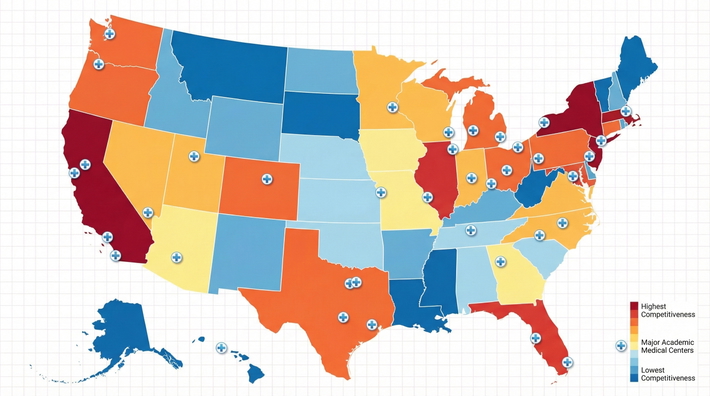
The belief that “you can reset your geography with fellowship” is only half true—and half dangerous.
If you plan your training moves like a chess player, fellowship can absolutely shift your career region. If you treat it as a last‑minute escape hatch, it usually does not.
Let me walk you through how this really works, specialty by specialty, region by region, so you’re not guessing with the next 5–10 years of your life.
The Core Answer: Does Switching Regions for Fellowship Reset Your Career Geography?
Short version:
Switching regions for fellowship can reposition you, but it rarely fully resets your geographic reputation unless three conditions line up:
- You move to a region where you actually want to stay long term.
- Your fellowship program has strong local job placement power.
- You actively build that region’s network during fellowship (and do not disappear into research or just “keep your head down”).
If you ignore any of those, your “reset” will be partial at best. Plenty of residents move from Midwest → East Coast for fellowship, then still end up taking jobs back in the Midwest because that’s where their name and letters are strongest.
Think of fellowship not as a reset button, but as a strong directional nudge. It can move you into a new orbit—but gravity from your prior region is still pulling.
How Much Does Region Matter in Hiring?
Program directors and practice leaders care about three things:
- Where you trained
- Who will vouch for you
- Whether you “fit” their region and practice culture
Region is shorthand for all of that.
Here’s the pattern I’ve seen over and over:
- Big coastal academic centers: heavily biased toward people trained in their own region or other name‑brand places.
- Community jobs in the South/Midwest: more open to people from anywhere, but prefer applicants who “get” the local patient population and lifestyle.
- West Coast: extra sticky. Once you’re in, you’re in. Getting in late is possible but harder.
Fellowship can override your residency geography if the fellowship is in the exact region you want and you lean into that network hard.
How Different Training Pathways Affect Geography
Not all training paths are equal when it comes to geographic reset.
| Path | Reset Power | Typical Effect |
|---|---|---|
| Competitive subspecialty fellowship (cards, GI, heme/onc) | High | Strongly tied to fellowship region |
| Moderate fellowship (endocrine, rheum, ID) | Medium | Mix of residency + fellowship region |
| No fellowship (hospitalist, primary care) | Low | Residency region dominates |
| Highly niche/academic fellowship | High | Tied to niche centers more than region |
Internal Medicine → Fellowship
For IM subspecialties (cardiology, GI, heme/onc, PCCM):
- Hiring committees often say, “Where did you do fellowship?” before they ask where you did residency.
- Your mentors and letters from fellowship usually speak louder than residency faculty.
- Many groups explicitly recruit from their “known” fellowship programs.
So yes, here, switching regions for fellowship can substantially shift your geography.
But not automatically. A cardiology fellow at a big Northeast program who spends all of fellowship doing bench research with zero local clinical mentors will not have the same local job power as the co‑fellow who joins every local echo committee, moonlights, and goes to every regional meeting.
Surgery and Surgical Subspecialties
Surgery is old‑school, relationship‑heavy, and often provincial.
- Residency pedigree still matters a lot. People remember where you “grew up.”
- But for surgical subspecialties (vascular, CT, surg onc, MIS, etc), fellowship can be a major rebrand—if you want an academic career or you stay tied to that fellowship’s regional alumni network.
If you do gen surg residency in the Midwest, then vascular fellowship on the West Coast and aggressively network there, you can absolutely anchor yourself on the West Coast. If you do fellowship there but tell everyone, “Yeah, I’ll probably move back home,” guess what offers you’ll get?
EM, Pediatrics, Psychiatry, Family Med
Many physicians in these fields either:
- Do not do fellowship, or
- Do shorter/niche fellowships (peds EM, child psych, addiction, Geri, etc.)
For them, residency region is usually still king. Fellowship gives you a specialty angle, but not always a full geographic reset. It gives you an extra door in a region, not an automatic relocation package.
Regional Dynamics: What Actually “Sticks” You
Different U.S. regions have different “stickiness.” If you are thinking about moving regions for fellowship, you need to understand what you’re moving into.
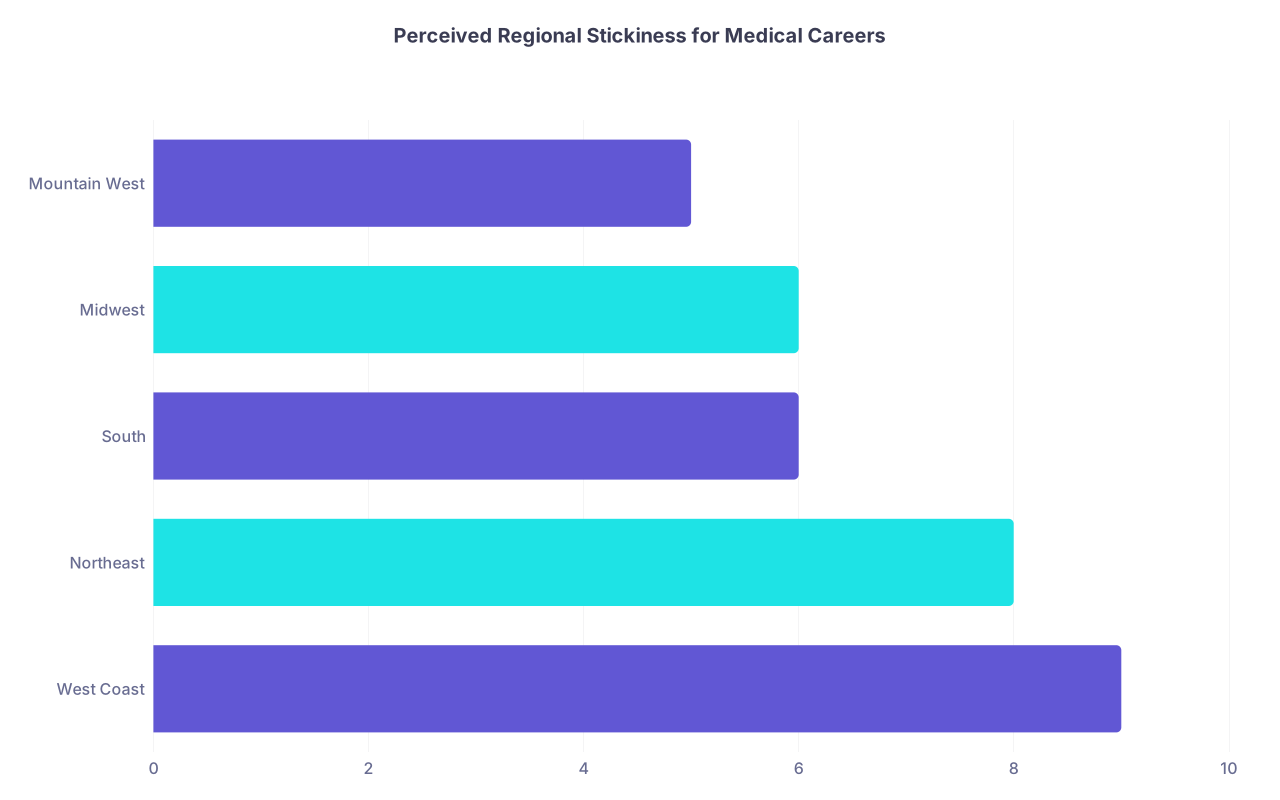
| Category | Value |
|---|---|
| West Coast | 9 |
| Northeast | 8 |
| South | 6 |
| Midwest | 6 |
| Mountain West | 5 |
Northeast
- Dense with academic centers. Heavy Ivy/name‑brand bias.
- Networks are tight; people know each other across hospitals and systems.
- If you do fellowship here and impress the right people, your Northeast options explode, but your prior Midwest residency becomes a minor footnote.
West Coast
- Limited spots relative to demand. Fiercely competitive for both residency and attending roles.
- Fellowship here is one of the best ways to break in, but you need local mentors actively selling you to their contacts.
- If you want to stay West Coast, aim for fellowship there. Trying to jump in as an attending from East Coast/Midwest without any West Coast training is much harder.
Midwest
- Often more open and pragmatic. They’ll hire good people from anywhere.
- If you trained in the Midwest and go coastal for fellowship, you can almost always come back if you want. The reverse is less guaranteed.
- Midwest fellowship can still help you move coasts, but you’ll lean more on research profile or specific niche, not just geography.
South
- Rapid growth, huge demand. Often flexible with geographic background.
- Strong in‑region loyalties (e.g., UT system, UAB, Emory networks).
- Doing fellowship in the South is a good launch pad for staying there, but also not a bad neutral base to move elsewhere if your CV is strong.
Mountain West
- Small ecosystem, everyone knows everyone.
- If you want to land here long‑term, one training stop in the region (residency or fellowship) helps a lot.
- Fellowship switch into Mountain West is possible, but you typically need clear commitment to the region (hiking, outdoor lifestyle, family there, etc.) to convince them you’ll actually stay.
How Programs Really Think: The Hidden Hiring Algorithm
Here’s the unspoken logic I’ve heard in conference rooms:
- “If they did fellowship here and were solid, we trust them.”
- “If they trained here and then went to [strong regional program] for fellowship and want to come back, that’s a plus.”
- “All their training is East Coast, and now they want to come to [small Southern city]? Are they actually going to stay?”
Fellowship gives hiring committees one of three stories:
- Linear local story: Residency and fellowship in the same region. Easiest to hire.
- Upgrade story: Residency in Region A → Fellowship in a “bigger” or more prestigious program in Region B. Good for Region B, still workable for Region A.
- Random walk story: Midwest residency → West Coast fellowship → applying for jobs in the Northeast “because partner matched there.” Harder sell unless your CV is stellar or you have a clear personal tie.
Your goal: avoid the random walk story. Build a coherent narrative.
When Fellowship Really Does Reset Your Geography
Here are the situations where fellowship is almost a true reset:
You move into a hyper‑prestigious fellowship that “travels” anywhere
Think: MGH cards, UCSF GI, MD Anderson heme/onc. Those names override a lot of geographic inertia. You’ll be competitive in multiple regions.You pivot from community residency to big academic fellowship and want an academic career
The academic world will care far more about your fellowship institution, research, and mentors than where you did residency.Your specialty is under‑supplied in a region
Example: certain oncology or advanced GI roles in the Mountain West or South. If fellowship is in that region and you’re willing to stay, you become very marketable.You had no strong ties before, and fellowship is your first “anchor”
If no clear home region from undergrad/med school/residency, fellowship in a region and serious local networking essentially makes that your new base.
When Fellowship Won’t Save Your Geography
You should not assume fellowship resets geography if:
- You hide in the lab for 3 years and barely interact with the local clinical community.
- You openly talk about, “Yeah, I’ll probably go back to [other region]” all through fellowship.
- The fellowship is small, not well‑connected, or historically poor at local job placement.
- You burn bridges or stay totally unknown to decision‑makers.
I’ve watched fellows finish at solid East Coast programs and end up back in their residency region simply because nobody locally really knew them or felt invested in their career.
How to Use Fellowship Intentionally to Shift Regions
If you’ve decided: “I want to change regions and stick the landing there,” here is the practical roadmap.

| Step | Description |
|---|---|
| Step 1 | Choose Target Region |
| Step 2 | Apply to Fellowships in That Region |
| Step 3 | Rank Programs by Local Placement Power |
| Step 4 | Match and Move |
| Step 5 | Find Local Mentors Early |
| Step 6 | Do Rotations at Target Hospitals |
| Step 7 | Attend Regional Meetings |
| Step 8 | Express Clear Intent to Stay |
| Step 9 | Apply Strategically to Local Jobs |
Key moves:
Pick the region first, not the fellowship “vibe.”
Decide: “I want to end up on the West Coast long‑term.” Then prioritize West Coast programs with strong job placement over marginal differences in call schedule or slightly nicer housing.Ask every program one blunt question:
“Where have your last 5 grads taken jobs?”
If most of them stay in the region and are happy, that program is a real geographic bridge.Front‑load networking in PGY‑4 / fellowship year 1.
Do visiting rotations, moonlight in the systems you might want to work for, show up at regional conferences. Ask your PD, “Who should I meet if I want to stay in this region?”Be explicit about wanting to stay.
Faculty will not assume this. Actual sentence you should say:
“I’m hoping to build my career in this region. If you hear of any groups looking in the next year or two, I’d love to be on that radar.”Align your personal life story with the region.
Even if you didn’t grow up there, lean into whatever is true: spouse’s family there, kids in local schools, your genuine love for that environment. People are scared of hiring “flight risks.”
Special Note for People Aiming to Move “Up” (Prestige or Competition)
Many residents in the Midwest or South want to move to big‑name coastal centers through fellowship. That’s realistic—but not automatic.
You need:
- Strong letters clearly stating you’re top tier in your class.
- At least some research output that proves you can play in a more academic ecosystem.
- A believable reason in your application and interviews: “Why this region now?”
Once you secure that fellowship, your old geography matters much less—but only if you behave like you’re joining that region for real, not just passing through.
Quick Reality Check: Common Scenarios

Here are a few patterns I see constantly, with blunt outcomes.
Scenario 1:
IM resident in the Midwest → cards fellowship in the Northeast → wants to stay Northeast.
Outcome: Very possible. Fellowship letters + local network often win. Midwest becomes a backup region, not your default.
Scenario 2:
IM resident in the Northeast → GI fellowship in the South → wants to go back to Northeast.
Outcome: Mixed. If your GI fellowship is big‑name and you maintain Northeast ties (mentors, conferences, research), you can go back. If not, you might find the South and Midwest more receptive than the Northeast.
Scenario 3:
Community residency in the South → solid academic fellowship in West Coast → wants any coastal job.
Outcome: Fellowship can be a real reset. West Coast is still tough, but your odds are much better than trying to jump straight after residency.
Scenario 4:
Residency and fellowship both in the Midwest → decides at the end of fellowship to move to California “for lifestyle.”
Outcome: Fighting an uphill battle. Possible, but you’re now competing with people who trained locally and have deep local mentors.
Tools to Help You Decide Where to Do Fellowship
Two things you should track:
- Where you’ve already built capital: med school, residency, family, etc.
- Where you want to be 10 years from now, not just 3.
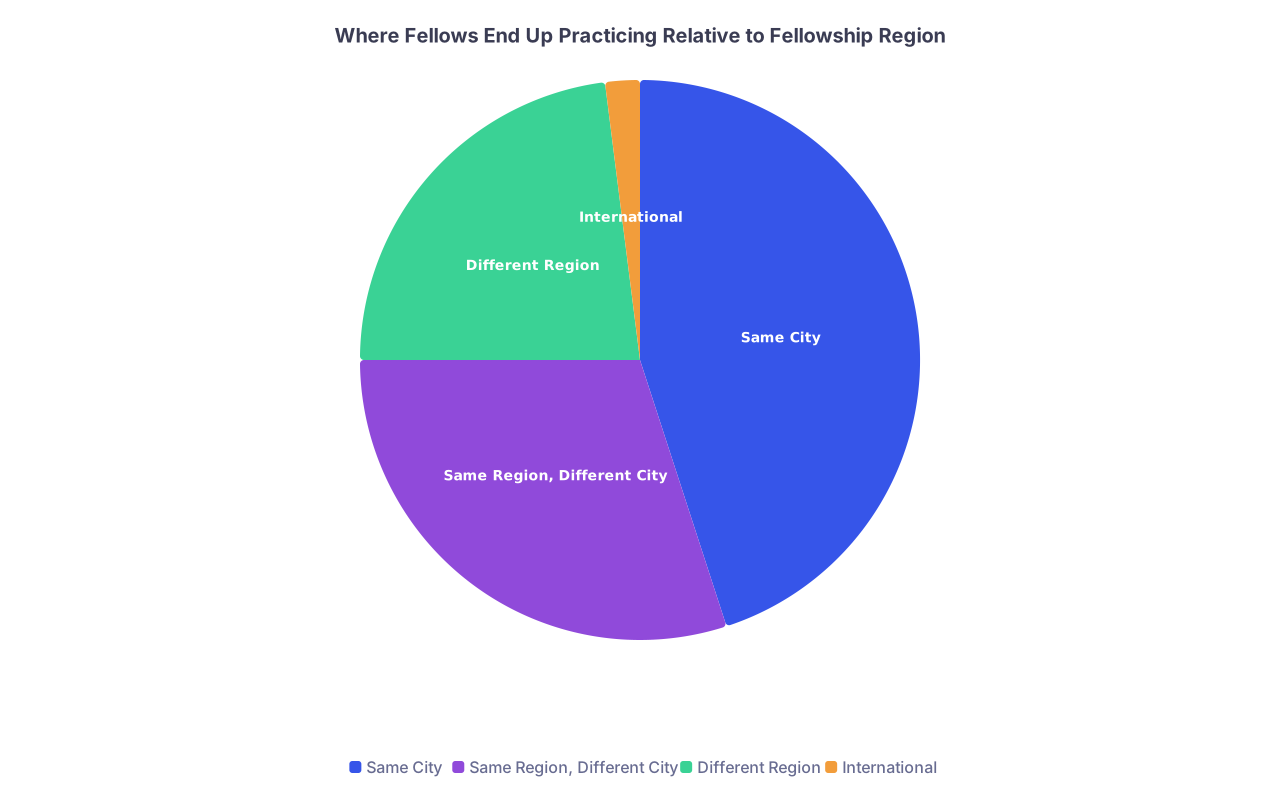
| Category | Value |
|---|---|
| Same City | 45 |
| Same Region, Different City | 30 |
| Different Region | 23 |
| International | 2 |
Roughly speaking (varies by specialty, but this is a common pattern):
- Almost half of fellows stay in the same city or metro area as their fellowship.
- Most of the rest are still in the same broader region.
- Only a minority use fellowship to hop to a completely different region—unless that was clearly intentional and supported by a strong network.
So if you want to “reset” your geography, you should assume:
“Where I do fellowship is where I’m most likely to end up.”
If that terrifies you, pick a different region.
One More Angle: Future of Medicine and Remote Flexibility
You’re reading this under “MISCELLANEOUS AND FUTURE OF MEDICINE,” so let’s hit the forward‑looking piece.
AI, telemedicine, and hybrid practice models are slowly loosening regional constraints for some fields: radiology, pathology, derm, psych, certain IM subspecialties. Some physicians already live in one state, read scans or see telehealth patients in another, and fly in occasionally.
But hospital‑based, procedural, and inpatient specialties are not going virtual in any meaningful way soon. Your geography will still matter. People will still ask, “Where did you train?” and think regionally.
What may change:
- Multi‑hospital systems spanning regions, making it easier to move within a corporate network.
- More hybrid roles where you can leverage a prestigious fellowship brand remotely to work from a different region.
Do not bet your entire early‑career strategy on that future flexibility. Use fellowship to build real, physical regional capital now, then adapt as options expand.
FAQ: Fellowship and Career Geography
1. If I love my residency region but want a “bigger name” fellowship elsewhere, will I hurt my chances of coming back?
Not usually. If your home region likes you, going to a more prestigious fellowship can actually increase your value when you return. Just stay in touch with mentors and let them know early: “I’d like to come back after fellowship—please keep me in mind.”
2. Does doing both residency and fellowship in the same region limit me geographically later?
It concentrates your network, but it does not irreversibly trap you. You can still move later, especially if your field is in demand or you’re willing to take less “perfect” first jobs. But yes, early‑career moves are harder the farther you go from your training base.
3. How early in residency should I think about fellowship geography?
By PGY‑2 you should have at least a tentative answer to: “Which regions am I open to long‑term?” You do not need it perfect, but you should not wait until fellowship rank list time to think about it for the first time.
4. Is a prestigious fellowship in the “wrong” region better than a solid fellowship in the region I want to live in?
If you want an academic career or ultra‑competitive subspecialty role, prestige may win. If your primary goal is long‑term stability in a specific region, a slightly less famous program in that region is often the better strategic choice. It depends which you care about more: brand or geography.
5. What’s one concrete step I can take this month to clarify my geographic strategy?
Pull up a map and mark: places you’d be happy long‑term, places you’d tolerate for 3–5 years, and hard nos. Then compare that to your current and potential fellowship locations. If your planned fellowship applications don’t line up with your “happy long‑term” map, adjust your list before you submit.
Now, open a blank page and write one sentence: “Ten years from now, I want to be practicing in ______ doing ______.” Use that sentence to decide which fellowship regions go on—and off—your rank list.