Texas GME does not behave like the coasts—and pretending it does will get you misled fast.
If you are thinking about training in Texas and you treat it like “just another state,” you will misunderstand the money, the power structure, and even why residents seem…strangely content compared with some other regions.
Let me break this down specifically.
1. Why Texas GME Is Its Own Ecosystem
Texas built its own GME universe on purpose.
Three pillars define the culture:
- Heavy state involvement and relatively stable funding.
- A strong culture of institutional autonomy—schools and hospital systems guard their independence aggressively.
- A very explicit, sometimes old‑school hierarchy in daily clinical life.
This is not New York’s union-heavy grind. Not California’s litigation‑sensitive, tech‑polished vibe. Texas GME grew out of:
- Rapid population growth
- A legislature obsessed with doctor supply (especially rural)
- The 2003 tort reform wave that turned Texas into a malpractice “safe zone”
- A decentralized higher-ed and hospital system that does not like Washington telling it what to do
You feel this as a resident from day one: how you are funded, how much leverage you have, how PDs talk to hospital executives, even how often you see the CMO in the hallways.
Let’s start with the money, because in Texas, money really does shape culture.
2. Funding: Why Texas Can Expand GME When Others Are Stuck
Most residents have a vague idea that “Medicare funds residency.” In Texas, that is only half the story and it is why you see new programs and expanded classes that would be impossible in some coastal states.
2.1 The layered funding model in Texas
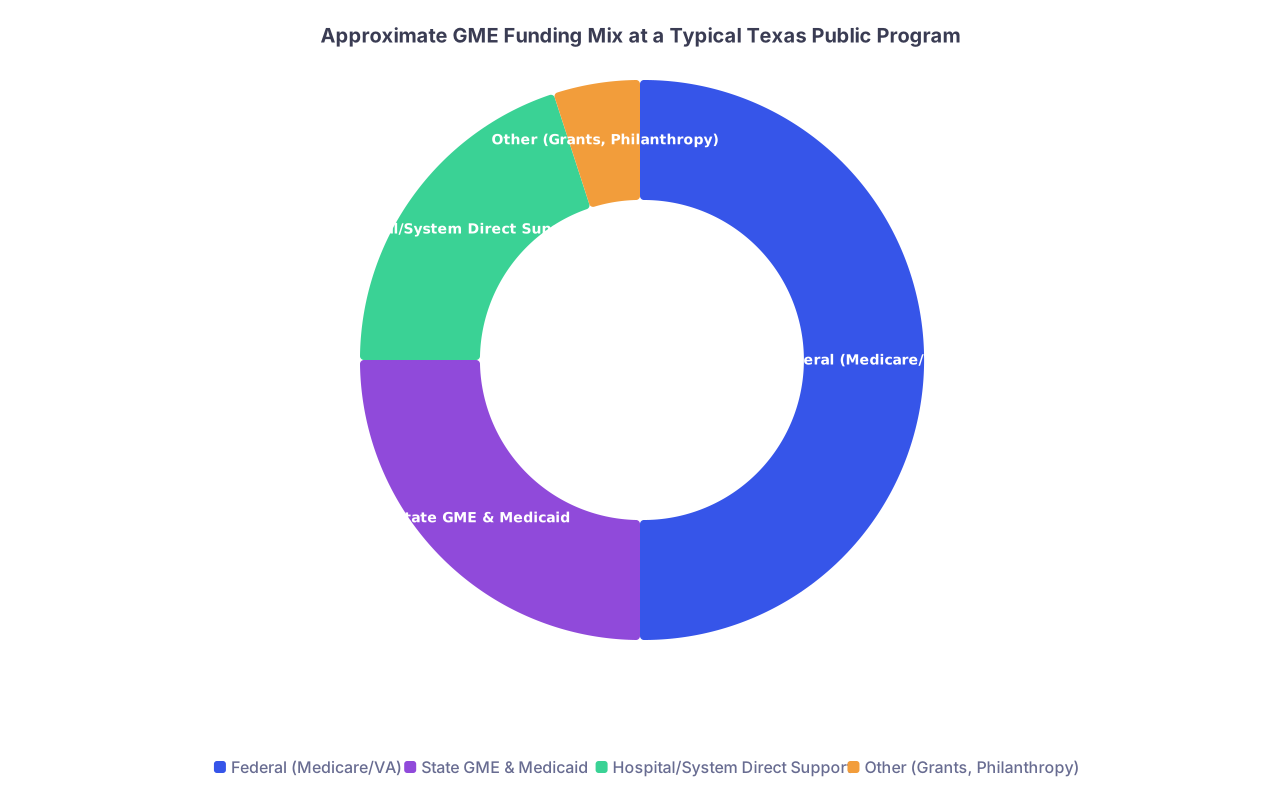
At a typical Texas program, resident positions are supported by a mix of:
- Federal GME dollars (Medicare DGME + IME)
- State GME expansion funds
- Medicaid GME (for some systems)
- Health system / hospital operating budgets
- VA or military funds (in specific sites)
- Occasionally, local “GME expansion” grants tied to community need
The key difference: Texas has repeatedly chosen, at the state level, to put real money behind GME expansion—even after the federal cap essentially froze Medicare-funded slots.
| Category | Value |
|---|---|
| Federal (Medicare/VA) | 50 |
| State GME & Medicaid | 25 |
| Hospital/System Direct Support | 20 |
| Other (Grants, Philanthropy) | 5 |
These numbers obviously vary by institution, but the pattern is consistent: Texas programs do not live and die on Medicare caps alone.
2.2 State-driven GME expansion
Texas has been unusually aggressive about expanding residency slots to match its exploding population and med school growth. The state does not want to train students in-state and lose them to other regions because there are no residency seats.
Concrete examples you will hear people grumble or brag about in halls:
- The Texas Higher Education Coordinating Board has targeted a 1.1:1 ratio of PGY-1 positions to Texas med school grads.
- Legislative sessions have repeatedly allocated tens of millions to:
- Start new GME programs in historically underserved regions (Rio Grande Valley, West Texas, rural hubs).
- Increase slots in high-need specialties—FM, IM, psych, EM, gen surgery.
- Support “new program” startup costs (an unsexy but huge deal for hospitals contemplating GME).
What that feels like from the resident side:
- You see brand-new programs popping up in mid-size cities—Harlingen, McAllen, Tyler, Lubbock expansions, programs around the Rio Grande Valley.
- Established metros (Houston, Dallas, San Antonio, Austin) keep absorbing more residents and fellows every few years.
- Hospitals with no prior academic culture suddenly have “GME offices” and call themselves “teaching hospitals.”
This expansion culture makes Texas GME feel fluid and opportunistic. You see PDs designing programs without the fatalism that often comes from federal cap limitations alone.
2.3 Public systems vs “private academic” in Texas
Texas has a mix of:
- Public academic giants:
UT Southwestern in Dallas, UT Houston (McGovern), UTMB Galveston, UT San Antonio, UT Rio Grande Valley, Texas Tech, Texas A&M, UT Tyler, etc. - Large not‑for‑profit systems with strong academic arms:
Baylor Scott & White, Methodist, Memorial Hermann, CHRISTUS in some regions. - “Academic‑community hybrids”:
HCA or joint ventures with universities, where the academic label is new, but the hospital has been community-focused for years.
The funding and control structure differs, and residents feel it:
| Institution Type | Funding Flavor | Culture Snapshot |
|---|---|---|
| Flagship UT / Texas Tech | Heavy state + Medicare + hospital | Strong academic identity, big hierarchies |
| Large private nonprofit | Hospital‑driven + Medicare + some state | High service load, pragmatic teaching |
| HCA / new community program | System‑driven, heavy service revenue | Lean faculty, more autonomy, variable rigor |
At a UT or Texas Tech campus, you will hear phrases like “legislative priorities,” “state appropriation,” and “UTH salary models.” At community-driven programs, administrators talk more about “service lines,” “RVUs,” and “case mix.”
Different language. Different incentives. Different culture.
3. Autonomy: Texas Programs Run Their Own Show
Texas GME is decentralized by design. Institutions are jealous of their autonomy. That bleeds into how residency and fellowship programs are structured and how much latitude you have as a trainee.
3.1 Autonomy at the institutional level
Here is the hierarchy that matters behind the scenes:
- State: Sets broad GME funding mechanisms, medical board regulations, tort environment.
- University systems: UT System, Texas Tech, Texas A&M, UH, etc., each with their own regents, internal politics, and academic priorities.
- Hospital systems: County hospitals, VA, private systems that hold clinical contracts and control day-to-day resources.
- Individual programs: PDs, chairs, and service line chiefs negotiating call, staffing, and scope of training.
No single entity micromanages everything. The ACGME does not get involved unless something is egregious. The state cares about output—more physicians, certain specialties—not your night float schedule.
So what you see as a resident:
- Enormous variability in autonomy between programs—even within the same city.
- One IM program in Houston lets PGY-2s run open ICUs with minimal in-house attending presence overnight; another 5 miles away has intensivists physically present 24/7 and expects detailed checkouts.
- Some EM programs allow early, aggressive procedural autonomy; others keep attendings very hands-on.
You graduate with far more independence at some Texas programs than at “big-name” residencies on the coasts. You also carry more responsibility earlier. It is not theoretical.
3.2 Resident-level autonomy: “See one, do one, teach one” is not dead here
At several Texas hospitals, the old ethos is alive:
- PGY‑1s putting in central lines at 2 a.m. with phone backup only.
- EM juniors running codes while the attending stands at the doorway, letting them sweat.
- Surgery residents doing unsupervised bedside procedures that in some states would involve a nurse manager, a checklist, three consents, and a safety committee.
Is that always good? No. But it is culturally accepted. You will hear things like:
- “This is how we make real doctors.”
- “By the time you are attending in Lubbock or Odessa, no one is holding your hand.”
And to be blunt, there is some truth to it. Many Texas‑trained grads—especially from county-heavy or border programs—are frighteningly competent in low‑resource, high‑volume environments. They had to be.
3.3 Administrative autonomy: PDs with teeth
In a lot of Texas programs, PDs are not just rubber stamps. They have:
- Direct lines to chairs and CMOs.
- Leveraged positions because GME expansion dollars matter to the hospital’s long-term growth.
- Strong local culture to support “we train our people our way” as long as ACGME boxes are checked.
So decisions about:
- Block schedules
- Call burden
- Which electives exist (and which quietly disappear)
- Protected didactics time
are heavily local. There is rarely a regional or system‑wide template imposed from above.
You get “UT Southwestern style” vs “Parkland style” vs “Methodist style” vs “McAllen style”—and they are not the same.
4. Hierarchies: Old-School Medicine, Texas Edition
Hierarchies in Texas GME are less subtle than on the coasts. People say the quiet parts out loud.
4.1 The standard clinical pecking order
The basic structure is familiar:
- Attending physician
- Fellow (where applicable)
- Senior resident
- Junior resident
- Intern
- Medical student
- Nursing staff / APPs with parallel clinical authority
But the tone is different. A few traits I see repeatedly:
Strong emphasis on “knowing your place” early in training.
Interns are expected to over-communicate, not freelance.Seniors genuinely “own” the team.
It is common to hear: “This is Dr. X’s team; any issues go through him/her.” Seniors are evaluated not just on knowledge but on authority and control of the floor.Chairs and program leadership command real deference.
You will see standing-room-only when the department chair gives grand rounds. People still stand when certain long‑tenured attendings walk into a meeting.Nursing hierarchies are also formal.
Charge nurses, nurse managers, and longstanding unit RNs carry a lot of informal power, and the culture respects their seniority.
It is not as “flat” or collaborative‑performative as some West Coast teams try to be. Hierarchy is accepted as the default structure to keep a gigantic, high-acuity machine functioning.
4.2 Where hierarchy is strict vs where it melts
Hierarchy is most rigid in:
High-acuity, high-liability environments:
- Trauma bays at county hospitals.
- Busy ICUs in large urban centers (Houston, Dallas, San Antonio).
- ORs in flagship surgical departments.
Legacy departments with long institutional memory:
- Traditional IM and surgery departments at older schools (UTMB, UTSW, Baylor-affiliated).
You see it soften more in:
- Newer community-based programs started post-2010.
- Certain specialties where recruitment has been difficult (psych, primary care in remote areas)—leadership is more accommodating because they cannot afford to alienate residents.
- Outpatient-dominant services, where teams are smaller and more longitudinal.
In some of the newer HCA/partner programs, the vibe is: “We need happy residents or this program will implode and lose accreditation.” That tempers the hierarchy a bit.
4.3 How this impacts daily life
A few concrete scenarios:
On rounds, at an older UT program:
The attending grills the senior. The senior turns around later and quietly grills the intern. The med student is supposed to absorb, not interrupt. Questions are allowed, but timing and tone matter.On rounds, at a newer community-academic hybrid:
Attending is more relaxed, calls everyone by first name, expects open questions from students. But decisions still flow downward—there is no illusion of consensus democracy.Calling consults:
As a Texas intern in medicine or surgery, you learn quickly that how you present and your perceived rank can determine how fast a consultant shows up. Seniors coach you on phrasing and “consult etiquette.” That is hierarchy in practice.
The upside: clarity. You know who is in charge. You know whose name is on the line. The downside: pushing back against bad decisions or toxic personalities requires more finesse and usually senior backing.
5. The Legal and Political Environment: Why Everyone Acts Less Afraid
You cannot talk about Texas GME culture without mentioning tort reform and politics. They are background radiation.
5.1 Malpractice environment and its subtle effects
Since 2003, Texas has had some of the most physician-friendly malpractice caps in the country. Physicians bring this up a lot more in private than in public forums, but it shapes behavior.
What you see in training:
- Less obsessive documentation driven purely by fear of litigation.
- Attendings slightly more willing to let residents take first pass on procedures and complex encounters.
- A culture that tolerates “doing what is clinically right even if it is not defensively perfect.”
Compare that to states where every senior physician’s first instinct is, “How does this look in court?” Texas is not lawless, but it is less paralyzed by worst-case legal scenarios.
5.2 Politics and institutional stance
Texas is politically conservative at the state level, but academic centers are large, diverse, and sometimes openly at odds with Austin on specific issues (public health, reproductive care, Medicaid expansion).
For you as a resident, this plays out as:
- Certain kinds of research or advocacy (reproductive rights, border health policy, migrant health) are politically hot. Some departments are highly supportive; others quietly discourage getting “too public.”
- Rural service commitments and pipeline programs are praised and funded; you will see scholarships and loan repayment for people headed to small towns.
- Some specialties (OB/GYN, EM) must navigate state laws that affect what care is allowed or how it must be documented. Residents see this daily.
Texas GME admins are used to operating within these constraints. They work around them aggressively, but not carelessly.
6. Workload, Lifestyle, and Resident Satisfaction: The Real Tradeoffs
Let us be direct: Texas residencies are not “easy,” but they can feel sustainable when compared with certain northeast or west coast programs.
6.1 Service load vs support
Texas has high patient volumes, especially in:
- County hospitals (Parkland, Ben Taub, University Health San Antonio, Dell/Seton safety-net, etc.).
- Border and near‑border institutions serving uninsured and underinsured populations.
You will see:
- High census on ward teams.
- Intense ED throughput expectations.
- Large volumes of pathology that coastal trainees only see in board questions.
Yet you also see:
Reasonable cost of living.
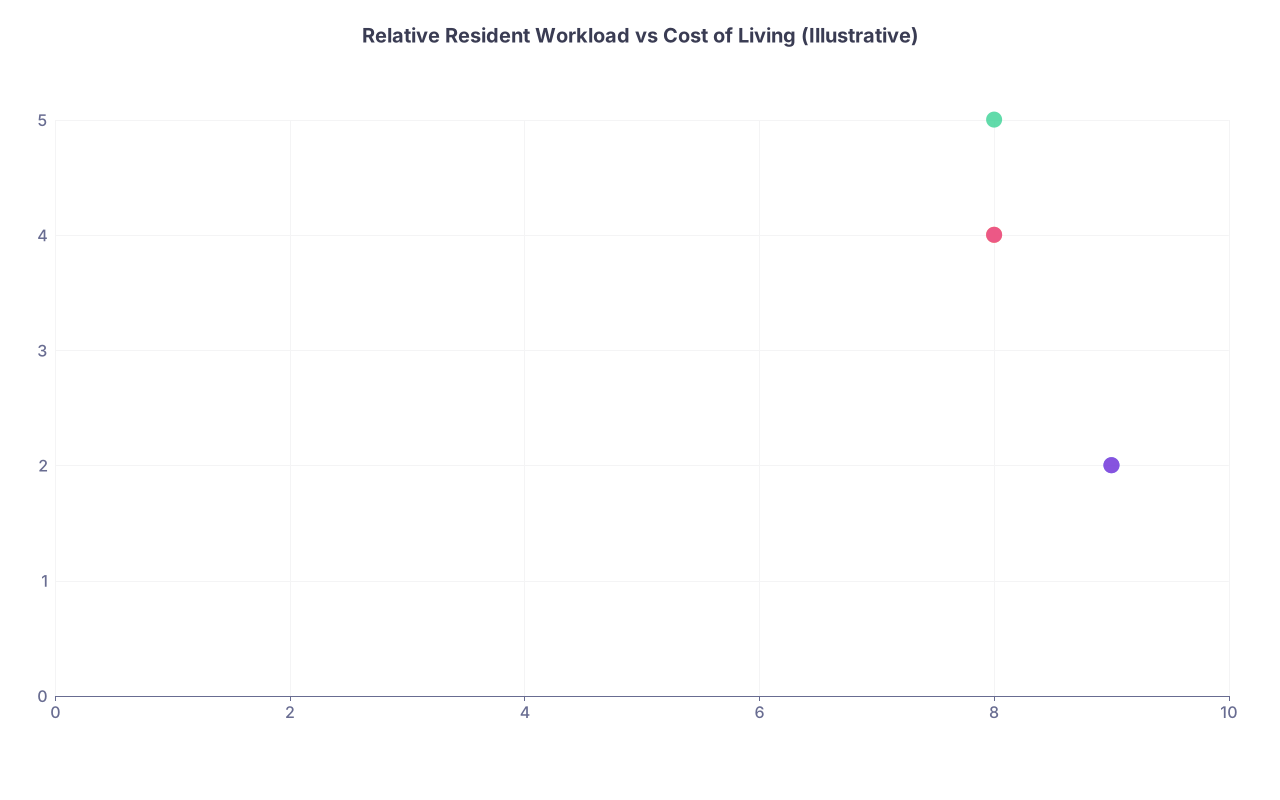
A PGY‑2 salary in Houston or San Antonio stretches much further than in LA or NYC.Often, a culture that sees residents as part of the long-term regional workforce.
Programs want you to stay in Texas. They do not want to crush you to the point you run to another state.
| Category | Value |
|---|---|
| NYC Academic | 9,2 |
| SF Academic | 9,2 |
| Houston Academic | 8,5 |
| San Antonio County | 8,4 |
| Dallas Academic | 8,4 |
(Where x = workload intensity 1–10, y = cost-of-living favorability 1–10; illustrative, but captures the general sentiment.)
6.2 Why many Texas residents seem relatively content
When you talk to residents at big Texas programs off the record, you hear things like:
- “We work hard, but I can afford an apartment alone and eat out occasionally.”
- “I am not terrified of being sued for every decision.”
- “I want to stay in Texas anyway, so networking here matters.”
The cultural undercurrent is: work is intense, but life is not structurally impossible. That contrast is striking for applicants who have rotated on both coasts.
6.3 The hidden risk: variable quality in newer programs
The dark side of rapid GME expansion: not all programs mature at the same pace.
Red flags I see in a few younger Texas programs:
- Thin faculty bench: two full-time teaching attendings “covering” a whole program.
- Over-reliance on hospitalists or locums with minimal teaching interest.
- Residents functioning as service workhorses to prop up new service lines.
- Weak subspecialty exposure in fields like rheum, ID, or complex onc.
Some of these programs will become excellent with time and leadership. Others are essentially cheap labor attached to a hospital that wanted GME dollars and prestige.
You absolutely must treat “Texas program” as a heterogeneous category. Baylor Scott & White Temple is not the same as a brand-new three‑resident-per-year program in a hospital that had zero academic culture 5 years ago.
7. How Texas GME Culture Shapes Graduates’ Careers
One reason Texas GME matters nationally: it exports a particular kind of physician.
7.1 Procedural comfort and clinical independence
Graduates of strong Texas programs, especially high-volume safety‑net and county ones, tend to:
- Be less fazed by minimal resources.
- Have strong procedural skills relative to peers from some “elite” but highly supervised programs.
- Feel comfortable early taking independent call in community settings.
You see this in:
- Texas‑trained EM docs staffing rural EDs alone at night.
- General internists handling complex ICU-lite care in community hospitals.
- Family medicine grads doing scopes, OB, and inpatient in smaller towns.
That is not universal, but the pattern is visible.
7.2 Ties to the state and retention
Texas has been fairly successful at what many states talk about: training physicians and keeping them.
Reasons:
- Many trainees are Texans to begin with and want to stay.
- The job market is robust in metropolitan and suburban areas.
- Malpractice and cost of living remain relatively favorable.
- Social and family networks are local; people do not feel forced out.
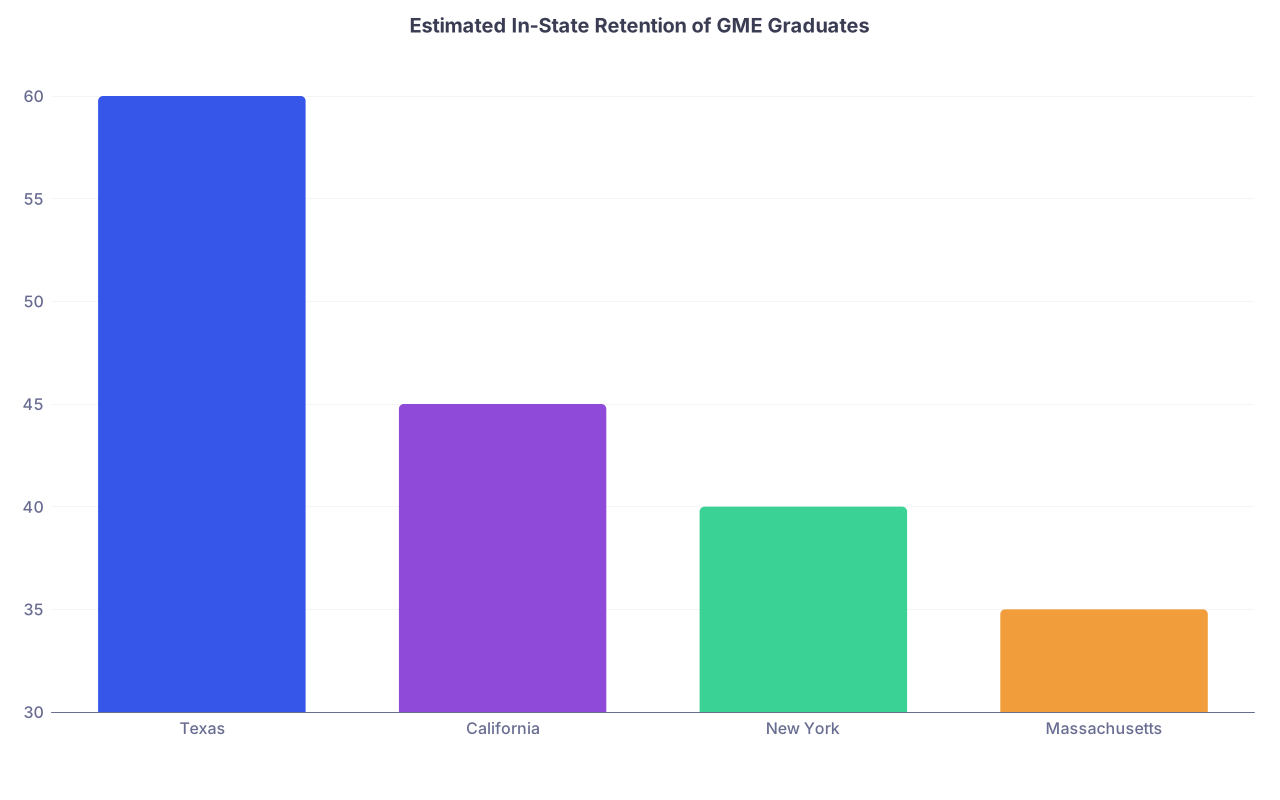
| Category | Value |
|---|---|
| Texas | 60 |
| California | 45 |
| New York | 40 |
| Massachusetts | 35 |
(Approximate, varies by specialty and data source, but Texas reliably lands on the higher end.)
7.3 National reputation and portability
Nationally, Texas GME has a mixed but predictable reputation:
- Top Texas flagships (UTSW, Baylor-affiliated, big county-based programs) are respected as high‑volume, no‑nonsense training grounds.
- Some peripheral or new programs are still “unknown quantities” to fellowship PDs in Boston or Chicago.
- The stereotype: “Good clinicians, sometimes less research‑heavy unless from specific academic powerhouses.”
If you want highly research-intense fellowships on the coasts, it matters which Texas program you choose and how intentional you are about scholarly output. But in pure clinical terms, Texas grads generally have no trouble finding jobs.
8. For Applicants: How To Read Texas GME Correctly
Let me be blunt about what you should do if you are contemplating Texas.
Do not treat all Texas programs as interchangeable.
A UT flagship, a major Baylor-affiliated site, a large county hospital, and a 3-year-old community program in an HCA system are completely different ecosystems.When you interview, ask pointed questions:
- “How are new positions funded?”
If they say “the state is supporting expansion” and can explain it, that is a good sign of institutional commitment. - “How many core faculty are 100% dedicated to education?”
Under 4 in a medium-sized program? Be cautious. - “How much autonomy do seniors have overnight? Are attendings in-house or home-call?”
This tells you about responsibility and culture.
- “How are new positions funded?”
Pay attention to how people talk about hierarchy.
- If interns are terrified of seniors, that is a culture issue, not “Texas.”
- If seniors talk about being supported but held responsible, that is just hierarchy functioning as designed.
Consider your goals relative to Texas culture:
- Want heavy autonomy, high volume, and plan to be a community workhorse? Many Texas programs will fit you well.
- Want very structured, heavily supervised, research-dominant training with big-name brand recognition on both coasts? Look carefully at only specific Texas centers—or consider elsewhere.
Ignore simplistic online narratives.
- “Texas is chill.” Not really. It is busy, but livable.
- “Texas programs are all community-level.” Definitely wrong. Some are world‑class tertiary centers.
- “New programs are always bad.” Not always—but you must vet them harder.
Key Takeaways
- Texas GME runs on a distinct blend of robust state funding, institutional autonomy, and unapologetically hierarchical clinical culture.
- Residents often get real autonomy and high-volume experience, but the quality and academic depth vary dramatically between legacy flagships and newer expansion programs.
- If you understand the money, the power structure, and the hierarchy, you can choose a Texas program that amplifies your strengths instead of trapping you in someone else’s agenda.