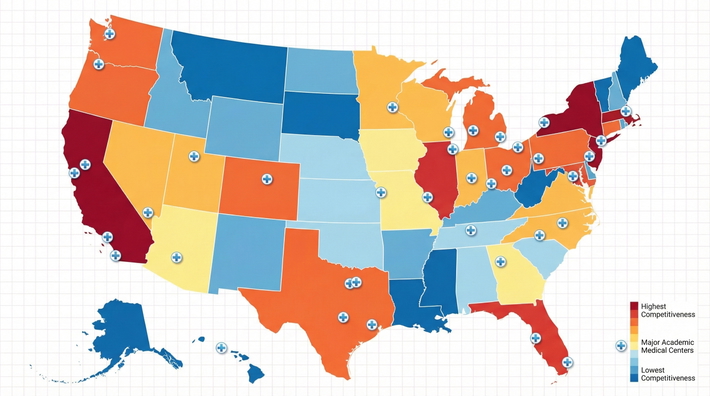
The biggest mistake students make when training in one region and wanting residency in another is assuming their application “will speak for itself.” It will not. Geography is a bias you have to actively fight.
You’re in med school in Region A. Your entire professional network, mentors, and ‘people who can pick up the phone for you’ are in Region B. You want to go back to B for residency—or move there for the first time—but everything around you (home institution programs, visiting attendings, local alumni events) is pulling you toward A.
Here’s how you bridge that gap without torpedoing your chances.
Step 1: Get Honest About Your Geographic Risk Profile
First, you need to understand how programs see you on paper.
They’re asking: “Is this person actually likely to come here, or are we just their backup region?”
Your file gets a silent, sometimes brutal, geography filter:
- Med school in Midwest, all rotations in Midwest, family in Midwest, applying to California with no ties listed? Red flag.
- DO in the South, applying to NYC with no local letters, no rotations, and a generic personal statement? Red flag.
- Caribbean IMG with all US rotations in Florida wanting to match in Boston, no New England connection? You get the idea.
Programs are drowning in applicants. Geography is an easy way to thin the pile. You need to make that filter work for you instead of against you.
Here’s how they’re mentally sorting you:
| Profile Type | How Programs Interpret It |
|---|---|
| Strong ties + rotations in region | Likely to rank us high |
| Only personal ties (family/partner) | Possible interest, needs explanation |
| Only rotations in region | Some interest, unclear long-term |
| No ties, no rotations | Probably using us as backup |
| School + ties in other region | High risk of ranking us low |
If your med school is in Region A and all your connections are in Region B, you are in the “confusing signal” category by default. Your job is to simplify that story.
Step 2: Pick a Primary and a Secondary Region—Not Five
You cannot “kind of” apply everywhere and expect a coherent narrative. Programs smell that chaos from a mile away.
You need:
- One primary target region (where you most want to match)
- One realistic secondary region (where you’d still be okay matching, and where your current school might give you more strength)
That’s it. Not four. Not “I’ll just cast a wide net across the whole country.” Wide nets usually mean shallow impressions.
If your situation is:
- Med school in Texas (Region A)
- Family, partner, long-term plans in New England (Region B)
A sensible structure might be:
- Primary: Northeast (NY/MA/CT/RI/NJ)
- Secondary: Some Texas programs and maybe adjacent states where your school has strong relationships
You do not also throw in 12 programs from California, 8 from Chicago, 5 from the Pacific Northwest “just because they’re nice cities.” That dilutes your geographic story, and it shows.
Step 3: Build Real, Documentable “Ties” to the Target Region
Programs don’t care about vibes. They care about evidence.
You’re trying to prove: “I’m actually serious about your region, not just applying everywhere.”
Let’s break down what counts as a “tie” and how strong it is:
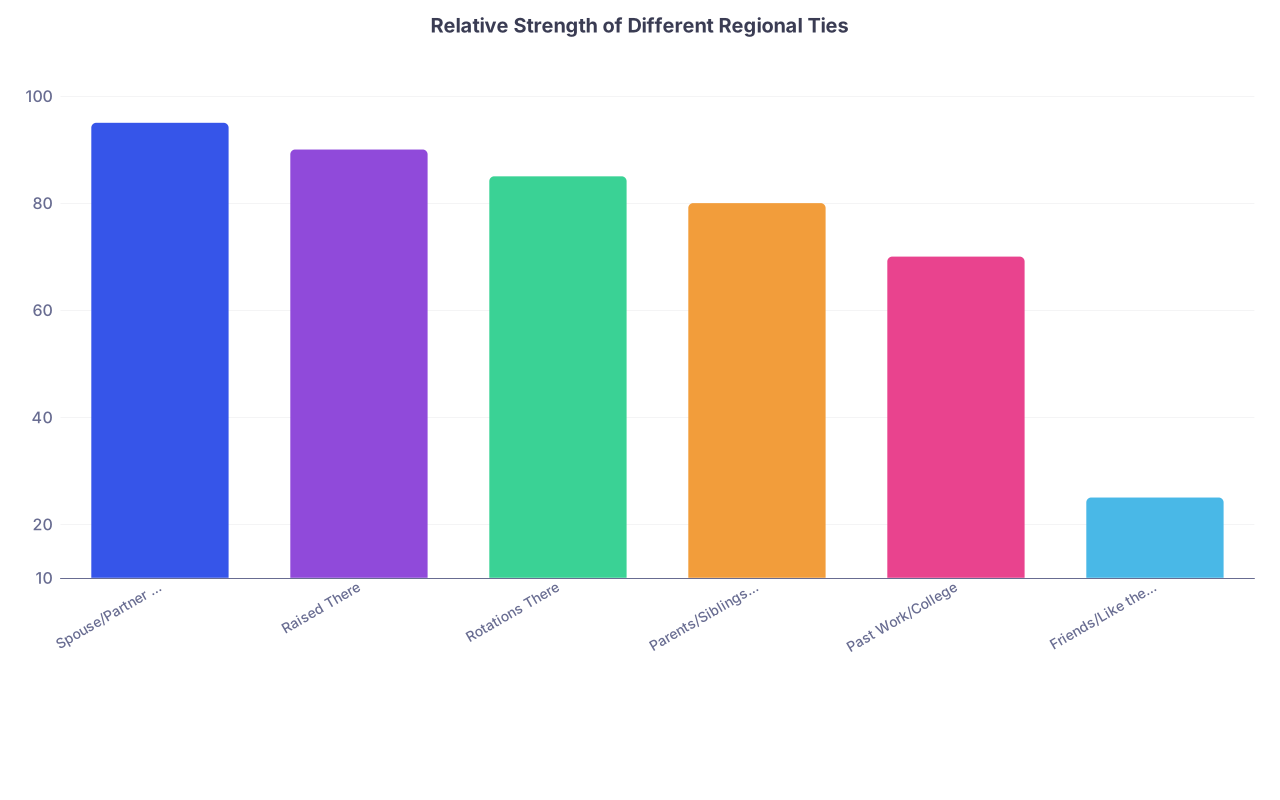
| Category | Value |
|---|---|
| Spouse/Partner There | 95 |
| Raised There | 90 |
| Rotations There | 85 |
| Parents/Siblings There | 80 |
| Past Work/College | 70 |
| Friends/Like the City | 25 |
You can’t change where you grew up. But you can create stronger signals:
Away Rotations / Auditions
If your specialty values them (surgery, ortho, EM, some IM subs), away rotations in your target region are gold.
If you’re in third year and reading this, you should be planning:- 1–2 away rotations in Region B at places you’d actually be happy to match
- Mix “reach” and “solid realistic” programs—do not do both at ultra-competitive “destination” places
On these rotations:
- Tell people plainly: “I’m in med school in X, but my family/partner/future plans are in this region. I’m trying to move here permanently.”
- Ask explicitly: “If things go well, would you be comfortable writing a letter that addresses my commitment to this area?”
Conferences and Regional Presence
Go to at least one major regional conference in your target area if your budget allows. Not just national meetings in random cities.Walk up to program booths from your target region and say:
“I go to school in [other region] but I’m planning to move to [their region] for residency long term—can you tell me how your program views applicants from outside the area?”That one sentence plants a seed. You’re no longer just “Out-of-region applicant #86.”
Past Life Ties You Forgot Were Valuable
Did you:- Go to undergrad in that region?
- Grow up there and move away for med school?
- Work a job there for a few years before M1?
- Have a long-term partner already living there?
All of those belong explicitly in your ERAS geographic preferences section and/or in one short, clear sentence in your personal statement or secondary questions.
Step 4: Engineer Letters That Cross Regions
Your letters are your portable credibility. Use them deliberately.
You should be thinking about:
- 1–2 letters from your current region (home institution, core rotations, department leadership)
- 1–2 letters that are tightly linked to your target region or clearly explain why you belong there
If your entire network is in Region B but you train in Region A, flip the usual script:
Get one strong letter from a big-name or respected physician in Region B who:
- Knows your work (research, past clinical work, scribing, pre-med job, post-bacc, etc.)
- Can explicitly say: “This applicant is committed to returning to [Region B]; they have strong professional and personal ties here.”
Then anchor that with your best clinical letters from your home institution. Programs still want to see that people where you actually trained clinically trust you.
If you’re doing research hosted in Region B (even remotely), make that PI pull some geographic weight:
- Ask them to mention your plan: “They have expressed a clear intention to practice in [region] long-term and are actively seeking residency here.”
Do not just hope letter writers will guess this. You say, directly:
“Because my med school is in [other region], I’m worried programs in [target region] will doubt my commitment to moving there. Would you be comfortable addressing that in your letter?”
That one sentence can shift how your file lands in the first read.
Step 5: Fix Your Application Story So It Doesn’t Look Split
Right now, your file might look like this chaos:
- ERAS geographic preference: “Open to any region”
- Personal statement: Generic “I love this specialty”
- Experiences: All in Region A
- “Ties” section: Mention some friends and that you like the city vibe of Region B
- Letters: Mixed with no clear pattern
That screams: “I am applying everywhere and will go wherever anyone takes me.”
If you’re truly okay matching anywhere, fine. But if you are strategically targeting Region B, your whole file needs to whisper that constantly.
Concrete fixes:
ERAS Geographic Preferences
Use it. Do not leave it blank if geography actually matters to you.If your primary goal is Region B, mark that region. If there is a secondary you’d be happy with, select it—but do not light up half the map.
Personal Statement (Short, Clean Signal)
You do not turn your PS into a travel diary. You add one surgical strike line that anchors your plan.Example:
- “Though I completed medical school in Texas, my long-term personal and professional goals are rooted in the Northeast, where my partner and extended family live and where I intend to practice.”
Or, with a bit more specificity:
- “Medical school took me to the Midwest, but my clinical mentors, family, and long-term goals are all in the Pacific Northwest, and I am committed to returning there for residency and practice.”
One or two lines. Not a paragraph. Not defensive. Just factual.
Supplemental Questions
Many programs now directly ask why their region or their specific institution. This is your chance to close the loop.Good answer pattern:
- A clear personal or professional reason you’re tied to that region (family, previous schooling, partner’s job, long-term plan)
- One program-specific reason (training style, patient population, specific track or focus)
Not: “I like [City] and I hear you’re collegial.”
Step 6: Use Rotations and Schedule Strategy to Your Advantage
If you’re still early enough to adjust your third/fourth year schedule, do it.
Here’s a simple way to think about timing:

| Step | Description |
|---|---|
| Step 1 | M3 Spring |
| Step 2 | Identify Target Region |
| Step 3 | Research Away Options |
| Step 4 | M4 Early - Away in Target Region |
| Step 5 | Get Letter Addressing Region Ties |
| Step 6 | Submit ERAS With Clear Geographic Story |
Two key principles:
Do at least one rotation in the target region before ERAS submissions if you can. That gives you:
- A letter
- Something non-flimsy to say in “why this region”
- A real feel for whether you actually like training there
Avoid loading all your away rotations at hyper-competitive name-brand programs. Especially if they’re not realistic for your stats. Better to shine at a strong mid-tier program that actually might rank you, than be anonymous in a place that takes 260+ Step 2 and nothing less.
If you’re late and can’t change rotations, you compensate with:
- Strong letters mentioning your long-term region plan
- Clear geographic preference marking
- Strategic emails (we’ll get there)
Step 7: Control the Interview Invite Odds With Smart Program Selection
If you’re applying to a region where you have fewer built-in ties, your program list has to be smarter, not just bigger.
Think about it like this:
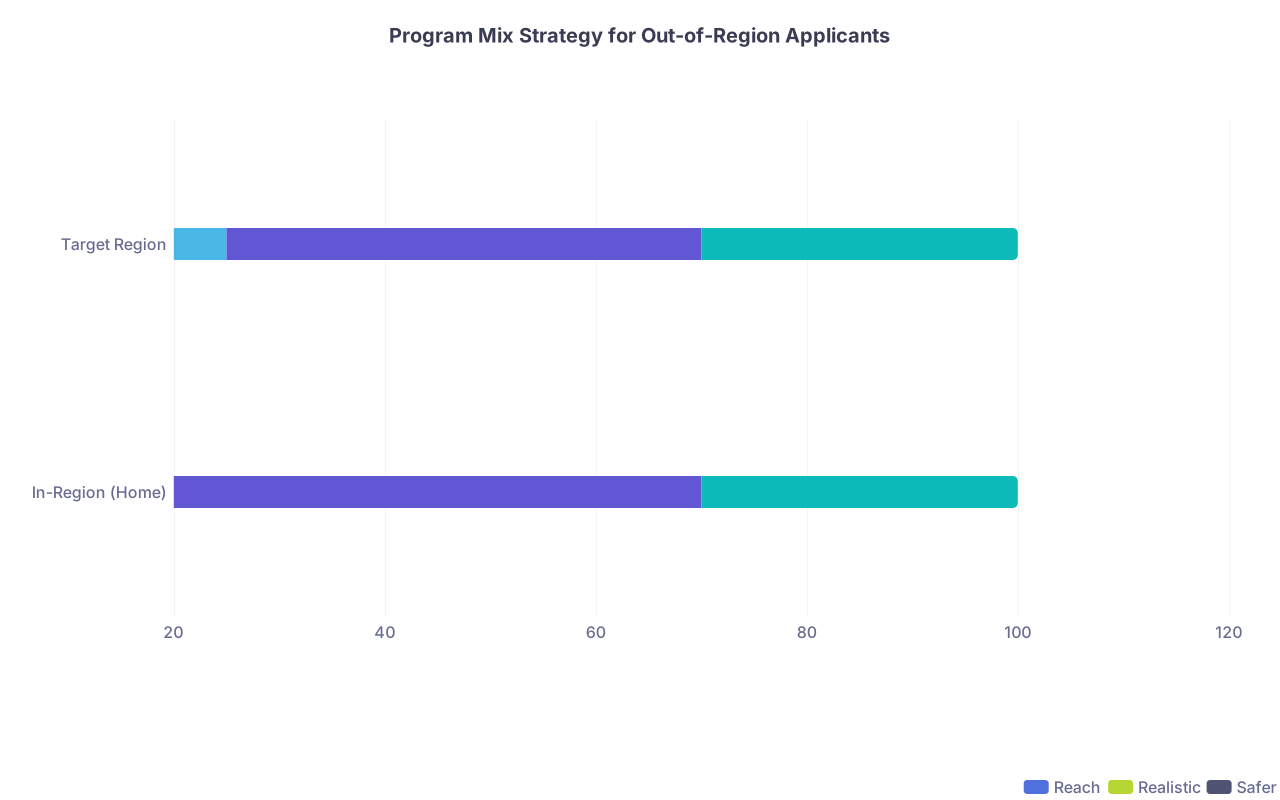
| Category | Reach | Realistic | Safer |
|---|---|---|---|
| In-Region (Home) | 20 | 50 | 30 |
| Target Region | 25 | 45 | 30 |
Translation into actual action steps:
- In your current region (home school’s area):
- You can have more “reach” because your school name carries weight locally and you may have home institution backing.
- In the target region:
- You need a healthy number of realistic and safer programs.
- Stop pretending that 15 “top brand-name” programs in your target city = a smart strategy. They do not.
If you’re from a lower-profile school or an IMG/DO, and you’re trying to change regions, prestige-chasing will kill your match chances faster than anything.
You want:
- Community and university-affiliated programs in that region
- Places known to take out-of-region applicants
- Programs where your Step/COMLEX and class rank actually put you in the competitive band
Do not just follow where your classmates are applying. Their geography and stats are not yours.
Step 8: Use Targeted Emails—But Don’t Be Annoying
Program directors are not sitting there waiting for your email. But done well, a small number of targeted messages can help, especially when you’re bridging regions.
You send very few, only when:
- You have a genuine tie (family, partner, prior degree, long-term plan)
- OR you have a real connection (their resident is your mentor, your PI collaborates with them, your home PD suggests them)
Your email should:
- Be short
- Be concrete
- Clarify why an “out-of-region” person is serious about their program
Something like:
Dear Dr. [PD],
I’m a fourth-year at [Med School in Region A] applying in [Specialty]. Though I trained in [Region A], my partner and extended family are in [City/Region B], and I’m planning to move there permanently after graduation.
I was particularly drawn to your program because of [one specific thing: curriculum structure, patient population, unique track, etc.]. My ERAS AAMC ID is [ID]. I know you receive many applications, but I wanted to briefly clarify my strong commitment to training in [Region B].
Thank you for your time,
[Name]
That’s it. You are not asking for an interview directly. You’re correcting the geographic misperception.
Send this only to a handful of truly prioritized programs, not 60.
Step 9: Handle Interviews Without Sounding Inconsistent
If you get interviews in both regions, you will absolutely be asked some version of:
“So, you’re in med school in [Region A] but now applying heavily to [Region B]. Why the move?”
You need a clean, consistent answer. Not a ramble.
Good structure:
- A concrete anchor (family, partner, long-term career plan, previous life there)
- A professional reason that fits the region (patient population, academic interest, practice style)
- A forward-looking statement (you’re not just chasing a vibe; you’re building a life there)
Example:
“I grew up in the Northeast and my partner and family are all still here, so long term I’ve always planned to come back. I went to med school in the Midwest because it was the best choice for my training at the time, but my clinical and research interests—especially in urban underserved care—fit really well with the patient population here. I’m looking for a place to train and then hopefully stay to practice, and this region makes sense both personally and professionally.”
What you do not say:
- “I’ll go wherever I match.”
- “I like big cities.”
- A totally different story at each interview depending on region.
Assume you might end up in the same fellowship application pool later and people who interviewed you in different regions may compare notes. Keep your story coherent.
Step 10: If You’re Early in Training, Start Planting Seeds Now
If you’re M1–M2 and already know your med school region and your desired residency region won’t match, you’re actually in a great position. You have time to engineer this.
Here’s how a smart multi-year plan might look:
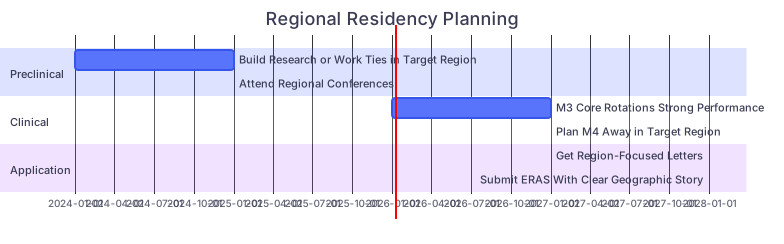
| Task | Details |
|---|---|
| Preclinical: Build Research or Work Ties in Target Region | a1, 2024, 1y |
| Preclinical: Attend Regional Conferences | a2, 2025, 0.5y |
| Clinical: M3 Core Rotations Strong Performance | b1, 2026, 1y |
| Clinical: Plan M4 Away in Target Region | b2, 2027, 0.5y |
| Application: Get Region-Focused Letters | c1, 2027, 0.5y |
| Application: Submit ERAS With Clear Geographic Story | c2, 2028, 0.5y |
Concrete early moves:
- Find research or a remote project with a PI in your target region
- Go back to that region on breaks, shadow, volunteer, maintain presence
- Make sure at least one of your strongest mentors is actually based in the region you want, even if you mostly interact virtually
You’re basically stockpiling future “ties” and letters before M4.
Step 11: Special Considerations by Background
This isn’t the same game for everyone.
DO and IMG Applicants
Moving regions as a DO or IMG is absolutely possible, but you cannot be naïve:
- Some regions are more DO/IMG-friendly than others. Study actual match lists and program rosters—don’t guess.
- Your “ties” need to be even stronger: repeated rotations, strong letters, serious geographic explanation.
- If your school has historic pipelines to certain regions, use those first, then extend strategically outward.
Couples Matching Across Regions
If you’re couples matching and your partner’s training or job is fixed in Region B, that’s a powerful, very real tie. Do not bury it.
- Mention it in interviews when appropriate
- Clarify in supplemental applications or emails that you’re couples matching and anchored to that region
- Make sure your partner’s story matches yours; no contradictions
Quick Reality Check Before You Hit Submit
Before ERAS goes out, look at your application as a stranger.
Ask three questions:
- If I knew nothing about me, what region would I assume this person is committed to, based purely on:
- Med school
- Rotations
- Experiences
- Letters (as far as I can tell)
- Does that match where I actually want to end up?
- Is there at least one clean, explicit sentence somewhere that explains the apparent mismatch?
If the story is muddy, fix it now. Small wording changes and a couple of targeted emails can be the difference between “out-of-region, probably not coming” and “realistic applicant with a clear reason to be here.”




Bottom Line
Three things matter most if you’re in med school in one region and gunning for residency in another:
- Your application needs a clear, coherent geographic story—not silence, not chaos.
- You must manufacture real ties to your target region: rotations, letters, mentors, and concrete reasons to be there.
- You can’t just apply “everywhere”; pick a primary region, a backup region, and build your entire strategy around those, from rotations to program list to how you answer “Why here?” on interview day.
Do those well, and being “out-of-region” becomes a hurdle, not a deal-breaker.