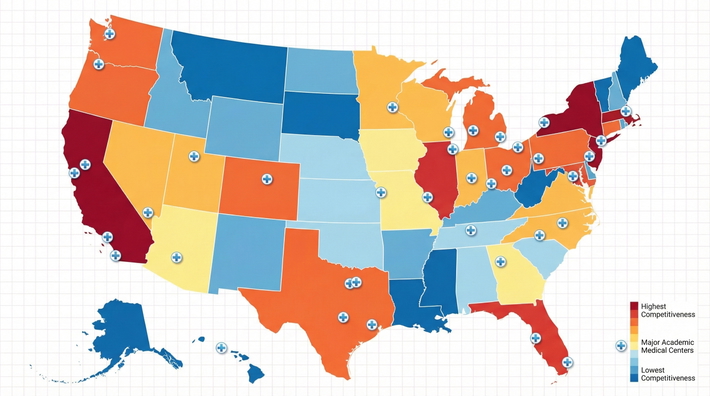
A regionally scattered rank list is not “broad.” It is a liability. Fix it before it fixes your life for you.
You applied everywhere, interviews came in from all over, and now your list looks like a dartboard someone threw at a US map. You are weeks or days from rank list certification and suddenly it hits you:
“If I match literally anywhere on this list, am I going to be happy with that city for 3–7 years?”
If your honest answer is “not really,” you have a scattered application problem. The good news: you can still fix a lot of it before rank list lock. But you need to be deliberate and a little ruthless.
This is the playbook.
1. Diagnose How Badly Scattered You Really Are

You cannot fix what you have not mapped.
Step 1: Put your current list on a map
Literally.
- Open Google My Maps, Scribble Maps, or even print a blank map.
- Drop a pin for every program where you:
- Interviewed
- Expect to rank
- Color-code:
- One color for “serious consideration”
- One color for “probably filler”
Now ask yourself three blunt questions:
Do I have clear geographic clusters, or is it pure chaos?
Example: 4 in the Northeast, 5 in Texas, 3 random on the West Coast, 2 Midwest. That is scattered.Where are my actual support systems?
Mark:- Partner / spouse
- Kids’ grandparents
- Close friends you will rely on
- Any city you lived in 2+ years
Where do I absolutely not want to live for 3–7 years?
Be honest. “I could tolerate anywhere” is how people end up miserable.
Step 2: Classify each program by geographic viability
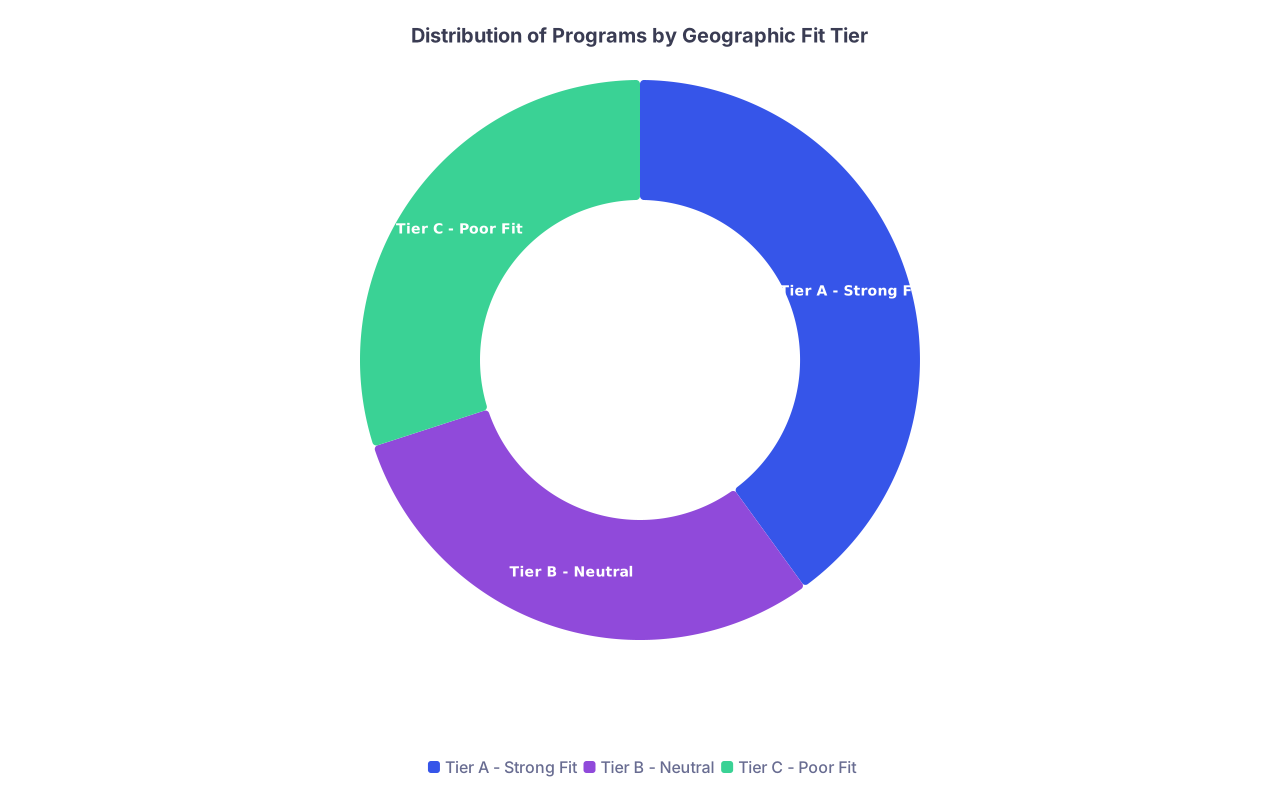
Use a harsh but useful three-tier system:
Tier A – Strong geographic fit
- In or near a city you truly want
- Within 2–4 hours of close support
- You understand the cost of living and lifestyle and still want it
Tier B – Neutral
- You do not hate the idea, but have never truly imagined living there
- You could make it work but are unsure about 5+ year prospects
Tier C – Never would have applied if you were honest
- You applied to “cast a wide net”
- You do not see yourself happy there long-term
- You would be tempted to re-apply or transfer if you matched there
Label every program A/B/C right now.
If >40% of your list is Tier C, your application is badly scattered and needs aggressive triage before rank list lock.
2. Understand What You Can Still Change Pre–Rank Lock
There is a myth that once interviews are over, everything is “set.” That is lazy thinking.
You still control three major levers:
- Which programs you rank
- The order you rank them
- How clearly your file signals regional preference (for programs still finalizing their lists)
You are not rewriting your ERAS, but you can:
- Drop programs
- Reorder based on geography and life priorities
- Send targeted, believable regional update signals to a narrow set of programs
Let’s break those down.
3. Ruthlessly Prune: Programs You Should Drop Completely
| Category | Value |
|---|---|
| Tier A - Strong Fit | 8 |
| Tier B - Neutral | 6 |
| Tier C - Poor Fit | 6 |
You do not “have” to rank every place that interviewed you. NRMP’s own guidance: only rank programs where you would be willing to train.
A scattered list becomes dangerous when you are ranking programs you do not truly want just to fill space. That is how people end up across the country from everyone they love, in a city they have no interest in, because they left a “just in case” program at #14.
A simple cut protocol
For each Tier C program, run this script:
- “If this is the only program I match at, would I:
- Be willing to move there?
- Accept the cost of living / climate / distance from support?
- Realistically stay for the full program duration?”
If the answer is no to any of these, delete it from your rank list. Not move it down. Remove it.
Common pushback I hear from applicants:
“But it is better than not matching.”
That is not always true. An unhappy intern year with burnout and poor performance can cripple your career more than a planned, strategic re-application year.“I might grow to like it.”
Maybe. Or you might not. You do not gamble your entire 20s or early 30s on maybe.
Practical rule of thumb
- If you would quietly hope to not match there: drop it.
- If you would consider scrambling out or reapplying from there: drop it.
- If your partner said, “I will not move there,” and they mean it: drop it.
Harsh? Yes. Effective? Absolutely.
4. Rebuild Your Rank List Around Geography That Actually Works

Now that you have removed the truly bad fits, you rebuild around reality.
Step 1: Decide your primary geographic region priorities
You are allowed to name favorites. In fact, you must.
Example priority structure:
- Primary: Northeast within 3 hours of family
- Secondary: Any major metro where partner can find work
- Tertiary: Strong academic programs in colder climates (if that matters to you)
- Non-starters: Isolated rural areas, extremely high COL cities without family
Write your personal version of that. On paper.
Step 2: Rank by life first, program second
Among programs you would genuinely accept, the correct order is:
- City / region fit
- Program culture and training quality
- Prestige / name
Anyone telling you prestige comes first is selling something. Or compensating.
For each Tier A and Tier B program:
- Score City/Region from 1–5
- Score Program Fit from 1–5 (based on your gut from interview day, resident vibes, schedule, etc.)
- Create a simple composite: City x2 + Program
Example:
| Program | City/Region (1–5) | Program Fit (1–5) | Composite Score |
|---|---|---|---|
| A - Boston | 5 | 4 | 14 |
| B - Mid-size Midwest | 3 | 5 | 11 |
| C - Rural South | 1 | 5 | 7 |
| D - West Coast metro | 4 | 4 | 12 |
Then sort primarily by composite, but sanity-check against your stated priorities:
- If City score is 5 and Program score is 4 → that should be high.
- If City score is 2 and Program score is 5 → ask yourself if you really want daily life there.
Step 3: Create regional clusters in your list
Instead of a chaotic pattern:
- #1 Northeast
- #2 Texas
- #3 Midwest
- #4 California
- #5 Northeast
Try clustering:
- #1–4: Top Northeast choices
- #5–7: Other acceptable Northeast / Mid-Atlantic
- #8–10: Your “partner-viable” metros (e.g., Chicago, Dallas, Seattle)
- #11+: Only places you can live with and will not hate yourself for ranking
This clustering:
- Keeps you in your primary region as long as there is any realistic chance
- Only sends you far if every closer option is exhausted
5. Re-Signal Regional Interest (The Right Way, Even Late)
Programs are still adjusting rank lists right up until their own internal lock dates. That means there is a tactical window to sharpen your regional story, especially if your file looked scattered.
Who to contact
Limit yourself to a short, targeted list:
- 3–6 top-priority programs in your highest priority region
- Maybe 1–2 in your second region if you have a strong, believable tie
Do not spam 20 programs with copy-paste “I love your city” emails. It looks desperate and transparent.
What to say (and what not to say)
You are not rewriting your entire life. You are clarifying.
Key elements to include:
A clear, specific geographic tie:
- “My partner has accepted an offer in Boston starting July.”
- “My parents live 45 minutes from your hospital, and I plan to be their primary support as they age.”
- “I grew up in New Jersey and plan to build my long-term practice here.”
A genuine statement of preference:
- “Your program is among my top choices.”
- If true and you are comfortable ethically: “Your program is my top choice.”
Concise professionalism: 2–3 short paragraphs, no rambling.
Avoid:
- Obvious copy-paste templates
- Vague “I love your city and your program” without specifics
- Overstating ties that do not exist (“I visited once and liked the food” is not a regional tie)
Sample short email template
Subject: Continued Interest – [Your Name], [Specialty] Applicant
Dear Dr. [PD Last Name],
I wanted to briefly express my continued strong interest in [Program Name]. Since interview day, my partner has accepted a job in [City], and we will be relocating there this summer regardless of where I match. Because of this, I intend to build my long-term career in the [Region] area.
Based on my experience meeting your residents and learning about your curriculum, [Program Name] is among my very top choices, and I would be excited to train with your team.
Thank you again for the opportunity to interview.
Sincerely,
[Name], AAMC ID [ID]
Do not overcomplicate it. Clear, believable, anchored to real life.
6. Fixing Problems with Partner, Family, and Future Moves
This is where a “regionally scattered” application becomes dangerous. You do not live in a vacuum.

| Step | Description |
|---|---|
| Step 1 | Start Rank List |
| Step 2 | Cluster programs in region |
| Step 3 | Define top 2 regions |
| Step 4 | Limit to partner viable cities |
| Step 5 | Include all acceptable cities |
| Step 6 | Remove nonviable locations |
| Step 7 | Delete from list |
| Step 8 | Finalize order |
| Step 9 | Certify list |
| Step 10 | Have primary region? |
| Step 11 | Partner constraints? |
| Step 12 | Any programs you would regret? |
Partner / spouse considerations
If your partner works, studies, or has professional licensure constraints, you cannot rank purely by “vibes.” You need to:
Map realistic job markets
- Can they actually work in that city? (Not theoretically. Realistically.)
- Will their income + yours handle local COL?
Honest conversation protocol
Sit down with your partner and your tentative rank list and ask:- Which cities are absolutely off the table for them?
- Which are viable but not ideal?
- Which would they be excited about?
Any city in their hard “no” column should come off your list. If you ignore this, you are not “keeping options open”; you are setting up a slow-motion disaster.
Family and long-term plans
Think beyond PGY-1.
- Do you plan to:
- Have kids during residency?
- Need childcare support?
- Help aging parents?
If yes, distance matters more than you think. A two-hour drive is fundamentally different than a four-hour flight.
Ask:
- “If an emergency happened, could I get to my main support person / patient within half a day?”
- “If we have a child, will we have any backup besides paid childcare?”
I have seen residents burn out not because of call schedules, but because they were alone in a city with zero support structure. Do not romanticize independence. Residency is already isolating.
7. Reality Check: Prestige vs. Location vs. Personal Sanity
Here is where people get stuck: “But Program X is so good. It is across the country, my partner cannot move, but it is such a big name…”
You need a blunt framework.
The 3-question sanity test for far-away “prestige” programs
For any great-but-distant program, ask:
Does this location blow up my personal life?
- Long-distance with partner for 3–7 years?
- No feasible family support?
- Massive COL hit without compensation?
Will the prestige actually change my outcomes?
- Some specialties, maybe (e.g., Derm, Ortho, Neurosurgery at a top-5).
- Many others, not nearly as much as people think.
Could I get 80–90% of the training benefit closer to home?
- Often the answer is yes.
If a program fails #1 and cannot clearly justify itself on #2 and #3, it has no business near the top of your list.
When it makes sense to sacrifice geography
I am not saying never do it. I am saying be intentional.
Reasonable trade-offs:
- You are single, flexible, and excited by that city.
- The program opens doors in an ultra-competitive subspecialty you are committed to.
- Your long-term life plan is actually in that region (you want to settle there).
Unreasonable trade-offs:
- You are moving away from a spouse who cannot relocate just because the place is “famous.”
- You hate cold but rank a polar vortex city #1 because it is ranked #12 in US News.
- You tell yourself, “It’s only 3 years,” ignoring the fact that 3 residency years are not normal years.
8. Special Cases: Couples Match and Late Realizations
| Category | Value |
|---|---|
| No coordination | 30 |
| Some regional clustering | 55 |
| Clear shared top region | 80 |
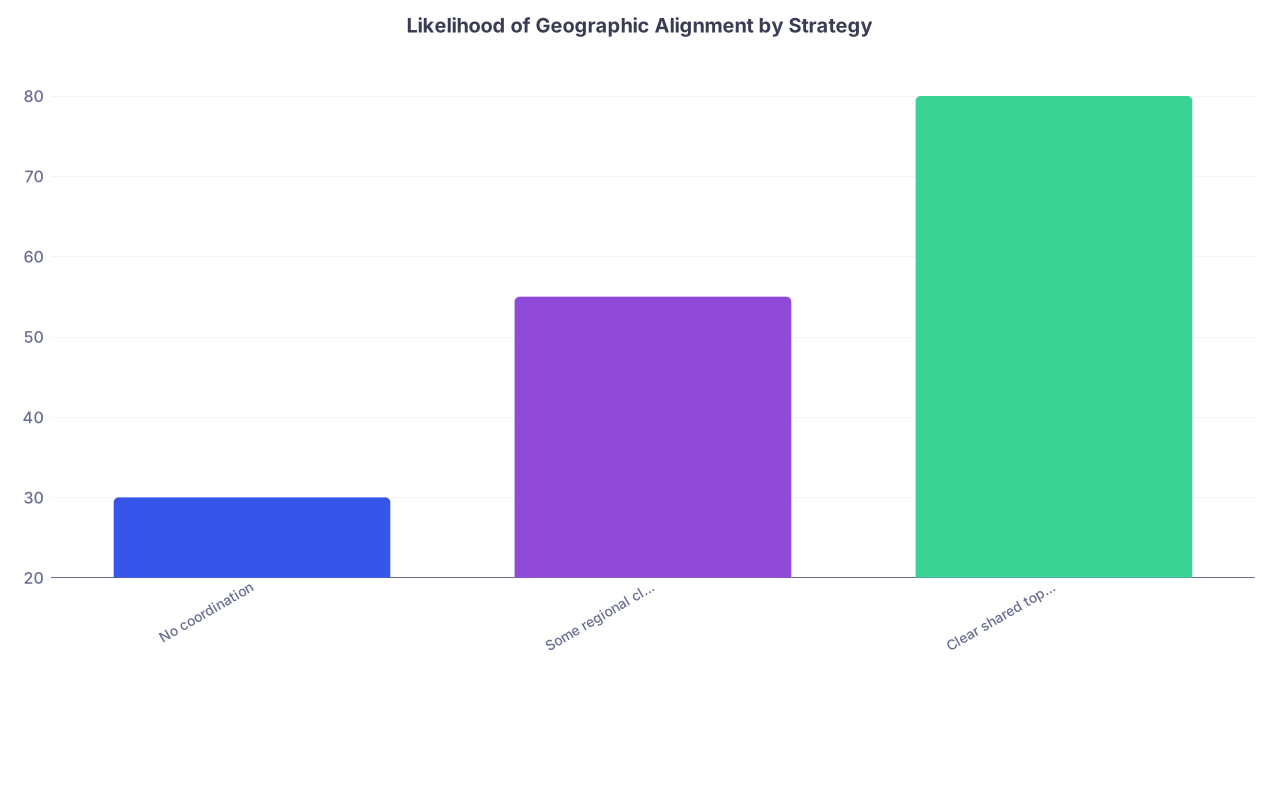
Couples Match with scattered interviews
This gets messy fast if you do not apply structure.
Protocol:
- Define a shared top region or city cluster (e.g., “Within 2 hours of Chicago,” “Northeast corridor,” “Texas triangle”).
- Generate rank pairs such that:
- All combinations in your top region appear first.
- “One person in dream city, other person across the country” pairs are deleted, not just moved down.
- Only allow far-flung combos that:
- You both explicitly accept in writing (literally write it down and sign it if you need to).
- Do not leave one partner completely stranded.
I have seen couples destroy their relationship by ranking fantasy combinations “just in case.” Do not do that.
Late realization: “I actually hate where I’m currently living”
Sometimes the scattered list is a reaction to your current location. You suddenly realize: I never want to live in a place like this again.
Good. Use that clarity.
- Re-score program cities based on:
- Climate you can live with
- Culture and diversity
- Outdoor / urban life match to you
- Drop programs in “clones” of your current unhappy city, even if they are near family.
You are not obligated to repeat a bad environment because it is familiar.
9. Final 7-Day Fix Plan Before Rank List Lock

If you are inside of two weeks from rank list lock, use this compressed protocol:
Day 1–2: Map and triage
- Put every program on a map.
- Label Tier A/B/C for each.
- Delete all Tier C programs you would not accept as your only match.
Day 3: Life audit
- Sit down with partner / key family.
- Review:
- Regions that are viable
- Hard no’s for everyone involved
- Cut any program in a hard-no city for your real life.
Day 4: Rebuild and cluster
- Decide your:
- Primary region
- Secondary region
- Reorder your rank list:
- Primary region programs first, sorted by composite (City x2 + Program)
- Then secondary region
- Then only truly acceptable outliers
Day 5: Targeted communication
- Identify 3–6 top-priority programs in your primary region.
- Send concise update emails clarifying:
- Your geographic commitment
- Your continued interest
- Do not ask for special treatment; just be clear.
Day 6: Sanity check with someone who will be honest
- Show your list to:
- A mentor
- An attending you trust
- A brutally honest friend
- Ask very specific questions:
- “If I match at #8, does my life still basically work?”
- “Am I overvaluing prestige here?”
- “Is anything on here obviously inconsistent with what I say I want?”
Day 7: Lock with intention
- Sleep on the final version.
- Make no changes in a panic in the last 12 hours unless something major breaks (e.g., partner job changes, major family event).
- Certify your list knowing you would accept matching at any of the ranked programs.
If you cannot say that about your current list, you are not done.