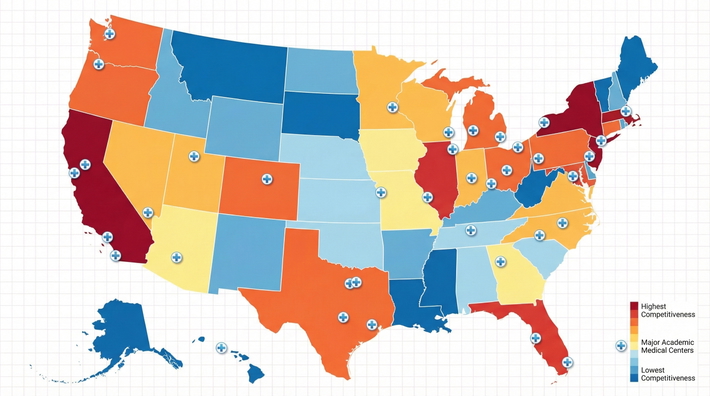
The standard residency advice to “just apply broad” is lazy, expensive, and wrong for regional applicants.
If you are serious about matching in one region—Northeast only, California only, Midwest within driving distance of family—you cannot afford a random shotgun strategy. You need a surgical one. A targeted, region-focused list that is big enough to be safe but small enough that you are not lighting thousands of dollars on fire.
Here is how to do that, step by step.
1. Get Clear on Your Non-Negotiables Before You Touch ERAS
You cannot build a targeted regional list if you are fuzzy about what “regional” means for you.
Define your constraints like a grown adult, not like a fantasy:
Geography
- Is it:
- One state?
- One metro area + reasonable driving radius (e.g., 3–4 hours)?
- A true region (e.g., “Mid-Atlantic” or “Pacific Northwest”)?
- Is it:
Life anchor points
- Partner’s job city
- Kids’ schools
- Elderly family you actually help care for (not hypothetical)
- Visa constraints (you need H-1B friendly states/programs)
Commute tolerance
- Max distance from your anchor city you will realistically commute or move to
- Urban vs suburban vs rural tolerance
Write this out. Literally. One page.
Example of a clear constraint set:
- Region: Within 3 hours of Boston by car
- Specialty: IM categorical only
- Life: Partner has job in downtown Boston, cannot move states this year
- Commute: Willing to live anywhere on commuter rail or within 45–60 minutes driving, no daily 1.5‑hour commutes
- Visa: U.S. citizen, no restrictions
This already slices out half the Northeast. That is good. You are building a targeted list, not a fantasy roster of places you like on Instagram.
2. Know Your Lane: Where You Actually Fit in This Region
You cannot judge which programs to apply to until you know which tier you realistically sit in. Not national tier. Regional tier.
Stop guessing. Use numbers and patterns.
2.1 Build a brutally honest self-profile
Write down:
- Step 2 CK (or COMLEX Level 2) score
- Class rank or quartile
- AOA / GHHS / none
- Research: publications, posters, QI projects
- Red flags:
- Step failure
- LOA
- Big gap in training
- Extra strengths:
- Strong home institution reputation in that specialty
- Impactful leadership (not just “treasurer of 3 clubs”)
- Region ties (grew up there, college, family, previous work)
Now you map yourself roughly against programs in that region.
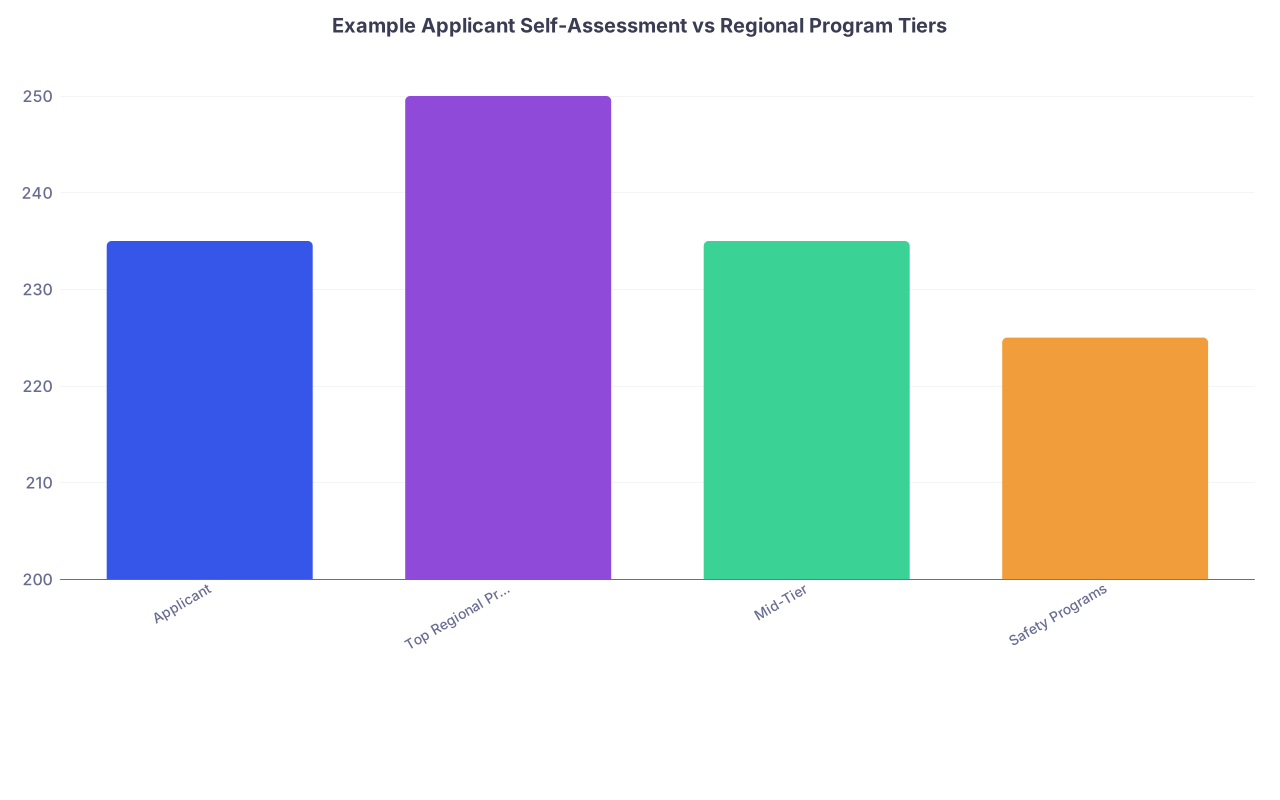
| Category | Value |
|---|---|
| Applicant | 235 |
| Top Regional Programs | 250 |
| Mid-Tier | 235 |
| Safety Programs | 225 |
If you are:
- 260+ with strong research → You can target top regional academic centers and solid community programs.
- 230–245 mid-range → Mix of mid-tier academic, strong community, and some safer community programs.
- <225 or with red flags → Lean heavier to community-heavy, IMG-friendly, and smaller academic centers.
You are not using this to beat yourself up. You are using it like a flight plan. Wrong assessment = wrong destination.
3. Define a Rational Application Size for a Single Region
Overapplying is usually a symptom of not trusting your own planning.
For one region only, you cannot play the “80+ programs just to be safe” game in most core specialties. You actually have to choose.
3.1 Reasonable ranges by competitiveness
Assuming you are restricting to one main region, here is a realistic starting range for most U.S. MD/DO applicants without major red flags:
| Specialty Type | Typical Range (One Region) |
|---|---|
| Very competitive (Derm, Ortho, ENT, Plastics) | 40–60+ programs (often multi-region needed) |
| Competitive (EM, Anesthesia, Radiology) | 25–40 programs |
| Core (IM, FM, Peds, Psych, Neurology) | 18–30 programs |
| Narrow location within region (e.g., just SoCal) | 20–35 if enough programs exist |
If you are strictly limited to, say, “Chicago area only” and there are only 10–15 programs in your specialty, your safety margin has to come from improving your application and geography flexibility, not inflating your list.
You cannot brute-force a geography that does not have enough programs.
4. Build a Raw Regional Program Pool (No Judging Yet)
Now you actually find the programs.
4.1 Start with program databases (but do not stop there)
Sources:
- ACGME / FREIDA
- Specialty-specific databases (AAIM, EMRA, etc.)
- NRMP Charting Outcomes and Program Director Survey for context
- State GME listings (e.g., “Massachusetts residency programs internal medicine”)
Your step:
Filter by:
- State(s) in your chosen region
- Specialty
- Program type (categorical, advanced, prelim as needed)
Dump every program name into a spreadsheet. No judgment yet.
Basic columns to start:
- Program Name
- City
- State
- Program Type (Academic / Hybrid / Community)
- Positions (categorical/advanced)
- Website link
You should end with a raw pool for your region. For internal medicine in the Northeast, that might be 70+ programs. For neurology in the Pacific Northwest, maybe 10–15.
That raw pool is not your final list. It is the starting block.
5. Add the Only 6 Filters That Actually Matter
This is where students usually get lost in noise. Fancy hospital name, nice cafeteria, glossy website. All distractions.
For a regional strategy, the filters that matter are:
- Geography in region
- Program type and training quality
- Competitiveness relative to your profile
- Visa / IMG friendliness as relevant
- Lifestyle and schedule sanity
- Your real life constraints (partner job, kids, commute)
5.1 Geography inside the region
You already chose your region. Now refine.
Example (NY/NJ/CT region, anchored in NYC):
- “Must apply” geography: NYC proper + immediate suburbs you would live in
- “Maybe” geography: 1–2 hours away but commutable or reasonable to move
- “No” geography: 4+ hours upstate, rural with nothing tying you there
Add columns:
- Distance from anchor city (approximate drive/train time)
- Category: Core / Acceptable / No
Use Google Maps or equivalent. Be honest about where you will live and commute from.
5.2 Program type and training environment
You are choosing a job, not a brand.
Label each program:
- Academic (university hospital, heavy fellowship pipeline)
- Hybrid (academic affiliate with strong community exposure)
- Community (mostly community, may have academic tie but less research)
Which mix do you want? For a regional applicant:
- Want fellowship in that region? Include the academic centers but not only them.
- Want to stay in the community after residency? Do not ignore high-quality community programs with great job placement locally.
6. Do a First-Pass Competitiveness Cut
Now the real pruning starts.
You are asking one question: What is my realistic chance of getting an interview here, given my profile and this program’s historical behavior?
6.1 Use hard filters from public data
Look for:
- Stated minimum Step or COMLEX scores
- Prior year interview pattern (if available through forums, mentors, or your school)
- IMG friendliness (for IMGs / FMGs)
- DO friendliness (if you are DO and the program has almost no DOs historically)
Create columns:
- “Likely Reach / Match / Safety” (relative to your profile)
- US MD / DO / IMG friendliness (Yes / Mixed / No data)
Be realistic:
- 218 with a Step 1 fail applying to Mass General for categorical IM? That is not a reach. That is a donation.
- 238 with decent research applying to a mid-tier university program in the same region where your med school regularly matches? That is fair game.
6.2 Where to get this intel
- FREIDA: graduates by med school type
- Program websites: current residents and their schools
- Program social media: they often highlight residents and where they are from
- Past match lists from your home school: which programs historically accept your grads
- Senior residents / chief residents: quick email or 10‑minute call can be gold
7. Create a Tiered, Regional-Only Shortlist
Once you have filtered by geography and competitiveness, you convert the raw pool into a tiered target list.
Break your list into three buckets:
- Tier 1 – Aspirational but plausible (reach)
- Tier 2 – Realistic core targets
- Tier 3 – Safer programs you would still actually attend
A good regional distribution for a core specialty (IM, FM, Peds, Psych, Neuro) in one region:
- 20–25 total programs
- 4–6 Tier 1
- 10–14 Tier 2
- 6–8 Tier 3
For competitive specialties, scale up total numbers but keep a similar ratio.
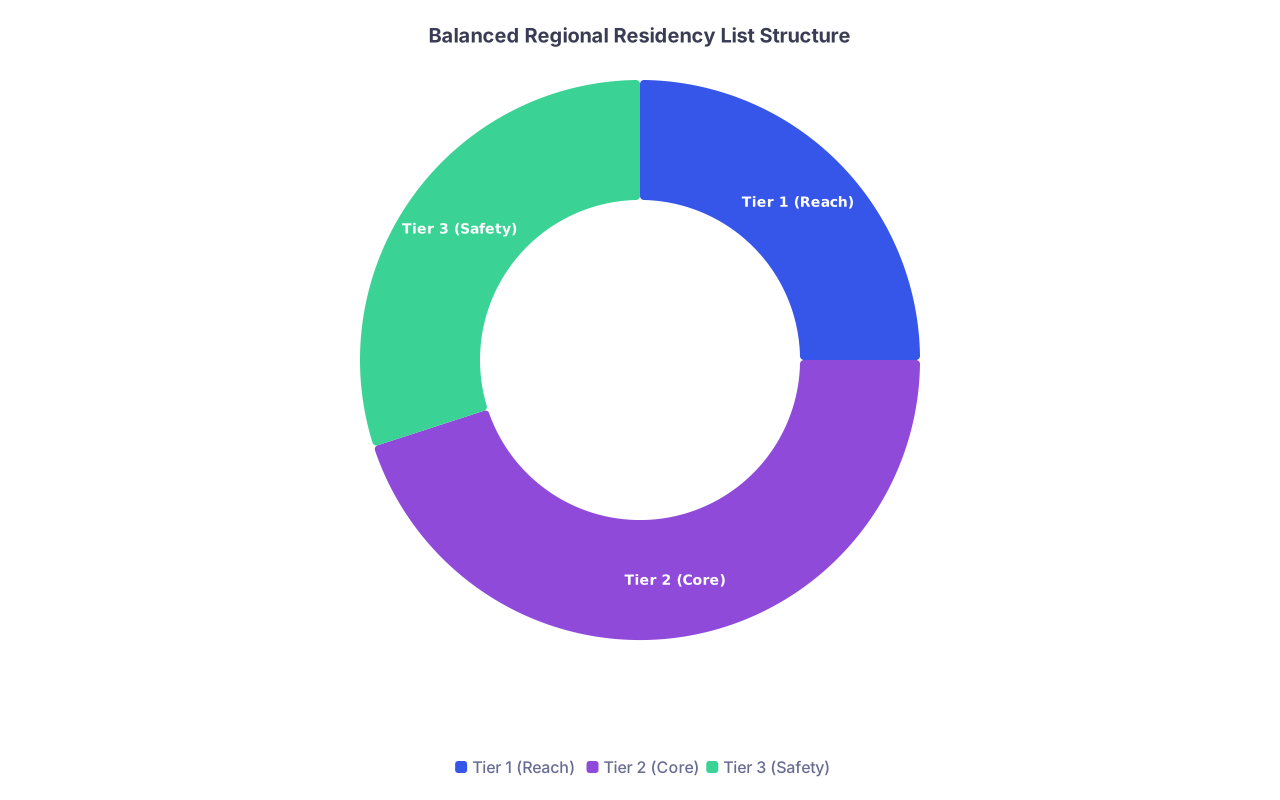
| Category | Value |
|---|---|
| Tier 1 (Reach) | 25 |
| Tier 2 (Core) | 45 |
| Tier 3 (Safety) | 30 |
If your spreadsheet has:
- 15 reaches
- 4 realistic
- 1 safety
…you do not have a regional strategy. You have a hope strategy.
8. Money and Sanity: Stop the List from Quietly Expanding
Overapplying is rarely a conscious choice. It is a slow-creep problem.
Someone on Reddit says “I applied to 85 programs and got 18 interviews.” Then you panic-add 12 more in another state you do not want.
You prevent that by using hard caps and a decision protocol.
8.1 Set a numeric cap before ERAS opens
Decide:
- Absolute max number of programs you will apply to
- Core region count vs. backup region (if you absolutely must add a second region later)
Example:
- “I will apply to 25 IM programs in the Midwest. If by November 1 I have <6 interviews, I will add up to 10 programs in a secondary region.”
Write this down. Share it with someone who will call you out if you break it.
8.2 Understand the actual cost of “just 10 more”
Rough estimate:
| Item | Estimated Cost |
|---|---|
| ERAS fees (extra 10) | \$200–\$300 |
| Extra interview travel (if any) | \$0–\$1,000+ |
| Time for added research and tracking | Several hours |
Those 10 extras are not free. And if 8 of them are outside your region, they dilute your focus and increase the chance you match somewhere you do not want to live.
9. Use a Simple Decision Flow to Add or Cut Programs
You need a protocol. Not vibes.
Here is a clean way to decide whether a program belongs on your final regional list:

| Step | Description |
|---|---|
| Step 1 | Program in raw regional pool |
| Step 2 | Remove |
| Step 3 | Keep on target list |
| Step 4 | Within my true geography? |
| Step 5 | Reasonable fit to my stats? |
| Step 6 | Program type fits my goals? |
| Step 7 | Would I actually go here? |
The key question that almost nobody asks honestly is:
“If this were my only match, would I actually go?”
If the answer is no, you are overapplying. You are buying lottery tickets for a prize you will not accept.
10. Build a Region-First Backup Plan (Without Blowing Up Your Strategy)
Sometimes, one region genuinely does not give you enough safety.
Maybe:
- Your Step 2 is low for that region’s baseline
- You are IMG with no U.S. clinical experience
- The region has only a handful of programs in your specialty
You still do not need a chaotic backup. You need a structured Plan B.
10.1 Secondary region rules
If you must add a second region:
- Pick one clear secondary region, not scattered random states.
- Use the same process: geography → competitiveness → tiers.
- Cap the secondary region to a small, disciplined number (for core specialties, 8–12; for very competitive, maybe 15–20).
Example:
- Primary: Pacific Northwest (Washington, Oregon, Idaho; 20 programs)
- Secondary: Northern California (8–10 programs)
- No random single-apps to Texas, Florida, or Midwest “just in case”
10.2 Timeline for triggering Plan B
Do not pull the ripcord on day 1.
Use fixed checkpoints based on interview counts:
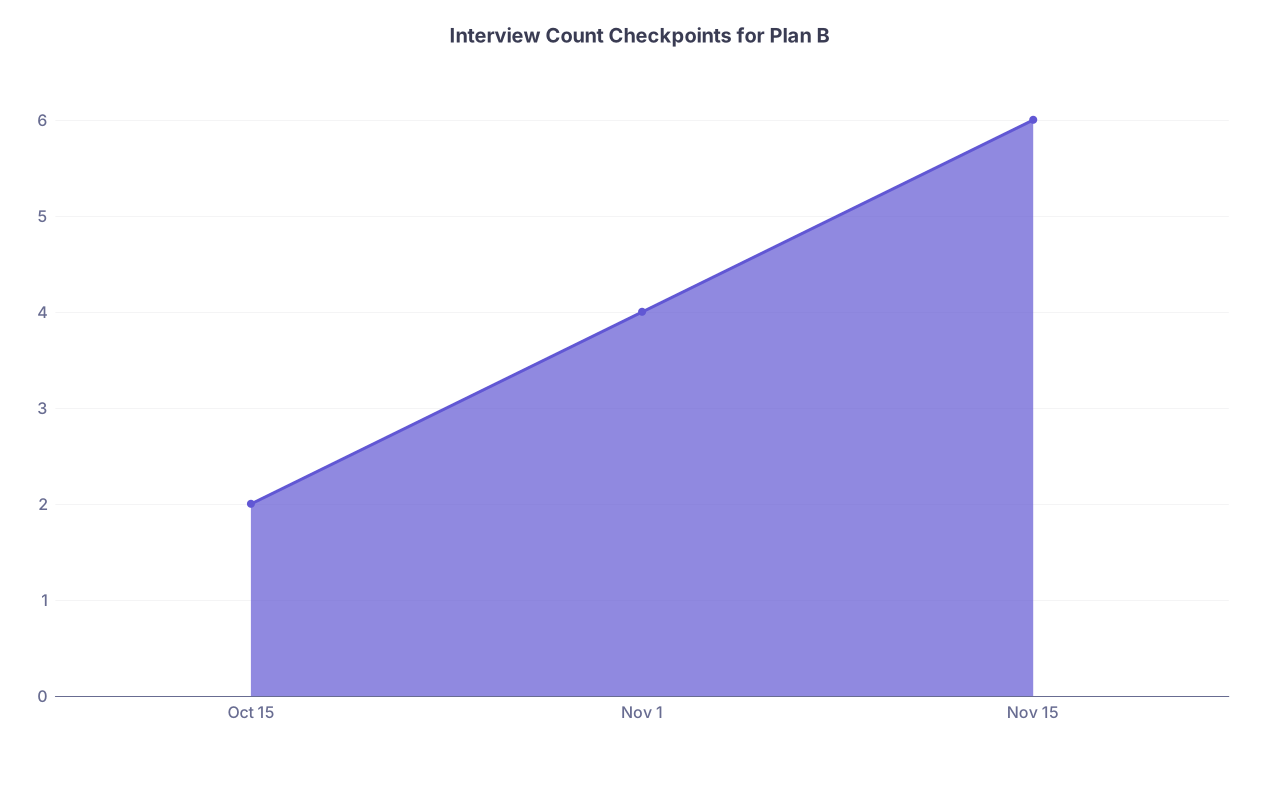
| Category | Value |
|---|---|
| Oct 15 | 2 |
| Nov 1 | 4 |
| Nov 15 | 6 |
Example rule:
- If by Nov 1 you have:
- 0–2 interviews → Add secondary region programs (predefined list)
- 3–6 interviews → Consider adding a few more true-safety programs within region or secondary region
- ≥7 interviews in core specialties → Do not add more; focus on preparing
11. Special Issues: Couples Match, IMGs, DOs, and Visas
You are not applying in a vacuum. Some situations break the usual rules unless you plan carefully.
11.1 Couples Match in one region
Couples match + regional restriction = you must be even more structured.
Steps:
- Define shared geography (overlap of both of your real constraints).
- Build individual program lists first using everything above.
- Identify:
- Programs that both of you are applying to in the same city
- Nearby program pairs (Hospital A + Hospital B within 30–45 minutes)
For couples in a single region, the application count naturally creeps up. The antidote is coordination, not panic.
11.2 IMG / FMG in a restricted region
If you are IMG restricting to one region, you do not have much margin for fantasy.
Actions:
- Start with programs in that region that have visible IMG residents in recent classes.
- Pay attention to:
- Needed US clinical experience
- YOG (year of graduation) cutoffs
- Minimum Step scores and explicit IMG policies
If the region has very few IMG-friendly programs, you either:
- Loosen your geography
- Or accept a very high risk of not matching
There is no magic list that bypasses regional realities.
11.3 DO applicants in historically MD-heavy urban regions
Look at:
- % of DOs in current residents
- States that are generally more DO-friendly (Midwest and South vs some Northeast/Ivy corridors)
If your dream region is historically MD-heavy and you are DO, your list must:
- Include the few DO-friendly programs there
- Add a secondary region where DOs match in much larger numbers
That is not pessimism. That is how you stay employed.
12. Turn Your Targeted List Into an Execution Plan
A good list is useless if it lives in a forgotten spreadsheet tab.
Convert your final list into a working tool.
12.1 Build an application tracker
Columns to add:
- Program name, city, state
- Tier (1/2/3)
- Applied? (Y/N + date)
- SVI/extra essay needed?
- Interview offered? (Y/N + date)
- Interview date
- Post-interview impression (1–5)
- Rank list tentative position
This does two things:
- Keeps you from “just adding a few more” mid-season without seeing the bloat
- Gives you a reality check when you see, for example, that all 5 interviews so far are from Tier 3 community programs and none from Tier 1
12.2 Schedule regional research in batches
You do not have time to deeply research 40 programs individually in August.
Use batching:
- Week 1: Deep dive on all Tier 1 programs in your region
- Week 2: Deep dive on Tier 2 programs in your core city
- Week 3: Quick scan of Tier 3 safety programs (enough to avoid sounding clueless in a PS or interview)
Focus your time where it moves the needle:
Personal statements, supplemental answers, and interview prep tailored to your actual, realistic list.
13. Common Mistakes That Blow Up a Regional Strategy
I have watched people sabotage themselves with the same handful of errors.
Avoid these:
Building the list around prestige, not geography + fit
- “I want to stay in Chicago, but I’m applying to every Top 20 IM program along the East Coast.” That is not a Chicago strategy.
Zero true safeties in the region
- All aspirational academic centers, no strong community programs. Then they are shocked by 2 interviews and a SOAP.
Expanding to random states under stress
- LSAT-style panic in late October: “I just added 15 programs in Texas; I have never been there.” Then they match there and hate it.
Ignoring spousal/partner realities
- Partner cannot move for 2 years. Applicant applies all over the country “just to see.” That never ends cleanly.
Not cutting programs you would never attend
- “But I might get an interview.” Sure. And then you will either cancel it or rank it last. Why did you pay to apply?
14. A Concrete, Regional Example
Let me walk you through a stripped-down example.
Profile:
- US MD, Step 2 CK 238, no failures
- Mid-tier med school, Northeast
- Wants IM, hopes for cards fellowship
- Partner locked into job in Philadelphia for at least 3 years
- Wants to stay within ~2 hours of Philly
Process:
- Region definition:
- Primary: Philly metro, New Jersey, Delaware, South/central Pennsylvania, NYC within 2 hours
- Raw pool:
- Use FREIDA → find 55 IM programs in that multi-state region
- Geography filter:
- Remove programs >2.5 hours from Philly → now 38 programs
- Competitiveness filter:
- Remove 4 ultra-elite programs (Penn, Columbia, Cornell, etc.) as pure donation reaches
- Remove 3 programs with stated Step 2 minimum >245 (or historically insane match stats)
- Now 31 programs
- Tiering:
- Tier 1 (reach but plausible): 6 programs (Jefferson, Einstein, Temple, comparable NYC programs)
- Tier 2 (realistic): 14 programs (mid-tier academic and strong community affiliates)
- Tier 3 (safety): 11 programs (community-heavy with decent reputation)
- Cap and final cut:
- Decide on 24 total
- Remove 7 Tier 3 that are farthest from city / poor reviews / misaligned schedule
- Final list:
- 5 Tier 1
- 11 Tier 2
- 8 Tier 3
This applicant is now regionally focused, financially sane, and protected against catastrophe without applying to 60+ programs they do not want.
FAQ (Exactly 3 Questions)
1. If I really only want one city (e.g., Boston, Chicago, Seattle), is that just too risky?
It depends on the specialty and the number of programs in that city. Some metros have enough programs in core specialties that a well-balanced, city-only list can work, especially for solid U.S. MD/DO applicants without red flags. But you must be honest about volume. If your chosen city has only 4 programs in your specialty and two are extreme reaches for you, that is not a viable city-only strategy. In that case, expand to a “city plus 1–2 hours radius” rule and build your list around that.
2. How many interviews do I need to feel safe if I am regionally restricted?
For most core specialties, the general rule of thumb still holds: around 10–12 interviews gives you a high probability of matching somewhere you rank. Being regionally restricted does not change that math; it just changes the distribution of where those interviews come from. If by mid-November you are sitting on 2–3 interviews only, your Plan B (secondary region, extra safeties) needs to activate. If you are already at 8–10, continuing to add more programs rarely changes your outcome; it just drains money and time.
3. What if my dream region is very competitive (like California or Manhattan), but I have an average Step score?
Then you treat that region as your primary preference, not your only strategy. You can absolutely apply heavily within that region, but you need a real backup region where your profile is more competitive and programs are less saturated. For example, someone with a mid-230s Step score wanting IM in California should apply to a targeted set of CA programs (favoring community and mid-tier academic), and simultaneously build a larger list in a second region (e.g., Mountain West, Midwest) where those same credentials place them more in the “core” rather than “reach” category. That is how you protect both your preference and your chances.
Open a spreadsheet right now and list every program in your chosen region for your specialty. Then, for each one, answer two questions: “Is this within my real geography?” and “If this were my only match, would I go?” Any program that fails either question gets deleted today.