How to Use Rotations Strategically to Anchor Yourself to One Region
It is June, and you just realized something uncomfortable: you want to end up in one specific region for residency–Midwest, Northeast, West Coast, whatever–but your CV is all over the map. Undergrad on one coast. Med school on another. No family nearby. No obvious “ties.”
You hear it constantly on interview day:
“We look for applicants with a demonstrated commitment to our region.”
You have…none of that on paper. Or very little.
Here is the fix: you use your remaining rotations as a weapon. Not as random “I heard this is a good elective,” but as a deliberate, targeted strategy to look like a clear regional fit by the time programs see your application.
I am going to walk you through exactly how to do that.
Step 1: Be Honest About Your Situation
Before you start gaming rotations, you need brutal clarity on where you stand.
Ask yourself three questions:
- What region do I actually want?
- What ties do I already have there (even weak ones)?
- How many rotations do I realistically control (core and electives)?
Common scenarios I see:
Scenario A: No obvious ties
- Med school in Texas
- Want: Pacific Northwest
- No family there, no prior address, no previous training
Scenario B: Weak or indirect ties
- Family in Philadelphia, but you went to med school in California
- Want: Mid-Atlantic / Northeast anchor
- You have some story, but not consistently documented
Scenario C: Multiple regions, no clear anchor
- Grew up in the South, undergrad in Midwest, med school in Northeast
- You are “from everywhere” which actually reads as “from nowhere” to some PDs
You need to pick one primary region to anchor yourself to. You can have a secondary region, but your rotations should overwhelmingly support one story:
“I am serious about building my career here, and my choices already show that.”
If your answer is “I do not care where I end up,” then fine, this is less for you. But if you are targeting a specific region or city cluster, rotations are your most controllable lever.
Step 2: Understand What “Regional Fit” Actually Means
Programs do not read your mind. They look for evidence that you will show up, be stable, and likely stay.
Here is what residency programs usually count as regional ties:
- Grew up in the area (high school, home address)
- College or medical school in-region
- Prior employment in-region (scribe, EMT, nurse, research assistant)
- Immediate family in the region (parents, siblings, spouse/partner, children)
- Military assignment there (for you or spouse)
- Meaningful, documented time in the region (months, not weekends)
And here is what your rotations can provide:
- Concrete time physically in the region
- Letters from regional faculty
- EMR familiarity with that region’s major systems (Epic at X, Cerner at Y)
- A credible narrative: “I worked here, I know what this population and health system are like, and I want more of it.”
Rotations are how you convert a vague preference into a documented track record.
Step 3: Build a Regional Rotation Map
Now you design your year like a campaign, not like a buffet.
3.1 Decide your “Regional Anchor Cluster”
Pick 1–2 metro areas or subregions inside your target region. Not “the Midwest” generically, but for example:
- Chicago + Milwaukee
- Boston + Providence
- Seattle + Portland
- Dallas + Houston
- Atlanta + Birmingham
Your goal is to stack experiences around that cluster so programs see pattern and intention.
3.2 Prioritize Rotation Types
Not all rotations are equal politically.
Here is the hierarchy of impact for anchoring yourself regionally:
| Rank | Rotation Type |
|---|---|
| 1 | Home sub-internships in-region |
| 2 | Away sub-internships (visiting) |
| 3 | Specialty electives at target sites |
| 4 | Regional community / rural rotations |
| 5 | Research electives physically in-region |
Let me translate that.
Sub-internships (“Sub-I”, Acting Internship, AI)
- These are gold. You are acting as an intern, usually on inpatient services.
- High face time with residents and attendings.
- Best chance to get a big-name regional letter and a “we know this person” note to PD.
Away sub-internships at your dream programs or their neighbors
- Yes, VSLO / VSAS is a pain. Do it anyway.
- If you want to be in Chicago, one month at UChicago, Northwestern, Rush, or Loyola is high-yield.
- Even if you do not match there, the LOR and regional recognition travel.
Specialty electives at secondary regional programs
- These build depth. EM at a major community site. Cardiology at a private hospital.
- You are showing “I did not just do one tourist month; I kept coming back.”
Community and rural rotations in-region
- Underestimated. A strong LOR from a well-respected community doc who is plugged into the region’s residency leadership can help.
- Also gives you a different population and practice style to talk about.
Research electives physically based in-region
- Less visible clinically but still useful.
- If it locks you into a lab or group tied to a flagship institution, that matters.
Step 4: Concrete Rotation Strategy by Year and Specialty
Everyone’s constraints are different, but here is a general playbook.
For Third-Year Students (MS3)
If you are early enough, start planting flags now.
Clerkship site choices (if your school has multiple sites or affiliates)
- When given a choice, take the in-region partner that is closest to your target area.
- Example: Your school has IM at both community and university-affiliated hospitals in the same city. If your target is that city long-term, pick the university-affiliated one with a residency program.
Early networking
- Identify faculty who are well connected specifically to your target region.
- That cardiologist who did fellowship at Cleveland Clinic? That PD who used to be faculty in Boston? You want to be on their radar.
Summer after MS3
- Use this time to either:
- Do a short clinical elective in-region
- Or begin research attached to a regional institution / PI if and only if you can be physically present and visible for at least a few weeks
- Use this time to either:
You are laying the groundwork so that your MS4 rotations are not your first time in the region.
For Fourth-Year Students (MS4)
This is where you get aggressive and deliberate.
You have maybe 4–6 months of “electives” you can weaponize. Here is how I would structure, assuming a typical timeline and a single main target region.
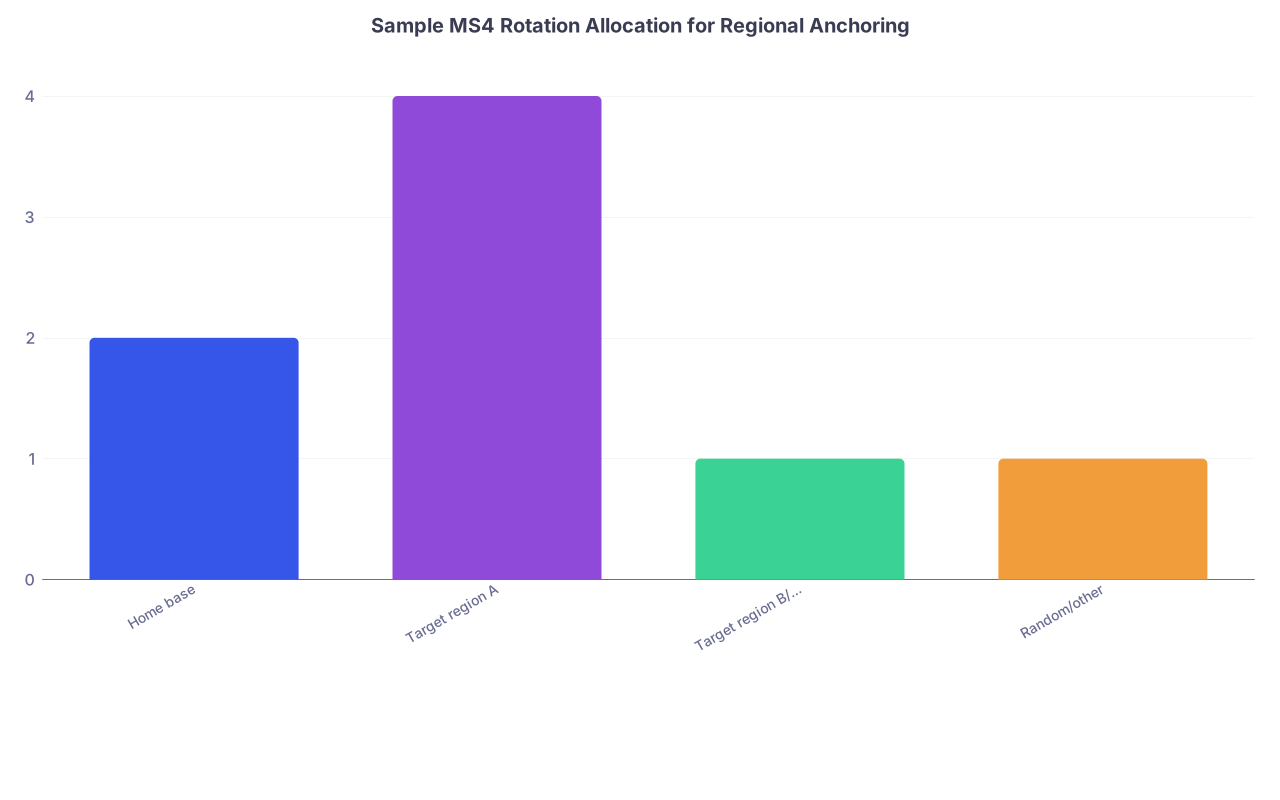
| Category | Value |
|---|---|
| Home base | 2 |
| Target region A | 4 |
| Target region B/secondary | 1 |
| Random/other | 1 |
Interpretation:
- 2 months: Home institution required / non-negotiable
- 4 months: In your primary target region
- 1 month: Optional secondary region or true dream program
- 1 month: Flex / interview buffer / personal interest
Example Strategy: Want to Anchor to the Northeast
You are at a Midwest med school. You want Northeast IM or EM.
Plan:
- July: Home IM Sub-I (Midwest) – you still need a strong home letter
- August: IM Sub-I in Boston (e.g., BIDMC, Tufts affiliate, or a solid community program)
- September: EM or specialty elective in New York or Philly
- October: Community hospital rotation in CT or NJ with a known residency
- November: Interview month
- December: Optional second Northeast elective (if your school calendar allows) or back at home program
By November, your application shows:
- You chose to spend 3–4 months in New England / Mid-Atlantic
- You have multiple attendings from that region who know you
- You can honestly say: “I have spent significant time working in this region and plan to build my career here.”
That reads as credible. Not wishful.
Step 5: Use Away Rotations Surgically, Not Emotionally
Here is where people screw this up. They treat away rotations like fandom.
“I love UCSF, I am doing my away there.”
Fine. But if you want to anchor to Northern California broadly, it may be smarter to:
- Do one dream-away (e.g., UCSF)
- And one at another strong Bay Area or Northern California program (e.g., Stanford, Santa Clara Valley, Kaiser, UC Davis)
Why? Because:
- If your dream-away does not give you a strong letter, you still have another regional backstop
- Programs in the same region often know each other’s reputations and faculty
Be strategic:
- Aim for 2–3 total in-region away rotations, not 6 all over the map
- Cluster them geographically, not in random cities that just sounded fun
- Prioritize programs and hospitals that are:
- Known for solid training (not necessarily “Top 10” brand)
- Actually in your realistic match range
Step 6: What to Do During the Rotation So It Actually Counts
Being physically present in the region is not enough. You need to be memorable, connected, and documented.
6.1 Behave like a future colleague, not a guest
On regional-intent rotations, your mindset is different. You are not just “passing through.”
Do this:
- Show up early and stay engaged until sign-out
- Learn the system quirks quickly (pager expectations, note templates, order prefs)
- Take ownership of patients to the extent allowed
- Ask for feedback midway through the rotation and adjust visibly
- Be explicit with residents and attendings that you are interested in the region, not just their one program
What you want is for someone to say in a meeting:
“I worked with them on our wards month. They are solid. They want to be in this area.”
6.2 Have the “Regional Intent” Conversation On Purpose
At some point in the rotation, you should say out loud:
- “I am really trying to anchor myself to this region long-term.”
- “I grew up elsewhere, but I want to build my career here for [reason].”
- “I am hoping to get a strong letter that also speaks to my interest in this region.”
Not in a needy way. In a clear, adult way.
This does three things:
- Signals to faculty how to frame your letter
- Plants you in their memory when PDs ask, “Anyone strong from outside schools who seems serious about coming here?”
- Gives you practice explaining your regional story, which you will use on interviews and in your personal statement
Step 7: Turn Those Rotations into a Clear Regional Story
Rotations only help if you convert them into a coherent narrative on paper and in conversation.
You need consistency across:
- Personal statement
- ERAS experiences
- Letters of Recommendation
- Interviews
7.1 ERAS / Application Entries
When you list these rotations, do not just say:
“Sub-internship in Internal Medicine.”
Write the location and a one-line regional hook in the description if you can do it without sounding fake.
Example:
- Experience name: Internal Medicine Acting Internship – Boston Teaching Hospital
- Description: One-month AI on general medicine service at a large safety-net hospital serving Boston and surrounding communities; solidified my goal to train and practice in New England long-term.
You are feeding the PD the conclusion you want them to draw.
7.2 Personal Statement and Supplemental Essays
You do not need a full paragraph on each rotation. But you should have 1–2 clean sentences that connect the dots:
- “Although I trained in the Midwest, I have spent several months on sub-internships and electives in [region], working with [population type], and I am committed to completing residency and building my career here.”
Mention your specific hospitals:
- “At my acting internship at [Hospital A] and elective at [Hospital B], I saw…”
Those names stick.
7.3 Letters of Recommendation
When you request a letter from a regional attending, say the quiet part out loud in your ask:
- “I am especially targeting residency programs in [region], and I am hoping your letter can speak not only to my clinical performance, but also to my clear interest in practicing in this region.”
Many attendings will happily include a sentence like:
“Although they trained in [other area], they have expressed a sustained interest in returning to and settling in [region], and have demonstrated that by completing multiple rotations here.”
That one line can change how a PD reads your entire file.
Step 8: Use Non-Clinical Time to Deepen the Anchor
Rotations give you the skeleton. Fill it in.
During or around your regional rotations:
- Attend regional conferences or society meetings (e.g., state ACP, ACEP chapter meetings)
- Join regional specialty societies as a student member
- Meet with program leadership briefly if appropriate (not to beg for interviews, but to signal interest and ask good questions)
You want your name circulating in that ecosystem more than once.
You can also:
- Look for short research projects or QI work tied to that region’s hospitals or patient populations
- Volunteer once or twice with a local free clinic or community event if time permits
Do not overdo this. Your main job is still to be excellent on the rotation itself. But a couple of intentional touches add weight.
Step 9: What If You Have Constraints?
Not everyone can pick up and spend four months in one region. Maybe you have:
- Visa issues
- Family obligations
- Limited ability to travel
- School rules restricting away rotations
You are not dead in the water. You just need to be more precise.
If you can only do 1 away rotation:
Choose the single highest-yield city/region node, not just the fanciest name.
Example: If you want the Pacific Northwest, one solid month at OHSU or UW is better than a random famous East Coast away.
Then leverage everything else remotely:
- Virtual research with in-region groups, but try to “visit” for a week if possible
- Tele-mentorship with in-region faculty (and then mention these relationships in your application)
- Explicit regional commitment in your essays and interviews
If your school does not allow many electives:
Then your best lever is where you do your required rotations, if there is any choice at all (satellite campuses, affiliated hospitals).
If even that is restricted, your strategy leans more heavily on:
- Family / life reasons for region (partner job, parents, children, etc.)
- A very clear verbal narrative about why you are committed to that region long-term
You can still win, but your storytelling has to be sharper.
Step 10: Common Mistakes That Undermine Your Regional Anchor
I see these patterns constantly. Avoid them.
Scattering away rotations across 4–5 regions
- One month in California, one in New York, one in Texas, one in Florida.
- This reads as indecisive and opportunistic. Pick a lane.
Doing “fun” electives in dream vacation cities utterly unrelated to your target region
- If you absolutely have to do that wilderness medicine month in Colorado for your soul, fine. But not at the expense of the region you allegedly care about.
Failing to tell anyone why you are there
- Faculty thinks you just got randomly placed. You never mention your regional goals. Then you expect them to magically write that you are committed to the region. They will not.
Ignoring mid-tier or community programs in your target region
- Everyone chases the 2–3 “top” academic names. Smart players sprinkle in a community-based rotation or less-hyped academic site that is still regionally respected. Those places sometimes hustle harder for you.
Mixed signals on your application
- Personal statement says you want the Midwest.
- Rotations in California and New York only.
- Family listed in Florida.
- That does not scream “anchored.”
Your goal is alignment: what you say, where you rotate, what your letters say, and where you apply all point in the same regional direction.
Visual: A Simple Regional Strategy Flow

| Step | Description |
|---|---|
| Step 1 | Choose Primary Region |
| Step 2 | Pick 1-2 City Clusters |
| Step 3 | Plan 2-3 Rotations In Cluster |
| Step 4 | Prioritize Sub I and Core Electives |
| Step 5 | State Regional Intent On Rotation |
| Step 6 | Get Region Focused Letters |
| Step 7 | Align Personal Statement and ERAS |
Quick Example: Putting It All Together
You are at a med school in Florida. You want to train and eventually practice in the Midwest, preferably around Chicago.
You design:
MS3:
- Ask advisors about Chicago connections. Identify one attending who did residency there.
- Do a small QI project with them related to urban primary care.
MS4:
- July: Home IM Sub-I (Florida) – get strong home letter.
- August: IM Sub-I at a Chicago academic program (Rush or Loyola).
- September: EM or Cardiology elective at a different Chicago-area hospital (e.g., Northwestern affiliate, Advocate Christ).
- October: Community hospital rotation in the greater Chicago region or nearby Midwest city (Milwaukee, Peoria, etc.).
- November: Interviews.
- December: Flex / backup elective.
On those Chicago months, you:
- Tell residents and attendings that you intend to move to the Midwest long-term.
- Ask 1–2 of the strongest attendings for letters before the rotation ends.
- Mention Chicago or “Midwest urban communities” specifically in your personal statement.
By application time, your file shows:
- Med school in Florida
- 3 months of senior rotations in Chicago/Midwest
- Letters from Chicago faculty saying you want to be there
- Essay language echoing that
Now you look like a legitimate Midwest applicant, not a tourist.
FAQs
1. How many away rotations do I actually need to anchor myself to a region?
For most students, 2–3 months total in the target region is enough to establish a believable anchor, especially if at least one month is a sub-internship. One is better than zero, but two or three (clustered in the same region) changes how PDs see your application.
2. If I already have family in a region, do I still need regional rotations?
Yes, if you can manage it. Family ties help, but programs like to see that you have worked in that healthcare environment too. A couple of regional rotations plus explicit mention of your family connections creates a much stronger case than family alone.
3. Should I prioritize a top-name hospital in my target region or a solid but lesser-known program where I might stand out more?
If you can only pick one, I usually recommend a strong but realistic program where you are more likely to get a truly enthusiastic letter and real facetime with faculty. Brand helps, but a generic letter from a superstar place is less useful than a glowing, specific letter from a very good mid-tier program in your target region.
4. What if my school timeline does not let me do regional away rotations before ERAS submission?
Then you lean hard on what you can control: clear regional explanation in your personal statement, highlighting any non-clinical ties (family, previous residence, partner’s job), and trying to do at least one in-region rotation right after ERAS submission so you can update programs and still potentially get a late regional letter. It is not ideal, but it is still better than nothing.