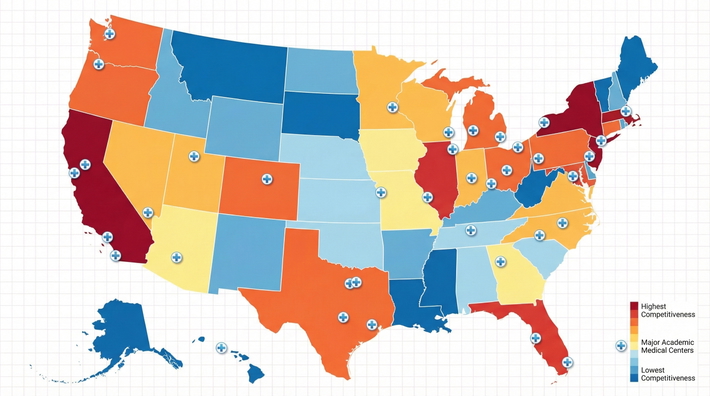
You are post-interview, sitting in a call room at 10:30 p.m., re-checking your ERAS. Your partner just accepted a job three states away. Or your parents’ health has taken a bad turn. Or you realized, somewhat late in the game, that you actually want to be in the Pacific Northwest, not the Southeast.
You have a problem: programs in that new region barely know you exist. You did not rotate there. You did not grow up there. You checked the “geographic preference” box somewhere else. And now you are trying to figure out how to send emails that:
- Do not sound desperate
- Actually move the needle
- Do not annoy program leadership
Let me be blunt: most “I’m very interested in your program” emails are garbage. Generic, vague, and completely ignorable. Program directors see dozens of them every day from October to February.
You can do better. And you need to, because geography is one of the most powerful levers in residency selection. Programs want people who are likely to come and likely to stay. Your email has one job: make that seem obviously true, despite your current location and history.
Here is the fix: structure, timing, and targeted templates that sound like a real person, not an auto-generated form letter.
Step 1: Know What Programs Actually Want To See
Before you touch your keyboard, be clear on what the reader cares about. Program directors and coordinators skim faster than you think. They are screening for signals, not reading your autobiography.
They are asking three questions:
Why this region, specifically, now?
“I just like the West Coast” is not an answer. They want:- A personal tie (family, partner, support system)
- A professional tie (long-term career, specific patient populations, academic focus)
- Or a plausible, adult reason (“this is where my spouse will practice law,” “this is where my kids’ grandparents are,” etc.)
Why their program in that region?
They know you are probably emailing multiple programs. That is fine. But if your email to Boston looks identical to your email to Seattle, you have wasted both of your time. You need:- 1–2 specific program details (curriculum, tracks, affiliated hospitals, reputation in a niche area)
- A clear link between those details and your goals
What are you actually asking for?
Do you want:- Interview consideration?
- Reconsideration after silence?
- To signal serious ranking interest post-interview?
- To give an update that reinforces your regional tie?
If your email does not answer all three, it will not work.
Step 2: Decide Which “Bucket” You Fall Into
You are not sending one generic “Hello Region” email. You are sending a specific type of email based on your situation. Rough buckets:
| Scenario Code | Situation | Goal |
|---|---|---|
| PRE-NOINT | Before any invite, no prior contact | Get on their radar |
| PRE-WAIT | You applied, no invite late in season | Prompt reconsideration |
| POST-INT | You interviewed there | Signal stronger interest |
| UPDATE-TIES | New or stronger regional ties emerged | Provide meaningful update |
| COUPLES | Couples matching into region | Show joint commitment |
You might fit more than one, but do not mix them in one message. Pick the primary goal for each program and write to that.
I will walk through each scenario with templates you can customize.
Step 3: Core Structure For Any Regional Interest Email
Use a predictable, clean structure. PDs are reading on phones between cases.
- Subject line
- Short intro (who you are, what specialty, how you’re connected to them)
- Clear statement of regional interest (with a concrete reason)
- 1–2 specific program details tied to your goals
- Explicit ask (interview, consideration, note of interest, etc.)
- Brief, gracious close
Avoid walls of text. Aim for 150–250 words, max.
Subject Line Templates That Actually Get Opened
Pick one and adapt:
- “Applicant expressing strong interest in [Region/City] and [Program Name]”
- “Genuine interest in training in [City/Region] – [Your Name], [Specialty] applicant”
- “Update: New long-term relocation to [City/Region] – [Your Name], [Specialty]”
- “Couples Match interest in [Region] – [Your Last Name & Partner Last Name]”
No all caps, no exclamation marks, no “URGENT.”
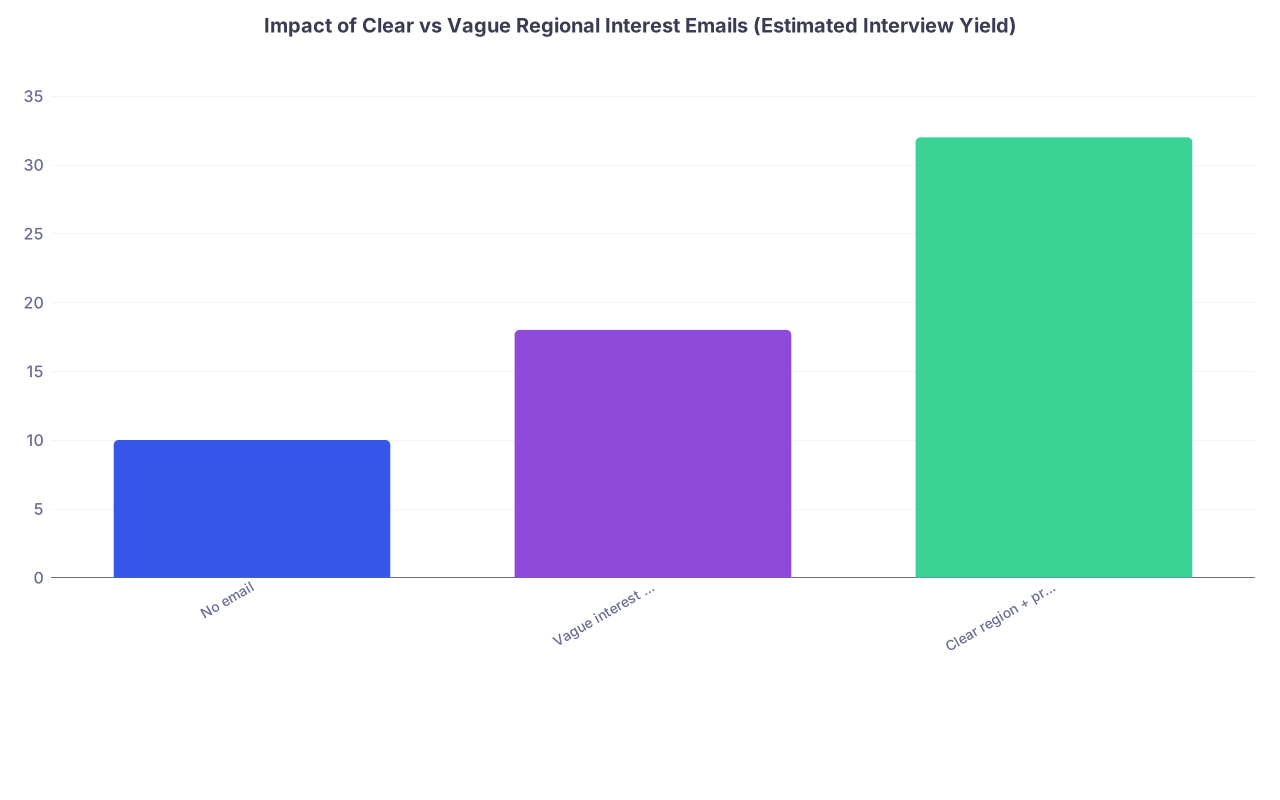
| Category | Value |
|---|---|
| No email | 10 |
| Vague interest email | 18 |
| Clear region + program tie email | 32 |
(Values illustrative, but the pattern matches what I’ve seen anecdotally.)
Step 4: Templates By Scenario
1. PRE-NOINT – You Have No Interview Yet, Early/Mid Cycle
This is the “get me on your radar in this new region” email.
Template: Initial Regional Interest (Pre-Interview)
Subject: Applicant expressing strong interest in [Region] and [Program Name]
Dr. [Last Name] and the [Program Name] team,
My name is [Your Name], and I am a [MS4 / transitional year resident] applying to [specialty] in the 2024–2025 cycle (AAMC ID: [ID]). I am writing to express genuine interest in training in [City/Region], specifically at [Program Name].
[City/Region] is my top geographic priority because [1–2 sentences – concrete reason].
Examples:
- My partner has accepted a job at [Company/Hospital] starting [month/year], and we are relocating permanently to [City].
- My parents recently moved to [Suburb/City] and I am planning to establish my long-term career in the area to be close to family.
- I intend to build a career serving [specific population] in [region], and your program’s focus on [X] aligns directly with that goal.
I am particularly drawn to [Program Name] because of [1–2 specific program features: e.g., your strong training in community-based oncology, the global health track, the X hospital’s large immigrant patient population]. These fit well with my interests in [briefly link to your background or future plans].
I understand how competitive this season is and appreciate the volume of applications you review. If my application is still under consideration, I would be very grateful for the opportunity to interview and to learn more about [Program Name] and the [City] training environment.
Thank you for your time and consideration.
Sincerely,
[Your Full Name], [Degree]
[Current Institution]
AAMC ID: [ID]
Preferred contact: [phone/email]
Key details you must customize:
- The regional reason must sound like an adult decision, not whimsy.
- The program specifics must be real. “Strong clinical training” means nothing. Use concrete features: trauma level, specific tracks, community vs tertiary, patient populations, unique rotations.
Do not write:
“I am very interested in [Program] because of your excellent clinical training and strong reputation.”
That sentence could be sent to every program in the country. And usually is.
2. PRE-WAIT – Late In The Season, No Interview Yet
At some point, you realize it is January, you have zero interviews in the region you need to be in, and you are sweating. This is when a targeted, honest email is worth sending.
You are not entitled to an interview. You are asking for a second look.
Template: Late-Season Reconsideration With Regional Emphasis
Subject: Strong interest in [Program Name] and long-term relocation to [City/Region]
Dr. [Last Name] and [Program Name] leadership,
I hope the season is going smoothly. My name is [Your Name] (AAMC ID: [ID]), an applicant in [specialty] from [Your School]. I am writing to reiterate my strong interest in training in [City/Region], with [Program Name] as a top choice.
Since submitting my ERAS application, my long-term plans have become firmly centered on [City/Region]. [1–2 sentences – clear, concrete update or clarification.]
Examples:
- My spouse has now finalized their position with [Institution] in [City], and we will be relocating there this summer.
- Due to family health needs, I will be moving to [Region] to help support my [parent/grandparent], who lives in [specific city].
- I have secured long-term housing in [Neighborhood/City], and my goal is to build my career in [Region] after residency.
I recognize the large number of exceptional applicants you review each year. If there is still flexibility in your interview schedule, I would be extremely grateful if you might reconsider my application for an interview. I believe I would be a strong fit for [Program Name], especially given your strengths in [1–2 specific program features] and my interests in [brief tie to your CV].
Thank you very much for your time and any consideration you are able to offer.
Respectfully,
[Your Full Name], [Degree]
[Current Institution]
AAMC ID: [ID]
This is not magic. You might still get no reply. But this is how you ask without sounding frantic or entitled.
3. POST-INT – You Already Interviewed There
Now you are not begging for an interview. You are clarifying that they are geographically aligned with your rank list.
Use this if:
- They are in a new geographic region for you, and you want to reassure them you would actually come.
- Something changed after the interview that strengthened your ties to that region.
Template: Post-Interview Regional Commitment Email
Subject: Gratitude for interview and strong interest in [Program Name] and [Region]
Dr. [Last Name],
Thank you again for the opportunity to interview with [Program Name] on [date]. Speaking with you and meeting your residents reinforced my sense that [Program Name] would be an excellent fit for my training and long-term goals.
I wanted to briefly emphasize my commitment to building my career in [City/Region]. [1–2 sentences of specific, credible reason].
Examples:
- My partner and I will be moving to [City] this summer for their position at [Institution], and we are planning to make [Region] our permanent home.
- My extended family is based in [Suburb/City], and my goal is to practice in the area after residency, ideally continuing to serve the [specific] patient population I saw during my visit.
The interview day highlighted aspects of your program that align closely with my priorities: [1–2 concrete items you observed: resident camaraderie, specific clinic site, ICU structure, research mentorship in X]. I wanted to share that [Program Name] will be ranked very highly on my list.
Thank you again for your time and for considering my application.
Sincerely,
[Your Full Name]
You do not have to use the phrase “ranked to match” unless you are 100% certain they are your #1. And even then, be careful and honest. PDs talk. Burning your integrity for a perceived edge is stupid.
4. UPDATE-TIES – New Or Stronger Regional Connection
Sometimes your regional interest becomes stronger mid-season:
- Family moved
- Spouse matched / took a job
- You accepted an offer for research / MPH / fellowship in that region
This is your excuse to send a short, focused update.
Template: Regional Ties Update Email
Subject: Update on regional ties to [City/Region] – [Your Name], [Specialty] applicant
Dear Dr. [Last Name] and [Program Name] team,
I hope you are doing well. My name is [Your Name] (AAMC ID: [ID]), an applicant to your [specialty] residency program this cycle. I am writing briefly to share an update that strengthens my long-term connection to [City/Region].
Since submitting my application, [specific update – 2–3 lines]:
Examples:
- My spouse has signed a contract with [Employer] in [City], beginning [month/year], and we have arranged housing in [Neighborhood].
- My parents have relocated to [Suburb/City], where I will be helping support their medical care and intend to remain long term.
- I have accepted a research position with [Institution] in [City], starting this summer, and plan to continue this work during residency in the area.
Given this change, training in [City/Region] has become my top geographic priority. [Program Name] remains a program of strong interest for me because of your [1–2 specific, relevant strengths].
Thank you very much for your time and for any continued consideration of my application.
Best regards,
[Your Full Name]
[Current Institution]
You are not demanding an interview. You are simply making yourself less risky from a geographic perspective. That matters, especially at programs worried about attrition.
5. COUPLES – Coordinating A Geographic Signal For Two People
Couples Match adds complexity but also leverage. Programs want people with reasons to stay. Two partners anchored to a city is a very good reason.
You send two separate emails:
- One from you to your specialty program
- One from your partner to theirs
You can reference each other, but do not attach your partner’s CV unless explicitly requested.
Template: Couples Match Regional Interest
Subject: Couples Match interest in [Region] – [Your Last Name & Partner Last Name]
Dr. [Last Name],
My name is [Your Name] (AAMC ID: [ID]), an applicant to your [specialty] program. My partner, [Partner Full Name] (AAMC ID: [ID]), is concurrently applying in [their specialty]. We are participating in the Couples Match with a strong focus on training together in [City/Region].
We have prioritized [City/Region] for both personal and professional reasons: [1–3 sentences – joint reason].
Examples:
- We have family support in [City] and plan to establish our long-term home and careers in the area.
- My partner has deep ties to [Region], and we hope to remain close to their extended family while both pursuing academic careers.
I am particularly interested in [Program Name] because of [specific features]. [Partner First Name] has similarly identified [Partner’s target program or institution in the region] as a top choice.
We recognize the challenges involved in accommodating couples, and we do not expect special treatment. I simply wanted to share this context, as it reinforces our commitment to remaining in [Region] throughout residency and beyond.
Thank you very much for considering my application.
Sincerely,
[Your Full Name]
[Current Institution]
Your partner sends a parallel email to their program, referencing you in the same way. Clean, honest, not pushy.
Step 5: How To Customize Without Sounding Like A Robot
The easiest way to get ignored: send what looks like a mail merge.
Watch for these red flags:
- Same paragraph copy-pasted to 15 programs with only the name changed
- Overly formal, lifeless language
- Zero reference to anything unique about the program
Fix it with three anchors:
One sentence that could not apply to any other city
- “My grandparents live in Renton, and I hope to be close to them as their health declines.”
- “My spouse is joining the cardiology faculty at [Specific Hospital].”
- “I completed high school and college in [City] and plan to return long term.”
One detail that clearly came from their website or your interview
- “Your X clinic serving primarily [language]-speaking patients matches my previous work at [clinic].”
- “The global health elective in [country] you described on interview day aligns with my career interest in [topic].”
- “Your 3+1 ambulatory schedule is exactly the structure I am seeking to develop strong primary care continuity.”
One line that connects your actual CV to their strength
- “My research in [field] with Dr. [Name] at [Institution] would fit well with ongoing work at [their department].”
- “My experience as a chief scribe in a community ED makes me particularly interested in your high-volume community sites.”
If your email does not include all three, you have more editing to do.

Step 6: Timing, Frequency, And Who To Send To
When to send
Rough practical timing:
Pre-interview interest:
- Late September to November for most specialties
- For very competitive fields (Derm, Ortho, ENT), earlier is better
Reconsideration / late interest:
- December–January, once it is clear interview offers are tapering
Post-interview interest:
- Within 1 week of your interview
- Again in late February if you feel strongly (and only if you are not spamming)
Update on regional ties:
- As soon as the change is official (signed contract, move finalized, etc.)
How often to email
Rule of thumb:
- 1–2 emails per program per season is usually enough.
- 3 emails is the hard cap. Beyond that, you cross into “memorable for the wrong reasons” territory.
Who to send to
- Program Director as primary recipient
- CC program coordinator (they actually manage a lot of the logistics)
- Do not CC half the faculty. It looks chaotic.
If a program explicitly says “do not send post-interview communication” or uses a portal system, follow their rules. You are trying to show you are mature and professional, not someone who disregards instructions.
Step 7: Common Mistakes That Kill Your Signal
I have watched people do all of these. Learn from them.
Over-explaining your life story
Do not turn this into a personal statement. 200 words is enough to convey seriousness.Vague or fake-sounding regional reasons
- “I love the culture of the West Coast” – meaningless.
- “I visited once and liked the vibe” – fine for vacation, not enough for life decisions.
Make the anchor concrete: family, partner, career plan, community, long-term housing.
Promising the same thing to multiple programs
Never tell more than one program they are your absolute #1 “ranked to match.” That lie spreads fast.Emailing 30 programs with identical text
If you are going to mass-mail a whole region, you are wasting your time. Pick 5–10 that you are genuinely ready to prioritize and put effort into those messages.Typos in program or city names
You laugh. It happens constantly. Triple-check.Sounding entitled
Any sentence that starts to sound like “I deserve an interview because…” needs to be deleted. You request, you do not demand.

| Step | Description |
|---|---|
| Step 1 | Need new region focus |
| Step 2 | Send POST-INT email |
| Step 3 | Send PRE-NOINT or PRE-WAIT email |
| Step 4 | Prioritize programs for targeted emails |
| Step 5 | Send UPDATE-TIES email |
| Step 6 | Hold, avoid unnecessary email |
| Step 7 | Already interviewed? |
| Step 8 | Any invites from region? |
| Step 9 | New or stronger regional ties? |
Step 8: Quick Editing Checklist Before You Hit Send
Run each email through this 10-point check. Takes 3 minutes. Saves you from avoidable mistakes.
- Subject line: clear about region + program + your name
- First sentence: identifies who you are and what specialty
- Region reason: specific, credible, not generic fluff
- Program reason: at least one detail that could not apply anywhere else
- Ask: clearly stated (interview consideration, ranking interest, update)
- Length: under ~250 words
- Tone: respectful, not begging, not entitled
- No obvious copy-paste errors (wrong program or city)
- Signature: full name, degree, institution, AAMC ID
- Alignment with their communication policies (no direct email if they forbid it)
If you cannot check all 10, fix it before sending.
Step 9: Example – Bad vs Improved Email
To show you how this plays out, here is a quick before/after.
Bad version
Dear Program Director,
I am very interested in your excellent residency program. I have always wanted to train in the Midwest and believe your program would be a great fit. I think your residents are very strong and your hospital is very good. Please consider me for an interview.
Sincerely,
[Name]
Zero impact. Could be sent to 150 programs.
Improved version
Subject: Applicant with strong interest in [City] and [Program Name] – [Your Name]
Dear Dr. [Last Name],
My name is [Your Name] (AAMC ID: [ID]), an applicant in [specialty] from [School]. I am writing to express genuine interest in training in [City] at [Program Name].
My partner recently accepted a position at [Company] in [Suburb], and we will be relocating to the [City] area permanently this summer. We have both spent significant time in [Region], and our long-term plan is to establish our careers and family there.
I am particularly drawn to [Program Name] because of your [specific program detail – e.g., strong inpatient training at both [Hospital A] and [Hospital B], and your dedicated clinic serving predominantly [X] patients]. This aligns closely with my interests in [tie to your experiences].
If my application remains under review, I would be very grateful for the opportunity to interview and to learn more about your program.
Thank you for your time and consideration.
Sincerely,
[Your Full Name]
Now you sound like a real person with a real plan. Huge difference.
Bottom Line
Three things to keep in your head as you draft:
Programs care about geographic commitment because it predicts retention. Your email has one job: make your presence in that region seem inevitable and logical, not hypothetical.
Specificity wins. One concrete regional tie + one real program detail + one clear ask will always beat a long, generic “I’m very interested” paragraph.
Be strategic, not spammy. Target a small number of programs in your new region, send clean, customized emails in the right scenario bucket, and then stop. Let your application and your stated ties do the work.