Last winter, I sat in a residency rank meeting where a New York City applicant’s file was on the screen. Stellar Step 2, glowing letters from big-name places, chief resident at a famous academic hospital. You’d think the room would be buzzing with enthusiasm. Instead, one of the senior faculty leaned back and said what everyone was really thinking: “Why would this guy actually come to here after training in Manhattan?”
That one question kills more big-city applications to Rust Belt programs than any low Step score ever will. And it almost never shows up in the rejection email.
Let me walk you through what program directors in Rust Belt cities actually say when the door is closed, the Zoom is locked, and they’re deciding whether someone who’s spent their entire life in coastal metros is worth a rank list gamble.
The First Filter: “Do They Even Know Where This Is?”
The unofficial first screen isn’t your score. It’s geography and credibility.
Rust Belt PDs know their cities are not on the default fantasy map for most med students. Cleveland, Milwaukee, Pittsburgh, Buffalo, St. Louis, Detroit, Toledo, Dayton, Akron, Youngstown, Rochester, Peoria, Erie, Scranton. They live every day with the reality that:
- Many applicants have never set foot there
- A good chunk only applied because it was on some Reddit “safety” list
- Some literally think the Midwest is one giant cornfield with one hospital in it
So when a big-city applicant from NYC, Boston, San Francisco, LA, or DC hits the inbox, this is the first internal reaction:
“Ok, what’s the catch?”
Or more bluntly, from a PD I know in Ohio:
“Why would a Brooklyn hipster suddenly want to come live next to the steel mill?”
That sounds harsh. But they’re not wrong to ask. Attrition, poor fit, and mid-year transfers are poison to small- and mid-sized Rust Belt programs. They cannot afford residents who are miserable from day one because they wanted “more vibe” or “better brunch.”
So your file gets scanned with that skepticism from the jump.
If your ERAS looks like:
- Born and raised in Los Angeles
- Undergrad: UCLA
- Med school: UCSF
- Rotations: All West Coast big systems
- Research: Coastal academic names
The immediate unspoken question is:
“Why here, now?”
If your application doesn’t answer that clearly and convincingly, you’re dead in the water long before anyone brings up your Step score cutoffs.
What They Assume About Big-City Applicants (And Often Don’t Say Out Loud)
Let me be blunt. There are stereotypes. You can either pretend they don’t exist or learn how to directly disarm them.
Here’s the internal monologue I’ve heard variations of in Midwest and Rust Belt conference rooms:
- “They’re not going to handle the pace and staffing reality here.”
- “They’re used to having five consultants on every case. We don’t have that.”
- “Are they going to roll their eyes when they see our EMR and our ancillary support?”
- “This person has only lived in very expensive, very dense cities. Are they going to be bored out of their mind here in 3 months?”
- “Will they spend the whole time comparing us to their med school hospital?”
And one that comes up more often than you’d like to think:
“Is this just a backup for them? If they get an offer from anywhere with a Whole Foods every two blocks, are we out?”
PDs in Rust Belt cities carry some scars:
- Residents who matched, then tried to transfer out after 6 months to a coastal program
- Trainees who spent three years complaining about the city, the weather, and how “there’s nothing to do”
- Applicants who talked a big game about being “excited to explore the Midwest” and then obviously ranked them low
They remember all of that when your New York or LA address hits their screen.
What They Secretly Like About You (If You Pass the Smell Test)
Now the part no one tells you: Rust Belt PDs actually love certain types of big-city applicants. And they compete hard for them if they think you’re legit.
Because the other side of the conversation sounds like this:
- “If this NYC grad really wants to be here, that’s a big win for our reputation.”
- “Coming from MGH/Columbia/UCSF gives them automatic credibility with the older faculty.”
- “They’ve seen high-acuity, high-volume pathology. They’ll be fine when it gets crazy.”
- “They’ll push us academically—maybe do more research, QI, help our match list.”
There’s a quiet status game in Rust Belt programs. They’re trying to prove—to themselves, to their hospital, to the med students—that they can attract people who could have gone “anywhere.” A few well-chosen big-city residents do wonders for that narrative locally.
So if you show up as:
- Technically strong
- Not arrogant
- Genuinely open to living there
- Ready to work and not whine
You go from “risk” to “trophy resident” in about 15 minutes.
The Real Math: Risk vs. Reward of Ranking You
Here’s how the risk–reward calculation really works behind the scenes. When your Zoom window closes, the room has a very specific kind of conversation.

They won’t say it like this in your face, but this is the mental table they’re working from:
| Factor | Quiet Thought in the Room |
|---|---|
| Geographic history | Have they ever lived away from the coasts? |
| Stated reason for region | Is this scripted fluff or a believable story? |
| Ties to area | Any family, friends, partner, or prior time nearby? |
| Attitude about lifestyle | Will they hate the city in 3 months? |
| Stability / commitment | Are they likely to transfer out if they get a 'better' offer? |
| Fit with current residents | Will they mesh with our culture, or look down on it? |
The safer play, from a PD perspective, is the applicant who:
- Went to a midwestern med school
- Grew up in Ohio/PA/Michigan/Indiana
- Has average but solid scores
- Clearly wants to stay in the region long-term
Versus the flashy coastal applicant who:
- Has a 260+ Step 2
- Did research at a big-name place
- But has zero articulate reason for wanting to be in Buffalo or Toledo
When push comes to shove on rank night, they’ll usually take the “less sexy, more likely to actually show up and stay” resident.
Unless.
Unless you’ve done the work to convince them you’re not a flight risk.
The Parts of Your Application That Scream “I Won’t Actually Come”
Some of you are sabotaging yourselves and have no idea.
Here’s what PDs and coordinators in Rust Belt cities quietly flag as red alarms when they skim your ERAS and listen to your answers.
1. The Generic “I’m Open to Anywhere” Line
The minute you say some version of:
“I’m really open to living anywhere and exploring new regions.”
You’ve just said nothing. And they know it.
What they hear instead:
“I don’t care where I go, and this city is interchangeable with 40 others I applied to.”
Programs in cities that often feel overlooked are hypersensitive to this kind of vagueness. They want evidence that out of all the not-coastal, not-sexy cities, you’re actually talking about them.
2. No Concrete Ties, No Concrete Reasons
If you say:
“I’d love to experience the Midwest.”
And that’s it? Bad sign.
But if you say:
“My partner grew up in Indiana and her family is still in Fort Wayne. We’ve talked a lot about planting roots somewhere that’s driving distance from them, and your city is a realistic, affordable place for us to do that.”
Completely different reaction.
A PD in western Pennsylvania once told me:
“I can forgive a lot if I believe they’re actually going to buy a house here or raise kids here. Or at least be happy for three years.”
3. The “Temporary Hardship” Vibe
Watch your phrasing. Rust Belt PDs have very sensitive antennae for people who think their city is a stepping stone punishment.
If anything you write or say implies:
- “I’m just here to get good training and then get out”
- “I’m sacrificing lifestyle for education”
- “This is my backup plan”
…you’re done.
They want people who can at least convincingly say: “I can see myself happy here for this phase of my life,” and sound like they mean it.
What Makes You Golden: The Big-City Applicant They Will All Fight For
Let me flip it. Here’s the composite of the big-city applicant Rust Belt PDs quietly love.
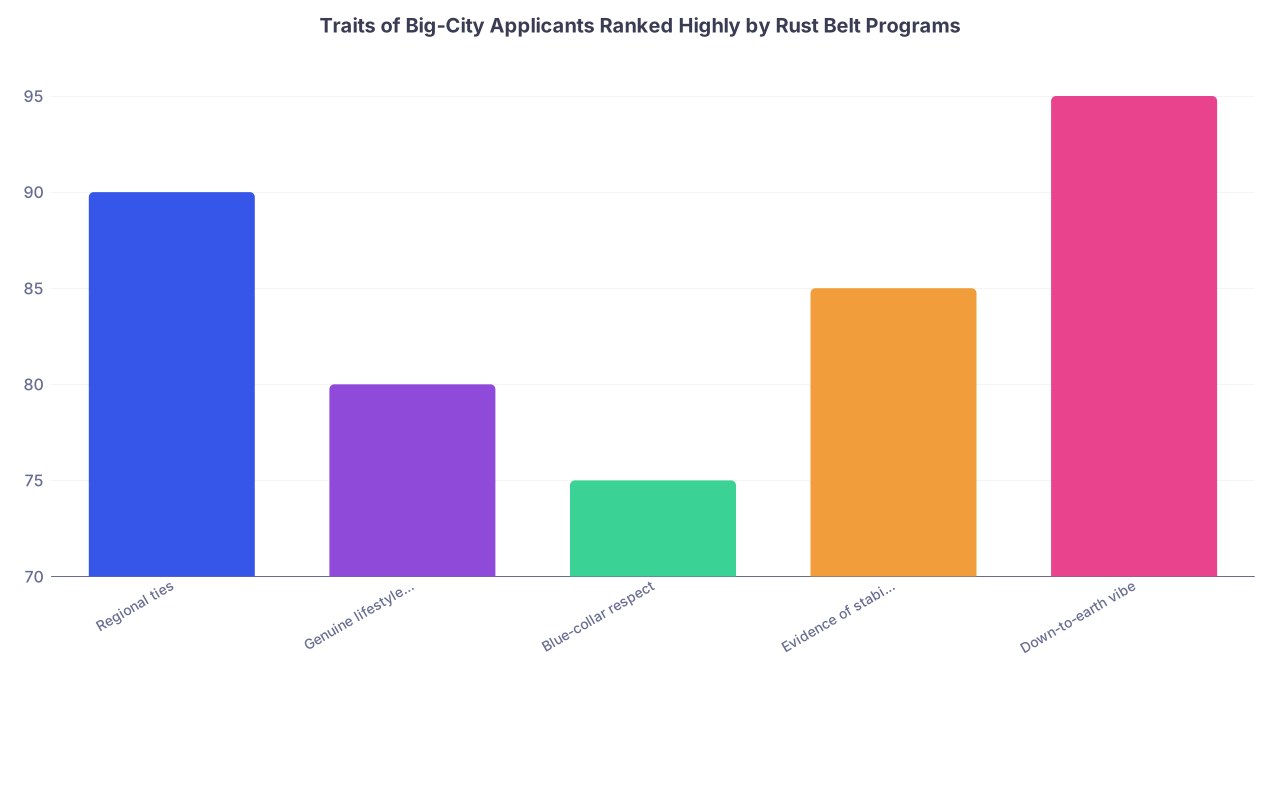
| Category | Value |
|---|---|
| Regional ties | 90 |
| Genuine lifestyle interest | 80 |
| Blue-collar respect | 75 |
| Evidence of stability | 85 |
| Down-to-earth vibe | 95 |
I’ve seen programs in Cleveland, Pittsburgh, and St. Louis push these people way up their rank lists, even over objectively “stronger” applications on paper.
The golden combination looks roughly like:
- You come from a big coastal city, but
- You have some tie—family, partner, college roommate, former job—to the Midwest or that specific state, or
- You’ve spent time in smaller cities or more working-class environments and don’t act like this is Mars
- You speak respectfully about cost of living, community, and real people, not just restaurants and nightlife
And on top of that:
You show up on interview day (or Zoom) clearly having done your homework.
I’ve heard these exact lines sway rank discussions:
- “She knew our sports teams, knew we were building a new cancer center, and even mentioned the local park she’d visited during her away rotation.”
- “He talked about wanting to buy a house at some point and said realistically that’s not happening in Boston or SF. That was honest.”
- “She said she saw herself as a community doctor long-term and that this city felt like someplace she could actually live, not just survive three years.”
PDs and faculty are human. They live there. They raise their kids there. When you talk about their city with curiosity instead of condescension, you immediately separate yourself.
Behind Closed Doors: How Rank Meetings Actually Talk About You
Let me pull the curtain back on what happens post-interview.
A typical Rust Belt rank meeting goes case by case. When your file (big coastal background, Rust Belt applicant) comes up, the conversation often circles one central question:
“Do we believe they’ll actually show up and stay?”
I’ve heard:
- “New York kid, never lived anywhere else. Seemed sincere, but I’m not fully convinced.”
- “She said her fiancé is from an hour away and already has a job offer here. I’d bump her up.”
- “He kept saying ‘small town’ but we’re a metro of 2 million people… not sure he understands where we are.”
- “Her email afterwards mentioned a specific neighborhood and cost of housing. She’s looked into this. I trust it more.”
Sometimes they’ll literally split hairs between two applicants:
Applicant A: Midwest med school, average scores, clear regional ties.
Applicant B: Big coastal med school, higher scores, but no articulated reason for the region.
On paper, Applicant B wins.
In that room? Applicant A often goes higher. Because the nightmare scenario for a Rust Belt PD is this:
- They use a top rank slot on a coastal star
- The star ranks them low as a backup
- They go unmatched or drop to much lower-choice candidates
- Or worse—match and then leave
They would rather have 10 residents who are 100% all-in than 2 superstars and 3 flight risks.
How to Signal You’re Not a Flight Risk (Without Groveling)
You cannot just say “I really love your city” and expect anyone to buy it. They’ve heard that 300 times.
You have to show it in specific, behavioral ways.
1. Build a Believable Story in Your Application
Your personal statement or geographic preferences section should not sound like a real estate brochure. It should sound like a life plan.
Strong:
“I grew up in Queens and have spent most of my life in major coastal cities. Over the last few years, watching my parents struggle to stay in our neighborhood, I’ve become very conscious of cost of living and long-term sustainability. I’m looking for a place where I can build a career, maybe own a home one day, and practice in a community that needs doctors. That’s what drew me to cities like Pittsburgh and Cleveland.”
Weak:
“I’m excited to explore new regions and I’m very open to the Midwest.”
One of those makes a PD think, “Ok, that’s credible.” The other screams boilerplate.
2. Explicitly Acknowledge the Contrast
Do not pretend your move from Manhattan to Toledo is insignificant. Name it, and frame it as a conscious choice.
“I realize moving from San Francisco to a smaller Rust Belt city will be a big lifestyle change. I’ve thought a lot about that. The trade-offs that matter most to me at this stage—affordability, sense of community, being part of a program where I can have close relationships with faculty—line up more with what your city offers than with staying on the coasts.”
This kind of sentence relaxes a lot of PDs. It shows you’re not walking in blind.
3. Do the Simple, Concrete Homework
If you interview at a program in, say, Rochester or Milwaukee, and you can’t name:
- One neighborhood you looked up
- One local feature (sports team, lakefront, major park, local industry)
- One real, pragmatic reason you could see yourself there
You didn’t prepare.
People on the selection committee absolutely notice when you say:
“I was looking at [X neighborhood] because the housing seemed doable on a resident salary.”
Or
“I saw there are a lot of trails/waterfront/arts spaces. That matters a lot to me for my downtime.”
That’s the stuff that moves you from “generic coastal applicant” to “this person has actually pictured a life here.”
The Money and Lifestyle Angle PDs Won’t Put on the Website
Here’s one more quiet truth: Rust Belt programs know their biggest hidden advantage. It’s not just the pathology. It’s the math.
They know residents in:
- NYC
- Boston
- Bay Area
- DC
…are often broke, stressed, and several years away from ever being able to buy anything bigger than a studio apartment.
So when a big-city applicant looks them in the eye (or camera) and says:
“Honestly, the idea of having a bit more breathing room financially for the next three years is really appealing. I want to be able to focus on training, not on whether I can afford groceries.”
They nod. Because that’s real.
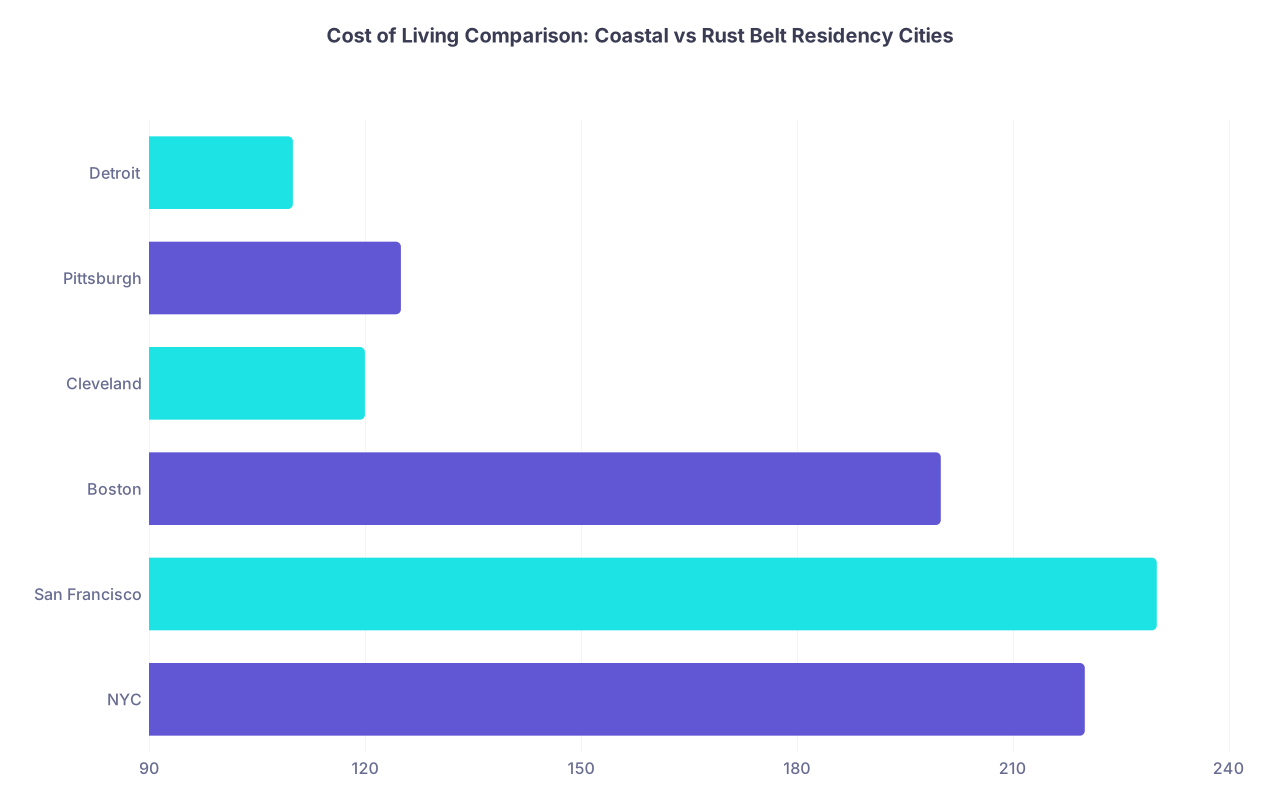
| Category | Value |
|---|---|
| NYC | 220 |
| San Francisco | 230 |
| Boston | 200 |
| Cleveland | 120 |
| Pittsburgh | 125 |
| Detroit | 110 |
Residents talk. PDs hear stories of friends in coastal residencies working extra shifts, drowning in rent, never saving a dime. They know they can offer you something different—even if it’s not framed all that well in the brochure.
If you articulate that you get this difference, you immediately come across as more serious, more grounded, less likely to be disillusioned.
The Future: Rust Belt Programs Are Getting Picky About You
Here’s where this is heading.
As remote work takes off and some people flee high-cost coasts, Rust Belt cities have quietly become less of a joke and more of a realistic life plan. Hospital systems there are investing heavily: new cancer centers, research expansions, “innovation districts.”
They’re tired of being Plan B.
You’re going to see more of the following:
- Programs explicitly asking about regional ties or long-term intentions
- Better-organized attempts to sell the city, not just the hospital
- PDs favoring applicants who can clearly articulate a Midwest/Rust Belt logic
Programs in places like Columbus, Cincinnati, Pittsburgh, and Minneapolis are already blurring the line between “Rust Belt” and “modern mid-sized hub.” They can be choosier with coastal applicants. And they are.
If you’re coming from a big coastal city and you genuinely want to match in a Rust Belt program, you have to treat it as a strategic choice, not a consolation prize.
Because I promise you—behind closed doors, they can tell the difference.

| Step | Description |
|---|---|
| Step 1 | Review Application |
| Step 2 | Standard review |
| Step 3 | Lower risk perception |
| Step 4 | Moderate risk, consider strongly |
| Step 5 | Flight risk, rank lower |
| Step 6 | Check Interview Vibe |
| Step 7 | Rank competitively |
| Step 8 | Coastal Background? |
| Step 9 | Any Regional Ties? |
| Step 10 | Clear Life Story For Region? |
| Step 11 | Seems Genuine About City? |
With this framework in mind, you can decide how you’re going to present yourself—not as a wandering coastal nomad “open to anywhere,” but as someone making a deliberate, grown-up decision about where to train and live.
You’ll only get a few interviews at places that see you as a potential fit. What you do with them may decide whether you ever practice in that part of the country. The programs you’re looking at? They’re deciding whether you’re the kind of big-city applicant they quietly brag about—or the kind they’ve been burned by before.
What comes next for you is shaping that story on paper and in person, so when your file comes up on the projector in that Rust Belt conference room, there’s no hesitation when someone asks, “Do we believe this one will actually come?”
That part is on you.