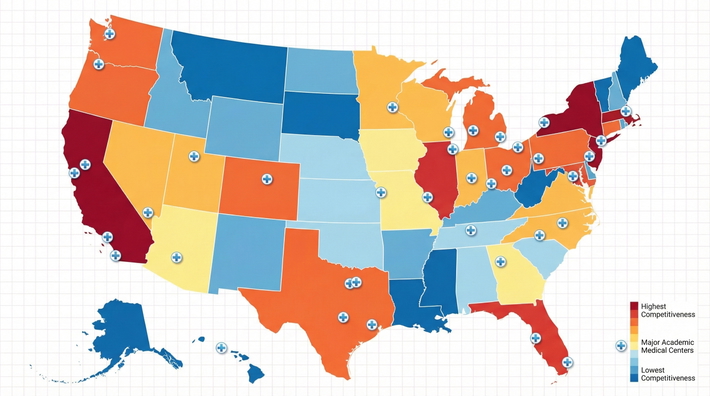
The way programs use “regional ties” on rank day is nowhere near as noble or objective as people pretend. It’s a political, risk‑management tool. And if you don’t understand how that game is actually played behind closed doors, you’ll get burned by it.
Let me walk you into the room.
What “Regional Ties” Really Signal To Program Directors
On paper, “regional ties” is about community, fit, and likelihood to stay in the area.
In reality, to program directors and core faculty, “regional ties” mostly translates to three questions:
- Are you actually going to show up here in July and not ghost us?
- If we invest three years in you, are you going to bolt the second you graduate?
- If something goes sideways (family, burnout, second thoughts), do you have anchors here that make you less likely to quit or transfer?
That’s the subtext.
They’ve all been burned before. The star applicant from the opposite coast who swore they were “eager to move and settle down” then asked to transfer after intern year. The resident who hated the city, spiraled, and left. The categorical slot that turned into a scramble nightmare.
So when faculty say, “I like that she has strong ties to the area,” what they’re actually saying is, “This one is less likely to cause us an expensive, time‑consuming headache.”
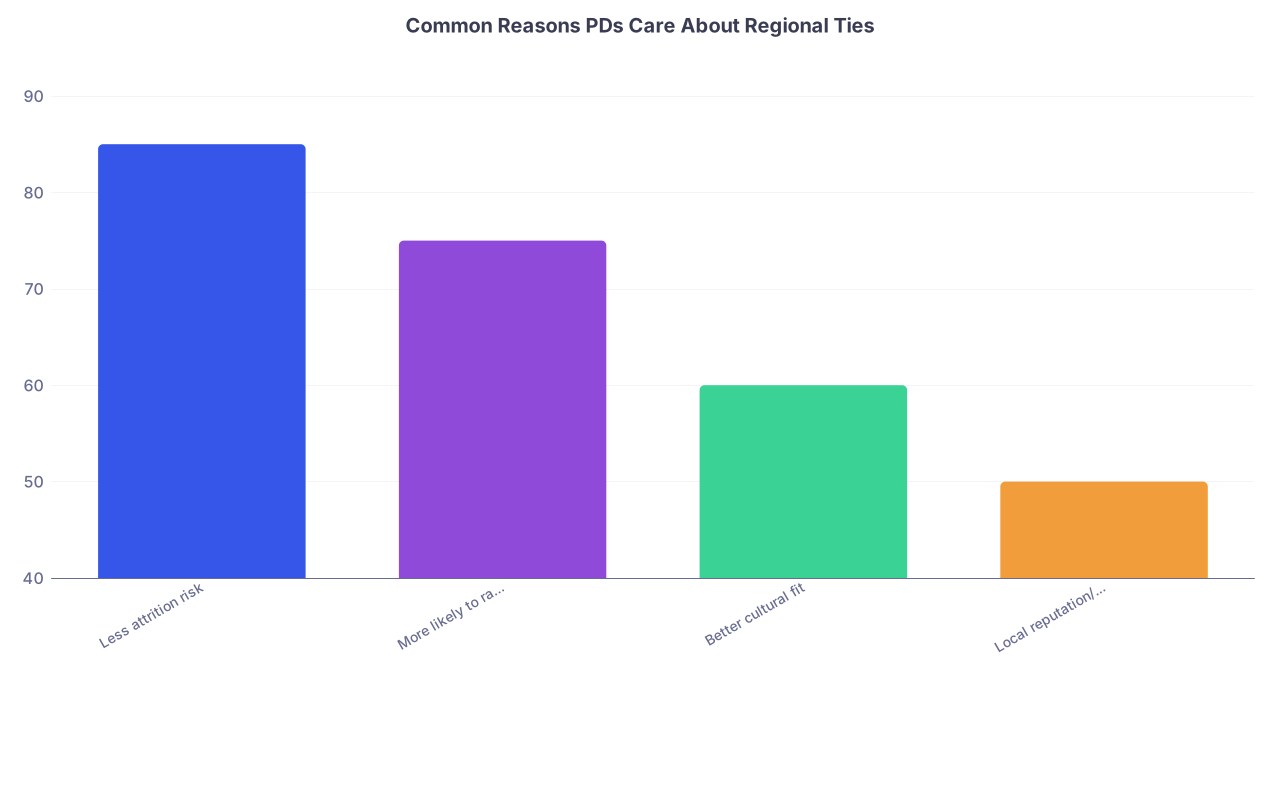
| Category | Value |
|---|---|
| Less attrition risk | 85 |
| More likely to rank us highly | 75 |
| Better cultural fit | 60 |
| Local reputation/reference check | 50 |
Notice what’s missing from that list: “best academic potential” or “smartest applicant.” That comes earlier. Regional ties show up after you’ve cleared the clinical/academic bar. Then it becomes a tiebreaker and a risk filter.
Where In The Process Regional Ties Actually Matter
People imagine PDs scrolling ERAS and filtering by “states lived in.” That’s not how it works. Regional ties mostly matter in three late‑stage moments: interview invite decisions at the margin, post‑interview discussions, and final rank list disputes.
1. Pre‑interview: The Marginal Invite
If you’re clearly strong or clearly weak, your ties don’t matter. You’re in or out on merit.
Where ties sneak in is the gray zone.
I’ve seen this exact conversation in selection committee meetings:
“We’ve already got 28 invites out of 30 for this date. We have 6 people clustered here—who do we pull?”
“These two are both 245-ish, average letters, no red flags. One is from here, went to undergrad at State U, says family in town. The other is from out of region, no mention of any ties.”
“Take the local.”
That’s it. No big philosophical debate. Just a low‑risk decision. When you have 6 decent but not amazing people for 2–3 slots, the one with regional anchors wins more often than not.
2. Post‑Interview: Turning “Good” Into “Safe”
After interviews, programs sort candidates into rough bins:
- Auto‑high rank (everyone loved them, no concerns)
- Strong / solid
- Middle / neutral
- Concern / question mark
- Auto‑low or do‑not‑rank
Regional ties won’t rescue you from the bottom two buckets. But inside that huge middle group? That’s where they matter.
Faculty will say things like:
- “She was quiet, but she trained at Midwest Med and her whole family is here. She’s likely to stay.”
- “He’s fine, but he’s from the West Coast, all his interviews are there, and he didn’t give me a compelling reason to come to [our city]. I’d push him down a bit.”
Same academic profile. The regional story shifts you up or down within the tier.
3. Rank Day: The Tiebreaker You Don’t See Coming
On rank day—or more realistically, the week or two before—committees usually have clumps of applicants who look almost identical: similar Step 2, similar letters, similar interviews.
This is where PDs explicitly use regional ties as a tiebreaker, even if they don’t write that in any “official” document. I’ve literally seen:
- Two applicants with almost the same scores and comments.
- The only difference in the summary notes: “Family in town, strong desire to stay” vs. “No known ties to region.”
- PD: “Make the local one #12 and the other #15. If we fill by 14, I want the one less likely to bail.”
Same thing happens around the “safety floor” on the list—where they decide how far down they can go and still feel good about the likely class. They bump people with weak or no ties down a bit, because those applicants might rank the program lower or go elsewhere.
What Counts As “Real” Regional Ties (From A PD’s Perspective)
Not all regional ties are created equal. Programs see the difference between real anchors and vague hand-waving.

Let me be blunt about how they classify it, because people fool themselves here.
The strongest, most credible ties:
- You grew up in the region, especially if it’s the same city or state.
- You did undergrad or med school in that state/neighboring states.
- Your spouse/partner already has a job or training position there.
- Your parents, children, or other first‑degree family live locally and you actually reference them specifically.
- You previously worked there (scribe, nurse, tech) or did longitudinal experiences there.
Moderately strong but still helpful:
- You went to undergrad nearby but left for med school.
- You’ve done away rotations or summer research at that institution or in the city.
- You’re from a clearly associated “feeder” region. For example, rural state bordering the metro area.
Weak or borderline meaningless:
- “I like the city.”
- “I visited once and loved the culture.”
- “I’m excited to explore a new region.”
- A cousin two hours away that you mention once.
- “I’m open to relocating anywhere in the country” with no specifics.
Borderline insulting:
- Dropping a random “regional interest” line for every program without customizing. (Yes, PDs can tell. They compare your PS or supplemental responses while sitting together.)
How They Actually Verify These Ties
They don’t run a background investigation. But they do infer and cross‑check in simple, very human ways.
They look at:
- Your permanent address vs. current address in ERAS.
- Where you went to high school, undergrad, and med school.
- Your CV entries—jobs, volunteering, clinical work locations.
- The way you answer, “So what brings you to [our city]?” on interview day.
And sometimes they just straight up ask you:
“Your whole application is Northeast, but we’re in Texas. Help me understand why you’re applying here.”
If your answer sounds like a rehearsed script or a generic “open to new experiences,” they mentally downgrade your “ties” to zero or close.
I’ve seen PDs literally mark “fake ties” in their notes if someone tried too hard to stretch a flimsy story.
How Different Program Types Use Regional Ties
Not all programs care the same way. But they all care somewhat. The difference is degree and how openly they admit it.
| Program Type | Regional Ties Weight |
|---|---|
| Community, non‑destination city | Very High |
| Community, desirable city | Moderate |
| University, mid‑tier | Moderate‑High |
| Big‑name academic center | Low‑Moderate |
| Highly competitive specialty | Low (except at margin) |
Community Programs In Less Popular Cities
These are the most aggressive about regional ties. They’ve been burned the most.
A community internal medicine program in a Rust Belt city? Or a FM program in a rural area 2 hours from the nearest major airport? They live on residents with real reason to be there.
In those rooms, I’ve heard:
- “Out‑of‑state, no ties, and 15 interviews? He’s never coming here.”
- “Her fiancé is from the area and she went to State U. She’s at the top of our realistic list.”
They use ties as both a tiebreaker and a probability estimator: will you rank them high enough that they’re likely to match you? That’s the game.
University Programs In Mid‑Tier Markets
These programs care about two things: reputation and fill stability. They won’t take a weak hometown applicant over a much stronger out‑of‑region applicant. But when applicants are in the same performance ballpark, regional ties absolutely come into play.
Classic scenario:
- Candidate A: 250 Step 2, from across the country, no ties, strong research, good interview.
- Candidate B: 243 Step 2, local med school, rotating at the hospital, strong resident advocate, family nearby.
Is A better on paper? Slightly. Will B be nudged higher on the rank list? At many mid‑tier university programs, yes. Because B is “known quantity + likely to stay.”
Big‑Name Academic Centers
Here’s where people get the wrong idea. They think “top 10” means they do not care at all about regional ties. Wrong again.
Do they care less? Yes. They’re drawing from a national pool and can usually fill all their slots no matter what.
But if they have two people they both like—one with strong local connections, one completely random—it is absolutely discussed. I’ve sat in meetings where an associate PD said:
“She’s here for med school, her partner is starting a PhD here, and she wants to be faculty down the line. That’s someone we can grow.”
That doesn’t beat a significantly stronger out‑of‑region applicant. But when there’s a cluster at the same level, that’s how people get nudged up or down a few positions.
Highly Competitive Specialties
For things like ortho, derm, plastics, ENT, regional ties matter less globally, because raw competitiveness dominates. But they still creep in at the margins:
- Home program advantage is huge. That is a form of regional tie.
- If two externs are similar, the one who’s from the region or has trained nearby sometimes gets the nod, because they’re seen as more likely to actually come.
So no, you won’t match derm just because your grandma lives in that city. But, yes, ties can help break close calls.
How Applicants Quietly Sabotage Themselves With Regional Ties
A lot of you are doing this part badly, without realizing it. Not just failing to help yourselves—actively making programs distrust your commitment.

| Step | Description |
|---|---|
| Step 1 | Cluster of similar applicants |
| Step 2 | Lower tier |
| Step 3 | Ranked higher in cluster |
| Step 4 | Ranked lower in cluster |
| Step 5 | Any clear red flags |
| Step 6 | Regional ties present |
Here’s what I see repeatedly:
You write copy‑paste regional lines.
You spray “I have always loved the Midwest” at 10 different midwestern programs, none personalized, all vague.
Faculty read 30 of those in a row. They stop believing any of them.
You tell every city they’re your “top choice.”
Then on interview day you give the same shallow answer about “great training and diverse patient population.” They’ve heard it 500 times. It means nothing.
You omit obvious ties.
I’ve seen applicants with four years of undergrad in that city, plus siblings living there—never mentioned once in the app or interview. PDs are busy; they will not always connect those dots unless you draw the line in bold.
You tell a confusing geography story.
Northeast childhood, Southern undergrad, Midwest med school, applying heavy to West Coast, and when asked “where do you want to end up?” you say, “Honestly, I’m open to anywhere.”
That tells them: no particular reason to believe you’ll come here.
How To Present Regional Ties So They Actually Help You
There’s a right way to use this, and it isn’t complicated. It’s just specific, consistent storytelling.

1. Decide Your Real Anchor Regions
You probably have 1–3 areas where you could credibly say: “I have a reason to be here.”
That might be:
- Where you grew up.
- Where you did undergrad or med school.
- Where your partner or close family live or are moving.
- A place you’ve already lived for years and could genuinely see as home.
Be honest with yourself. You do not get to claim “strong regional ties” to five completely different parts of the country. Faculty can see your geography at a glance.
2. Make The Story Obvious In Your Written Application
You don’t need to write a whole essay about it. But you do need to plant clear, specific clues in a few places:
- ERAS experiences: If you worked or volunteered in that city, give a one‑line description that references your connection.
- Personal statement or program‑specific statements: One or two sentences that mention concrete reasons for that region. Not generic travel brochure phrases.
- Additional questions / supplemental ERAS: When they ask why that region or program, be explicit: “My parents moved to [city] during M2, and I’m hoping to train close to where they live.”
Brevity is fine. Specificity is not optional.
3. Back It Up Verbally On Interview Day
You will get versions of: “So what brings you to [our region]?” Have an answer ready that hits three things:
- Your history there (school, family, prior living there).
- Your present or near‑future anchor (partner job, family move, genuine desire to settle).
- Your professional rationale (training style, patient population, academic needs).
Example of a weak answer:
“I’ve heard great things about the city and I’m open to exploring new places.”
Example that plays well in the room:
“I did undergrad at [local university], my sister lives 15 minutes from here now, and my spouse is applying to jobs in [city]. We’ve always thought we’d end up back here long‑term, so when I saw how strong your inpatient training is and how much your graduates stay in the area, it felt like a great fit.”
No drama. No over‑selling. Just a coherent, believable story.
4. Don’t Lie. Do Not “Borrow” Ties.
Faculty talk. PDs know PDs in other regions. Residents grew up in all sorts of places and can smell nonsense quickly.
If you claim “strong family presence in [city]” and it turns out you meant one cousin you haven’t seen in 10 years, that becomes a trust issue. Not a small thing.
Programs will absolutely tolerate “I have no specific ties, but here is why I want to be here anyway” if it sounds thoughtful and consistent. They are much less forgiving of exaggeration.
How Rank Lists Really Shift Because Of Ties
Let me show you how this plays out in actual rank discussions, because that’s what you care about.
We’re in the conference room, looking at three applicants in the same cluster:
- All have solid Step 2 (let’s say 240–245).
- All had “good” interviews.
- No major red flags, no superstars.
The comments might look like this:
- Applicant X: “Home student, rotated here, knows system, quiet but hardworking, parents live in nearby suburb.”
- Applicant Y: “From same state, strong teamwork comments, fiancé in city, wants to stay local.”
- Applicant Z: “From far state, no ties, interviewing widely on coasts, said ‘open to anywhere’ when asked.”
Nobody hates Z. But here’s the conversation I’ve actually heard versions of:
PD: “We like all three. Who do you feel most confident will come here if we rank them similarly?”
APD: “X and Y. Z is harder to read. Good guy, but this isn’t obviously his first choice region.”
PD: “Fine. Stack X then Y then Z. If we end up hitting Z’s spot, that’s fine, but I want the locals slightly higher.”
That’s how regional ties turn into a tiebreaker. It’s not “we only want locals.” It’s probability management under uncertainty.
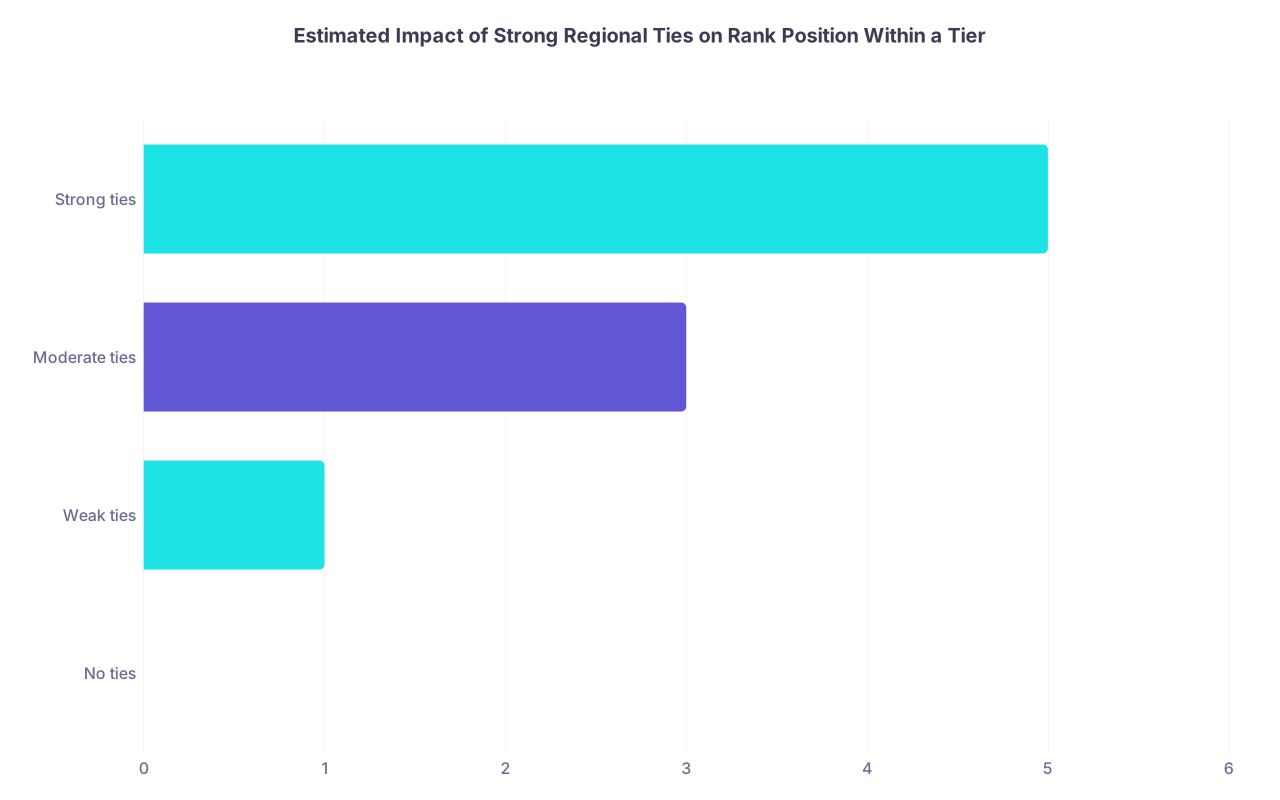
| Category | Value |
|---|---|
| No ties | 0 |
| Weak ties | 1 |
| Moderate ties | 3 |
| Strong ties | 5 |
Those numbers aren’t gospel, but that’s the scale: a few spots here, a few spots there. Enough to move you from “just below where they actually fill” to “just above.”
The Future: Are Regional Ties Getting More Or Less Important?
With virtual interviews, PDs worry even more about gamesmanship. Applicants shotgun across the whole country at low travel cost. That makes it harder to predict where anyone will actually go.
So what do risk‑averse humans do when they’re less sure? They cling even tighter to whatever signals of commitment they can find.
Which means:
- Programs in less popular regions → leaning harder on ties to predict yield.
- Big city programs → still drowned in applicants, but using ties at the margin to guess who might stay and become faculty.
Unless the match system radically changes or we move to some centralized geographic preference system (don’t hold your breath), “regional ties” as a quiet rank tiebreaker is not going anywhere.
It’s becoming more important, not less, particularly outside the coasts and name‑brand centers.
FAQs
1. I have zero real regional ties to a place I like. Am I doomed there?
No. If you are clearly one of their strongest applicants, they will rank you high regardless. Regional ties matter most in the middle—when you’re comparable to several others. In that case, your job is to build a coherent story of why you want that region: prior visits, mentors there, lifestyle fit, type of practice you want. You cannot conjure a decade of history, but you can be specific and thoughtful instead of generic.
2. Should I explicitly say a program is my “top choice” to boost my rank?
Use that sparingly and only when it’s actually true or very close. PDs have been lied to for years. If you tell five different places they’re your top choice, someone will eventually compare notes. What works better is: “You’re one of my top programs, and I’d be thrilled to match here because [specific reasons].” That’s honest, still positive, and doesn’t back you into a corner.
3. If my partner might move to that region but has no job yet, should I mention it?
Yes, but phrase it carefully. Do not present speculation as fact. You can say, “My partner is actively applying to positions in [city], and we’re both hoping to build our lives here long‑term.” That signals intention without lying. If they later do not move, nobody’s going to run a background check. What you cannot do is, “My partner has a job there” when they don’t.
4. How do I balance multiple regional stories if my life is spread out?
Pick primary and secondary regions. For example: “I’m primarily focused on the Midwest because of family and training style, but I also have a strong interest in the Pacific Northwest where I went to undergrad.” Your application should show a pattern that matches that statement. Then, when talking to programs in each region, emphasize the relevant piece of your story without pretending the others do not exist. Consistency beats over‑tailoring.
Key points: programs use regional ties as a risk filter and tiebreaker, especially in the middle of the rank list. They reward concrete, believable anchors—not vague fluff. Use that knowledge to tell a clear, consistent geography story, and you’ll quietly gain positions on rank day that you never see—but absolutely feel on Match Day.