It’s a Thursday night in January. You’re on ERAS, staring at a spreadsheet labeled “West Coast Lifestyle Programs.” You’ve got columns for “near the beach,” “no 24s,” “chill culture,” and a couple notes from Reddit about “good vibes” and “everyone seemed happy.”
You’re picturing walks on the beach post-call, hiking on golden weekends, maybe even surfing before pre-rounds at that SoCal program everyone swears is “so chill.”
Let me tell you what actually happens in those programs. And what faculty say in the conference room after you leave the interview day talking about “work–life balance.”
What Program Directors Really Mean by “Lifestyle”
“Lifestyle” on the West Coast is code. But not the way applicants think.
When applicants say “lifestyle,” they mean:
- Reasonable hours
- Supportive culture
- Time for family, hobbies, fitness
- Not being destroyed by malignant seniors
When many West Coast program directors hear “lifestyle,” they think:
- You want to work less
- You’re not serious about the field
- You’re using geography as your main criterion
- You’ll complain about call and push back on workload
Harsh? Yes. But I’ve watched PDs at big-name West Coast programs literally circle “mentions lifestyle 3+ times” in their notes as a red flag.
Here’s the translation game that happens behind closed doors:
| Applicant Phrase | How Some PDs Hear It |
|---|---|
| "Work–life balance is important" | "I prioritize my time over work" |
| "I love the outdoors" | "I might be gone every golden weekend" |
| "I want a lifestyle program" | "I want an easier residency" |
| "I value wellness" | "I might resist hard rotations" |
| "I prefer no 24s" | "I may have boundaries they don't like" |
None of this is written on websites. But I’ve sat in rank meetings where someone says, “Nice candidate, but they’re very lifestyle-focused. Are they going to survive here?” And that’s at programs the internet calls “cush.”
The real truth: West Coast “lifestyle” and West Coast “expectations” coexist in the same building. One doesn’t cancel the other.
Why West Coast Programs Feel Different (and Why That’s Misleading)
You’re not hallucinating. West Coast residencies can feel different on interview day.
You see residents in Patagonia vests, talking about their ski passes. You see photos from beach days and hiking trips in the recruitment slide deck. You see sunlight coming through the windows instead of grey Midwest winter.
So you think: “This must be a lifestyle program.”
What’s actually going on is a mix of geography, culture, and presentation.
Geography Isn’t Lifestyle
You can finish a 28-hour call at a “lifestyle” Bay Area program and still be too exhausted to see the Golden Gate Bridge. You can be at a “chill” LA program and never once touch the ocean until PGY-3.
Being near water, mountains, or wine country doesn’t lower your census. It doesn’t reduce the number of notes. It doesn’t stop attendings from paging you at 2 am.
The only guaranteed lifestyle edge you get from geography is this: when you are finally off, the outside is actually nice. That’s it. The hours are still the hours.
Culture vs. Optics
A lot of West Coast programs are masters of optics. Wellness days. Group hikes. Residents smiling around picnic tables.
You know when a lot of those photos are taken? Retreat days. Or very carefully curated low-census times. You’re not seeing the day the ED boarded 40 patients and two residents cried in the stairwell.
In conference rooms I’ve heard:
- “Make sure we show the hiking picture; people expect that from us.”
- “Can we get a slide with the residents at the beach?”
- “Applicants really care about wellness language right now—put that earlier in the talk.”
Is there anything wrong with that? Not really. But don’t confuse marketing with structure.
The Three Types of “Lifestyle” Programs on the West Coast
Let’s pull back the curtain. When people talk about West Coast “lifestyle residencies,” they’re usually unknowingly grouping together three very different beasts.
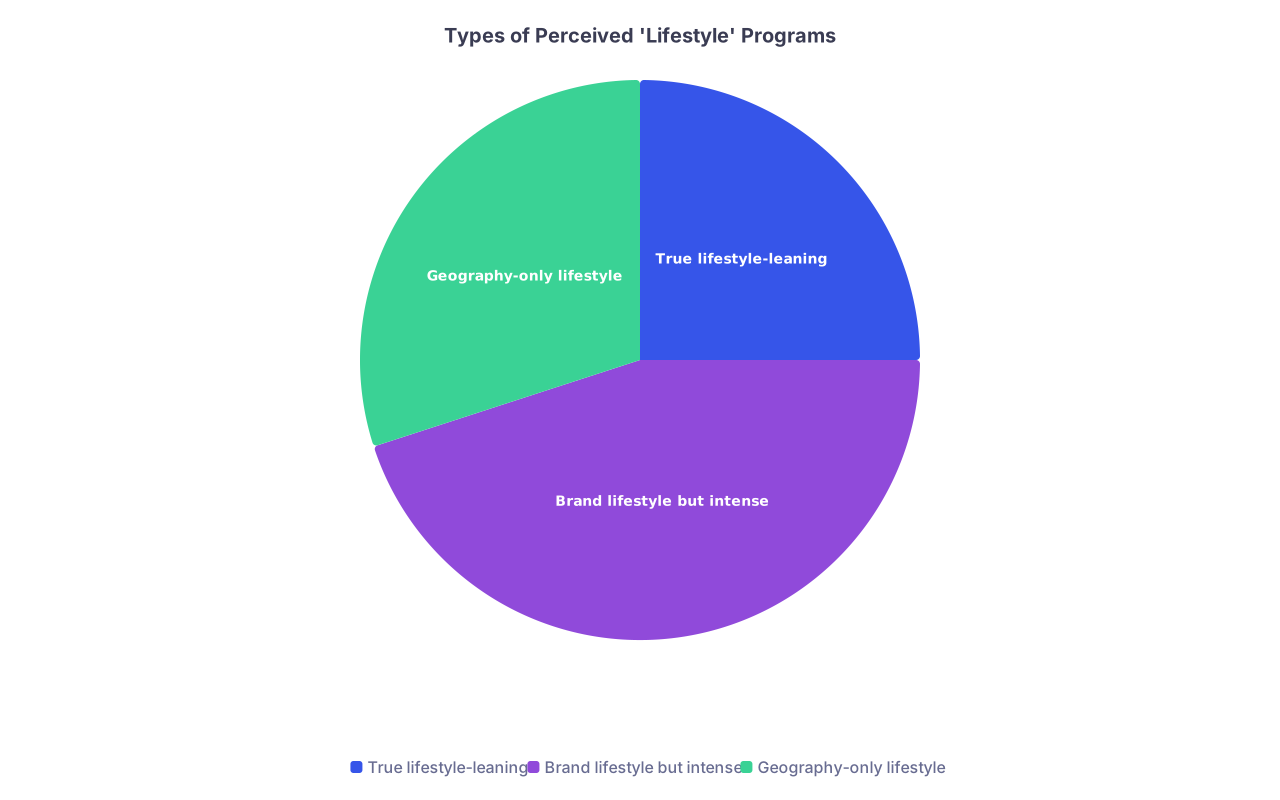
| Category | Value |
|---|---|
| True lifestyle-leaning | 25 |
| Brand lifestyle but intense | 45 |
| Geography-only lifestyle | 30 |
1. The True Lifestyle-Leaning Programs (Rare, Not Mythical)
These exist. Usually smaller or mid-sized, often community or community-affiliated, sometimes in second-tier or more suburban cities rather than marquee coastal zip codes.
They have:
- A genuine culture of sharing the load
- Leadership that actually cares about
- No habitual 28-hour post-call abuse
- Sane expectations for documentation
- Protecting golden weekends
- Attendings who don’t think “I suffered so you should too”
The catch? Trade-offs. Always.
You might get:
- Slightly weaker research infrastructure
- Fewer fellowship pipelines to hyper-competitive niches
- Less procedural volume in certain subspecialties
- A name that doesn’t open doors automatically
These programs can be terrific for people aiming for general practice in a region, outpatient-heavy careers, or balanced academic paths where you’re willing to hustle a bit extra on your own.
But they’re not lining the beach in Santa Monica or in the center of San Francisco’s hottest neighborhoods. The market value of sun + ocean + prestige + true lifestyle is basically zero. Those dials don’t all go to max at once.
2. The “Brand Lifestyle” Programs (Most Common)
These are the ones everyone on Reddit, SDN, and med school group chats calls “chill,” “supportive,” “good lifestyle,” usually in places like:
- San Diego
- Orange County
- West LA and Santa Monica
- The nicer parts of the Bay or Silicon Valley
- Certain PNW cities with strong outdoors branding
Here’s the inside truth: many of these have workload and intensity that would shock you if you stripped away the sunshine and marketing.
You’ll hear phrases at morning report like:
- “We’re a relaxed program, but our expectations are very high.”
- “We care about wellness, and wellness here means doing the work well.”
- “We don’t tolerate coasting, but we’re collegial.”
That “relaxed” feeling comes from:
- Less openly malignant behavior
- A bit more flexibility when life events happen
- Colleagues who go hiking together and are less overtly cutthroat
Not from hours that magically shrink to 40 per week.
Behind closed doors, PDs at these sites say:
- “We are absolutely not a lifestyle program. Applicants keep mislabeling us.”
- “We want people who choose us for training quality, not just the beach.”
If your personal bar is “anything is better than a malignant Midwest hellscape,” then yes, these feel like lifestyle. But they’re still real residencies, with real call, and real burnout risks.
3. The Geography-Only Lifestyle Illusion Programs
Then there are programs that are frankly intense, sometimes under-resourced, but in gorgeous places. High COL coastal city, understaffed safety-net hospital, explosive volume. Beautiful sunsets. Rough training.
These programs may not even try to brand as “lifestyle,” but students project it onto them because of location.
Then residents show up thinking “chill West Coast vibes” and run straight into:
- Chronic understaffing
- High patient-to-resident ratios
- “We’re a small program so you get lots of autonomy” (translation: you’re the only one)
- Minimal ancillary support at night
That’s how you get PGY-2s saying, “I see the ocean on the way to work and from the car on the way home. That’s my West Coast experience.”
What PDs Actually Worry About With “Lifestyle” Applicants
Program leadership talks. Chairs talk. Faculty remember the residents who imploded.
There’s a pattern that haunts them: the resident who came for “lifestyle” and then discovered medicine is never fully lifestyle.
So, when they read your application, a few alarms go off if you push the wrong buttons.
Red Flag Patterns They’ve Seen Before
They remember the resident who:
- Told everyone they chose the program because of skiing, then disappeared every free weekend and never bonded with the team
- Constantly compared their call schedule to their friend’s supposedly cush program in SoCal
- Pushed back on extra shifts, jeopardizing coverage and pissing off co-residents
So when you say “I really want a lifestyle-oriented program,” some PDs are thinking, “I’ve seen this movie before. It didn’t end well.”
What They Actually Want to Hear Instead
They want to hear:
- You know the training will be hard
- You chose their program for the training quality and people, not just the zip code
- You value longevity and sustainability so you can be a better physician long-term
On the interview trail, smart applicants at West Coast “lifestyle-labeled” sites say things like:
- “I know residency is going to be demanding wherever I go. What I’m looking for is a place where the culture supports learning from that intensity rather than just surviving it.”
- “I do best in programs where people support each other through the hard days and there’s some structure for recovery and growth.”
Same underlying desire. Completely different message.
The Money and COL Problem Nobody Mentions Publicly
Here’s a dirty little secret: many West Coast “lifestyle” residencies are financially brutal.
You think:
- Sun
- Outdoors
- Wellness
Your paycheck thinks:
- $2,400 rent for a shared apartment
- Long commute from a slightly less insane zip code
- Food prices that feel like a bad joke
, SoCal Coastal, Bay Area](https://cdn.residencyadvisor.com/images/articles_svg/chart-approximate-pgy-1-salary-vs-cost-index-8428.svg "Approximate PGY-1 Salary vs Cost Index")
| Category | Value |
|---|---|
| Midwest City | 65000 |
| [Pacific Northwest](https://residencyadvisor.com/resources/regional-residency-guides/inside-california-vs-pacific-northwest-residency-culture-clashes) | 68000 |
| SoCal Coastal | 70000 |
| Bay Area | 72000 |
Now compare that to relative cost indices:
- Midwest city: baseline 1.0
- PNW: 1.2–1.3
- SoCal coastal: 1.5–1.7
- Bay Area: 1.8–2.0+
Salary goes up a little. Cost of living explodes. Residents end up:
- Taking longer commutes from cheaper areas
- Moonlighting as soon as they’re allowed (so much for lifestyle)
- Putting off family plans because childcare is astronomical
Several PDs will tell you privately: “If you’re coming here for lifestyle and you don’t have some financial buffer, you’re going to feel squeezed. Hard.”
Residents who actually achieve a good lifestyle at these sites usually:
- Have a partner with a decent income
- Or family help
- Or are very disciplined with budget and expectations
The brochure doesn’t show the two exhausted interns comparing bank balances at 2 am between admits.
How to Actually Identify a Lifestyle-Reasonable West Coast Program
Forget the website photos and wellness buzzwords. Here’s how insiders actually gauge whether a West Coast program has a shot at being livable.
The Questions Residents Answer Between the Lines
On your interview day, pay close attention to how residents answer these, especially when faculty aren’t in the room:
“How often are people staying late post-call?”
- If they say, “We’re supposed to leave by 11, but realistically it’s more like 1–2 some days,” you’re getting the real workload story.
“When things get unsafe or overwhelming, what actually happens?”
- You’re looking for: “Chiefs and attendings step in, we redistribute, sometimes we cap early.”
- Red flag: “We just power through; we’re very resilient.”
“How many people here have serious hobbies or families and seem okay?”
- Scan the room. Do you see parents, partners, runners, musicians who look functional? Or just a sea of exhausted PGY-2s saying “It gets better… eventually”?
“Who protects your time—chiefs, PD, attendings, or no one?”
- Strong sign: specific examples of being told to go home, call being covered after major life events, actual enforcement of rules.
Ask this stuff. Not “are you a lifestyle program?” No one serious will say yes to that out loud.
The Structural Signals That Matter
You want:
- Real coverage plans for vacations and illness
- Notoriously engaged chiefs (residents will mention them a lot if they are)
- Clear policies applied consistently, not “depends on the attending”
- A mix of residents with lives outside work, not just solo hyper-grinders
Programs that actually function well are proud of very specific systems:
- “We cross-cover X service to allow for protected clinic blocks.”
- “Our night float is structured to avoid chronic circadian whiplash.”
If all you hear is vague “we value wellness,” they probably value it mostly in PowerPoints.
The Future: Lifestyle Is Becoming a Political Word
You’re applying at a time when “wellness,” “burnout,” and “lifestyle” are politically charged inside residency leadership.
Some older-school attendings still think:
- “We did 120-hour weeks, why are they complaining at 80?”
Younger faculty and some PDs think:
- “If we don’t make this sustainable, we’ll destroy a generation and lose good people.”
So there’s a tug-of-war. And you’re walking into the middle of it.

| Step | Description |
|---|---|
| Step 1 | Applicant wants lifestyle |
| Step 2 | Program marketing wellness |
| Step 3 | Real workload |
| Step 4 | Expectation of sacrifice |
| Step 5 | Push for sustainable training |
| Step 6 | Resident reality |
| Step 7 | Burnout or balance |
| Step 8 | Leadership culture |
Many West Coast programs are leaning hard into the branding, not always the structural change. Residents pick up the slack in the gap between language and reality.
Over the next decade, the programs that survive and thrive will be the ones that:
- Stop weaponizing “resilience” as code for “do more with less”
- Make real, unsexy investments: better staffing, realistic caps, actual mental health access
- Are honest with applicants about the work, and still create room for humans with lives
You can already see the divide if you talk to residents at the same city’s programs. In the same zip code, you’ll find one program quietly serious about safety and another still doing the “we’re a family, we grind” speech with no guardrails.
How You Should Talk About Lifestyle Without Getting Labeled
You want a life. Reasonable. You also want to match. Also reasonable.
The trick is framing.
Bad way on interview day:
- “I’m really looking for a lifestyle program.”
- “I prioritize my life outside of medicine.”
- “I want somewhere with no 24-hour calls.”
This reads as: “I’m interviewing you as a shield against work.”
Better way:
- “I’m looking for a place where the culture is sustainable enough that I can bring my best self to patients for the long run.”
- “I care a lot about being part of a team that supports each other on the hard days. That’s how I’ve stayed grounded so far.”
- “I’m fine with hard work; I just want to make sure that the learning and support match the intensity.”
You’re saying the same thing, but now it sounds like:
- You understand residency will be hard
- You’re serious about the work
- You’ve thought like an adult about burnout and longevity
Applicants who can walk that line—honest but not entitled—do well, even at the so-called “lifestyle” and “non-lifestyle” programs alike.
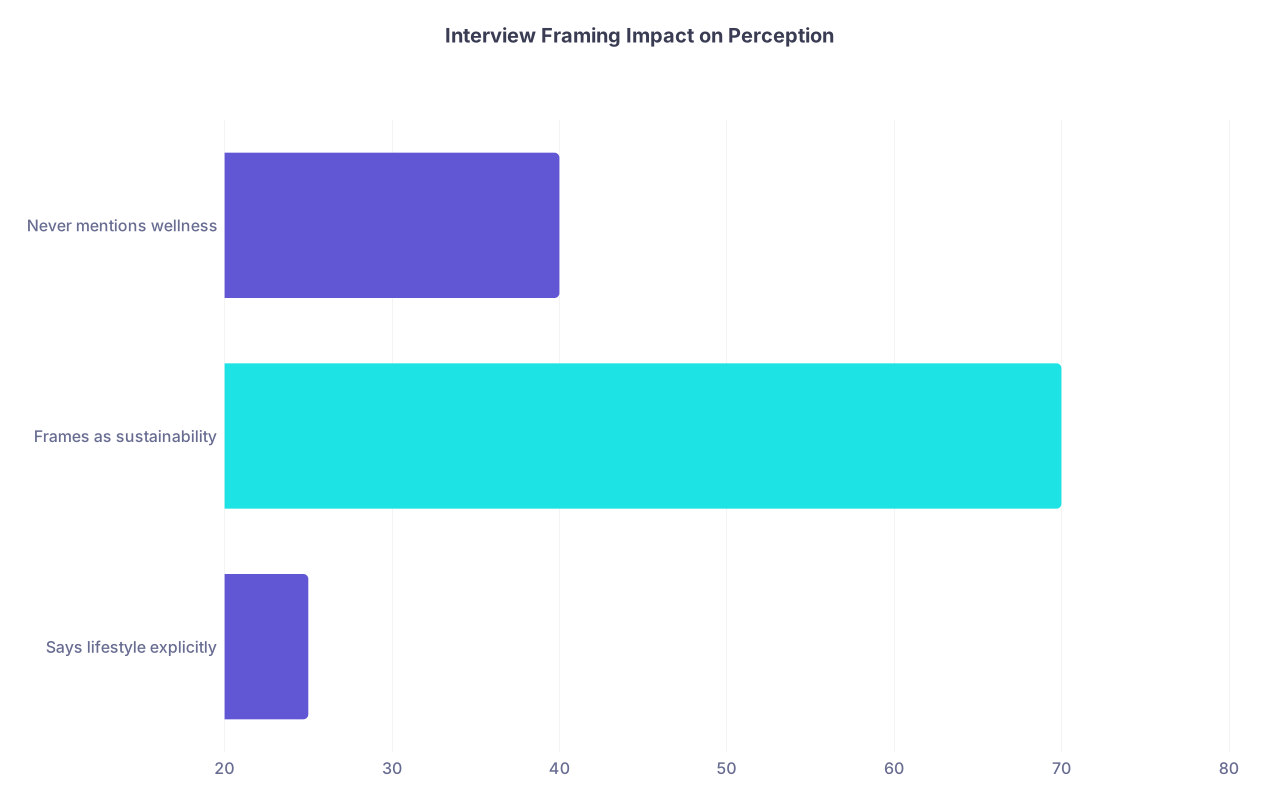
| Category | Value |
|---|---|
| Says lifestyle explicitly | 25 |
| Frames as sustainability | 70 |
| Never mentions wellness | 40 |
(Think of those numbers as “how often faculty later describe the applicant positively in discussion,” not a real dataset, but it’s roughly true to what I’ve seen.)
Final Reality Check
You’re not wrong to want a decent life during residency. You’re just dealing with a system that’s still pretending that wanting that is suspicious.
Here’s what you need to carry with you about West Coast “lifestyle” programs:
- The word “lifestyle” is radioactive in some rooms. Want balance, but frame it as sustainability and team culture, not ease.
- Geography is not lifestyle. Sunshine and beaches do not shorten your hours; they just make your rare free days nicer. Don’t confuse marketing photos with call schedules.
- The real lifestyle programs are the ones with functional systems, humane leadership, and residents who still look like people by PGY-3—not the ones with the best Instagrammable views.
You can absolutely build a good life in a West Coast residency. Just stop chasing the word “lifestyle” and start interrogating the structure, the culture, and the truth residents tell when the door closes and the faculty leave the room.