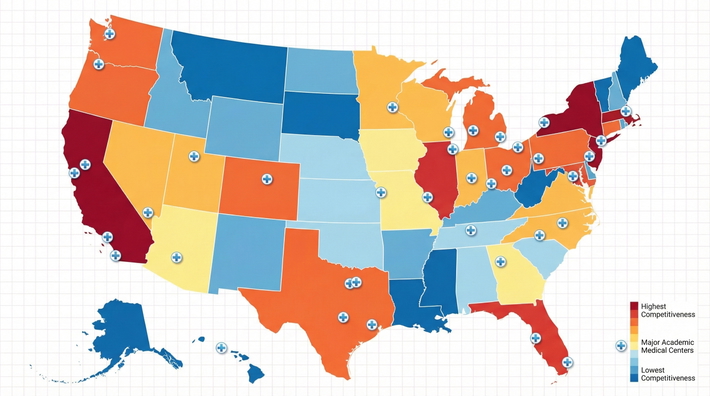
The debate between night float and 24‑hour call is not a matter of “preference.” It is a structural decision that shapes training quality, regional culture, and how broken residents feel by PGY‑3.
Let me break this down specifically.
Most students think this is just about “Do I want to be up all night every fourth day or every night for a week?” That is shallow. The real differences show up in continuity of care, error patterns, burnout trajectories, and even where certain residency programs can recruit competitively. And yes—there are absolutely regional patterns in how programs have chosen sides.
1. What We Actually Mean by Night Float vs 24‑Hour Call
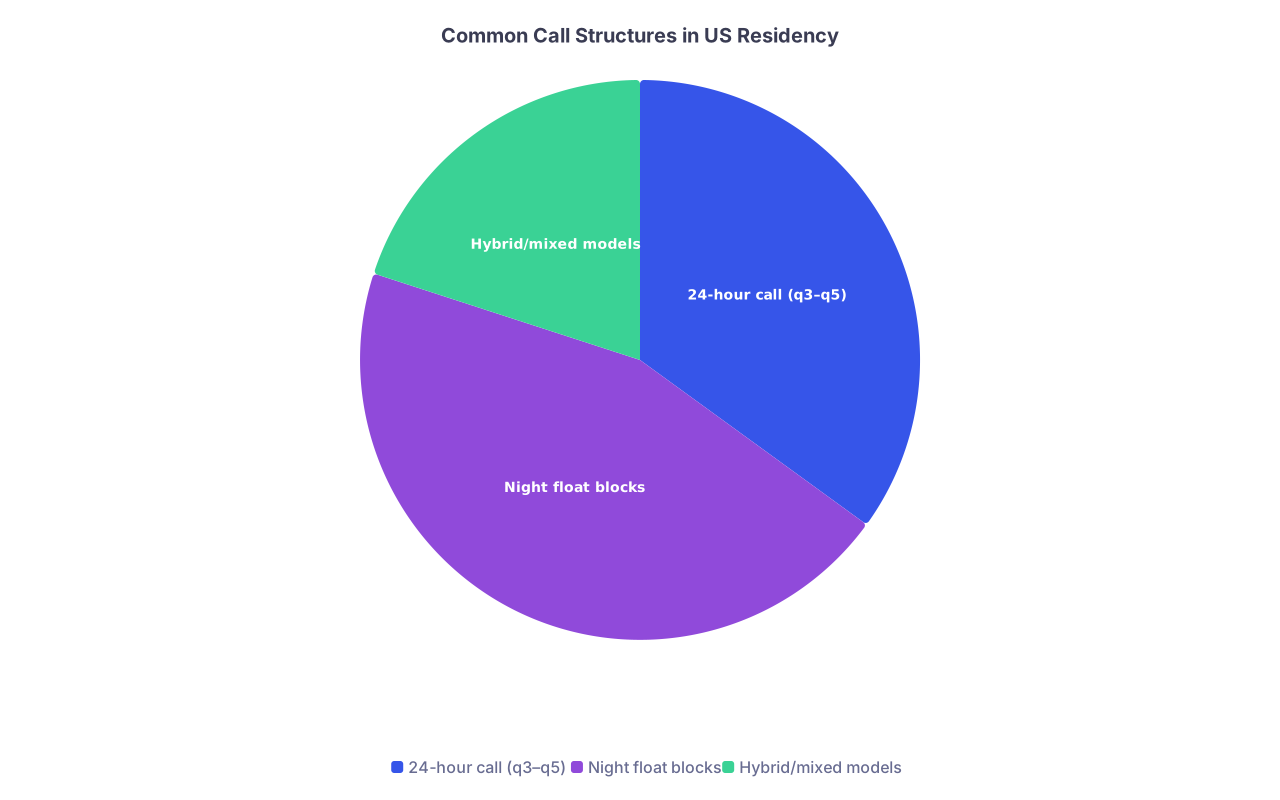
| Category | Value |
|---|---|
| 24-hour call (q3–q5) | 35 |
| Night float blocks | 45 |
| Hybrid/mixed models | 20 |
You cannot compare these systems intelligently if you are fuzzy on the mechanics.
The classic 24‑hour (or 28‑hour) call model
Typical structure in a traditional medicine, surgery, or OB program:
- Day team works 6–12 hours per day.
- Every 3rd–5th day, you have a 24‑hour “call” (which in practice is 24–28 hours).
- You admit overnight and continue to round on those patients the next day.
- Then you go home, ideally with a mandated rest period.
Call frequency examples I have actually seen:
- q3 call: Tue–Fri–Mon–Thu… (brutal, now rare in ACGME‑compliant form outside some surgical and OB services).
- q4 call: Post‑call day off or “light” (often not light).
- q5 or q6 call: More common in better‑resourced university programs.
Core characteristics:
- You see patients from presentation through the acute overnight period into morning rounds and early management.
- You experience real circadian disruption but with recovery days built in.
- Cognitive performance clearly degrades late into the shift, and error risk rises toward the end.
The night float model
Night float (NF) means a dedicated team that covers nights, usually for a fixed block, while day teams work days:
- Night float team works ~6–7 consecutive nights (often more), e.g., 6 pm–7 am.
- Day team signs out in the evening and gets sign‑out back in the morning.
- Night float may admit new patients, cross‑cover, and handle codes/rapid responses.
Typical NF schedules:
- 2–4 week blocks, sometimes multiple blocks per year.
- Some programs use “short call” or late stay (e.g., until 9–11 pm) combined with NF after.
Core characteristics:
- More consistent (but inverted) schedule during NF blocks, less oscillation.
- Heavier emphasis on cross‑coverage and managing unfamiliar patients.
- Lots of sign‑outs, which becomes its own safety risk if done poorly.
Hybrid models
You will see all kinds of Frankenstein hybrids:
- Medicine: night float for weekdays, 24‑hour call on weekends.
- Surgery: “home call” for some subspecialty services, in‑house NF for trauma/ICU, q4 in‑house call for other rotations.
- IM subspecialties: short call with “twilight” resident until midnight, then night float.
The point: when you ask a program “Do you have night float or 24‑hour call?” and they answer in one word, they are glossing over critical details. Ask for actual patterns: number of NF weeks per year, q4 vs q6, weekend structure, ICU exceptions.
2. Regional Patterns: Who Does What Where

There is no official ACGME “East coast = X, Midwest = Y” rule. But there are clear tendencies driven by:
- Historical training culture.
- Unionization and resident advocacy.
- Hospital density and competition for applicants.
- Academic vs community orientation.
Here is the rough reality, based on how programs actually run:
| Region | Dominant Style | Typical Flavor |
|---|---|---|
| Northeast (urban) | Night float / hybrid | NF on wards, ICU may still use 24-hr call |
| Northeast (community) | Mixed | Traditional call more common, lighter NF use |
| West Coast | Night float heavy | Strong NF, more progressive scheduling |
| Midwest (academic) | Hybrid | Mix of NF and 24-hr, varies by department |
| South | 24-hr call common | More traditional q4–q6, slower NF adoption |
Northeast
Think Boston, NYC, Philly, Baltimore, DC.
- Large academic centers (MGH, BWH, Columbia, Penn, Hopkins) leaned toward NF earlier, especially in internal medicine and pediatrics.
- Strong resident advocacy, some union presence (e.g., CIR) pushed for elimination or reduction of 24‑hour calls on wards.
- ICUs and surgical services often retain 24‑hour or 24+4 models, justified by continuity and procedural exposure.
You still see smaller community programs in New England and upstate New York with very traditional call: q4 or q5 in‑house, minimal NF, lots of cross‑coverage, especially in surgery and OB.
West Coast
California in particular has been relatively aggressive with NF, shorter calls, and schedule reforms.
- UCSF, Stanford, UCLA, UCSD, OHSU: strong use of NF in medicine and subspecialties.
- Greater emphasis on “wellness” messaging, though the execution varies.
- California labor law and institutional risk management culture nudged some systems away from long in‑house calls earlier than other regions.
Surgery and OB/GYN out West are not magically cushy. Trauma centers and busy OB services still use long calls, but floor and consult services increasingly rely on NF.
Midwest
The Midwest is heterogeneous.
- Flagship academic centers (Michigan, Mayo, WashU, Northwestern) often use hybrid structures. Medicine may be NF‑heavy; surgical subspecialties and ICUs may retain 24‑hour calls.
- Large state systems (Ohio State, Wisconsin, Iowa, Minnesota) may vary even within the same institution by department.
- Community‑based programs in the Midwest can be extremely traditional: true q3–q4 call, less NF, heavy reliance on cross‑coverage, especially where resident staffing is lean.
South and Southeast
More traditional, more slowly adopting NF, especially in non‑university programs.
- Many medicine and surgery residencies still run classic call cycles with 24‑hour or 24+4 schedules, especially in community and hybrid community‑academic programs.
- Night float is used, but often only in a limited way (e.g., to cover weekdays or specific rotations like wards but not ICU).
- Resident advocacy is often weaker; unions are rare; cultural resistance to major schedule overhauls is higher.
Again, major academic outliers exist. Emory Internal Medicine ≠ mid‑size community program in rural Alabama.
Why these patterns exist
It is not just “old‑school vs new‑school” attitude.
- Billing and patient volume: busy urban centers with constant 24/7 admissions find NF more efficient than repeatedly flipping day teams.
- Recruitment pressure: highly competitive programs in coastal cities know applicants care about schedule structure; they advertise NF and “no 24‑hour call on wards” as a feature.
- Specialty board expectations: surgical fields fear loss of continuity and operative time with NF and have been slower to change.
So yes, geography matters. But specialty and program type override geography. A community general surgery program in California may be more old‑school than an internal medicine program in Tennessee.
3. How These Models Hit Residents: Sleep, Learning, and Burnout
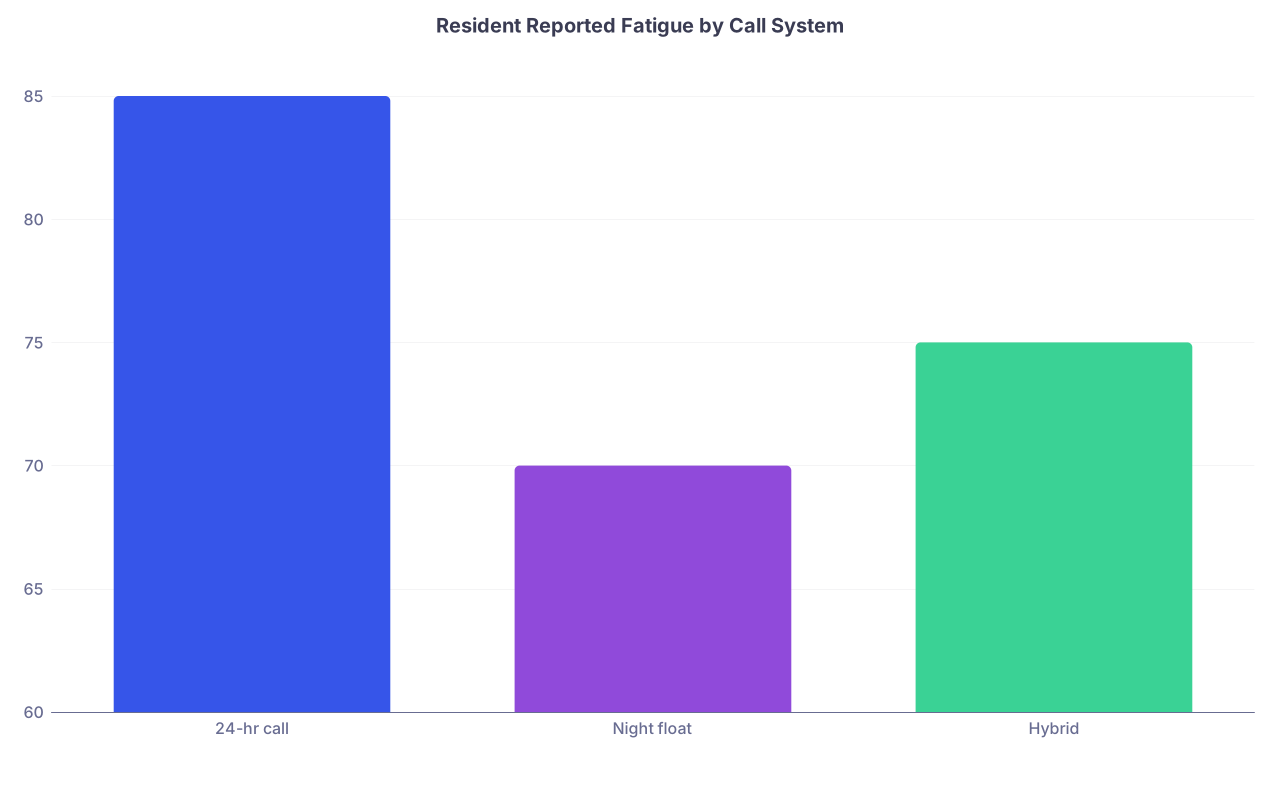
| Category | Value |
|---|---|
| 24-hr call | 85 |
| Night float | 70 |
| Hybrid | 75 |
Numbers here are illustrative, but they reflect what you hear when you actually talk to residents. Let me walk through the main domains.
Sleep and circadian rhythm
24‑hour call:
- Massive acute sleep deprivation on call days.
- Circadian rhythm whiplash: you may have a daytime circadian pattern, then a 28‑hour run, then crash sleep at odd hours.
- Recovery depends heavily on whether post‑call days are protected. Many residents will tell you they still round, still write notes, still get dragged into late tasks.
What I have heard more than once: “On q4, I was a zombie post‑call, borderline functional the next day, and then by my ‘off’ day I was doing laundry and trying not to scream.”
Night float:
- More consistent shift pattern, but chronic circadian inversion.
- Sleep quality during the day is rarely as good, especially if the resident has kids, lives near a noisy street, or has bad blackout curtains.
- By week 2 of NF, many residents describe feeling emotionally flat, socially disconnected, and physically sluggish.
NF can be less acutely brutal but more insidiously draining. Chronic partial sleep deprivation vs episodic severe deprivation.
Cognitive performance and patient safety
There are two different failure modes.
24‑hour call:
- Highest risk late at night and toward the end of the call period: missed subtle signs, dose calculation errors, anchoring bias.
- To be blunt, some of the worst errors I have seen (near‑misses and real harm) have happened at 5–7 am on call days when everyone’s frontal lobe is offline.
Night float:
- Many more handoffs. Every handoff is an opportunity for information loss.
- Cross‑coverage on unfamiliar patients. NF residents often know very little about baseline goals of care, nuanced management decisions, or family preferences.
- Pressure to “just put a patch on it until the day team returns,” which can under‑treat or over‑treat.
The literature is mixed because you are trading one risk (individual cognitive degradation) for another (system‑level handoff and fragmentation). Well‑run NF programs with excellent sign‑out processes can outperform sloppy 24‑hour call systems. The reverse is also true.
Education and continuity of care
This is where nuance matters.
24‑hour call advantages:
- You admit, manage overnight, and then present the same patient on rounds. That is real continuity.
- You see disease trajectories over the critical initial 24 hours. For example, watching a borderline sepsis case crash at 3 am after you thought they were “ok” at 10 pm—that cements clinical judgment more than any lecture.
- In procedural and operative fields, you stay with the team and the case, building narrative understanding of why certain decisions were made.
24‑hour call disadvantages:
- Cognitive bandwidth for learning at hour 22 is low. Teaching during post‑call rounds is mostly performative.
- Residents sometimes “check out” mentally near the end of call. They are present physically for learning opportunities but not retaining much.
Night float advantages:
- The day team can be more consistently awake and engaged in teaching, conference, and deliberate practice.
- NF residents see a tremendous volume of acute issues, cross‑cover pages, and rapid responses—excellent for pattern recognition and honing basic management.
Night float disadvantages:
- You often do not see the outcome of your overnight decisions. You titrate oxygen, tweak insulin, call for a CT… and then never see what happened.
- Less sense of “owning” a patient from the beginning. You inherit problems every night that are not emotionally “yours.”
Residents often describe NF as “pure service, zero teaching,” unless the program deliberately builds in overnight teaching (case reviews, short chalk talks, protected 20‑minute teaching windows). Very few programs do this well.
Burnout and mental health
The impact is not subtle.
24‑hour call–heavy programs:
- More acute episodes of “I cannot do this anymore” during heavy rotations.
- But some residents prefer it because you have true off‑days and blocks of non‑call time that feel more normal.
Night float–heavy programs:
- Higher risk of social isolation—working nights while the rest of your life (friends, partner, kids) is on a day schedule.
- Mood flattening and depersonalization are common by the end of a 2–4 week NF block.
- Residents often feel like “garbage collectors,” constantly dealing with leftovers and cross‑cover rather than building their own panel of patients.
There is no universal “healthier” system. It depends on:
- How many NF weeks per year.
- How protected post‑call days really are.
- How many 24‑hour calls per month.
- Whether the program respects caps and workload or routinely “bends” them.
4. Specialty‑Specific and Regional Nuances

| Step | Description |
|---|---|
| Step 1 | Residency Program |
| Step 2 | Internal Medicine |
| Step 3 | Surgery |
| Step 4 | OB GYN |
| Step 5 | Pediatrics |
| Step 6 | Night float common |
| Step 7 | Hybrid on ICU |
| Step 8 | 24-hr call frequent |
| Step 9 | Night float on trauma/ICU |
| Step 10 | Traditional call on L and D |
| Step 11 | Night float on clinics |
| Step 12 | NF in large childrens hospitals |
| Step 13 | Call model in smaller programs |
You cannot talk about call structures in a vacuum. Surgery in Houston is not the same as internal medicine in Seattle.
Internal medicine
Regional trend:
- Northeast and West Coast academic IM: NF on wards is the norm; ICU may still have 24‑hour calls (often 24+4) or night float with longer shifts.
- South and Midwest community IM: more 24‑hour calls, sometimes with limited NF for cross‑cover.
Impact:
- IM residents in NF‑heavy systems often have more predictable ward months, but their ICU time can be punishing.
- Community IM residents in traditional call models may feel more continuous ownership of their patients but pay the price in sleep and burnout.
General surgery and surgical subspecialties
Surgery lags behind medicine in NF adoption. Reasons:
- Operative continuity: attendings want the same residents who admitted the patient to be present in the OR or for complications.
- Culture: “Surgery is hard; call is part of the deal” is not just a slogan, it is part of identity.
Regional pattern:
- Major academic centers in all regions now use some NF for trauma/ICU.
- Many surgical residencies in the South and Midwest still rely heavily on q3–q4 call, especially in junior years.
- West Coast and Northeast surgical programs have moved more toward hybrid models but still maintain long in‑house calls on certain rotations.
Practical reality: if you choose a surgical specialty, expect a much higher burden of 24‑hour calls regardless of region, though the balance might tilt slightly toward NF at large coastal academics.
OB/GYN
Labor and delivery is inherently unpredictable. You cannot “schedule” deliveries around a perfect NF paradigm.
- Many OB residencies run 24‑hour or 12+12 models on L&D.
- Some programs use NF to staff triage and postpartum units, but the core L&D service often uses 24‑hour call.
Regional trends mirror surgery: more traditional call in the South and community programs; more experimentation with NF and shift‑based models in large coastal academics.
Pediatrics
Peds mirrors IM to some extent, with children’s hospitals often building NF systems for wards and PICU but keeping certain services (e.g., NICU) on longer call patterns.
Important nuance: pediatric volumes and staffing can vary widely by region. A small Midwestern peds program covering a broad catchment area may have more brutal call than a large East Coast program with layered coverage.
5. Future Directions: Where This Is Actually Going
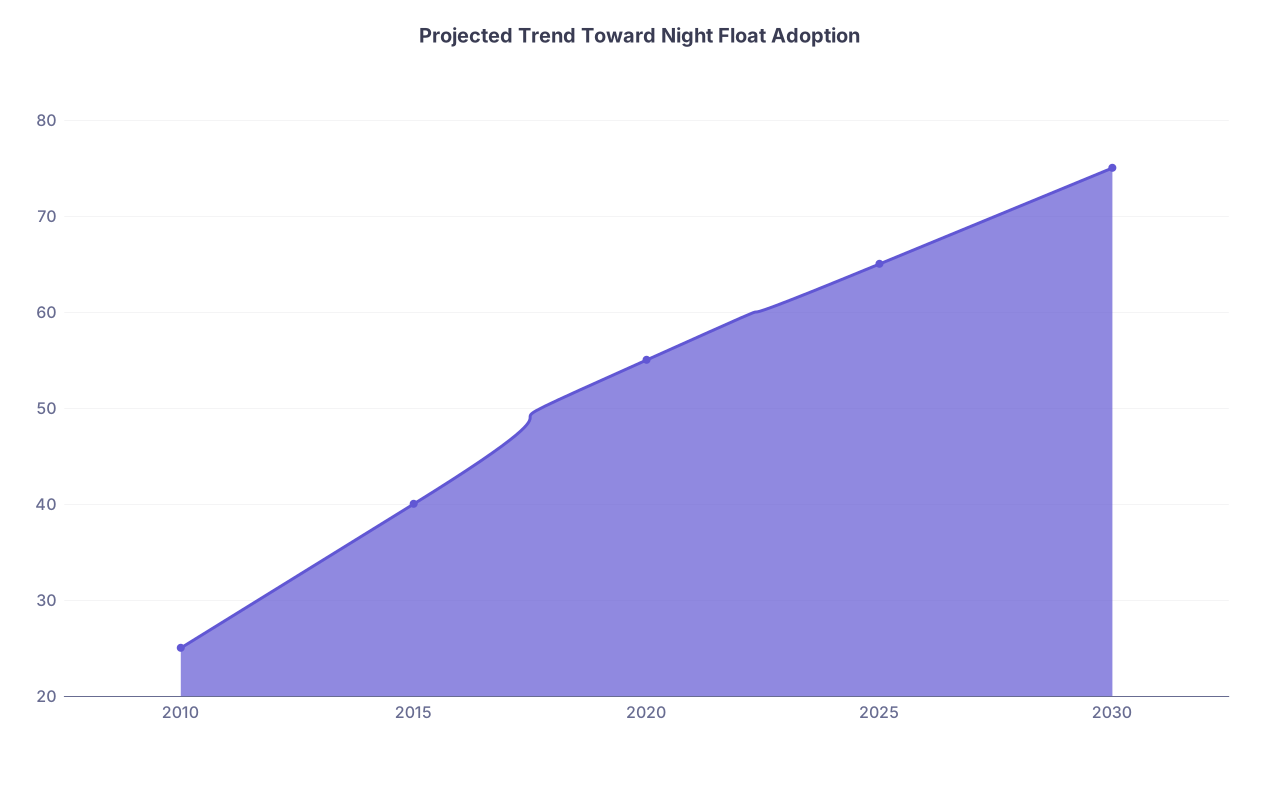
| Category | Value |
|---|---|
| 2010 | 25 |
| 2015 | 40 |
| 2020 | 55 |
| 2025 | 65 |
| 2030 | 75 |
We are not going back to the 1990s “call until you drop” era. But we are not moving to a universal NF utopia either. The future is more nuanced and messy.
Regulatory and liability pressure
Drivers of continued change:
- Duty hour enforcement: Programs that push 24+4 to the max attract scrutiny when bad outcomes happen.
- Patient safety culture: Hospitals are increasingly aware that exhausted residents are a clear liability.
- Public perception: Stories of 28‑hour shifts leading to errors are PR disasters.
Result: pressure to either shorten calls or build NF systems with more reliable coverage.
Data on outcomes is not simple
Randomized studies of NF vs extended shifts have shown:
- Extended duty hours hurt resident sleep and performance.
- NF is not a panacea because of handoff errors.
So the conversation is shifting from “Which is better?” to “How do we design either system to minimize its particular risks?”
Trends I see:
- Better sign‑out tools (standardized templates, mandatory face‑to‑face handoff).
- Limiting consecutive NF weeks to 2–3 maximum.
- Capping the number of 24‑hour calls per month.
- Use of physician extenders (NPs, PAs, nocturnists) to offload pure service work.
Regional convergence vs divergence
I expect:
- Convergence in academic centers across regions toward hybrid models: some NF, some 24‑hour calls, more structured, more defensible to accrediting bodies.
- Divergence in community programs: some will modernize aggressively to recruit residents; others will cling to traditional models until they become recruitment liabilities.
Coastal urban programs will keep advertising “no 24‑hour calls on wards.” Some Southern and Midwestern programs will counter with: “We still train you in real continuity, we are hardcore,” and some applicants will actually prefer that.
Resident activism and unions
On the West Coast and in the Northeast, unionization has already nudged schedules:
- More NF adoption.
- Tighter enforcement of rest periods and time off between shifts.
- Explicit language about maximum continuous hours.
If unions spread further into the South and Midwest, expect more pressure against frequent 24‑hour calls, especially in medicine and pediatrics. Surgery and OB will resist more, but even those fields will have to justify extreme call patterns with concrete educational value.
6. How You Should Actually Use This Information as an Applicant or Resident
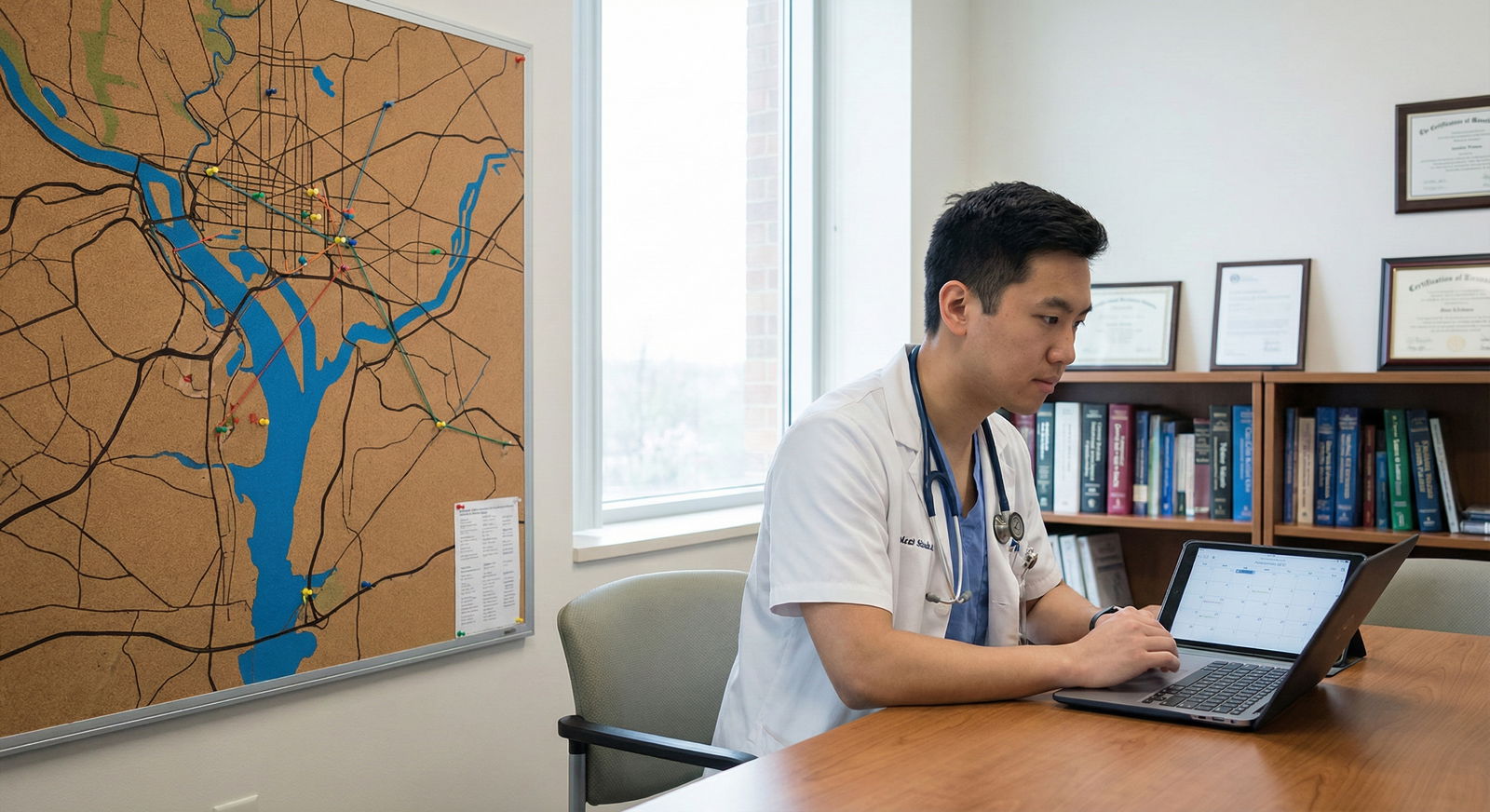
Do not stop at “Do you have night float?” That is lazy questioning. Here is what you should really be asking and looking for.
Questions to ask programs (and what they reveal)
Ask specifics, not abstractions. For example:
- “How many 24‑hour calls per month do interns do on your busiest rotations?”
- “How many total weeks of night float does an intern and a senior do per year?”
- “Are there any rotations with q3 call? Which ones and for how long?”
- “What does a typical night float shift actually look like—how many patients are you covering, and what are the admit caps?”
- “How are handoffs structured between day team and night float? Is it face‑to‑face with attendings? Scripted? In‑person or phone?”
When you ask this, listen for two things:
- Whether the residents answer immediately and concretely (a good sign).
- Whether they wince or laugh nervously before answering (bad sign).
How to interpret regional differences as an applicant
If you are targeting a region, connect the dots:
- Northeast / West Coast IM: expect more NF on wards, fewer 24‑hour calls, but intense volumes and heavy night cross‑coverage.
- South / Midwest community: expect more 24‑hour calls, possibly fewer NF blocks but heavier single‑shift burdens.
If you know you struggle badly with circadian inversion and isolation, heavy NF may be worse for you than scattered 24‑hour calls. If you know that 28 hours awake makes you nonfunctional for 48 hours afterward, NF may be safer for you personally.
For current residents: coping within each system
Night float:
- Treat sleep like a procedure: blackout curtains, earplugs, consistent sleep window, no social heroics during NF blocks.
- Build tiny rituals: same pre‑shift meal, 5‑minute review of high‑risk labs/imaging at the start of each shift, structured check‑out list.
- Demand better sign‑out processes if they are sloppy. That is not “complaining”; that is patient safety.
24‑hour call:
- Front‑load cognitively demanding tasks earlier in the shift before fatigue peaks.
- Use checklists at night for high‑risk tasks (heparin dosing, insulin changes, electrolyte repletion).
- Protect post‑call days fiercely. If your program routinely violates this, document patterns and involve chief residents and GME; this is a systemic issue, not a personal resilience problem.
And yes, factor this into fellowship and job choices. Many hospitalist jobs, for instance, now offer NF or nocturnist roles that are far better structured than residency NF blocks. Some surgical fellowships are far more humane than their residency predecessors; others are worse.
7. Where This Leaves You

Three points to walk away with:
Night float vs 24‑hour call is not a simple “modern vs traditional” dichotomy. Each has specific failure modes—cognitive fatigue vs handoff fragmentation—that play out differently by region, specialty, and program culture.
Regional trends are real, but specialty and program type matter more. Coastal academic IM programs skew NF; Southern and Midwestern community programs skew 24‑hour call, especially in surgery and OB. Always ask for concrete schedules, not labels.
Your experience and learning will depend less on which system a program uses and more on how intelligently they have designed it: protected post‑call days, reasonable NF block lengths, real sign‑out structure, and honest enforcement of duty hours. That is what you should be interrogating on interview day.