The unspoken rule in the South is simple: if they already know you, you start the race a full lap ahead.
Program directors in Southern residency programs quietly, consistently, and very deliberately favor “home-grown” applicants—students from their own medical school or at least from their own region. They will never put that on a website. You will not see it in any program brochure. But I’ve watched it play out year after year in ranking meetings from Texas to the Carolinas.
Let me walk you through what really happens behind those closed doors.
What "Home-Grown" Really Means in the South
You are not just competing as “Applicant #183 from a US MD school.” In the South, there’s a clear hierarchy of familiarity that drives decisions far more than you realize.
| Rank | Applicant Type |
|---|---|
| 1 | Same-institution med student |
| 2 | Same-state med school |
| 3 | Same-region (multi-state South) |
| 4 | Strong US MD from outside region |
| 5 | DO / IMG with clear local ties |
No one in the room says, “Let’s rank our own higher just because they’re ours.” That would sound biased and unprofessional. What they do say is:
- “We know this student.”
- “Our residents like working with her.”
- “He’ll fit here. He’s been here for four years.”
- “She understands our patient population and workload.”
Translation: home-grown equals lower risk. And residency selection in Southern programs is all about risk management.
Home-grown for Southern programs usually means one of three things:
- You did medical school at that exact institution.
- You trained at another school in the same state (think UTH vs Baylor vs UTMB, or UAB vs USA).
- You’re from the broader region (Texas, Deep South, Southeast) and have evidence you’ll actually stay there.
Let’s get specific, because that’s where the truth is.
At a mid-sized internal medicine program in Georgia, a typical rank list top 10 might look like this:
- 4–5 from their own medical school
- 2–3 from other Georgia schools (MCG, Mercer, PCOM-GA)
- 1–2 from nearby states (AL, SC, FL)
- Maybe 1 from outside the region with some compelling tie
You, from a “better” coastal med school with a higher Step score but no Southern connection? You’re probably in the 20s. If you’re lucky.
Why Southern Programs Trust Their Own More
Let me be blunt: Southern programs don’t have time—or patience—to guess who’s going to survive and who’s going to crumble when the real work hits.
Here’s what they say quietly in meetings:
- “I’ve seen him on wards. He doesn’t complain.”
- “She takes feedback well. We rode her pretty hard on her sub-I and she bounced back.”
- “Our nurses like him, that’s not nothing.”
- “We can read between the lines on her evals. She’ll grind.”
With a home student, they’ve seen you for two years straight. Not on paper. In person. On busy services. During 2 a.m. codes. With pissed-off families. That data is worth more than a 20-point Step difference.
And in the South, there’s another layer most applicants underestimate: culture.
Not some vague “Southern hospitality” nonsense. I mean:
- Are you going to condescend to rural patients with no insurance?
- Can you communicate with someone who has a sixth-grade reading level without sounding like a jerk?
- Will you adapt to a system where “we always did it this way” is a real barrier to change?
- Will you collapse when you realize half your patient population has no follow-up options?
Home students have already proven they can function in that ecosystem. They’ve been on those wards. They’ve fought those discharge battles. They’ve seen the social work barriers. They know that “just follow up with your PCP” is often fantasy.
So when a PD at a Southern program is staring at two nearly identical applications—one from their own school, one from some well-regarded Northeastern program—they almost always default to the devil they know.
And they won’t apologize for it.
The Family Business Mentality: Loyalty and Retention
Southern programs think long-term. Many are playing a 10–15 year game, not just a 3-year residency cycle.
In program director offices from Mississippi to North Carolina, I’ve heard variations of the same calculation:
- “Is this someone who will stay in the region?”
- “Will this person be a chief resident here?”
- “Could we recruit them as faculty?”
- “Will they join one of our affiliated hospitals locally?”
This is where “home-grown” takes on a second meaning: not just trained here, but likely to plant roots here.
An honest conversation I heard in a Texas program:
“The Harvard kid is great. But she’s gone after residency. She’s already talking about fellowships in Boston. Why invest our bandwidth in someone who’s just passing through when we’ve got two UTMB kids who will probably stay in Houston?”
That’s the calculus.
They’re not just matching residents. They’re grooming future chiefs, junior faculty, and long-term community partners. Home-grown applicants signal stability and loyalty in a way outsiders usually do not.
There’s also pride involved. A PD at a Louisiana program once showed me their faculty roster and circled name after name:
“LSU. LSU. LSU. Tulane. LSU. We build our own.”
It’s not an accident.
The Southern Patient Factor: This Is Not a Side Detail
You cannot understand Southern residency preferences without talking about the patients. Because the patient population fundamentally shapes what programs want in an applicant.
Southern patient populations skew:
- Sicker, due to delayed care and chronic disease
- Poorer, often underinsured or uninsured
- More rural or semi-rural
- More religious and conservative in certain subregions
- More racially diverse in others (Black in Deep South, Hispanic in Texas, etc.)
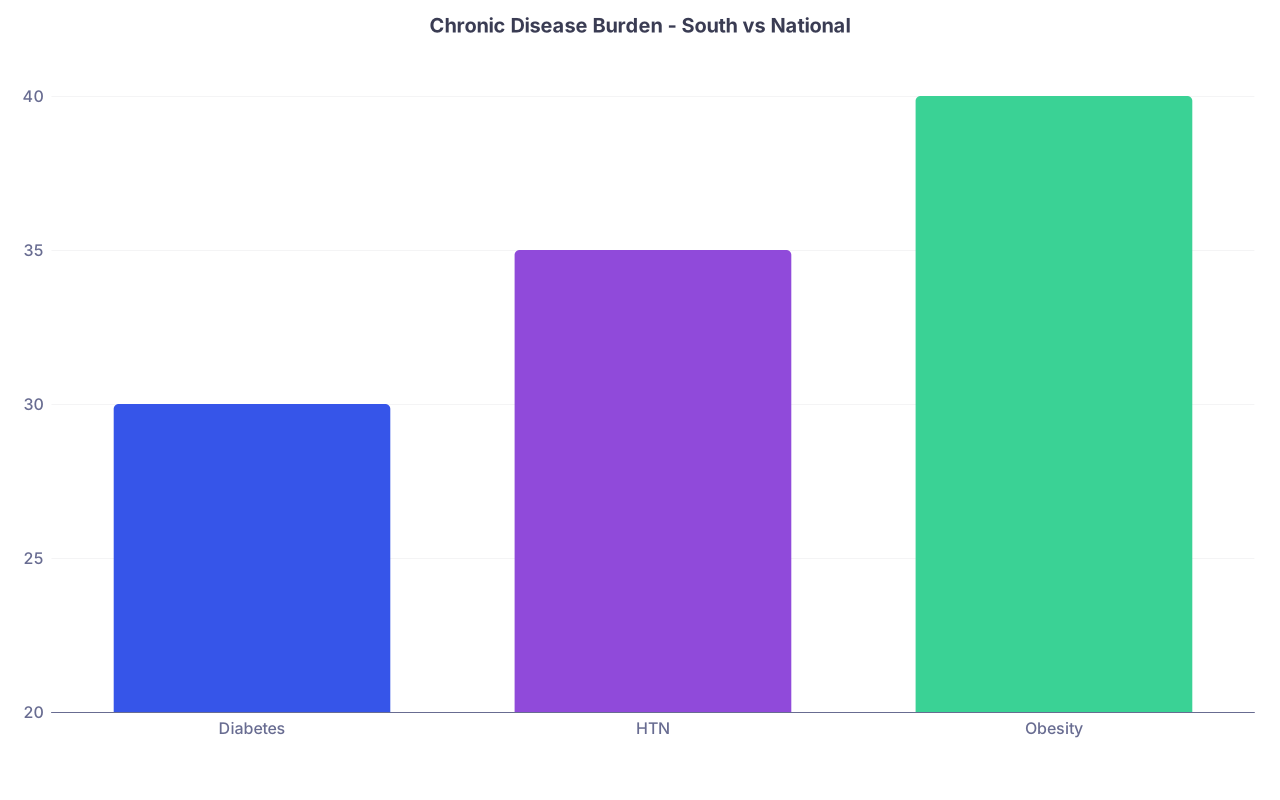
| Category | Value |
|---|---|
| Diabetes | 30 |
| HTN | 35 |
| Obesity | 40 |
Those numbers are not exact per program, but the pattern is real: higher chronic disease burden, more social complexity.
Home-grown applicants from Southern schools have already been swallowed by that environment. They’ve handled 10-patient lists where 8 have A1c >10 and can’t afford their insulin. They’ve watched residents scramble to connect patients to sliding-scale clinics that are already full.
So in meetings, what do faculty say?
- “He already knows how to talk to our patients.”
- “She doesn’t freak out when there’s no outpatient follow-up.”
- “He’s not offended when patients don’t trust the system.”
Compare that to a polished out-of-region applicant who’s never practiced outside a high-resourced urban safety-net with robust services. There’s a risk they’ll either burn out or clash with the local reality.
Programs in the South have been burned by this. They remember the out-of-region intern who spent half the year complaining:
- “Why don’t we have X service?”
- “At my med school, we always had Y resource.”
- “It’s ridiculous we can’t just get a quick outpatient follow-up.”
That intern doesn’t last. And PDs adjust. They start to prize local familiarity above a shiny pedigree.
Behind the Rank List: What Really Gets Said
Let me pull back the curtain a bit more and walk you through a typical rank meeting at a Southern program.
You’ve got a stack of candidates: a few home students, some in-state, some strong outsiders, plus DOs and IMGs.
The board might look something like this halfway through the season:
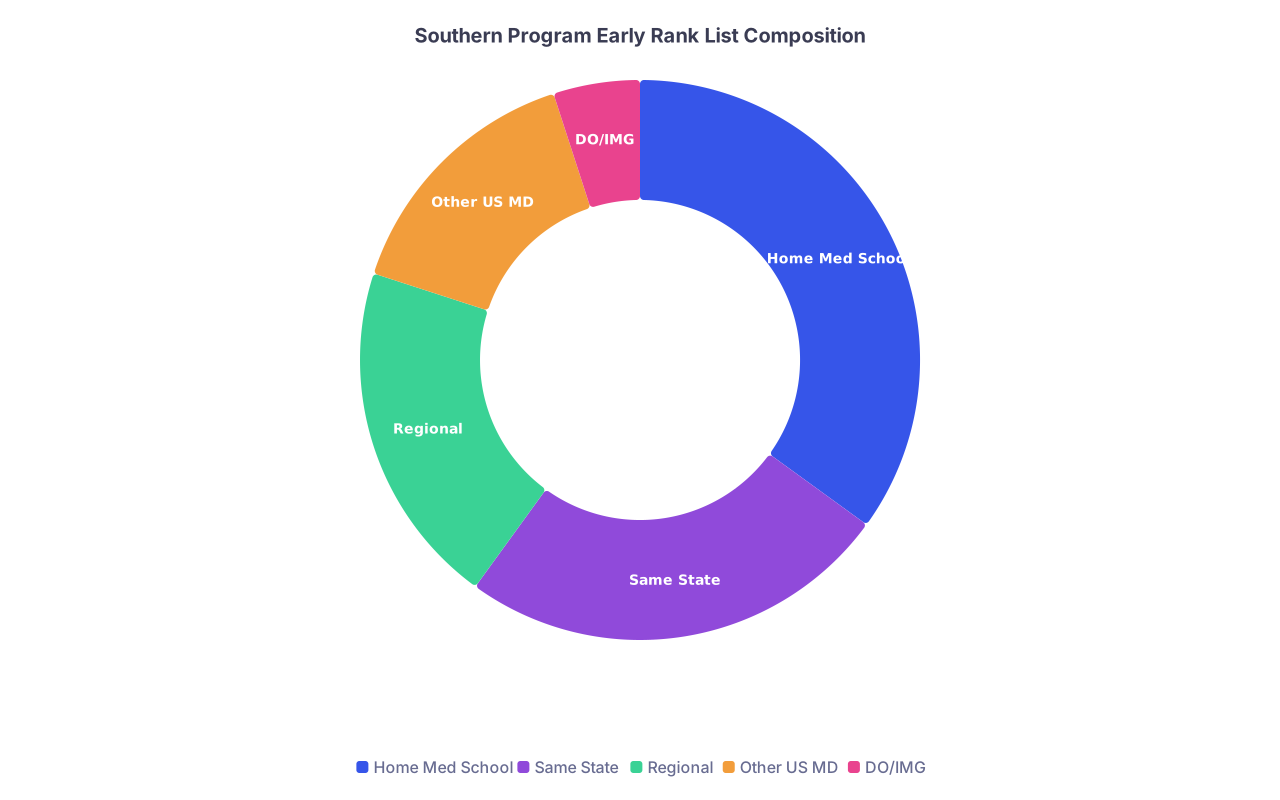
| Category | Value |
|---|---|
| Home Med School | 35 |
| Same State | 25 |
| Regional | 20 |
| Other US MD | 15 |
| DO/IMG | 5 |
Again, the exact percentages vary, but that shape? Very common.
Now imagine discussion:
Candidate 1: Home student, decent scores, strong letters, residents like them.
PD: “Put them high. We know them, no surprises.”
Candidate 2: Other state school, solid but not stellar.
Faculty: “We worked with her on an away. Quiet but competent. Good team player.”
PD: “Middle of the top third.”
Candidate 3: Big-name Northeast school, 250+ Step 2, glowing letters.
Faculty: “Impressive, but are they really coming here? We were one of ten interviews they did in the South.”
PD: “We like them, but I don’t want to waste a top spot if they rank us low. Upper-middle.”
Candidate 4: Home DO school, outstanding work ethic, did a strong sub-I at this institution.
Faculty: “Residents loved working with him. Very humble. Wants to stay in the region.”
PD: “Bump them up. Reliability beats shiny.”
No one says “we prefer home-grown” as a policy. It shows up in every borderline decision. Every tie-breaker. Every “who do we move up a few spots” debate.
And those little nudges accumulate into a very significant advantage.
Why This Is Stronger in the South Than in Some Other Regions
All regions show some preference for their own students. Let’s not pretend this is purely a Southern phenomenon.
But in the South, there are a few amplifiers:
Strong regional identity.
People grow up, train, and stay in the region. Texas is its own planet. The Deep South has its own gravitational field. There’s a distinct sense of “our people.”Workforce shortages.
Many Southern states are desperate for physicians, especially in primary care and certain surgical fields. Programs feel an obligation to train people who might stay. Outsiders who plan to bounce after residency are less attractive.Political and cultural variation.
Some applicants from other parts of the country do not adapt well. Directors don’t want to play social or political therapist to someone who spends three years resenting where they live.Institutional loyalty.
Many Southern academic centers grew up as regional flagships. They are very proud of “raising their own.” That pride carries real operational consequences.
I’ve sat in meetings where an outstanding out-of-region candidate was deliberately not ranked in the top three spots because the PD said out loud:
“Those top three positions matter. Historically, that’s who actually matches here. I want at least two of them to be our own.”
You will not see that sentence in any ERAS description. But it drives match outcomes.
Outsider With No Ties? Here’s What You’re Up Against
If you’re reading this from a non-Southern medical school, thinking about matching into a Southern residency, let’s be clear: you are absolutely fighting a headwind.
Not impossible. But real.
If you come from, say, a New York or California school and have:
- No family ties to the South
- No prior time living in the region
- No away rotations there
- No clear explanation for why you want to train—and possibly stay—there
Then in PD language, you are “a flight risk.” Or “tourist.” Sometimes “visiting scholar,” said with a hint of sarcasm.
I’ve heard:
- “They’re not coming. They’ll rank us as backup.”
- “Nice on paper, but I doubt they’ll be happy here long-term.”
Does that mean they won’t rank you? No. If you’re strong enough, you’ll still land on the list. But when they choose who to “protect” with high ranks, especially when they’re nervous about filling, the home-grown and regionally tied applicants almost always win.
How to Break In If You’re Not Home-Grown
Now for the part you actually care about: how to outplay this bias if you’re an outsider.
You do not brute-force this with just scores and publications. That’s what naive applicants try. Scores matter, but they don’t cancel out perceived risk.
To get Southern programs to treat you more like “one of theirs,” you need to attack on multiple levels.
1. Build Real, Documentable Regional Ties
Fake “I love the South” narratives don’t work. PDs have read too many of those.
You need specifics:
- Family in the region (and say where: Houston, Birmingham, Raleigh, etc.)
- Significant time lived there earlier in life
- Partner’s job or training plans in the region
- Clear reasoning on why you see yourself practicing there after residency
This better be reflected in your personal statement, your ERAS geographic preferences, and what you say on interview day. They cross-check all of it.
2. Do an Away Rotation Smartly
One away in the South, done well, can partially convert you into a “known entity.”
But you need to treat it like a months-long interview:
- Be on time. Every single day.
- Work. Not talk about how you worked at your home school. Actually work there.
- Be respectful with nursing staff and ancillary services. Word travels.
- Actively ask residents: “How does this place decide who to rank highly?” Then listen.
If you get a strong letter from that away, you’ve just converted from “random outsider” to “someone our people liked.” That’s a major upgrade in status.

| Step | Description |
|---|---|
| Step 1 | Non Southern Med Student |
| Step 2 | Choose Southern Away |
| Step 3 | Crush Rotation |
| Step 4 | Strong Letter from Local Faculty |
| Step 5 | Highlight Ties and Intent |
| Step 6 | More Competitive on Rank List |
3. Speak Their Language During Interviews
If you interview at a Southern program and say:
“I’d like to use residency as a launch pad to get back to the Northeast and match at a top fellowship there.”
You just cut your own ranking legs out.
They’re listening for:
- Interest in serving high-need populations
- Comfort with resource-limited realities
- Openness to long-term practice in the region
- Humility about learning the local culture
If your answers are all prestige-chasing, coastal-centric, and future-escape focused, you become a low-yield investment in their eyes.
The Future: Is This Changing or Getting Stronger?
You might think that as residency becomes more national and virtual, this home-grown bias would weaken. It hasn’t. If anything, in the South, it’s gotten sharper.
Why?
Virtual interviews made it even harder to assess “fit” and sincerity. So programs doubled down on the signals they trust most:
- Do we already know you?
- Have you trained in this environment?
- Are you linked to this region in ways that make staying likely?
I’ve seen programs increase the number of their own students they take over the last 5–7 years, not decrease. Especially mid-tier academic and strong community programs that are very concerned about filling with stable, reliable residents.
Could workforce shortages push them to broaden sourcing? Yes, but they will preferentially try to broaden within the region first—other state schools, nearby states’ DO schools—before going broad nationally.
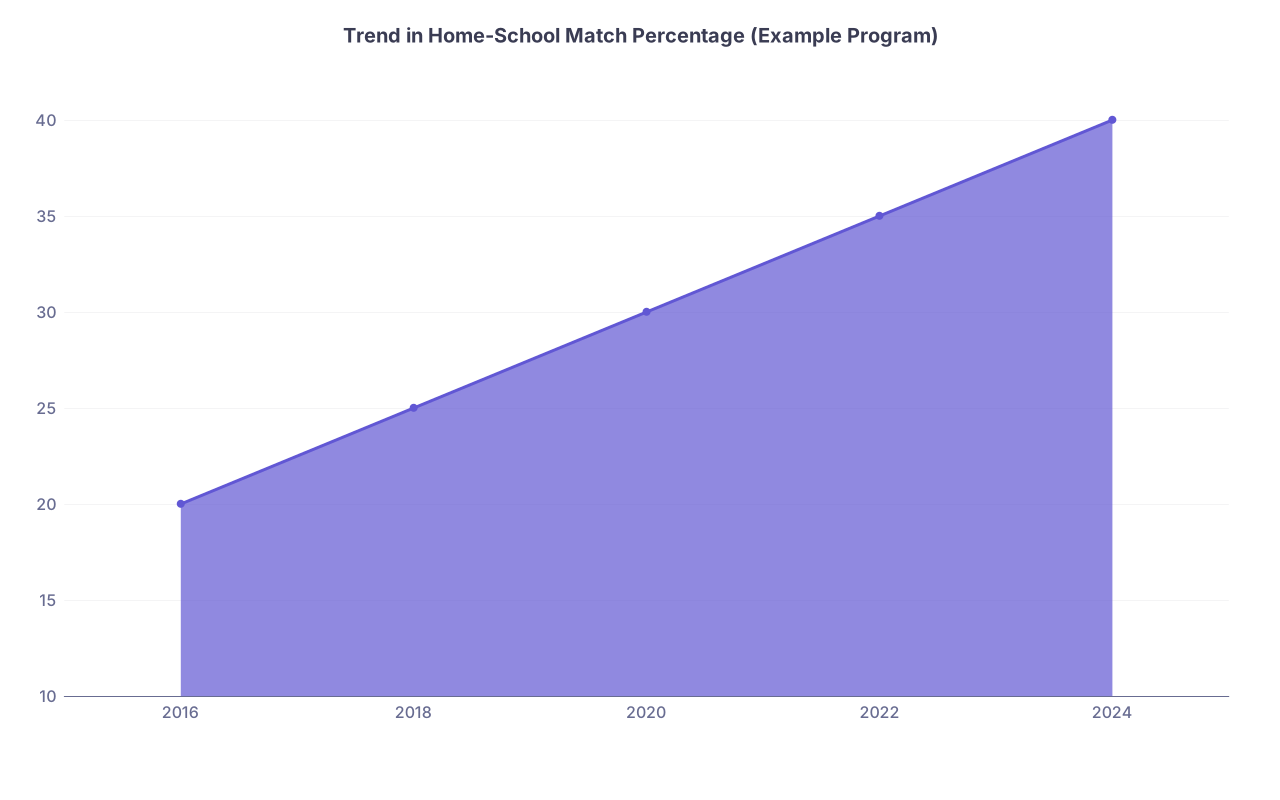
| Category | Value |
|---|---|
| 2016 | 20 |
| 2018 | 25 |
| 2020 | 30 |
| 2022 | 35 |
| 2024 | 40 |
Again, that’s illustrative, but the trend line direction? Very real across many Southern sites I’ve worked with.
How You Should Use This Information
If you’re already at a Southern medical school: you have more leverage there than you realize.
Do not assume you are just one of many. Your program likely views you as a safer, strategically smarter investment than some star from a coastal school. Your job is to not blow that advantage:
- Don’t be the problematic student everyone gossips about.
- Don’t flame out on your home sub-I.
- Don’t assume they’ll take you “no matter what” because you’re local. They will absolutely pass on you if you’re trouble.
If you’re not from the South but seriously considering training there, you need to treat geography like a core component of your strategy, not an afterthought. That means:
- Planning aways strategically
- Building real ties, not just writing about “loving sweet tea and SEC football”
- Being honest with yourself: could you actually live there for 3–7 years without resenting it?
Because here’s the last piece programs are too polite to say out loud:
They don’t want you if you’re going to spend three years acting like you’re “above” the region. They’ve had that resident. They do not want another.
If you can genuinely see yourself as part of their ecosystem—serving their patients, understanding their constraints, maybe even staying long term—then you can absolutely overcome the home-grown edge. It just won’t happen by accident.
With that reality on the table, you’re better prepared to think strategically about where you apply, where you rotate, and how you present yourself. The Southern programs that might actually be your best fit are out there—but you need to approach them with clearer eyes and better intel than most applicants get.
The next move is yours: deciding whether to lean into the region that already knows you…or to do the extra work needed to become “home-grown enough” somewhere new. The interview trail and rank list gamesmanship come after that—but those are stories for another day.