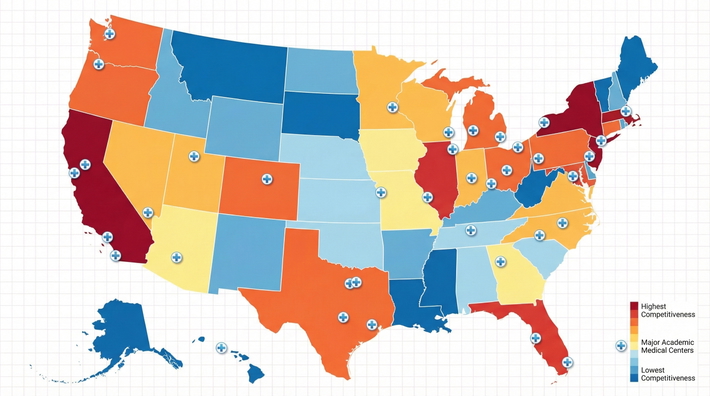
You’re on the couch with your partner. One of you wants academic neurology, the other is leaning toward community family medicine. Your families are in different states. Your schools are in different regions. You’ve just realized: a “normal” couples match in one metro area might not be realistic.
Now you’re staring at a US map asking, “Are we doing this by city? By state? By time zone? How do we not end up 1,000 miles apart?”
This is the two-body problem plus regional constraints. And yes, it’s harder than the standard couples match. But it’s solvable if you stop thinking “magic perfect city” and start thinking systems, tiers, and tradeoffs.
Here’s how to actually do that.
1. Get Specific About Your Situation (No, “We’ll Go Anywhere” Is Not a Plan)
If you’re trying to coordinate a couples match across regions, you’re usually in one of these situations:
- You’re at different med schools in different regions (e.g., one in the Northeast, one in Texas).
- You have hard regional pulls (kids, visas, military, family health, financial constraints).
- One partner is specialty-flexible, the other is not.
- One of you is geographically anchored for fellowship later, and you’re trying to “position” yourselves.
You cannot plan intelligently if you keep everything vague. Sit down and force the hard constraints out into the open.
Ask each other, out loud, and actually answer:
- Are there any regions that are truly off the table? (e.g., “We cannot afford California,” “I can’t be more than a direct flight away from my sick parent,” “I can’t do winters that involve -20°F.”)
- Who has the more competitive specialty? That person’s geography will be more constrained by program density.
- Who has the stronger application? That person may carry more of the geographic risk.
- Are you willing to do LDR for a year if it significantly improves both your long-term trajectories? Some couples are. Some absolutely aren’t.
Write this down. Not in your head. On paper or in a shared doc.
Then classify your constraints:
| Constraint Type | Example |
|---|---|
| Legal/visa | Must be near major academic center that sponsors J-1/H-1B |
| Family | Need to be within 3–4 hours of aging parent |
| Financial | Need low COL region (Midwest, South) |
| Career | One needs strong research hospital for future fellowship |
| Lifestyle | Need big city vs. ok with mid-sized regional hubs |
If you skip this and just start building rank lists, you will over-apply randomly, spend thousands, and still feel blind.
2. Understand How the Couples Match Actually Treats Regions
The algorithm doesn’t care about regions. It only cares about:
- Your pair codes (Program A1 + Program B1, A2 + B2, etc.)
- Whether there are two open spots in those programs when your pair is evaluated.
- Your relative rank on each program’s list.
So “match in the same region” is something you have to encode into the pair list. The system will not “try” to keep you nearby.
If you want to match:
- In the same city → you must include many same-city pair combinations.
- Within the same region (e.g., New England, Midwest) → you must include many “city A + city B in same region” pairs.
- In the same state / same time zone → same idea, you build those combos into your rank list.
No hidden geography logic. Just the pairs you actually enter.
Where people screw this up across regions:
- They anchor on a few big-name cities (Boston, NYC, Chicago, SF) and ignore smaller regional hubs.
- They don’t realize that some specialties (like EM, FM, IM) have regional clusters of programs that can be mixed and matched.
- They fail to build backup regional combinations and only build “same city or nothing” pairs.
If both of you insist on a single metro like Seattle or Boston and one of you isn’t competitive there, your joint probability drops fast. Think “web of cities,” not “single dot.”
3. Map Your Regional Strategy Before You Touch ERAS
Before you obsess over individual programs, build a regional framework. This is where most couples doing cross-region strategy finally stop panicking and start making sense.
Use something like this (adapt the regions to your life):
- Primary anchor region(s) – where you’d most like to be.
- Secondary regions – acceptable, realistic, maybe better for one partner’s field.
- Tertiary regions – places you’ll go only if it means not being long-distance.
Example for a couple: one wants academic IM → cards, the other wants psych, both currently in the Northeast but open to moving:
- Primary: Northeast (Boston, NYC, Philly, Baltimore, Providence, New Haven)
- Secondary: Upper Midwest (Chicago, Milwaukee, Minneapolis, Madison)
- Tertiary: Mid-Atlantic/Southeast (DC, Richmond, Raleigh-Durham, Charlotte)
Now assign competitiveness reality to each region. Where does each specialty have:
- Enough programs to create many pairs?
- A mix of academic + community?
- At least some programs where you’re individually above average?
If your anchor region is “Pacific Northwest” and one of you wants dermatology, you have a problem. There just aren’t many seats. You either widen region or loosen specialty expectations.
Drop a simple chart of how your focus might look:
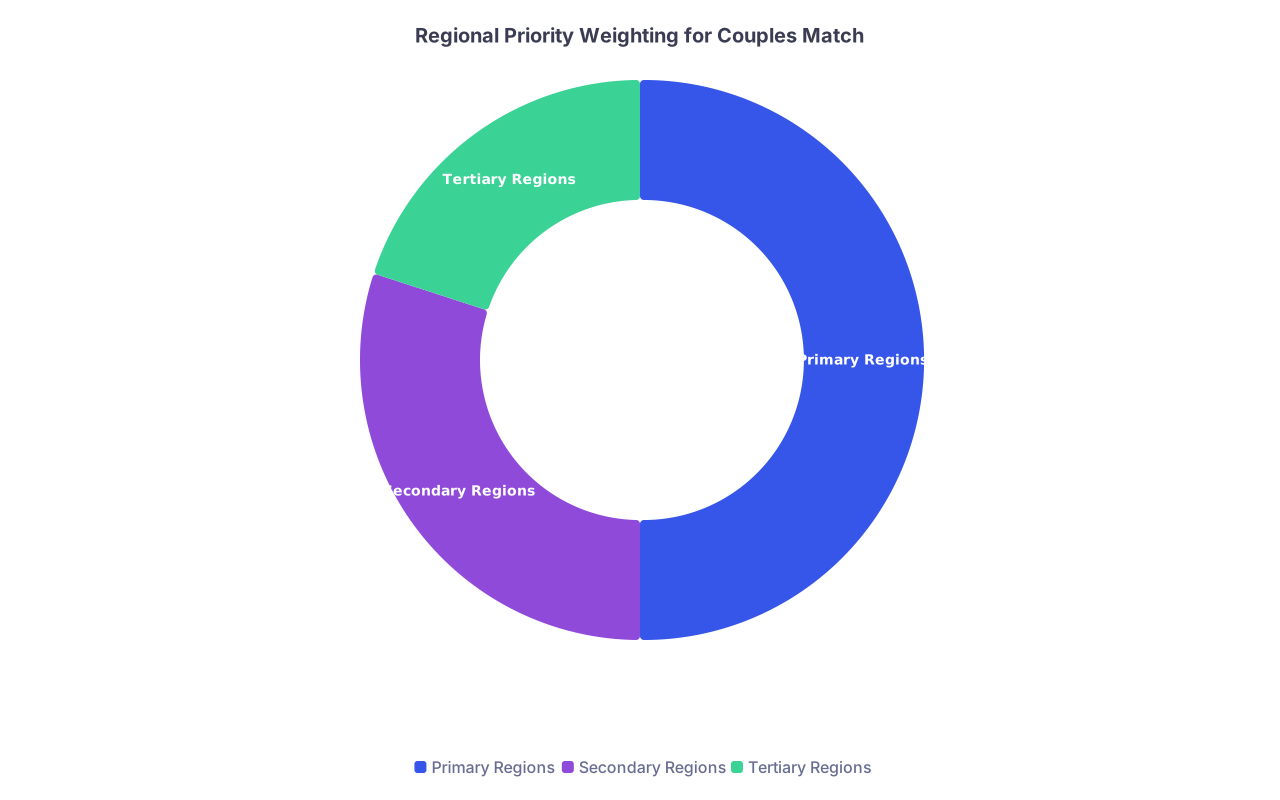
| Category | Value |
|---|---|
| Primary Regions | 50 |
| Secondary Regions | 30 |
| Tertiary Regions | 20 |
That’s roughly what a sane couples map looks like. Half your emotional energy on primaries, but enough bandwidth left for real backup zones.
4. Build a Program List That Actually Works Across Regions
Now we get practical.
You’re not just building two separate lists. You’re building overlapping regional ecosystems for both of you.
Step 1: For each partner, separately, create:
- Reach / reasonable / safety programs by region.
- Academic vs community mix.
- Places you’d actually live without being miserable.
Step 2: Overlay your lists.
For each region, ask:
- How many viable combos can we form here? (e.g., Partner A has 7 options in Chicago, Partner B has 10. That’s 70 theoretical city-level pairs – realistically you won’t rank all, but you see the density.)
- Does one of you have only 1–2 long-shot programs in a region? Then that region is fragile for couples match.
Quick rule of thumb: if one partner has fewer than 4–5 realistic programs in a region, that region is shaky as a joint target.
If you want a clean bird’s-eye view, build a simple table:
| Region | Partner A Programs | Partner B Programs | Overlap Strength |
|---|---|---|---|
| Northeast | 15 | 18 | Strong |
| Upper Midwest | 10 | 12 | Strong |
| Southeast | 6 | 9 | Moderate |
| West Coast | 4 | 3 | Weak |
If you both drool over West Coast lifestyle but you’ve only got 3–4 programs each, that’s not a primary target. That’s a lottery ticket.
Don’t lie to yourselves about this.
5. Strategy Depends on Specialty Pairing
Some combos are naturally easier across regions than others.
Easier regional coordination pairs
- IM + FM
- IM + Psych
- FM + Pediatrics
- IM + EM (if you’re flexible on academic vs community)
These fields have wide geographic distribution and lots of spots. For these couples, the bigger threat is over-constraining yourselves to a tiny set of cities.
What to do:
- Use more regions with moderate depth each.
- Don’t be afraid of second-tier cities (St. Louis, Kansas City, Columbus, Pittsburgh, Rochester, etc.).
- Apply broadly but rank smart. You don’t need 80 interviews each if 40 of them are solo in improbable regions.
Harder regional coordination pairs
- Any surgical field + any field
- Dermatology, Ophtho, Rad Onc, ENT + anything
- Highly academic-needy fields (future CT surgery, interventional fellowships, etc.)
For these, the competitive partner effectively “drags” the geography. You go where those programs exist in enough numbers.
You do not get to say “We want to be in New England or the Pacific Northwest ONLY” if one of you is going for ENT. You can want that. But if you treat it as a requirement, you are actively increasing your chance of LDR or unmatched.
For the hard pairs:
- Let the competitive field drive primary regions (where there’s real program density).
- Give the non-competitive field a wider spread and more community programs.
- Use safety regions where the competitive specialty is slightly less crazy (e.g., mid-sized Midwest cities).
6. How to Actually Use the Couples Match Mechanism Across Regions
Many people don’t realize how flexible the pair list can be. They treat it as “same city or bust.” That’s one way. Not the only way.
You can rank combinations like:
- Same hospital: A-Boston IM + B-Boston Psych
- Same city, different hospitals: A-Chicago IM (Rush) + B-Chicago Psych (UIC)
- Same region, different cities: A-Philly IM + B-NYC Psych
- Extreme LDR backups: A-Midwest, B-Southeast with good airports, if you’re okay with that as a last resort.
Your pair list should roughly follow region tiers:
- Top block: Same hospital / same city in primary regions.
- Middle block: Same city in secondary regions; same region combos in primary regions.
- Bottom block: Same region in secondary/tertiary zones, then your “if we must” LDR arrangements.
Visualize it as a flow, not a random spreadsheet:

| Step | Description |
|---|---|
| Step 1 | Primary Regions Same City |
| Step 2 | Primary Regions Same Region |
| Step 3 | Secondary Regions Same City |
| Step 4 | Secondary Regions Same Region |
| Step 5 | Tertiary Regions Same Region |
| Step 6 | LDR Safety Combinations |
If you never get past the first line of that flow in your actual pair list, you’re under-utilizing the system.
7. Interview Season: Don’t Let Geography Chaos Wreck You
Application planning is abstract. Interviews get real fast.
Some realities:
- You will not both get interviews everywhere you want in the same cities.
- You will sometimes have to choose between a great solo interview in one region vs a “medium” joint opportunity in another.
- Travel costs explode when you try to “force” regional overlap.
To deal with that:
Communicate in real time. Share every invite immediately. Maintain a joint spreadsheet with:
- Program
- City/region
- Date options
- Priority level (High/Med/Low) for each of you.
Decide in advance how you’ll handle clashes:
- If Partner A gets a dream program in a key region and Partner B has a clash with a lower-priority solo program, who flexes?
- Are you ever going to decline an interview if your partner doesn’t have regional options there? (Sometimes yes, sometimes no. Decide ahead of time.)
Be willing to pivot regions mid-season:
- If you both are doing very well in one region (e.g., Midwest) and poorly in another (e.g., West Coast), shift focus. Don’t keep chasing dead space.
The other trap: one partner goes all-in on a region with limited options while the other scatters. Then your final pair list is shallow in any one place. That’s how couples end up matched 900 miles apart with no direct flight.
8. When Regional Constraints Are Extreme
Some of you aren’t just “we like the East Coast.” You’re “I must be within 90 minutes of this specific city” or “my visa sponsor options are tiny” or “we have school-age kids and no money to move twice.”
Different rules apply.
Case: One partner truly cannot leave a specific region
Example: Your parent is terminally ill, and you’re the main support person in the Southeast. You must stay there; your partner is more flexible.
Then:
- That constrained partner needs to apply very broadly within that region. Both competitive and “beneath” their stats programs.
- The other partner should treat that region as their primary and secondary zone, and only lightly test other regions.
- LDR safety? You make that call honestly. But if it’s actually off the table, you both must accept that not matching together or at all is a higher risk. You compensate with numbers.
Case: Visa constraints + couples match
If one of you needs J-1/H-1B:
- Build a list of programs in your key regions that definitely sponsor.
- The visa-constrained partner should over-apply regionally, even to less-desired programs, to give the pair list substance.
- Avoid having their only sponsoring programs in ultra-competitive cities unless their app truly supports it.
Case: Kids / single-income reality
If one partner might not work (non-medical spouse, childcare issues):
- Focus on regions with reasonable COL + multiple hospitals in commutable radius.
- Avoid “cool but insane” markets where rent and childcare will crush you (e.g., SF, Manhattan) unless you have strong financial backing.
9. How Many Regions Is “Too Many”?
Across regions, couples tend to either go too narrow (only 1–2 cities) or too scattered (15 random places with no depth).
You want a few regions with depth, not everywhere with nothing.
Guideline:
- For most couples: 2–3 primary/secondary regions with real depth each.
- Each of those regions should allow, realistically:
- At least 5–7 programs per partner.
- Enough joint permutations that you can build 15–30 solid pairs per region.
If you are trying to meaningfully “compete” in 6+ distinct regions (Northeast, West Coast, Southeast, Texas, Midwest, Mountain West, etc.), you’re not actually competing anywhere. You’re dabbling.
Better: accept 3 realistic zones and ignore the fantasy of “maybe we end up in Portland or Denver or Austin or Boston.” That fantasy burns money and mental energy.
10. Dealing With the Emotional Side (Because This Part Sucks)
You can do everything right and still end up disappointed. Or split. Or in your tertiary region. That’s the ugly truth.
You will hear people say:
- “We only ranked like 10 pairs, and we matched at our #1!”
- “We both wanted San Diego and got it!”
Good for them. Their story is irrelevant to you if your specialties, stats, or constraints differ.
What actually helps:
- Be brutally honest about who is taking on more risk. It’s often the stronger applicant who agrees to flex on prestige or academic goals to preserve geography. They deserve explicit gratitude, not silent assumption.
- Talk about dealbreakers clearly:
- “I will not do LDR for more than X months.”
- “I would rather be apart for a year than both be in a city we hate for 7 years.”
- Decide if you’re willing to accept:
- One partner at a “lower tier” program to stay together in a region.
- One partner going unmatched and SOAPing regionally vs both expanding radius.
None of that is theoretical. I’ve seen couples where one partner passed on a top-10 academic IM program to match at a small community site near their partner. Five years later, they’re still together, doing a fellowship from there. No regrets.
I’ve also seen couples implode because they pretended they were “all in together” but secretly one person prioritized prestige and then resented the final outcome.
Do not script your rank list around a fantasy version of your relationship. Use the actual one.
11. Bottom Line: How to Not Get Crushed by the Two-Body Regional Problem
If you’re trying to coordinate a couples match across regions, the path is not mystical. It’s structured and a bit ruthless:
- Define your real constraints and priorities up front – regions, family, specialty competitiveness, and non-negotiables.
- Build regional depth, not scattershot breadth – 2–3 key regions with many realistic programs per partner beats 7 regions with 1–2 options each.
- Use the couples mechanism fully – same hospital, same city, same region, and, if you can stomach it, LDR backups, all explicitly encoded in your pair list.
Do that, and you’re not at the mercy of the map anymore. You’re running a plan instead of hoping the algorithm reads your mind.