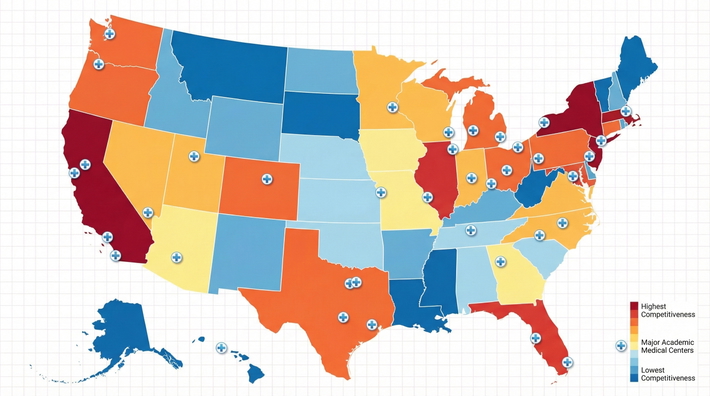
You are sitting on the couch with your partner. Their job contract is open on the coffee table. There it is in black and white: they’re locked to this region for the next 3–5 years. Meanwhile, you’re about to apply for residency.
You’re not choosing “where do I want to train?”
You’re choosing “how do I make this work here without blowing up my career or my relationship?”
I’ve seen this play out over and over: one partner is a teacher with tenure in a specific district; or a software engineer with a high-comp job that’s 3-days-in-office; or someone in the military with no flexibility. You? You’re the one who supposedly has “the Match” and a national job market… except practically, you don’t. Your map just shrank to a 100–200 mile radius. Sometimes less.
This is fixable. But only if you treat it like a constraint to engineer around, not a tragedy to wish away.
Let’s go step-by-step.
1. Get Precise About Your “Region” (Not a Vibe, a Map)
Most couples start with something vague like “We need to stay in the Bay Area” or “We’re locked to the Midwest.” That’s useless for residency strategy.
You need to convert “region” into an actual, hard map with commute math.
Start with this:
What exactly does your partner’s job require?
- Number of in-office days per week
- Hard location (single office vs several sites)
- Typical commute people actually tolerate there (40 vs 90 minutes)
- Realistic transportation (car? train? traffic hell?)
Now put numbers to it.
| Scenario | Max One-Way Commute | Typical Radius |
|---|---|---|
| Urban core with heavy traffic | 45 minutes | 10–15 miles |
| Suburban with highway access | 60 minutes | 25–35 miles |
| Mixed city-suburb region | 75 minutes | 35–50 miles |
Then do this together:
- Pull up a map (Google Maps, whatever).
- Drop a pin on your partner’s worksite.
- Draw a rough radius that matches your agreed max commute.
- Now overlay every residency program within that circle.
Yes, do it manually. Program by program.
IM, FM, psych, surgery, prelims, community programs, university affiliates. All of them.
You’re not just asking, “what’s in my state?” You’re asking, “Which specific programs are truly commutable if we want to stay in the same home?”
That list you produce? That’s your new universe. And you need to know if it’s 5 programs or 25. The whole rest of your strategy hangs on that number.
2. Reality Check: Competitiveness vs Supply in Your Region
Once you know how many programs you realistically have, you have to answer a blunt question:
Is this region/program list compatible with:
- Your specialty choice
- Your Step/COMLEX scores
- Your CV (research, red flags, etc.)
Or are you about to funnel a national match into a 5-program lottery with bad odds?
Here’s where people lie to themselves. “I really love dermatology and we have two derm programs in the city, it’ll be fine.” No. That’s not a plan. That’s fantasy.
You need to classify your situation:
| Situation | Programs in Radius | Your Specialty | Risk Level |
|---|---|---|---|
| A | 15–25+ | Primary care | Low |
| B | 8–15 | Mid-competitive | Medium |
| C | 3–8 | Competitive | High |
| D | 1–3 | Very competitive or weak app | Extreme |
If you’re in Situation A, you can mostly play within the system. If you’re in C or D, you need backup strategies yesterday (we’ll get to those).
Be brutally honest about your profile. If your Step 2 is 215 and you want ortho and there are two ortho programs in your radius: that’s not gritty determination; that’s denial.
This is where I’m telling you directly: sometimes the smart move is to modify your specialty plan because you’re geographically locked. Not because you’re weak. Because the geometry is hostile.
3. Expand the Definition of “Here” Before You Give Up
Before you start re-planning your entire career, check whether your “region” is really as small as you think.
Questions to ask:
- Could you or your partner tolerate a 60–75 minute commute if it keeps you living together?
- Are there satellite clinics, offices, or hybrid options your partner could shift to in year 2 or 3?
- Are there neighboring cities with direct train lines that are easier than driving 25 congested miles?
This is where a little creativity can double your program universe.
For example:
- Partner works in downtown Chicago. You default to only looking at Chicago programs. But Metra + CTA may make some suburban programs viable.
- Partner’s tech job is based in Seattle, but they’re already working hybrid. Maybe 1–2 days in person means you can consider Tacoma, Everett, even Olympia depending on schedule.
Have your partner actually talk to their boss or HR. Many people discover:
- They could “anchor” in the office 2–3 days in a row
- They might shift to a different office location in the same company
- Their company is more remote-flexible than the culture suggests
Do not guess. Get hard info. “Maybe I can work from home more later” is not strategy. “My manager said I can be fully remote after 12 months if performance is solid, and she put that in an email” is strategy.
4. Build a Tiered Target List: Core, Stretch, Lifeboat
Once you know your real radius and the program list, you need to stratify.
Think in three tiers:
Core programs
These are:
- Within your agreed-upon geographic radius
- In specialties and program types that fit your stats
- Realistic based on prior match data, resident bios, PD comments, etc.
Core programs are where you focus your energy: targeted emails, networking, tailored applications, away rotations if useful.
Stretch programs
Still within region, but:
- Either more competitive
- Or long-commute / suboptimal location but still technically workable
You still apply, but you don’t lie to yourself. Match here is a win, but not expected.
Lifeboat programs
This is where we talk about:
- Different but related specialties (FM instead of categorical IM; IM instead of neuro or PM&R; psych at a community program instead of big academic)
- Prelim / transitional years locally as a temporary anchor
- Slightly outside the “perfect” geographical radius but survivable, even if that means a long commute or short-term weekday separation
You’re not aiming to end up here. But your future self will be very happy you built this tier if your region is tight.
5. Use Every Regional Lever You Actually Have
When you’re geographically flexible, you can spray applications and hope. When you’re locked, you have to be targeted and a bit aggressive.
Here’s what that looks like in the real world.
5.1. Make your regional tie explicit and front-and-center
Programs want people who will actually show up and stay. You have a huge advantage here—if you actually communicate it.
That means:
- Personal statement: a short, clear paragraph about your long-term commitment to the area and your partner’s stable job here.
- ERAS experiences: mention local volunteering, family roots, or prior schooling in the region.
- Email to PD/coordinator after you apply: a tight 5–7 sentence note stating your strong interest in their program and why this region is non-negotiable for you long term.
You want them thinking: “If we rank this person, they will not leave. They are a safe bet.”
5.2. Put time into local networking
If you’re locked to a region, the regional game is everything.
Options:
- Do an away/sub-I rotation at a program in your radius, especially if your home institution is outside the region.
- Attend local specialty society meetings, grand rounds, or online regional conferences and speak to faculty afterward.
- Ask your school’s faculty if anyone trained or worked at the programs in your region and can email-introduce you.
I’ve watched applicants get interviews specifically because a staff doc texted a PD: “This student is moving to our area long-term with partner, looks strong, please take a look.”
You only need a couple of those nudges.
5.3. Customize your signals (if your specialty uses them)
In specialties with formal signaling (e.g., EM, some others), your approach is simple:
- Every signal goes to a program within your partner-locked region unless your list is too tiny to use them all.
- If you must use signals outside the region (for competitiveness reasons), those are pure backup.
You are not “keeping options open” nationally. You are concentrating leverage where it matters.
6. Decide up Front: Are You Willing to Train Apart?
Nobody likes this section. But skipping it is how couples blow up under Match pressure.
You and your partner need a straight conversation before you submit ERAS about this:
“If I cannot match within our commuting radius, are we willing to do:
- A long-distance arrangement for 1–3 years?
- Weekday separation and weekend commuting?
- Or is that a hard no, and we would rather I re-apply, SOAP locally, or pivot specialty?”
There is no universally right answer. I’ve seen all of these work and fail:
- Couple lives two hours apart, sees each other on weekends, survives 3 years.
- Partner quits job and relocates for your residency, resents it, marriage rots.
- Applicant abandons their preferred specialty to stay geographically, ends up fine.
- Applicant refuses to compromise specialty or geography, doesn’t match, spirals.
The mistake is not the choice. The mistake is not choosing until it’s forced on you by Match Day.
You need a pre-agreed hierarchy:
- Relationship vs career priority in this season
- What hardship you’re willing to accept (and for how long)
- The line you won’t cross (e.g., “We will not live in separate states for more than 1 year”)
Write it down. Old-school. Paper or shared note. You’ll be shocked how fuzzy people’s memories get when panic sets in around January.
7. Specialty-Specific Tactics When You’re Geographically Trapped
The advice changes quite a bit depending on what you’re aiming for.
7.1. Primary care (FM, IM, peds, psych in many regions)
If your partner has locked you to one region and you’re going into a less-competitive specialty and the region is not hyper-saturated, you’re actually in decent shape.
Your moves:
- Apply very broadly within your radius to all reasonable programs. Don’t get picky.
- Strongly consider community programs—these often value local longevity.
- Be available and responsive. These programs often move quickly and appreciate applicants who answer emails and interview requests promptly.
Here’s a rough pattern I see:
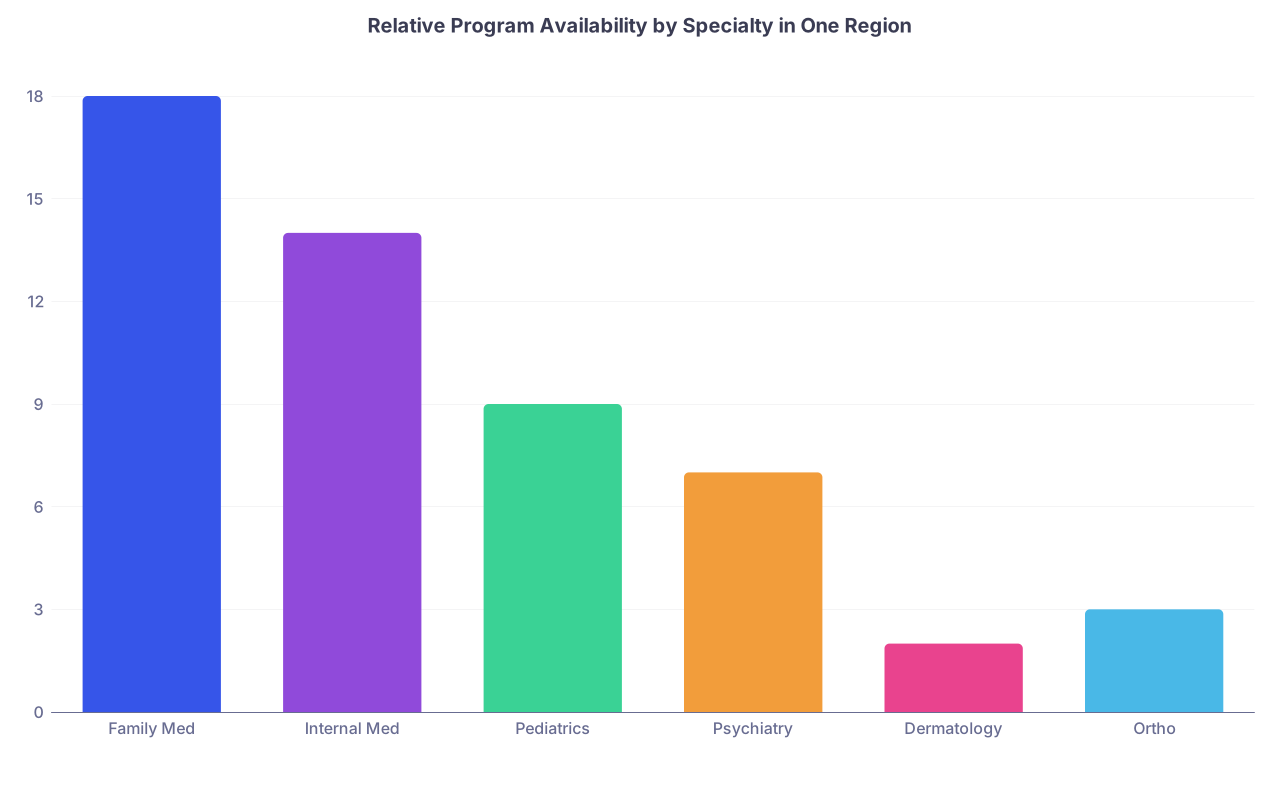
| Category | Value |
|---|---|
| Family Med | 18 |
| Internal Med | 14 |
| Pediatrics | 9 |
| Psychiatry | 7 |
| Dermatology | 2 |
| Ortho | 3 |
If your region looks anything like that, and you’re targeting the left half of this chart, you can usually make the regional lock work with solid planning.
7.2. Competitive specialties (derm, ortho, plastics, ENT, rad onc, etc.)
This is where things get ugly fast if your radius is small.
Your options:
- Double-apply (e.g., ortho + prelim/TY in your region; derm + IM/FM backup in region).
- Strongly consider doing research locally first (1–2 years) at an institution in that region to become “one of theirs.”
- Be honest with yourself about whether national flexibility is functionally required for your dream specialty.
I’ve seen applicants stay in the region, do a local research year, build connections, then match into the competitive specialty locally the next year when they suddenly have deep ties and strong letters from that exact institution.
I’ve also seen people waste three cycles trying to force a derm/ortho match in a two-program metro while refusing to broaden geographically or consider a backup specialty. That’s not determination; that’s refusing to read the room.
8. Financial and Lifestyle Logistics If You Need Two Locations
Sometimes the compromise ends up being a partial separation: you match a bit farther out than ideal, partner keeps job, you meet in the middle on weekends.
You have to treat that like a small engineering project, not a vague “we’ll make it work.”
Build a simple monthly budget:
Housing x2, travel, time cost, call schedule, who drives when.
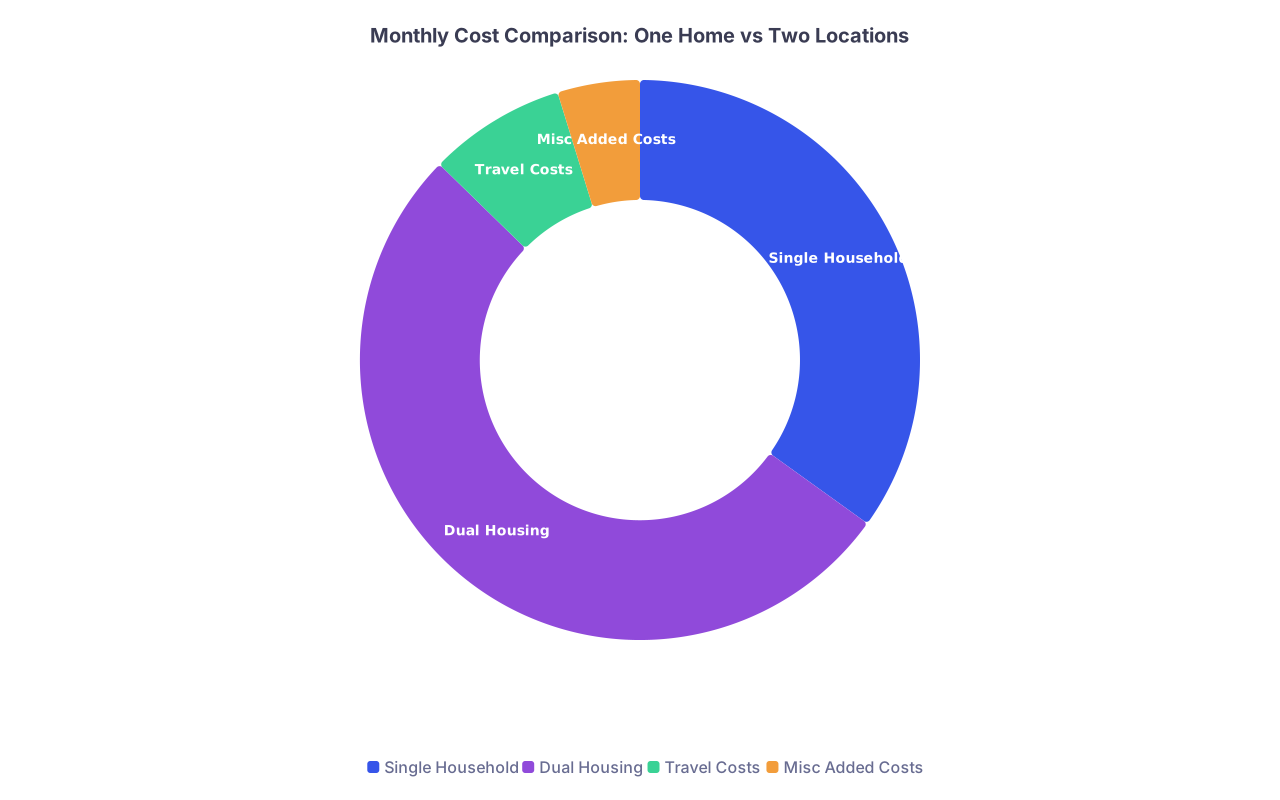
| Category | Value |
|---|---|
| Single Household | 2200 |
| Dual Housing | 3300 |
| Travel Costs | 500 |
| Misc Added Costs | 300 |
Numbers like that are common. Not always affordable. Definitely not trivial.
Things I’ve watched couples do to reduce the damage:
- Resident rents a room near the hospital instead of a full apartment; main home stays near partner’s job.
- Use hospital call rooms aggressively to keep some nights “free” from commuting.
- Stack days off to create “long weekend blocks” for quality time instead of random free Tuesdays.
You also have to be honest about fatigue: Driving an hour and a half after a 28-hour call is a safety hazard, not romance.
9. Use Time to Your Advantage if You’re Not Applying This Cycle
If you’re still in M2/M3 and already know your partner is locked to a region, you have more leverage than a panicked M4 in September.
Use it.
Here’s a simple planning timeline:
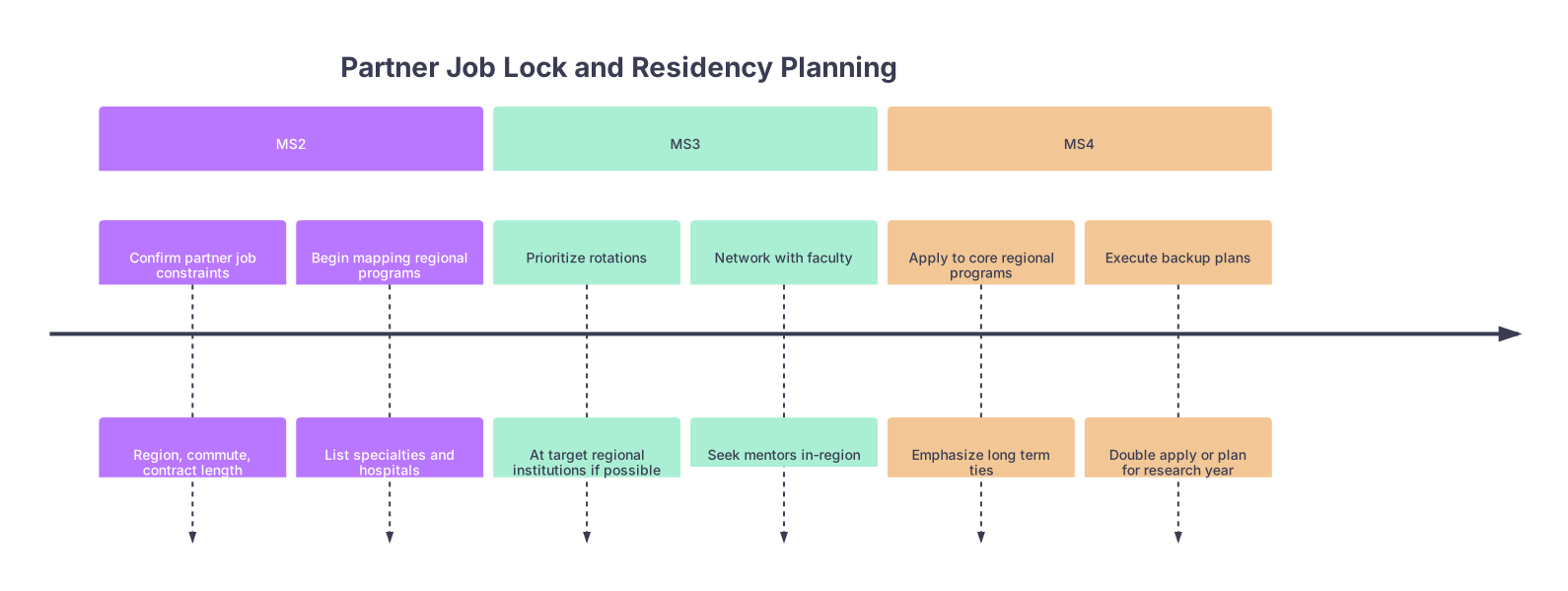
| Period | Event |
|---|---|
| MS2 - Confirm partner job constraints | Region, commute, contract length |
| MS2 - Begin mapping regional programs | List specialties and hospitals |
| MS3 - Prioritize rotations | At target regional institutions if possible |
| MS3 - Network with faculty | Seek mentors in-region |
| MS4 - Apply to core regional programs | Emphasize long term ties |
| MS4 - Execute backup plans | Double apply or plan for research year |
If you have a year or two:
- Do a research project with a PI in your target region (even remote, with a couple of in-person visits).
- Arrange away rotations there.
- Attend a regional conference and talk to faculty who work at those hospitals.
- Get your Step 2 as strong as humanly possible to widen your options within the region.
Time lets you manufacture local ties instead of just claiming them.
10. How to Talk About Your Situation Without Sounding Like a Red Flag
Programs sometimes get wary if you seem inflexible about geography—because they worry you’ll be difficult about scheduling, or you’ll bolt for personal reasons.
You need to frame this correctly.
Good framing in an interview:
- “My partner has a long-term position in this region, and we’re building our life here. So I’m very committed to training and then practicing in this area. That’s a big part of why your program is at the top of my list.”
Bad framing:
- “I can only rank programs in this city; my partner can’t move.”
- “I really, really need to be here or my relationship is in trouble.”
You’re emphasizing rootedness and long-term fit, not desperation or constraint. Program directors respond well to applicants who say, essentially: “I’m looking for a place to build a life and a career here; your program is part of that.”
If they push (some will), you stay calm:
- “If I’m fortunate enough to match here, this is where I plan to stay. My partner’s work is here, and we’re excited to anchor in this community.”
That’s it. No drama.
11. Plan for the “What If I Don’t Match Here?” Scenario Now
This is the scenario almost nobody plans emotionally for, and then they implode if it happens.
You need a pre-built fallback.
Realistic options if you don’t match in your region:
- SOAP into anything reasonable in the region (FM, prelim IM, TY, psych, peds). One year anchor, reassess next cycle.
- SOAP somewhere else while partner stays put—if you’ve both agreed that short-term separation is acceptable.
- No SOAP / voluntary withdrawal → research year in-region to strengthen app and deepen local ties, then reapply.
- If you’re early in training, pivot specialty to something with more regional availability.
You and your partner need to pick your preferred order before Match Week. Not decide live while your phone is buzzing with SOAP calls.
12. The Emotional Piece (Yes, You Have to Acknowledge It)
There’s a quiet grief in realizing you don’t have the national residency market everyone talks about. That you may not get the perfect program, or your dream specialty, because life is messier than the brochure version of medicine.
You’re allowed to be angry about that. For a bit.
Then you have to get practical again, because the Match will not pause and wait for your feelings to catch up.
Here’s the mindset that helps most people I’ve worked with in your situation:
- You are not “settling for less.” You are optimizing under real constraints. That’s what adults do.
- You are trading some optionality for relational and geographic stability. That is a valid trade, not a failure.
- Most of what makes residency good or miserable is not the program name. It’s leadership, culture, co-residents, and your own boundaries.
The goal is not to get everything. The goal is to build a life that doesn’t blow up in the process.
Concrete Next Step for You Today
Right now, do this with your partner:
- Open a map.
- Drop a pin on their worksite.
- Draw your true max commute radius.
- List every residency program inside that circle (by name and specialty).
That list is your battlefield. Once you see it clearly, you can start making smart moves—instead of wishing you lived in a different reality.
Then, only after the list is done, ask yourselves: “If none of these work out, what’s Plan B we can both live with?”
Write that answer down.