The usual “love will find a way” advice is useless for a long‑distance marriage during residency. You need logistics, not platitudes.
If you and your spouse are in different cities or regions while you’re in training, you’re in a high‑risk zone: high burnout, high resentment, and a real possibility that both your relationship and your career suffer unless you treat this like a joint operations plan.
This is your survival manual.
1. Get Brutally Clear on the Next 3–5 Years
Vague plans kill long‑distance marriages in residency. “We’ll see how it goes” is code for “We haven’t had the hard conversations yet.”
You and your spouse need a concrete 3–5 year map, not a fantasy.
Start with three blunt questions:
- How long will we be in separate regions at maximum?
- What is the first realistic chance to close the distance?
- Which career is more geographically flexible for the next 3–5 years?
Then translate that into something you can actually see.
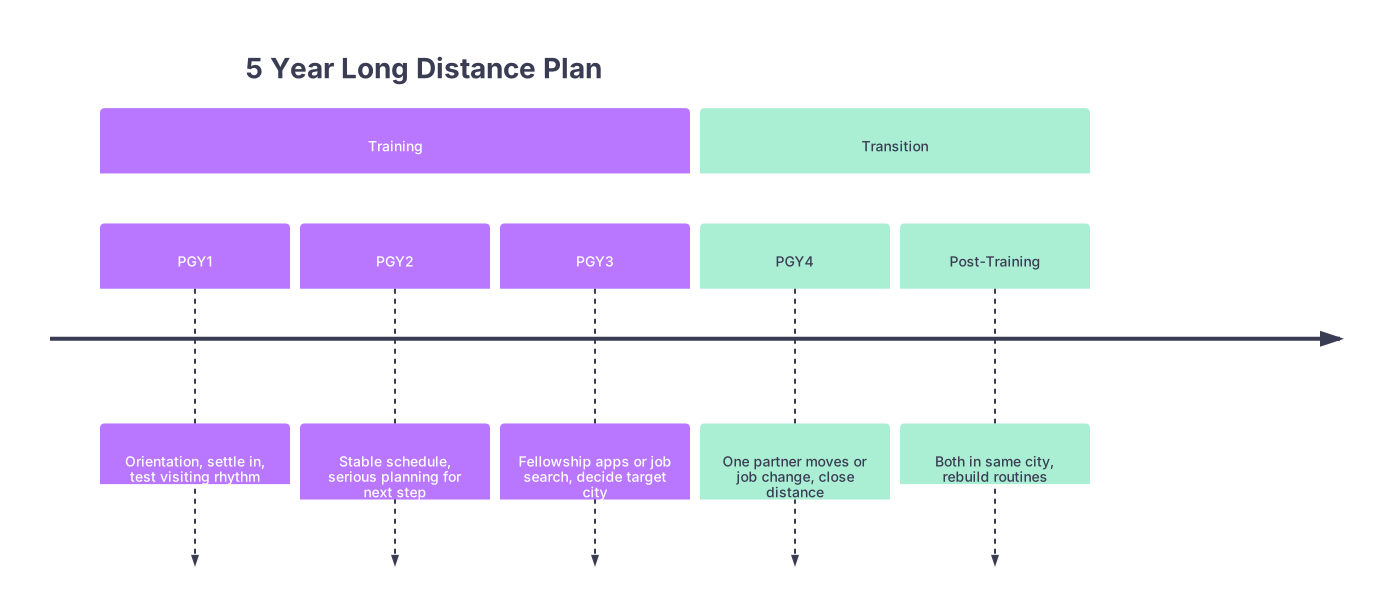
| Period | Event |
|---|---|
| Training - PGY1 | Orientation, settle in, test visiting rhythm |
| Training - PGY2 | Stable schedule, serious planning for next step |
| Training - PGY3 | Fellowship apps or job search, decide target city |
| Transition - PGY4 | One partner moves or job change, close distance |
| Transition - Post-Training | Both in same city, rebuild routines |
If you’re in different regions (say, you’re in a Midwest IM program, spouse is in the Pacific Northwest with a stable job), you need to define:
- Which region is the likely “end point” city or state
- Which partner is more portable
- How kids (current or future) change this equation
Do not tiptoe around this because it feels harsh. The couples who survive distance during residency are the ones who consciously choose the tradeoffs instead of pretending they do not exist.
2. Build a Region‑Specific Travel and Visit Plan
The distance between “Boston and New York” is wildly different from “Seattle and Houston.” The kind of plan you make depends on geography, airline routes, and cost.
You’re not planning vacations. You’re planning a commute.
Step 1: Map the actual logistics
Where are you and your spouse?
Use this basic breakdown:
| Region Pair Type | Example Cities | Typical Travel Mode | Realistic In-Person Frequency |
|---|---|---|---|
| Same Region, Short Haul | Boston–NYC, Chicago–Indy | Train/Car | Every 2–3 weeks |
| Adjacent Regions, 1–2 hr Flight | Chicago–Dallas, Atlanta–Miami | Direct Flight | Monthly or q6 weeks |
| Cross-Country, 4–6 hr Flight | Seattle–Boston, LA–NYC | Flight w/ time zone | Every 2–3 months |
| International | US–Canada, US–Europe | Flight + customs | 2–4 times per year |
If your expectations don’t match your category, adjust your fantasy, not the geography.
Step 2: Make a fixed visit cadence
You both need something predictable to look forward to—especially when residency turns into a blur.
Example for a Midwest–East Coast couple:
- PGY1 summer/fall: Visits every 6–8 weeks
- PGY2 and beyond (once you know your schedule better): Every 4–6 weeks
- One “anchor” extended visit per year (1–2 weeks during an easier rotation or vacation)
Block visits into your calendar before the academic year starts, then work around them when you get your final rotation schedule.
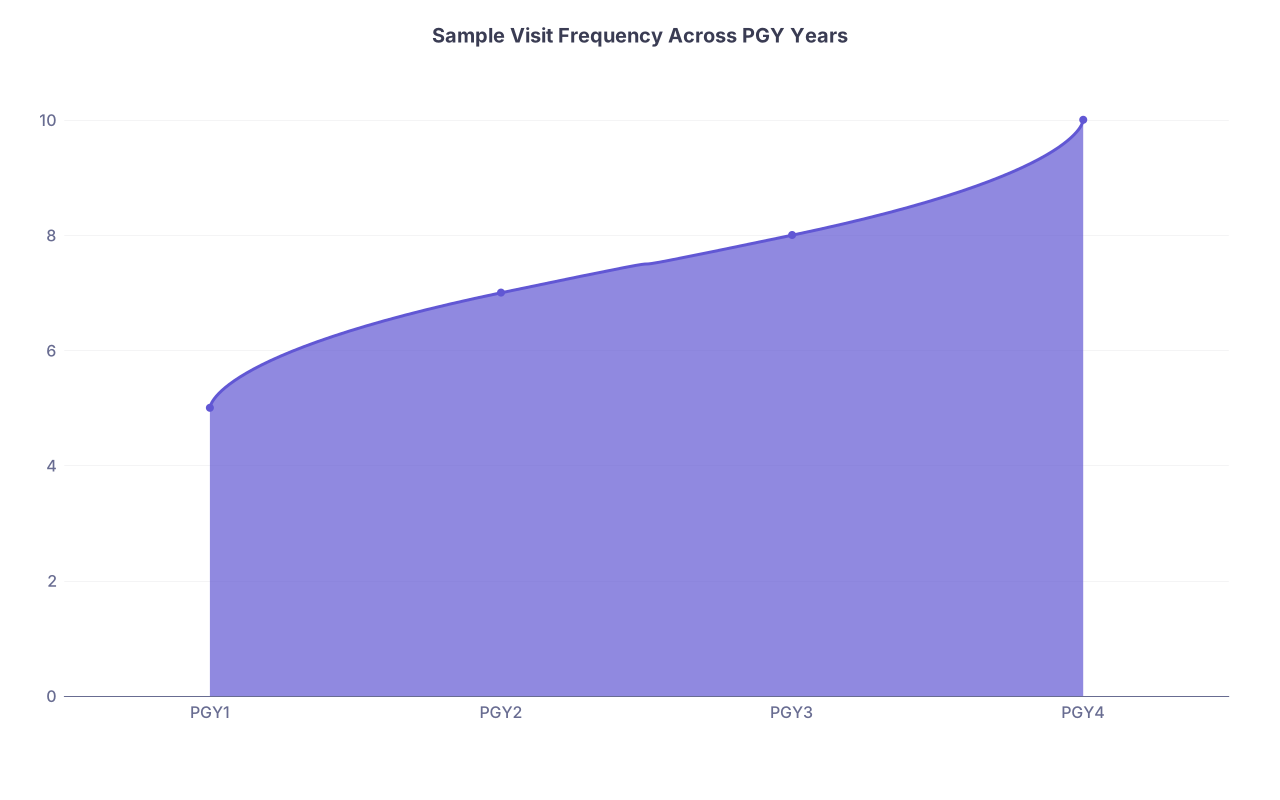
| Category | Value |
|---|---|
| PGY1 | 5 |
| PGY2 | 7 |
| PGY3 | 8 |
| PGY4 | 10 |
That’s a rough benchmark: visits per year. Your number might be higher or lower, but having a target keeps you honest.
Step 3: Pick your primary travel “hub”
If one of you is in a major airline hub (Chicago, Dallas, Atlanta, Denver), lean hard into that. Choose flight times that let you:
- Leave post‑call without destroying your brain
- Arrive in time for a real evening together, not just a midnight collapse
- Return with a buffer before your next shift
If you’re driving distance (same region), agree on whose city is “home base.” Do not alternate at random. Decide:
- “Most visits you come to me; every third visit I come to you”
- Or “School schedule means you come here during semesters; I come there on lighter rotations”
Make the rule once, not every time.
3. Build Communication Systems That Survive Night Float and 28‑Hour Calls
Love doesn’t die because you don’t care. It dies because your systems are too fragile for residency reality.
You’re not in a 9‑to‑5 relationship. You’re in:
- Night float one month
- Pre‑rounds at 5 a.m. the next
- A brutal ICU block after that
So you cannot rely on “we’ll talk when we can.” That’s amateur hour.
Create a default weekly communication pattern
Something like:
- 1–2 “real” video calls per week (30–60 minutes)
- 3–5 quick check‑ins (10–15 minutes)
- Daily async connection (texts, voice notes, photos)
But here’s the trick: you tie it to your rotation type, not just the calendar.

Example system by rotation:
On wards/ICU:
- One main call on your golden day off
- Short 5–10 minute calls on post‑call or before bed
- Voice notes during meal breaks
On clinic/elective:
- 2–3 proper video calls per week
- Regular good morning/good night messages
On nights:
- Call before you leave for shift or when you get home
- Agree ahead of time if they can wake you with a call on your “morning” (which is their afternoon)
Spell it out. You are not over‑engineering this. You’re tailoring your relationship to your schedule the way you tailor a treatment plan to comorbidities.
Hard rule: including your spouse in your day
You’re exhausted. You’re busy. None of that changes the fact that your spouse cannot read your mind.
Minimums that I’ve seen work:
Send one “day in the life” snapshot 2–4 times a week
Photo of your call room, the sunrise when you leave, your ridiculous cafeteria lunch. Tiny windows into your world reduce the distance more than you think.Use one “anchor question” daily
Something better than “how was your day?”
Try: “What’s the one thing today you wish I’d been there for?”
Or: “What moment today made you roll your eyes the hardest?”
These take 30 seconds. They buy you a lot.
4. Money: Stop Pretending It’s Not a Factor
Long‑distance during residency is expensive. Flights. Gas. Eating out because you don’t want to waste the 48 hours you’re together cooking and cleaning.
Ignoring the financial strain guarantees resentment later.
Start with a simple shared budget for distance costs:
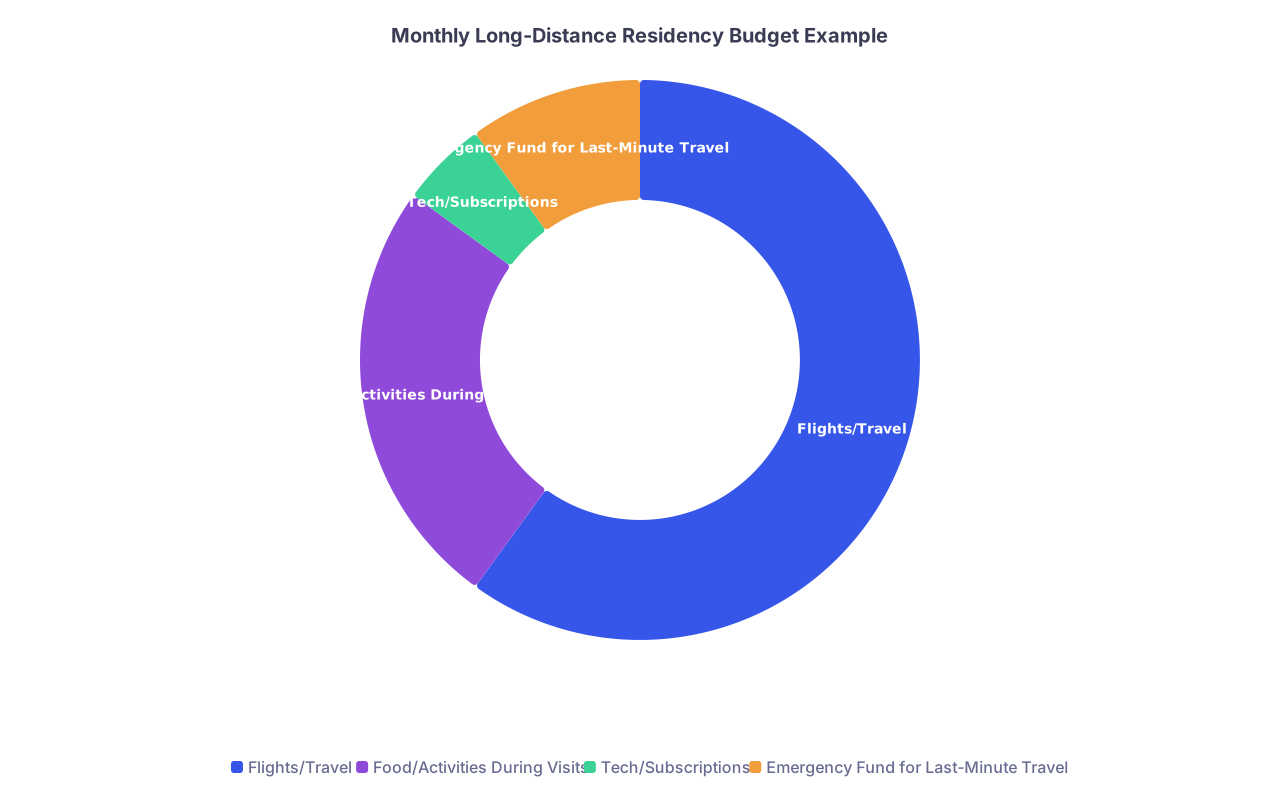
| Category | Value |
|---|---|
| Flights/Travel | 60 |
| Food/Activities During Visits | 25 |
| Tech/Subscriptions | 5 |
| Emergency Fund for Last-Minute Travel | 10 |
Percentages of your “relationship budget,” not your total income.
Practical moves:
- Choose one airline and one hotel chain and stay loyal. Points matter over 3–5 years.
- Pick a realistic “visit cost” (e.g., $350 for flight + $100 for weekend food/transport) and multiply by your target visit frequency.
- Have a tiny emergency fund for sudden travel (family illness, major emotional crisis, or the “we have to see each other now” moment).
If your spouse earns more and lives in a lower cost‑of‑living area, maybe they shoulder more of the travel cost. That’s not unfair. It’s math.
5. Kid Logistics: Regional Strategy Matters Even More
If you have kids—or plan to—while living apart in different regions, you’re basically stacking hard mode on top of hard mode. It is survivable, but it requires ruthless clarity.
You need to decide:
- Which city is the child’s primary home
- Which parent is “home base” during the school year
- How holidays, summers, and school breaks will work
And you must face the ugly truth: your ability to “just pop in” and help will be borderline nonexistent during some rotations. So you put guardrails in place.

For cross‑region families (e.g., parent A in Northeast, parent B + kids in South):
- Designate 3 “high presence” blocks per year where you protect lighter rotations or vacation to be physically there for major events (start of school, big recital, holidays).
- Accept that some things you miss. Not because you don’t care. Because you picked a brutal training path. Name the guilt, and talk about it out loud with your spouse, not just internally.
If you’re planning to have kids during residency while long‑distance: you must talk about whether you really want to stack new baby + residency + different states. Some couples handle it. Many don’t. I’m not going to sugarcoat that.
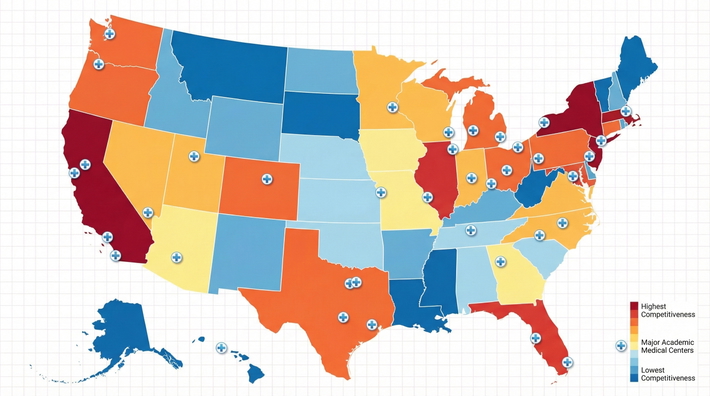
6. Region-Specific Career Planning: Position Yourself to Reunite
You’re in a “regional residency guide” category, so let’s be tactical about geography. Where you train affects:
- Where you’re likely to match for fellowship
- Where you’ll have contacts for attending jobs
- How easy it is to get both partners in the same city eventually
Think about it this way: residency location is not just your training site. It’s your launchpad.
| Your Residency Region | Spouse Region | Smart Long-Term Play |
|---|---|---|
| Northeast | Northeast or Mid-Atlantic | Target fellowship/job in spouse’s metro; exploit dense hospital network |
| Midwest | Any coast | Use lower COL to save money, plan big move post-training |
| South | South or Midwest | Leverage growth markets (Texas, Georgia) for dual jobs |
| West Coast | Anywhere | Consider spouse moving to major hub city (LA, SF, Seattle) for flexibility |
If you’re applying to fellowship:
- Narrow to cities where your spouse could realistically work and be happy.
- Rank programs not only by reputation, but by “relationship viability score.” Yes, really.
For example, if spouse is in Denver and you’re finishing IM in the Midwest:
- Denver, Salt Lake, Phoenix might be top of list before Boston or NYC unless the prestige bump is game‑changing.
- If you must choose a distant high‑prestige fellowship, agree on how many more years of distance you’re buying yourself.
If your spouse has the more flexible career:
- Start exploring remote‑friendly or region‑agnostic roles 1–2 years before you need them.
- Don’t wait until Match Day to say, “So… could you move?”
7. Fight the Two Predictable Relationship Killers
Most long‑distance residency marriages that crash don’t crash from “we don’t love each other.” They crash from two patterns that repeat over and over:
- “You don’t understand how hard my life is.”
- “I feel like an accessory to your career, not a partner.”
You attack these head‑on.
For the resident: stop hiding the ugly, but also stop weaponizing it
Your life is hard. The hours are insane. You’re constantly behind on notes, sleep, everything.
But if every conversation with your spouse is an emotional trauma dump about how awful your day was, they quickly learn: “I make their life heavier, not better.”
Concrete moves:
- Label your calls: “I need to vent” vs “I just want company” vs “I want to hear about your day”
- Once a week, ask them one question and talk 80% about their world, not your residency grind
Do not become a black hole of energy.
For the non‑resident spouse: ask for clarity, not mind‑reading
Residency structure is opaque and frankly insane to anyone outside medicine. Instead of silently stewing about why they “didn’t prioritize” you, ask specific questions:
- “Which months this year do you think will be worst?”
- “If I want to plan a big visit, when are the 2–3 best windows?”
- “What is one practical way I can make your life easier from here?”
You’re not a side character. But you also can’t expect them to spontaneously re‑explain the entire system every month.
8. Mental Health and When to Hit the Emergency Brake
There are a few red flags that mean you two need more than just “trying harder.”
Pay attention if:
- One of you starts dreading calls instead of looking forward to them
- Visits feel more like pressure than relief
- You catch yourself fantasizing about “how much easier it would be if we just broke up” more days than not
- Substance use ramps up (extra drinks post‑call every day, etc.)
That’s when you move from “DIY survival” to “we need help.”
Options that actually work with residency schedules:
- Teletherapy (for you, for them, or as a couple) during clinic half‑days or post‑call
- Couple’s therapists who advertise experience with medical couples, military couples, or long‑distance relationships
- Faculty mentors who have been through distance marriages during training—ask around quietly, you’re not the only one
You are not weak or failing if you need structure from outside. You’re trying to run a marriage on hard‑mode difficulty. Use every tool you’ve got.
9. Decide What “Success” Actually Looks Like For You Two
Here’s the part nobody talks about: not every long‑distance arrangement during residency has the same goal.
Some couples are trying to white‑knuckle 3 years, then reunite and never do distance again. Others know they’re signing on for 7–10 years of intermittent distance (dual training paths, military obligations, etc.). The emotional calculus is different.
You and your spouse should name what “success” is:
- “We make it through 3 years with our core connection intact, even if we’re not perfect.”
- “We minimize the impact on the kids and protect them from our worst stress.”
- “We get to the same city by X year, with neither of us completely torpedoing our career.”
Then reality‑check it:
- Are your current habits even pointed at that version of success?
- Or are you just surviving day to day and hoping it works out?
You can’t control everything. But you can be honest about whether your daily choices align with the life you both say you want.
FAQ (Exactly 3 Questions)
1. Is it realistic to do a cross‑country long‑distance marriage for all of residency?
Sometimes, but it’s high risk. If you’re talking 3 years IM + 3 years fellowship + maybe more for your spouse’s training or career, you’re adding up 6–8 years apart. A few couples make that work with strong systems, good finances, and a very clear endgame city. Most start to crack around years 3–4 if there’s no visible timeline to close the distance. If you’re planning for more than 3 years apart, you both need to be brutally honest about whether you’re choosing this or just drifting into it.
2. We keep fighting when we finally see each other in person—are we doomed?
Not necessarily. This is common. You build up pressure and expectations (“This weekend has to be perfect”), then you’re both exhausted and disoriented from travel, and it explodes. The fix: lower the bar for visits. Shorten them slightly if needed, avoid packing every minute with activities, and schedule a “low‑stakes” first evening (takeout, movie, early bed) before tackling heavier conversations. If every visit still turns into a disaster despite your best effort, that’s a signal to get a neutral third party (therapist, counselor) involved.
3. How soon should we start planning post‑residency or fellowship moves to reunite?
Earlier than you think. For fellowship‑bound residents, start talking seriously 12–18 months before applications. For those going straight into practice, start 9–12 months before job search. You’re not locking anything in that early, but you are identifying target regions, what your spouse would need to move, and which opportunities are non‑negotiable vs optional. Waiting until Match or until a job offer is in hand often corners one partner into a last‑minute, high‑stakes decision that breeds resentment.
Open your calendar right now and map the next 12 months: rotation blocks, likely call schedules, and three concrete visit windows. Then send that draft to your spouse and say, “Let’s turn this into our plan.”