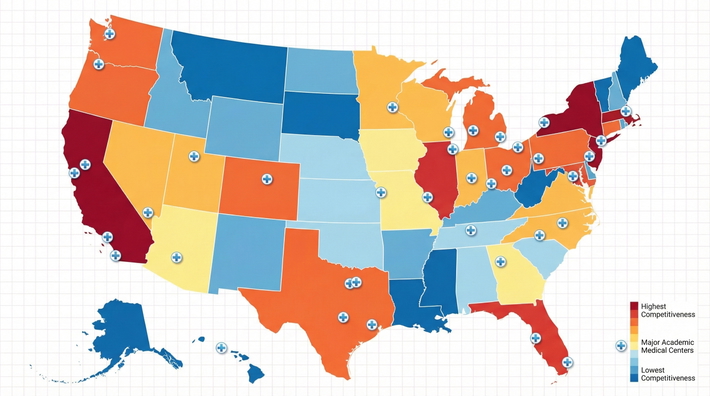
Regional ties emails matter—but not in the way most applicants think.
They rarely turn a “no chance” into an interview. But they absolutely can bump you from “maybe” to “okay, give this person a look.” If you treat them like magic keys, you’ll be disappointed. If you treat them like targeted, strategic nudges, they can be worth the time.
Let me walk you through what actually happens on the program side and how to play this game without wasting your whole October writing bad emails.
1. What “Regional Ties” Really Signal to Programs
Here’s the blunt reality: programs don’t care about your feelings; they care about your likelihood to show up, stay, and not quit.
“Regional ties” is shorthand for:
Can we trust this person to actually rank us and to be happy living here for 3–7 years?
Program directors and coordinators are thinking about:
- Will this applicant actually move here, or are we a backup to their home region?
- Will they be miserable in winter / heat / small town / big city and bail?
- Are they the type who understands our patient population and culture?
- Are we going to fill our class with people who will stick?
So when you send a regional ties email, you’re not just saying “I like your city.” You’re trying to answer: “I have real, concrete reasons to be in your area and I’m likely to come if you invite me.”
Programs especially care about regional ties when:
- You’re from a different region and applying “out of lane”
- You have no obvious connection on paper (no rotations, no address, no school nearby)
- They’re in a less competitive city/region and get burned by people not ranking them
- They’re community or smaller academic programs that heavily favor local / regional people
Big-name coastal programs? They’re less swayed. They’re flooded. But they still may glance at it.
2. How Much Do Regional Ties Emails Actually Matter?
Let’s talk impact—because that’s what you care about.
The rough hierarchy of what matters
No program director is putting “regional email” above your scores, letters, and school. Be realistic. If you’re a marginal academic fit, a regional ties email sometimes nudges you into the “consider” pile.
| Factor | Relative Impact on Interviews |
|---|---|
| Step 2 / COMLEX Level 2 | Very High |
| Clinical grades / class rank | High |
| Letters of recommendation | High |
| Research / experiences | Moderate to High (depends) |
| Personal statement | Moderate |
| **Regional ties on ERAS** | Low to Moderate |
| **Regional ties email** | Low |
That looks pessimistic. Here’s the nuance: within a borderline group, small things matter. A director deciding on their last 15 interview spots might absolutely take “this person has family here and wants to move back” more seriously than a random out-of-state applicant with no connection.
Where I’ve seen regional ties emails make a difference:
- Applicant from the West Coast applying to a Midwestern community program, explains they grew up 30 minutes away, want to move back for aging parents → gets interview.
- DO student with average scores emails regional IM programs explaining spouse job is fixed in the city → gets a couple of local interviews that likely would not have happened otherwise.
- IMG with solid scores targeting one region, clearly explains long-standing connection and intent to settle → gets at least a look where an unknown IMG might have been ignored.
Where it does almost nothing:
- You blast a generic “I love your program” email to 50 places.
- You have no plausible connection and try to invent one (“I visited once and liked the food scene”).
- You email a hyper-competitive coastal academic program with 5,000 applications and 80 spots. They’re barely reading ERAS, let alone email essays.
3. When You Should (and Should Not) Send Regional Ties Emails
You don’t need to send these to every program. That’s how you burn out and start writing garbage.
Send regional ties emails when:
You have a real connection that isn’t obvious from ERAS.
Examples:- Partner or spouse is from that city or has a job there.
- Your parents or close family live there and rely on you.
- You plan to move back to your home region but your current med school location hides that.
- You did undergrad there, but ERAS doesn’t make that obvious by state.
- You grew up in the state, moved away, and now want to return.
The program is in your top tier of interest in that region.
If you wouldn’t be genuinely happy matching there, don’t claim it.You’re “off-region” on paper.
Example: Caribbean or international student mass-applying to the US, or West Coaster heavily targeting the Southeast.
Skip regional ties emails when:
- Your only “tie” is “I like your city” or “I want to explore a new region.”
- You’re clearly not competitive for the program based on basic metrics (you failed Step twice and are targeting a top-10 academic IM program).
- The program explicitly says on their website: “Please do not email us about your application status” and you have nothing unique to add.
Think “surgical strike,” not “carpet bombing.”
4. How Programs Actually Process These Emails
Here’s the part most applicants never see.
Typical patterns I’ve watched:
- Many program directors do not personally read every email. The coordinator screens them. Some are forwarded, some get a quick “we’ll add this to your file,” some go straight to the void.
- Certain keywords matter: “spouse,” “family here,” “military orders,” “grew up in [town],” “moving permanently.” These scream “this person might rank us highly.”
- Some programs will literally make a tag in their spreadsheet: “regional ties,” “married to local,” “returning home.” That tag sometimes helps you in the discussion.
- Timing helps: emails sent before they build the first pass of interview offers are more useful than ones sent after invites go out.
- The more concise your email, the more likely it gets read in its entirety. If your email is a 900-word personal statement, it will not.
So no, you’re not wasting your time entirely. But you are competing with hundreds of other messages, and the message needs to be sharp.
5. Exactly How to Write a Regional Ties Email
You don’t need to overcomplicate this. You need 3 elements:
- Clear subject line
- One or two specific, credible reasons you’re tied to the region
- A short, honest statement of interest in their program
That’s it.
Subject line examples
- “Applicant – Regional ties to [City/State] – [Your Name, Specialty]”
- “ERAS Applicant with strong ties to [Region] – [Your Name]”
- “Spouse job in [City] – [Specialty] Applicant [Your Name]”
Make it skimmable. The coordinator should know what this is instantly.
Core email structure (you can copy this)
Keep it under 200–250 words. Ideally 120–180.
Dr. [Last Name] and [Program Name] Recruitment Team,
My name is [Your Name], an [MS4/IMG/graduate] applying to your [specialty] residency program this year (AAMC ID: [ID]). I’m reaching out briefly to share my strong ties to [City/State] and my sincere interest in training at [Program Name].
I [grew up in / went to high school or college in / have immediate family in / am relocating with my spouse to] [City/Region]. [1–2 specific details: parents in X suburb, spouse employed at Y hospital, military orders to Z base, etc.] We plan to be in [City/Region] long term, and I’m specifically hoping to complete residency and build my career here.
[One sentence about why their program makes sense for you: patient population, training environment, geographic fit—not generic fluff.]
Thank you for considering my application and for the work you do training residents. I would be genuinely excited for the opportunity to interview with your program.
Best regards,
[Your Name], [Degree / MS4 at X]
AAMC ID / ERAS ID: [Number]
[Phone] | [Email]
That’s all you need. No life story. No score recitation. They have ERAS for that.
6. Common Mistakes That Make Your Email Useless
If you’re going to send these, avoid the stuff that makes PDs roll their eyes.
The worst offenders:
- Sending mass, obviously copy‑pasted emails with no program-specific line. (“I am strongly interested in your excellent program.” Which one?)
- Overdoing the flattery. PDs read “your outstanding program” 400 times a season. It’s noise.
- Being vague about ties. “I have some connections in your region” is nothing. Say what they are.
- Trying to negotiate. “If you interview me I will rank you highly.” They’ve seen that before. It’s desperate.
- Writing a second personal statement. No one has time for that in October.
- Lying or exaggerating. “I plan to settle forever in your state” when you’ve publicly posted your dream life in another region on social media. Just don’t.
Your goal: be specific, believable, and efficient. If they’re reading email at 11:30 p.m. after a 14-hour day, you want them to get your point in one screen.
7. When to Send Them (Timing Strategy)
You want to land in the window where programs are still actively sorting applications, not after they’ve basically finalized their list.
Typical windows (varies by specialty, but general idea):
- ERAS opens to programs: late September
- First wave of interview offers: early–mid October
- Ongoing review / additional invites: October–November
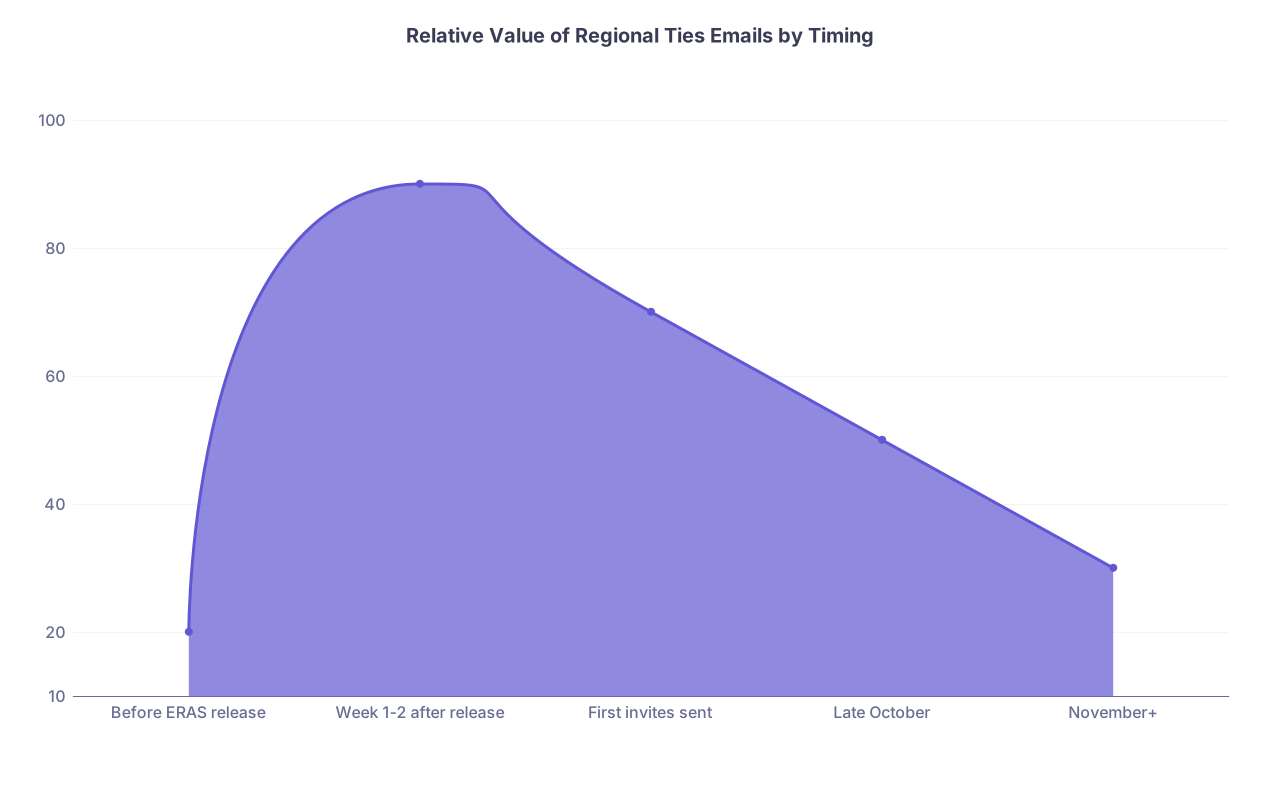
| Category | Value |
|---|---|
| Before ERAS release | 20 |
| Week 1-2 after release | 90 |
| First invites sent | 70 |
| Late October | 50 |
| November+ | 30 |
What I recommend:
- Send your highest-priority regional ties emails within 1–2 weeks of ERAS opening to programs.
- For programs that are slightly lower on your list, sending before they’re deep into interviews (early–mid October) is still fine.
- Sending after a program has clearly sent out the majority of invites? Low-yield. At that stage, follow-up interest emails sometimes make sense, but that’s a different category.
If a program explicitly states on their website that they start reviewing on X date, 1–3 days before that is a good target.
8. Special Cases: Couples, IMGs, DOs, and New Regions
Different applicant types get different mileage out of regional ties emails.
Couples match applicants
You should absolutely explain your geographic limits. Programs understand this and are often sympathetic.
What to emphasize:
- Partner’s specialty and where they’re applying
- That you both are targeting the same city/region as a priority
- That you’d strongly prefer to be in the same place even if there are slightly “better” programs elsewhere
Don’t send a novel about your relationship. Just the constraints.
IMGs and DOs
For IMGs and for DOs applying to MD-heavy programs, regional ties can matter a bit more, especially in less desirable locations.
What helps:
- Long-standing family in the region
- Prior degrees there (undergrad, master’s)
- Permanent residency / green card status tied to that region
- Prior clinical experiences or observerships in that state
What doesn’t help much:
- “I want to experience a new culture in your city.” That’s a tourism ad, not a regional tie.
New region applicants
If you are genuinely trying to move to a new part of the country—fine. But then be honest about why:
- Partner job
- Cost of living relative to your goals
- Military or other assignment
- Long-term desire to settle there for concrete reasons
If your reason is essentially “I’m flexible and just want a spot,” that’s not a regional tie. That’s just normal residency reality.
9. A Simple Decision Flow: Should You Send One?
Use this quick mental filter to decide.

| Step | Description |
|---|---|
| Step 1 | Considering email to program |
| Step 2 | Do not email |
| Step 3 | Maybe skip or batch later |
| Step 4 | Lower impact, send only if strong tie |
| Step 5 | Send concise regional ties email |
| Step 6 | Real regional connection? |
| Step 7 | Program is top choice in area? |
| Step 8 | Timing before main invites? |
Honestly, if you pause and think “I’m kind of stretching this,” you probably are. Programs can smell that.
FAQ (Exactly 6 Questions)
1. Can a regional ties email actually get me an interview I wouldn’t have otherwise received?
Yes, sometimes. Especially if you’re borderline on paper and your connection is strong and concrete—family in the area, spouse job, grew up locally, clear intent to settle. It will not rescue an application that is way below a program’s baseline for scores or red flags, but it can bump you from “maybe” to “let’s offer an interview.”
2. Should I mention my USMLE/COMLEX scores or red flags in the regional ties email?
Usually no. This isn’t the place to re-litigate your application. They already have your full file. The email’s job is to add one thing ERAS might not show well: your geographic commitment. Save explanations for red flags for your personal statement or ERAS fields, not for a 150-word email.
3. Is it better to email the program director, coordinator, or a generic address?
If the program lists a specific “Residency Program Email” or coordinator email, use that. They often manage communication and can tag your file. If not, emailing the PD + coordinator together is reasonable. Avoid tracking down personal Gmail addresses or blasting faculty who aren’t in leadership—you’ll just annoy people who can’t help you.
4. Can I send a regional ties email before ERAS officially releases to programs?
You can, but it’s not very useful. Many programs won’t start cross-referencing emails with applications until they have full ERAS access and have begun screening. Aim for shortly after programs first receive applications or right before their posted “start reviewing” date if they mention one.
5. Should I send a follow-up email if I don’t get an interview after my regional ties message?
You can, once, and keep it short. Something like: “I remain very interested in [Program] due to [brief tie]. If additional interview spots open, I’d be grateful to be considered.” Don’t pester them with multiple follow-ups. One reminder is professional; more than that starts to feel pushy.
6. Are regional ties more important for some specialties or regions than others?
Yes. They tend to matter more in primary care specialties (FM, IM, Peds, Psych), community and smaller academic programs, and in locations that struggle with retention or are geographically isolated. Highly competitive coastal academic programs lean much more heavily on traditional metrics and institutional pedigree; regional ties help less there, though they rarely hurt.
Key takeaways:
Use regional ties emails sparingly, only when you have a real, specific connection and genuine interest. Keep them short, concrete, and timed before main interview waves. They’re not magic, but they can be the small edge that gets you a look in a crowded pile.