The advice “train where you want to practice” is overrated — and sometimes flat‑out wrong.
You’re not picking a zip code. You’re picking a launchpad. For some careers, that launchpad is in the same city you’ll end up in. For others, it absolutely shouldn’t be.
Let me walk you through when it is smart to train where you want to practice, when it backfires, and how to make the decision like a grown‑up instead of a geography‑obsessed MS4.
The core question: Does location really matter for residency?
Short answer: yes, but not the way people think.
Here’s the key principle:
Programs don’t care that you “want to live in Denver.” They care that you look like someone who will stay in their region and fit their job market.
Residency is a 3–7 year job audition. Programs ask:
- “Will this person finish our program?”
- “Will they help our grads get jobs?”
- “Will they build our local network or disappear across the country?”
That’s where geography kicks in. Not as “I must train in the exact city I’ll work in,” but as “I should think in regions and networks.”
Let’s define that clearly.

Regions vs exact city
Programs and employers think in regions, not single hospitals.
A cardiology group in Dallas doesn’t only hire people who trained in Dallas. They hire people from:
- Big Texas systems (UTSW, Baylor, Houston Methodist)
- Neighboring states (OK, LA, AR) if there’s a connection
- National “name” programs anywhere
So the real question is usually:
“Is it smart to train in the same region where I ultimately want to practice?”
For most people: yes, that’s a real advantage.
For some people: not necessary. Sometimes even limiting.
When it is smart to train where you want to practice
Let’s be concrete. Here are the scenarios where training in your target region (or city) is legitimately powerful.
1. You’re going into a saturated field
Primary care in nice suburban areas. Outpatient psychiatry in coastal cities. Dermatology literally anywhere. These markets can be tight.
If you know you want:
- Outpatient peds in a specific metro
- Psych in a high‑demand coastal city
- EM in a popular urban area now feeling EM job squeeze
Then yes — training in that region gives you:
- Direct exposure to local job openings
- Faculty who know local private practices and hospital groups
- Easy networking with future employers at conferences, dinners, rotations
- A residency “brand” that local HR departments already know and trust
I’ve watched residents in oversupplied markets land jobs before graduation because some local group has “always hired from here” and the PD makes a single phone call.
2. You’re tied down geographically (family, visa, life)
If you’re:
- Caring for parents
- Locked to a spouse’s job geographic area
- On a visa that complicates where you can work or train
Then yes, you generally want to align training with where you realistically need to end up.
Not just the same city, but at least the same region and ideally same state. You’ll be building the exact network you’ll depend on when every job has to be “commuting distance from home.”
3. You’re targeting a smaller/non‑academic market
Big academic names travel well. Smaller community programs are often very regional in their influence.
If your dream is:
- Community general surgery in your home state
- Family medicine in a specific rural region
- OB in a mid‑sized city with 2–3 main hospitals
Then training in that same ecosystem is usually a smart move. The local players already know the training quality. The credentialing offices know the program director by name. Your residency likely supplies half the region’s hiring pipeline.
That’s not theoretical. There are programs where 50–70% of grads stay within 1–2 hours of the hospital. That’s not an accident. That’s the network doing its thing.
When it’s not smart to lock yourself to your future practice location
Here’s where people get burned: they over‑prioritize geography and under‑prioritize training quality, case volume, and reputation.
You don’t want to be the person who says 5 years later, “Yeah, I matched near home, but my training options and fellowship chances were worse than they needed to be.”
1. Competitive specialties: Go where the best training is
If you’re shooting for:
- Derm
- Ortho
- ENT
- Plastics
- Rad Onc
- Interventional subspecialties
You go where you can get the strongest, most reputable training. Period.
Employers and fellowship directors care far more about:
- Program name
- Surgical/procedural volume
- Your recommendations
- Your research and performance
than they do about whether you trained in their state.
A plastics fellowship in California will happily take the top resident from a big program in the Midwest over a mediocre local program grad. Same for private groups hiring.
Geography takes a back seat to caliber. If you get into a top‑tier program that isn’t your dream city, you should strongly consider going anyway. You can move later with a stronger CV and more leverage.
2. You’re early and honestly have no clue where you want to live
A lot of MS4s pretending to have a 20‑year plan are lying to themselves.
You think you “definitely want to end up in Chicago” because:
- Your med school is there
- Your social circle is there
- You’ve mostly seen that one lifestyle
Fast‑forward through residency: partners, kids, burnout, job offers, new priorities. People move. A lot.
If you truly don’t have strong geographic constraints, optimize for:
- Training quality
- Fit with program culture
- Case mix and opportunities
Then worry about where to practice later. Strong training gives you options, and options beat premature geographic handcuffs every time.
3. Your local options are genuinely weak for your goals
Let’s say you’re in a mid‑tier area with only one small IM program, low subspecialty exposure, and no real academic presence. But you want:
- Cards or GI at a strong program
- Solid research
- A shot at competitive fellowships
Chaining yourself to that local residency just because “I’d like to end up here” is short‑sighted. Better strategy:
- Train at a stronger regional or national program
- Crush residency, get fellowship
- Use your upgraded CV to come back later if you still want that city
Programs absolutely hire people who “come back home” after strong external training. In fact, a lot of them like that.
How much does training location affect where you can practice?
Let’s be data‑driven for a second.
Most residency program websites share “where our grads go” maps. The pattern repeats over and over:
- Huge clustering in the same state/region as the program
- Some spread to neighboring regions
- Smaller but consistent trickle to coasts and major metros
You’re biased toward the region you train in because:
- You rotate at local hospitals
- Your partner/family roots shift there
- Most job offers you hear about are local
So yes, location matters. But it’s more probability than destiny.
Think in terms of odds, not absolutes.
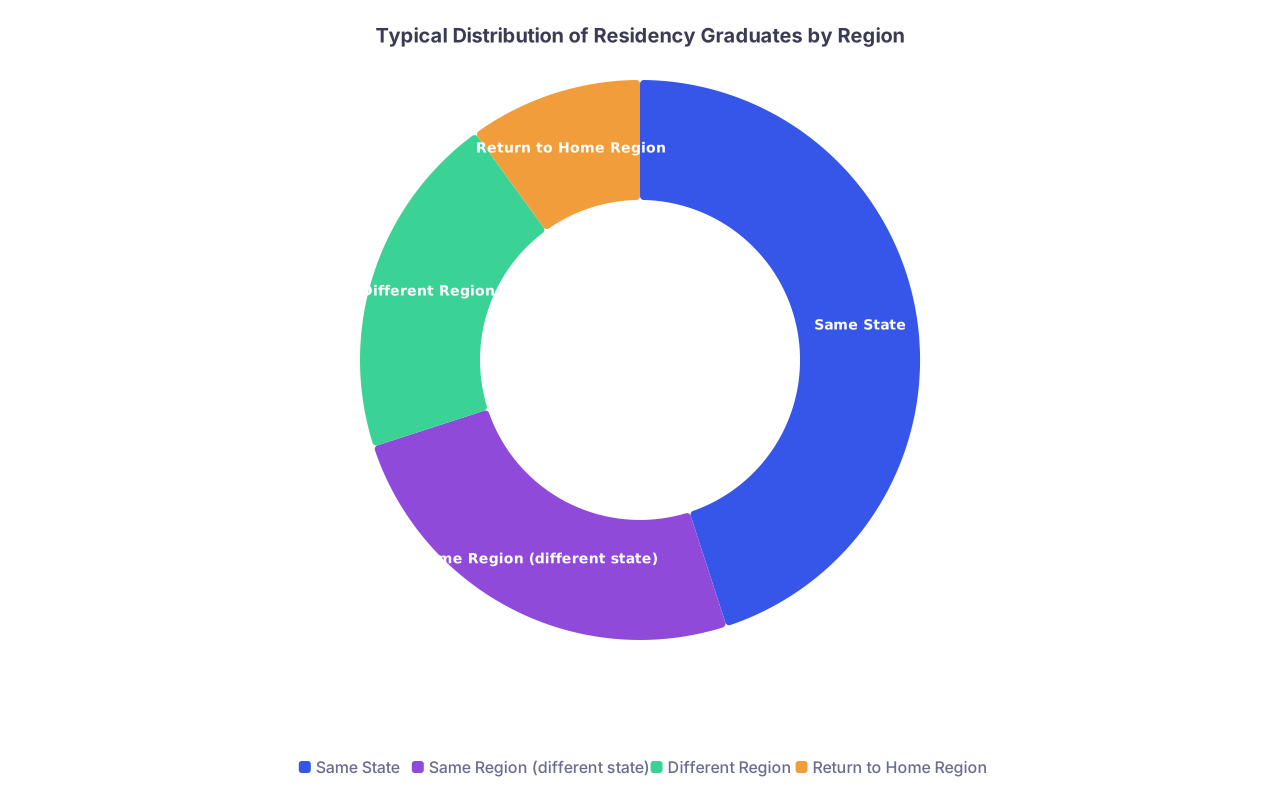
| Category | Value |
|---|---|
| Same State | 45 |
| Same Region (different state) | 25 |
| Different Region | 20 |
| Return to Home Region | 10 |
This is not exact for every specialty, but it’s roughly what you see:
- About half stay in the same state
- Another chunk stays in same broader region
- A significant minority move somewhere else entirely
So training location nudges your trajectory. It doesn’t concrete‑pour it.
Decision framework: How to decide if you should train where you want to practice
Here’s the actual decision tree I’d use with a student in front of me.

| Step | Description |
|---|---|
| Step 1 | Start |
| Step 2 | Prioritize region |
| Step 3 | Rank strong local programs high |
| Step 4 | Expand radius to nearby strong programs |
| Step 5 | Prioritize program quality over geography |
| Step 6 | Training in region is helpful |
| Step 7 | Optimize fit and training; region flexible |
| Step 8 | Strong geographic constraint? |
| Step 9 | Competitive specialty or fellowship goal? |
| Step 10 | Are local programs decent for your specialty? |
| Step 11 | Job market saturated in target area? |
Now let’s unpack that in real language.
Step 1: Are you geographically locked?
If yes (family, spouse, visa, chronic illness, etc.):
- Prioritize programs in your realistic living radius
- But still stratify by quality within that region
- If local programs are weak, widen the circle slightly (1–3 hours) if possible
If no:
Move to Step 2.
Step 2: How competitive are your specialty/fellowship goals?
If you’re aiming competitive:
Rank by program quality, case volume, reputation, and fit, not city.
If you’re aiming non‑competitive AND flexible about where you eventually practice: You’ve got more freedom to indulge geography without wrecking your career.
Step 3: What’s the job market like in your dream area?
Want to practice in:
- Coastal metros (SF, NYC, Boston, Seattle)?
- High‑demand lifestyle specialties in popular cities?
- Over‑supplied EM or certain surgical specialties in big markets?
Then training in that region can absolutely help. You’ll be the known local quantity instead of the stranger from “Somewhere Medical Center.”
If the job market is wide open (rural, underserved, smaller cities), training elsewhere isn’t much of a handicap.
Red flags: Bad reasons to insist on training where you’ll practice
Let’s be blunt. These are weak justifications:
“All my friends are here.”
You’re going to make new friends. Constantly.“I know the city already.”
That’s a comfort thing, not a career thing.“I don’t want to move twice.”
You might move 3–4 times in your career. This is normal.“I feel guilty leaving my med school attendings.”
They’ll survive. And the good ones will tell you to go where your training will be best.
If the only argument for a local, weaker program is comfort, that’s a poor trade. Residency is short. Your career is long.
Strategic plays if you can’t train where you want to practice
Maybe you don’t match in your dream region. Or no strong programs there. You still have options.
1. Use electives and away rotations wisely
As a student:
- Do away rotations in your target region to show interest and build early connections.
As a resident (depending on specialty/program rules):
- Pick electives in hospitals or systems in your future target area (especially in your final year).
- Attend regional conferences and meet local leaders.
2. Network like an adult, not a tourist
- Ask attendings: “Do you know anyone hiring in [region]?”
- Email alumni from your program who work there.
- Go to national meetings and specifically attend regional society events.
3. Align your CV with the market
If the target market is heavy on:
- Outpatient? Build outpatient experience.
- Academic? Get some research or teaching.
- Rural? Consider a rural track or moonlighting in similar settings.
You want your application to read like: “I’ve trained in X setting and want to continue that in [your city].”
Quick comparison: Training locally vs elsewhere
| Factor | Train in Target Region | Train Elsewhere (Strong Program) |
|---|---|---|
| Local job connections | Strong | Moderate (must network intentionally) |
| Understanding local system | High | Low–Moderate |
| Fellowship competitiveness | Depends on program | Often better at stronger programs |
| Flexibility to move later | Moderate | High |
| Comfort/familiarity | High | Variable |
No column “wins” outright. It depends what you value and where you’re constrained.
Where the future of medicine tilts this question
You’re not choosing for 2026 only. You’re choosing for a career where:
- Telemedicine makes geography slightly less important, but not irrelevant
- Big systems (Kaiser, HCA, Optum, academic mega‑systems) keep consolidating care
- Many new grads mix in‑person work with remote side gigs
What does that change?
Networks may matter more than micro‑location.
Being part of a large system’s training pipeline (e.g., Kaiser, Mayo, Cleveland Clinic, major university systems) can open doors in multiple states within that system, not just one hospital.Rural and underserved training might age very well.
Health systems and policy are pushing resources there. If you’re flexible, strong rural or community programs can set you up in a job market that isn’t painfully saturated.Telehealth creates “partial geographic independence,” but licensing and credentialing are still state‑based. Don’t assume you can live anywhere and practice anywhere without jumping through hoops.
So no, the future isn’t “location doesn’t matter.” It’s “location + system + network” all matter together.
FAQs
1. If I train in one region, will programs in other regions hold it against me when I apply for jobs or fellowship?
No. They might ask why you’re moving, but that’s not hostile — they’re screening for flight risk. A simple, honest story (“Family is here now,” “This is home,” “Partner’s job moved us”) is enough. Strong letters, solid performance, and a clear explanation beat regional differences.
2. Does this matter more for some specialties than others?
Yes. It matters more for: primary care, hospitalist work, psych, EM, and some surgical fields in oversupplied metros. It matters less for: super‑competitive specialties from name‑brand programs, or fields where there’s strong national demand (rural FM, some IM subspecialties). But regional bias never fully disappears.
3. I want to return to my home state after training elsewhere. How do I keep that door open?
Keep a light thread of connection: do a rotation there if you can, maintain contact with mentors from med school, attend that state’s specialty society meetings once or twice, and explicitly say in your future job search “I grew up here and always planned to come back.” Employers love believable “boomerang” stories.
4. My dream city only has weak programs in my specialty. Should I still go there for residency?
Usually no, especially if you care about competitive fellowships or advanced skills. You’re better off getting excellent training elsewhere, then coming back with a stronger CV. The exception is if you’re 100% locked to that city and your absolute top priority is never leaving. Just be honest with yourself about the trade‑offs.
5. I have no idea where I want to practice. How should I factor geography into my rank list?
Treat geography as a tiebreaker, not the main driver. Rank programs mostly by: training quality, culture, workload, leadership, and career outcomes. When two places feel equal on those axes, then use geography — where you’d rather live for 3–7 years — to break the tie. You’re buying training and opportunity first, scenery second.
Bottom line: Don’t blindly “train where you want to practice.” Train where you’ll become the strongest version of the physician you want to be, in a network that supports your realistic life constraints. Think in regions, not zip codes. And favor long‑term career leverage over short‑term geographic comfort.