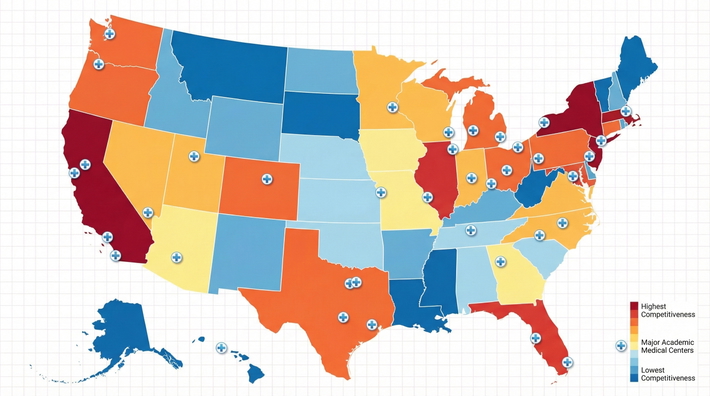
The idea that “region doesn’t matter for fellowship” is only half true—and that half will burn you if you plan blindly.
Here’s the real answer: fellowship directors care less about which region you trained in and more about whether your training region connects logically to your story, your goals, and their program’s ecosystem. But yes, region absolutely influences your chances through reputation, networks, and perceived fit.
Let’s break this down the way a busy fellowship PD actually thinks about it.
The Short Answer: Region Matters, But Not How You Think
If you want the TL;DR framework, it’s this:
Prestige and program reputation > geographic region.
A strong categorical IM program in the Midwest usually beats a weak community program in the coastal “hot” regions.Regional networks are real.
Programs pull heavily from regions they know: their own residents, their own state, their own training consortium, and their familiar neighboring regions.Your career story has to make geographic sense.
Going from Florida to Seattle to Texas to Boston can work—but only if your application clearly explains why.
What fellowship directors don’t care about: that you trained in “the South” versus “the Northeast” as a vague label.
What they do care about: the signal your training sends about case mix, rigor, letters, and likelihood you’ll fit and stay.
How Fellowship Directors Actually Evaluate Your Training Background
Most applicants wildly overestimate “regional bias” and underestimate three much more concrete things:
1. Program Name Recognition
Here’s the brutal piece: if they recognize your residency name immediately, region becomes secondary. A PD seeing “University of Michigan IM” or “Mayo Clinic” doesn’t care much whether that’s Midwest or North Pole. The brand itself carries weight.
The thought process is something like:
- “Is this a program I know and trust?”
- “Have we had residents/fellows from there before?”
- “Do I know people on that faculty who might have written their letters?”
Region amplifies this when it’s familiar. If you’re applying to a California cardiology fellowship from a known West Coast IM program, that’s a clean, comfortable signal.
2. Case Mix and Training Environment
They’re trying to infer: What kind of doctor did this environment likely produce?
Urban safety-net center in the Northeast? They expect high-volume, complicated patients, robust procedural exposure, and comfort with sick people. Rural community program in the Midwest? Maybe strong continuity care, but they’ll wonder about volume and complexity for some subspecialties.
That’s tied to region, but not defined by it. There are high-acuity community hospitals in the South and sleepy academic programs in the Northeast. PDs look at:
- Academic vs community
- Tertiary/quaternary referral center vs smaller hospital
- Presence of strong subspecialty divisions
- Research infrastructure (esp. for cards, GI, heme/onc, pulm/crit)
Region is just a shortcut for “What do I think the case mix looked like?” but they’ll refine that with your program’s profile.
3. Letters and People They Know
This is where region hits hardest.
If your letter writer is from a faculty member who trained or worked at the fellowship institution—or in that same regional ecosystem—your stock just went up. “I know her—she doesn’t overinflate her letters” matters more than “This person is from the same part of the country.”
Fellowship is fundamentally network-driven. Same med school consortium. Same state academic system. Same “everyone knows everyone” subspecialty circles.
Where Region Clearly Matters (And Where It Barely Does)
Let’s get specific.
Strong Region Effects
Region has a real impact in these scenarios:
Staying in the same region for fellowship.
Programs love to recruit from:- Their own residents
- Their local/regional partner institutions
- Known “feeder” programs in the same region
Returning to your home region.
If you trained away from home (e.g., grew up in California, trained in the Midwest) and now want to go back to the West Coast for fellowship—this is common and very workable. But your application should connect the dots: family ties, long-term plan, prior rotations, or med school there.Very regionally insular subspecialties or programs.
Some fellowships are notorious for being region-heavy. Certain East Coast GI programs, some Texas cardiology programs, many smaller community-based fellowships. It’s not written anywhere, but you’ll see it in their current fellow lists: almost all from nearby states or systems.Licensing and retention thinking.
PDs will never write this in their brochure, but they think: “Is this someone likely to stay in our region and maybe join faculty or a local practice?” If all your life is in New York and you’ve never set foot west of Pennsylvania, your sudden application to a small Idaho heme/onc program will raise eyebrows unless you explain why.
Weak or Overrated Region Effects
On the flip side, here’s where people obsess over region and shouldn’t:
Northeast vs Midwest vs South vs West Coast as broad labels.
Nobody’s saying, “They’re from the Midwest; we only take Northeast people.” That’s fantasy. They care about program quality and fit, not your compass direction.“I’m from a ‘less desirable’ region so I’m doomed.”
I’ve seen fellows from unglamorous regions match into top programs in “hot” cities because:- They crushed research
- They had strong letters
- They rotated or networked strategically
EMR or hospital system differences by region.
Fellowship PDs don’t care which EMR your region tends to use. They assume you can learn a new system in a week.
Matching Across Regions: What Actually Helps
You absolutely can move regions for fellowship. People do it every year. The ones who succeed tend to do the same smart things.

| Step | Description |
|---|---|
| Step 1 | PGY1-2 Decide Target Region |
| Step 2 | Research Programs and Fellow Profiles |
| Step 3 | Connect With Faculty in Target Region |
| Step 4 | Present/Publish With Regional Mentors |
| Step 5 | Signal Regional Interest in Personal Statement |
| Step 6 | Apply Broadly Including Home and Target Regions |
Here’s how to stack the deck when you’re shifting regions:
1. Get Mentors With Regional Reach
If your attendings trained or have collaborators in your target region, use that. Ask them directly:
- “Do you know anyone at X program?”
- “Would you feel comfortable emailing them about me?”
- “Is there a conference where I should present to meet folks from that region?”
Warm emails from known names cut straight through the regional barrier.
2. Show You Understand That Region Clinically
This is more than “I like the weather in California.”
If you’re moving from the Northeast to the South or Midwest, you might highlight:
- Exposure to similar patient populations (rural, underserved, certain disease burdens)
- Interest in health systems or public health issues tied to that region
- Previous rotations, away electives, or med school there
Your personal statement and interviews should make it sound like you’re moving with intention, not just chasing a vibe.
3. Use Conferences as Regional Equalizers
National conferences are the one place where region matters least.
If you’re aiming for GI in the West but trained in the Southeast, for instance:
- Get a poster or abstract at ACG, DDW, ACC, ATS, ASH—whatever matches your field.
- Go to sessions where faculty from your target programs are presenting.
- Ask a specific question after their talk and introduce yourself quickly.
- Follow up with a short email: “I’m IM PGY-2 at X, planning to apply to Y fellowship. Appreciate your insights on Z.”
You’re now more than “some random applicant from a different region.”
Special Cases: Competitive Fellowships and Elite Programs
Let’s talk about the heavy hitters: cardiology, GI, heme/onc, pulm/crit, some ID, some allergy/immunology at flagship academic centers.
For these, region interacts tightly with prestige and pipeline.
| Fellowship Type | Strong In-Region Preference? | Key Advantage |
|---|---|---|
| Cardiology (Top 20) | Moderate-High | Known feeder IM programs |
| Gastroenterology (Top 20) | High | Internal candidates and regional IM |
| Heme/Onc (Top 20) | Moderate | Research ties, mentors |
| Pulm/Crit (Top 20) | Moderate | ICU style familiarity |
| Nephrology | Low | Willing applicants |
| Endocrinology | Low-Moderate | Institutional ties |
Patterns I’ve seen over and over:
- Big-name coastal programs draw heavily from their own IM residents and from nearby high-prestige IM programs.
- They do take “outside region” applicants—but usually those with:
- Serious research portfolios
- Letters from nationally known faculty
- A clear tie or reason to be in that region long-term
So no, you’re not blocked from Boston heme/onc because you trained in Texas. But if you’re from a mid-tier TX program and applying blind, with no research and generic letters, the regional and prestige pipelines will bury you.
If You Want to Stay in Your Current Region
Staying put is usually easier than jumping, as long as you’re at a reasonably strong program.
If your goal is:
- “I’m at a good Midwest academic IM program and want Midwest GI/cardiology/pulm-crit.”
Your to-do list:
- Be excellent where you are: strong clinical performance, direct positive feedback from subspecialty faculty.
- Start early on research in your chosen field with your local department.
- Make sure the division knows you’re serious by mid-PGY2.
- Apply broadly within the region, not just to your own institution.
Region is working for you here. PDs in your area know your program, have seen grads before, maybe share conferences or consortia. You’re low-risk.
If You Want to Switch Regions Completely
This is harder but nowhere close to impossible.
Think of it as needing to do three things at once:
Overcome unfamiliarity.
They don’t know your program. You fix that with:- Clear letters from recognized people
- Strong, simple description of your training in your CV and experiences
- Maybe an away elective or research collaboration if feasible
Show regional intent.
Mention:- Family/partner ties
- Previous time spent in that region (med school, undergrad, prior work)
- Long-term plan: “I plan to practice in the Pacific Northwest…”
Outcompete the local pipeline.
You need something that makes them reach past their comfortable local candidates:- Better research
- More impressive letters
- Unique skills or background (e.g., dual training, MPH, QI portfolio, language skills relevant to local population)
Common Myths About Region and Fellowship
Let’s clean up a few persistent bad takes.
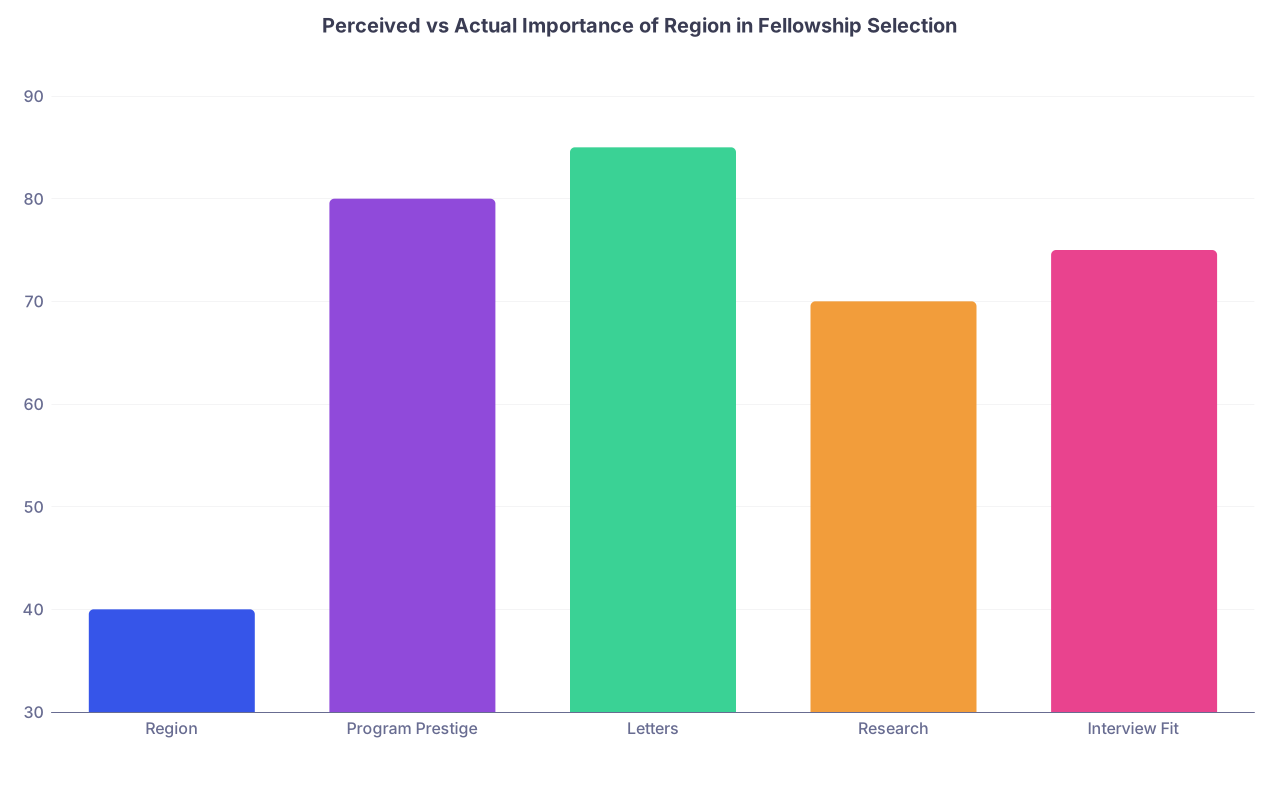
| Category | Value |
|---|---|
| Region | 40 |
| Program Prestige | 80 |
| Letters | 85 |
| Research | 70 |
| Interview Fit | 75 |
Myth 1: “If I don’t train in the Northeast or West Coast, I’ll never match into a top fellowship.”
Reality: I’ve watched people from strong Midwestern, Southern, and Mountain region programs match into MGH, UCSF, Penn, etc. They had serious research, big-time letters, and a coherent application.
Myth 2: “Community programs can’t place into competitive fellowships.”
Reality: Some can and do, if they have:
- Strong subspecialty faculty
- Active research
- A track record of successful grads
It’s not the word “community” that kills you. It’s the lack of scholarly output and networks.
Myth 3: “PDs are biased against my region.”
Reality: PDs are biased toward what and whom they know. Regions just cluster their prior experiences.
Myth 4: “I have to do a second residency or prelim year in a new region to have a shot there.”
Reality: Overkill 99% of the time. Use rotations, conferences, networking, and research collaborations instead.
Practical Checklist: How Much Will Region Matter For You?
Ask yourself these questions:
Is my residency program:
- Nationally known?
- Regionally well respected?
- Unknown outside my area?
Do faculty in my program have:
- Prior training or jobs at my target region institutions?
- Regular publications or conference activity with those regions?
Can I clearly explain:
- Why I want to be in X region?
- Whether I plan to stay there long-term?
Have prior residents from my program:
- Matched into that region before?
- In my target specialty?
If you’re “unknown program, few networks, dramatic region jump, no clear story”—region will hurt you. If you’re “solid program, good mentors, clear ties, and a focused narrative”—region becomes a smaller variable.
FAQ: Regional Training and Fellowship Directors (6 Questions)
1. Will training in a “non-coastal” region hurt my chances at top coastal fellowships?
Not by itself. What matters more is your program’s strength, your research output, and your letters. Many top coastal fellowships regularly take candidates from the Midwest, South, and Mountain regions. Your job is to make your application so strong they’re willing to reach across geography—and to use mentors and conferences to build some coastal connections.
2. Do fellowship directors prefer applicants from their own region?
They often have a comfort preference for applicants from their own or neighboring regions because they know those programs and people better. But it’s not a formal policy. Internal residents, regional feeder programs, and known institutions get an easier first look; strong external candidates can absolutely still break in.
3. Is it easier to stay in the same region for fellowship than to move?
Yes, usually. Staying in-region means your program is familiar, your faculty may already know local PDs, and there’s an existing track record of residents going into those fellowships. Moving regions just means you need more intentional networking, clearer explanation of your geographic choices, and stronger application components.
4. If my residency is in a weaker program but in a “good” region, does that help?
Not as much as people hope. A mediocre or low-exposure program in a popular region doesn’t magically outperform a strong, academically rigorous program in a less trendy region. When PDs compare two applicants side by side, the stronger program and letters usually win over geographic cachet.
5. How can I signal real interest in a different region without sounding fake?
Tie it to specifics: family/partner ties, prior living or training there, understanding of local patient populations, clear long-term career plans in that region, or meaningful prior experiences (e.g., undergrad, military service, public health work). Avoid generic lines like “I like the culture and lifestyle.” That sounds like tourism, not a career plan.
6. Should I pick my residency based on where I want to do fellowship regionally?
If you already know your dream region and field, it’s reasonable to slightly favor residencies that are strong in that region and specialty. But don’t sacrifice overall training quality just to be in the “right” region. Strong training, strong mentorship, and strong scholarly work will carry you farther than a strategically chosen zip code.
Key takeaways: Fellowship directors don’t care about “region” as a label; they care about program quality, networks, and whether your geographic story makes sense. You can absolutely move regions for fellowship—but you’ll need a stronger, more intentional application and some deliberate networking to do it.