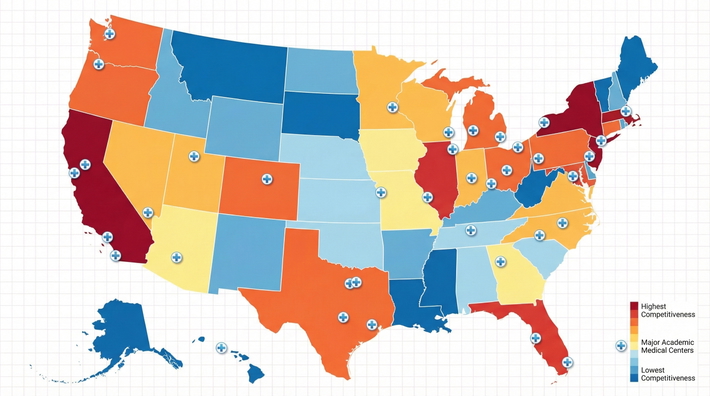
Last winter, I watched a program director at a mid-sized community hospital in Indiana scroll through ERAS on a large monitor. He glanced at Step scores for maybe three seconds, then said, “Okay, now let’s see who might actually stay here and not hate their life.” The student shadowing him looked stunned—he’d been told Step was everything. It isn’t. Not in the Midwest community world.
You’ve heard the official lines. “We review applications holistically.” “We value you as a whole person.” That’s the brochure version. Let me walk you through what actually happens in those small conference rooms when the doors close and Midwest community PDs start building their rank lists.
The Quiet Reality: Step Scores Are a Filter, Not the Decision
In most Midwest community programs—think 4–12 residents per year, non-university hospitals in places like Fort Wayne, Peoria, Green Bay, Sioux Falls—Step scores are a gate, not a finish line.
Here’s what PDs really do:
They set a soft floor. Then they stop caring much once you’re clearly above it.
I’ve watched this at community internal medicine and family med programs in Ohio and Wisconsin, and at a community EM program affiliated with a state school in Iowa. The conversation goes like this:
“What’s our cutoff this year?”
“Step 2 below 215? Just screen them out unless there’s a compelling story.”
Once you clear that bar, the score gets demoted. A 248 isn’t meaningfully better than a 232 to them if they think you might actually fit and stay.
To give you a sense of how they think:
| Program Type | Common Step 2 Floor | Above Which Score Barely Matters |
|---|---|---|
| Community FM | 205–210 | ~225 |
| Community IM | 210–215 | ~230 |
| Community EM | 220–225 | ~240 |
| Community Psych | 210–215 | ~230 |
| Community Surgery (small) | 220–225 | ~240 |
Do some programs aim higher? Sure. The community program that’s basically a de facto university affiliate in a metro area may care more.
But the myth you’ve been fed—that every point on your Step exam is destiny—is not how rank meetings sound. Once you pass their “we won’t get in trouble with GME for this score” threshold, the PDs flip to what they actually care about.
What They Privately Value More Than Step Scores
1. Likelihood You’ll Stay in the Region
This is number one. And they rarely say it plainly on the website.
Midwest community programs are terrified of being viewed as “backup” or “stepping stone” programs. They don’t want to train you for three years just to watch you sprint back to the coasts and tell everyone you “survived the Midwest.”
I sat in on a rank meeting at a community IM program in central Illinois. The PD pulled up two applicants:
- Applicant A: Step 2 = 252, top 30 med school, no ties to the Midwest, all rotations on the coasts, personal statement about “exploring different regions.”
- Applicant B: Step 2 = 231, DO from Michigan, grew up in rural Indiana, did a sub-I at the program, fiancé’s family in the next town.
The PD’s comment:
“We’ll be a three-year layover for A. B is here for life.”
B got ranked high. A slid down so far he might as well not have interviewed.
They look for:
- Midwest roots (grew up, college, med school, family here)
- Partner/family job or family support nearby
- Prior time spent happily in smaller towns, not just big cities
- Sub-Is or away rotations in similar community settings
They ask “So what brings you to [City]?” on interview day not as a nicety. They’re probing your long-term intent.
And yes, they absolutely say things behind closed doors like:
“Another California kid saying they ‘love the seasons’ … pass.”
2. Evidence You’ll Function Without a Giant Safety Net
Community hospitals don’t have endless consult services, overnight in-house specialty coverage, or a swarm of subspecialty fellows. That’s the whole point. They need residents who can handle that.
At a community EM program in Minnesota, I heard the PD say about one applicant with a stellar score:
“Brilliant kid. But he’s only trained at ivory tower places where the fellow does everything. I’m not sure he realizes at 2 a.m. here he is the show.”
They prize:
- Rotations at community hospitals, especially where documentation or letters say “independent,” “took ownership,” “great under limited supervision”
- Clear comfort with procedural work, not just “shadowed”
- Letters talking about your decision-making, not just your knowledge base
- Examples of you managing volume, not just “interesting zebras”
If your whole application screams “all I’ve ever known is a quaternary care center with 14 layers of backup,” they question your ability to adapt.
3. Work Ethic Signals They Can Trust
You’ll never hear this on a panel, but in PD meetings, the phrases that move the needle are things like:
- “Hardest-working student I’ve seen in 5 years”
- “Shows up early, leaves late, doesn’t complain”
- “The nurses loved them”
I sat with a PD in a Missouri community FM program flipping through an LOR from a rural preceptor. The letter wasn’t beautifully written. But it had this line:
“He never once checked the time to see if clinic was over. He stayed until every patient was done, even when I offered to cut him loose.”
The PD said, “That’s worth 10 extra Step points to me.”
They scan for:
- Consistent clinical comments about reliability
- No pattern of professionalism dings, even subtle ones
- Solid or improving clerkship grades, especially in “workhorse” rotations (IM, surgery, FM)
- No hint of “does the minimum” or “prefers academic work to patient care”
You won’t see “grind factor” on any rubric. But every community PD is tracking it mentally.
4. How Much the Nurses and Staff Will Hate or Love You
This one’s rarely discussed publicly, but it’s brutally real.
At multiple community programs, I’ve watched PDs pause after the interview day and ask the coordinator or nurse manager:
“So… who do you never want to work with again?”
If your Step is 260 and the unit secretary says, “He didn’t say thank you once,” you’re done.
One PD at a Wisconsin community hospital had a hard rule: if two or more nurses independently disliked a candidate, that candidate was moved to the bottom third of the rank list, no matter the CV.
They pick up on:
- How you behave on interview day with staff—coordinators, residents, nurses, techs—not just faculty
- Words in letters like “kind,” “respectful,” “team player,” “humble”
- Subtle attitude tells: eye contact, body language when speaking to non-physicians
If you treat staff like background furniture on interview day, those impressions absolutely make it to the PD.
5. Genuine Interest in Community Medicine, Not Just “Medicine”
There’s a pattern PDs are tired of: students using “community” as a euphemism for “backup.” They can smell it.
At a community psych program in Indiana, one applicant gave a very polished answer about their “interest in patient-centered care.” The PD’s comment afterward:
“That’s generic. I didn’t hear a single thing suggesting they understand what it means to treat the same family for years in a town of 40,000.”
Applicants who win them over tend to:
- Talk concretely about continuity, multi-generational care, longitudinal relationships
- Mention liking the idea of being “the” doctor in a community, not one of hundreds
- Express comfort with limited resources and MacGyver-style medicine at times
- Bring up experiences in FQHCs, rural clinics, or safety-net settings with specifics
If your entire personal statement reads like it was meant for a highly academic program and you swapped the word “academic” for “community” once, they notice.
6. Red Flags Hidden in Your Application Story
Here’s the part nobody likes to talk about: PDs are scanning your file like radiologists looking for pathology. Not just for greatness, but for risk.
And a Step score doesn’t move the needle on this nearly as much as you think.
Common “hidden” red flags that matter more than scores:
- Multiple unexplained LOAs or gaps
- A pattern of failed or marginal clinical rotations, even with good scores
- Repeated comments about “difficulty with feedback” or “rigid” personality
- Angry or defensive tone in your explanation of struggles
I watched a review at an Ohio community IM program where an applicant had a 245 Step 2 but had a professionalism remediation in M3. The PD said:
“I can fix knowledge. I cannot fix attitude. Hard pass.”
If you’ve got bumps, the way you own them and what you’ve done since carries far more weight than some extra Step points.

How Rank Meetings Actually Sound
Let me pull back the curtain on a real-style composite rank meeting for a Midwest community IM program. This is closer to reality than anything you’ve heard on a podcast.
The committee sits around a table with a spreadsheet projected. Columns: Name, Step 2, School, Region, Interview Score, Faculty Comments, Nurse/Staff Comments, “Fit” score.
They pull up two candidates:
Candidate X
- Step 2: 246
- MD, East Coast private school
- No Midwest ties, from NYC, partner in finance in Boston
- Excellent research, 2 publications
- Interview comments: “Very sharp, seemed a bit lukewarm on our city,” “Wants cards for sure”
- Staff comments: “Polite but checked phone a lot between sessions”
Candidate Y
- Step 2: 229
- DO from Michigan
- Grew up in rural Iowa, parents still there
- No research, but strong evals from community rotations
- Interview comments: “Understated, very genuine, seems committed to primary care in Midwest,” “Asked smart questions about rural rotations”
- Staff comments: “Super friendly, helped move chairs after lunch”
The discussion goes like this:
- APD: “X is academically stronger, obviously.”
- PD: “But X is gone after three years. Y might be faculty here in five.”
- Chief: “Residents really liked Y. We need steady workhorses, not just brains.”
- PD: “Rank Y above X.”
That’s the calculus. Sustainability of the program. Culture. Who will carry the beeper at 2 a.m. without drama.
To visualize what actually moves the rank:
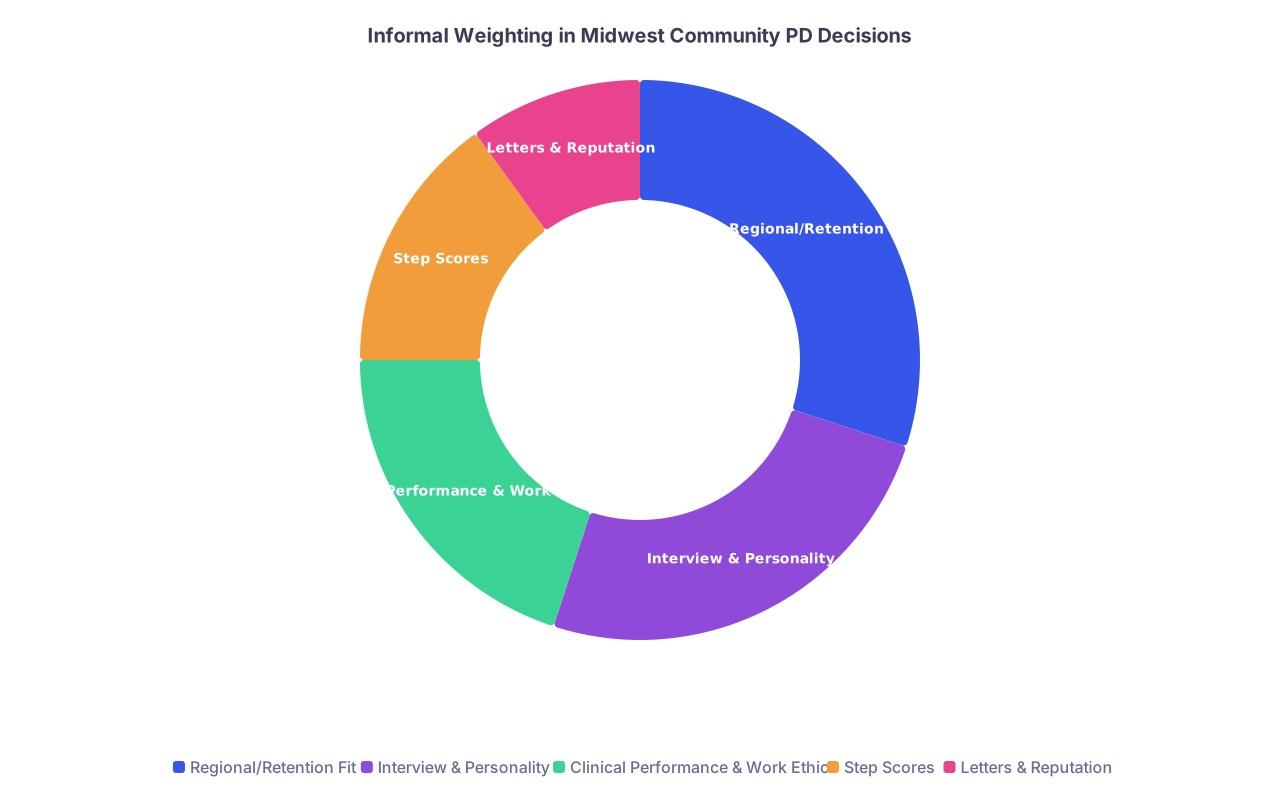
| Category | Value |
|---|---|
| Regional/Retention Fit | 30 |
| Interview & Personality | 25 |
| Clinical Performance & Work Ethic | 20 |
| Step Scores | 15 |
| Letters & Reputation | 10 |
No, they don’t put these numbers on paper. But you sit through enough rank meetings, you start to see the pattern.
How to Signal What PDs Really Want (Even If Your Step Is Average)
Step scores are frozen. The rest isn’t. You can still play the game strategically.
Make Your Midwest Story Obvious and Loud
Do not assume they’ll connect subtle dots. Spell it out.
- In your personal statement: explicitly mention why this region, why community care, and how it connects to your life.
- In your ERAS geographic preferences: don’t game it. If you want the Midwest, say it. Programs do look.
- In your interview answers: tie your future to the region concretely—family, partner’s job, cost of living, lifestyle, long-term goals.
The applicant who says, “Honestly, I see myself in a place just like this in 10 years, maybe even on your teaching faculty,” backed by some credible life story, gets remembered.
Stack Your Application With Community-Relevant Experiences
If your background is all big academic centers, you need to show you won’t melt down outside that bubble.
Find or highlight:
- Community hospital rotations
- Rural or semi-rural outpatient clinics
- FQHCs or VA experiences with real responsibility
- Continuity clinics where you saw the same patients repeatedly
Then talk about those specific stories in essays and interviews. Not in a dreamy, cliché way. In a grounded, “this is how it changed the way I think about being a doctor” way.

| Step | Description |
|---|---|
| Step 1 | Know your Step score |
| Step 2 | Apply more broadly or consider prelim |
| Step 3 | Clarify Midwest ties |
| Step 4 | Highlight regional story in PS |
| Step 5 | Target community rotations |
| Step 6 | Get letters from community faculty |
| Step 7 | Signal strong geographic preference |
| Step 8 | Interview - emphasize staying power |
| Step 9 | Above program floor |
Give Them Proof of Work Ethic and Humility
You can say you’re hard-working and humble. No one believes that on its own. They believe:
- LORs that tell specific stories of you staying late, taking extra patients, helping the team
- Comments like “never complained,” “always volunteered,” “residents relied on her”
- How you treat people on interview day when you think no one important is watching
One trick I’ve seen work: during the interview day, when there’s that awkward lull where lunch ends and people are packing up, help. Pick up plates, move chairs, thank the staff. Not performatively, just like a normal adult who notices work needs to be done.
Multiple coordinators have told PDs, “She was the only one who helped clean up.” That got written down.
Don’t Hide Your Bumps—Shape Them
If you’ve got a mediocre Step, marginal preclinical grades, or a leave of absence, PDs are gauging whether you’re going to unravel under pressure.
The worst thing you can do is dodge or get defensive. The best:
- Own it succinctly.
- Give a concrete, believable reason.
- Show what changed.
- Connect it to why you’ll be stable and reliable now.
I heard a PD in a Kansas community program say about an applicant with a Step 1 fail:
“His explanation was honest. He took a hit, fixed it, and his clerkship performance is rock solid. I trust that more than someone with a 250 and no adversity.”
They’re not looking for perfection. They’re looking for safe, steady, functional residents.

The Future: Why This Will Matter Even More
With Step 1 now pass/fail and Step 2 slowly losing its fetish status, Midwest community programs are being pushed even further toward what they already valued: behavior, reliability, retention.
Two trends are quietly shaping their priorities:
1. Physician Retention Crisis in Non-Metro Midwest
Hospitals in smaller Midwest cities and towns are getting crushed by churn. They train residents who then disappear to coastal cities or large metros. Local administrators are pressuring PDs hard:
“Stop matching people who leave. We need docs who will stay.”
That pressure filters down. The PD who keeps filling their program with “flight risks” eventually loses political capital. Sometimes their job.
So your “I might want to eventually move back to California” line? That’s not neutral. That’s a liability in their world.
2. Increased Scrutiny on Resident Performance and Wellness
Community programs don’t have layers of remediation committees and backup services. A struggling resident hits them harder. One intern who can’t function safely can jeopardize the entire program’s reputation with GME and the ACGME.
That’s why the obsession with soft signals:
- Can you handle volume without imploding?
- Do you seek help appropriately—not too late, not every five seconds?
- Are you emotionally stable enough for community practice, where you’ll be less insulated?
Step scores don’t answer those questions. Your letters, your story, your behavior do.
, Interview Impression](https://cdn.residencyadvisor.com/images/articles_svg/chart-shift-in-evaluation-focus-post-step-1-pass-fail-5608.svg "Shift in Evaluation Focus Post Step 1 Pass/Fail")
| Category | Value |
|---|---|
| Step Scores | 20 |
| Clinical Evaluations | 30 |
| [Geographic Fit](https://residencyadvisor.com/resources/regional-residency-guides/red-flag-errors-applicants-make-with-geographic-fit-in-the-midwest) | 25 |
| Interview Impression | 25 |
Programs are sliding away from single-score obsession toward “Will this person make our lives easier or harder for three years—and maybe beyond?”
Midwest community PDs were already there before everyone else.

If You Remember Nothing Else
Three points.
First, in Midwest community programs, your Step score just needs to clear their safety floor. After that, they care far more about whether you will show up, work hard, and not implode when you do not have an army of subspecialists behind you.
Second, they are quietly obsessed with retention and fit—regional ties, community orientation, and whether you’ll stick around the Midwest when the ink dries on your diploma.
Third, every interaction you have—with staff, residents, coordinators, not just faculty—is being mentally tallied as a proxy for “Can I trust this person at 3 a.m. on a Sunday in our hospital?”
Play to those priorities, and you’ll outperform applicants with prettier numbers who never realized they were being evaluated on a different scale.