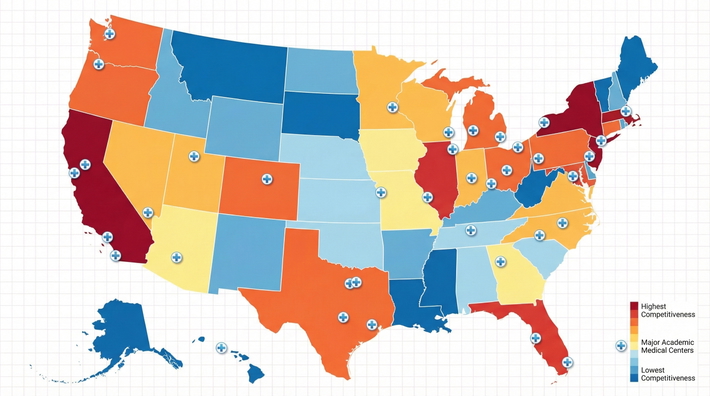
The worst way to choose a residency region is to pretend your religious or cultural needs won’t matter for “just a few years.”
They will. They always do.
I’ve watched people try to tough it out in regions where they had no community, no place to worship, no familiar food, constant microaggressions, and call schedules that made observance impossible. By PGY‑2 they weren’t just tired; they were quietly miserable and sometimes seriously thinking about quitting medicine altogether.
You do not want to be that story.
If you’re someone for whom faith, religious practice, or cultural community actually matters (and if you’re reading this, you probably are), you have to treat “regional fit” as a core part of your residency strategy, not a side note.
Let’s walk through how to do this like an adult who knows what’s coming, not a wide‑eyed applicant hoping it will all magically work out.
Step 1: Get Honest About What You Actually Need
Before you look at maps or program lists, you need brutal clarity on what’s non‑negotiable and what’s just “nice to have.”
Ask yourself very specifically:
- Do I need weekly in‑person worship or is virtual fine during heavy rotations?
- Do I need halal/kosher/vegetarian food easily accessible near the hospital or at least near home?
- Do I fast (Ramadan, Yom Kippur, certain days) and will I realistically keep doing that on call?
- Are there any holidays I will not work unless absolutely life‑or‑death?
- Do I wear specific religious clothing (hijab, turban, kippah, kirpan, etc.) that might cause friction in certain regions or institutions?
- Do I need a sizable cultural or language community (e.g., South Asian, Arab, Hispanic/Latino, East African, Orthodox Jewish, LDS, etc.) to feel grounded?
- How much overt or subtle discrimination can I realistically tolerate before it starts affecting my mental health?
You’re not writing a manifesto. You’re drawing a line.
Turn this into three buckets:
Non‑negotiable essentials
Example: “Must have at least one mosque/synagogue/temple/church of my denomination within a 30–40 minute drive” or “Must be allowed to wear my hijab and beard without a fight.”Strong preferences
Example: “I’d really like a visible South Asian community and access to familiar grocery stores within the city.”Flexibles
Example: “In an ideal world, I’d get Eid off, but I could live with switching calls or working nights if I can pray and celebrate after.”
Write these down. If they stay in your head, they’ll get fuzzy and you’ll rationalize anything when that “prestige” program emails an interview.
Step 2: Understand How Regions Actually Differ
Contrary to what some people pretend, the U.S. is not a uniform place culturally or religiously. A residency in Brooklyn is not the same life as a residency in rural Midwest, even with the same specialty.
Here’s a rough, honest snapshot:
| Region | Diversity Level | Religious Visibility | Cultural Resources |
|---|---|---|---|
| Northeast major cities | Very High | Mixed | Extensive |
| West Coast metros | Very High | Generally Secular | Extensive |
| Midwest large cities | Moderate–High | Christian-majority | Good |
| South large cities | High | Very Christian | Good–Excellent |
| Rural anywhere | Low–Moderate | Christian-majority | Limited |
This is blunt and generalized, but that’s the point. You’re deciding where to spend the most demanding 3–7 years of your life. You need to know, in broad strokes, what you’re stepping into.
Megacities and large metros
Think New York, Chicago, LA, Houston, Atlanta, DC.
Pros:
- Multiple houses of worship of every major faith.
- Ethnic grocery stores, restaurants, cultural centers.
- Easier to find co‑residents or attendings with your background.
- People are used to diversity. Your headscarf, turban, or accent is not the event of the day.
Cons:
- Expensive. That matters when tithes, offerings, or religious school tuition are part of your life.
- Commutes can be brutal, which can make attending services harder.
- Some programs are very “work comes first, everything else is your problem” in practice, despite glossy diversity statements.
Mid‑size cities and college towns
Places like Madison, Ann Arbor, Raleigh‑Durham, Salt Lake City, Kansas City, Pittsburgh.
Pros:
- Often one or two mosques/synagogues/temples/churches that become tight communities.
- Cost of living is saner.
- Hospital often the main employer, so policies are more standardized and HR more visible.
Cons:
- You might be “the first” person of your background in that program or department.
- Religious/cultural accommodation may be ad hoc instead of established.
- Social life can feel narrow if you’re used to big‑city cultural variety.
Rural or strongly homogeneous regions
Smaller towns, some parts of the South/Midwest/West.
Pros:
- Tight‑knit community can be very supportive if they accept you.
- Lower cost of living, easier to live close to the hospital.
Cons:
- Your house of worship might be an hour away. Or not exist locally.
- People may be well‑meaning but ignorant, leading to constant explanations about your practices.
- Real risk of isolation if you’re visibly different or non‑Christian in heavily religious areas.
Step 3: Do the Background Research Before You Love a Program
Most applicants do this backward. They fall in love with a name, a reputation, a vibe on interview day, and only later realize: “There’s no synagogue within an hour. The nearest halal grocery is three counties away. Great.”
Fix that.
Concrete research steps
Open Google Maps.
Search the hospital’s address, then:- “mosque,” “masjid”
- “synagogue”
- “church” + your denomination
- “temple,” “gurdwara,” “Buddhist temple,” etc.
- “halal grocery,” “kosher grocery,” “South Asian grocery,” “Middle Eastern grocery,” “Latin market,” etc.
Check population data.
Look up the city on Wikipedia or a census snapshot. Not perfect, but you’ll get a sense: is this 3% vs 30% of your group?Stalk resident bios and photos.
Program websites, Instagram, department pages. Do you see anyone who even remotely looks, dresses, or has a name like yours? Not essential, but very informative.Search “[Hospital name] religious accommodation,” “[Hospital name] chaplaincy services,” “pastoral care.”
You want to see if they already deal with diverse religious needs or if their chaplaincy page is “we have a chapel and a Christian chaplain.”Look up the local cultural scene.
“Islamic center of ___,” “Jewish community center ___,” “Indian association of ___,” “Arab American center ___,” etc.
If a place scores zero across almost all of this and you have strong needs, you should be ruthless: either cross it off or treat it as a long‑shot option, not a top rank.
Step 4: Use Interview Days to Test Reality, Not Just Smile
On interview day, everyone’s polished. DEI slides. Stock photos of diversity. Whatever.
Your job is to cut through it.
Questions to ask residents (informally, in breakout rooms or social events)
Pick 2–3 that fit your situation. Do not ask all of these like a checklist:
- “How does the program handle scheduling around major religious holidays?”
- “Are there residents who fast during Ramadan / observe strict fasting days? How have they made that work?”
- “Is there a chaplain or spiritual care team that actually visits residents and staff, or just for patients?”
- “How flexible are they about swapping call for religious reasons? Is that culturally accepted or do people roll their eyes?”
- “Do you feel comfortable wearing religious clothing or jewelry at work here?”
- “What’s the broader city like for [Muslim/Jewish/Hindu/Sikh/Orthodox Christian/etc.] life?”
You’re not fishing for perfection. You’re listening for tone.
If a resident says, “Honestly, it’s not built into the system, but we swap among ourselves and people are good about it,” that’s workable.
If they say, “We’ve never really had anyone who needed that,” or they look nervous before answering, that’s a yellow flag.
Step 5: Evaluate Call Schedules Against Your Practice
This is where people get blindsided. On paper, every program “respects diversity.” On the schedule, you’re on 28‑hour call every other weekend including your major holiday. Year after year.
You have to mentally plug your religious life into a PGY schedule.
Things to check and explicitly ask about
- Are you required to work certain holidays (Christmas, Easter, national holidays) and are non‑Christian holidays treated any differently?
- How is the holiday call schedule made? Is there a formal request system or just informal swaps?
- Are there rules on protected time on certain days (e.g., Friday evenings, Saturday, Sunday mornings)?
- Do they have Muslim, Jewish, or Hindu residents currently? Ask how those residents manage.
- Are religious requests filtered through program leadership or left to residents to hash out among themselves?
| Category | Value |
|---|---|
| Mandatory Holidays | 70 |
| Negotiable Holidays | 20 |
| Resident Swaps | 10 |
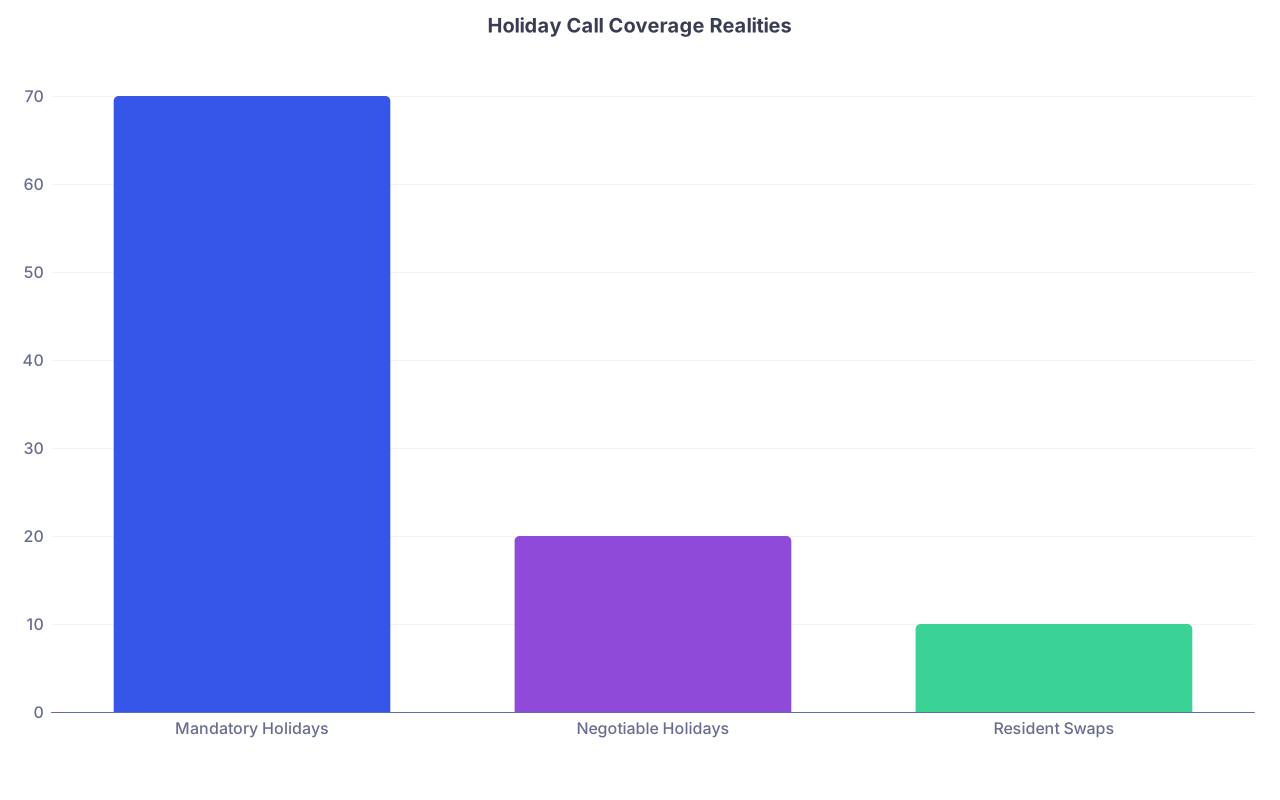
Interpretation: In most programs, the majority of holiday coverage is essentially “mandatory” in the sense that someone will cover it and leadership expects equal distribution; only a smaller slice is formally negotiable. Actual accommodations often happen through resident‑to‑resident swaps, not policy.
If fasting is a big deal for you, ask:
- “Have residents been permitted to adjust call or shift timing during Ramadan / major fast days?”
- “Are there spaces to pray near the wards that are actually accessible during busy days, or is the only quiet space in the basement on the other side of the hospital?”
You’re not asking for guarantees. You’re looking for seriousness and precedent.
Step 6: Weigh Safety and Bias Like a Grown‑up
You’ll never see this written on a program website, but you know it’s real: some regions carry higher day‑to‑day risk of harassment or bias for certain groups.
If you’re visibly Muslim, Black, Jewish, Sikh, or part of any routinely targeted minority, you can’t ignore that just because the faculty were nice on Zoom.
Concrete ways to assess:
- Search “[city name] hate crimes statistics,” “FBI hate crime [state],” “Islamophobia [city], antisemitism [city],” “racist incidents [hospital name].”
- Look for news about the academic center itself: lawsuits for discrimination, settlements, high‑profile cases. One incident isn’t definitive. A pattern matters.
- Ask residents quietly: “Have you personally felt safe here, both in the hospital and in town, as someone who is [your identity] or close to people who are?”
If you’re LGBTQ+ and religious, double complexity. Some regions are very religious and anti‑LGBTQ+. Some are secular but not supportive of religion. You’re choosing which stressor you’re more willing to live with and which community you can actually find.
Step 7: Think About Family, Kids, and Long‑Game Culture
If you’re married, engaged, have kids, or want them soon, your religious/cultural environment suddenly matters twice as much.
Questions to think through:
- Will my spouse find community, work, and safety here?
- Are there religious schools or at least weekend religious education options for kids?
- Are there playgrounds/parks where we won’t stand out like aliens?
- Does the hospital have any support for spouses/families from similar backgrounds?

Residency is temporary, but connections you build in those years often anchor where you end up long‑term. Training in an area where your community thrives can set you up for jobs and networks that match your life, not just your CV.
Step 8: Decide How Much You’re Willing to Trade for Prestige
Here’s the ugly, practical tension: a top‑tier program in a culturally lonely region vs. a solid program in a place where your religious and cultural life will flourish.
You cannot outsource this choice to rankings.
Be explicit with yourself:
- Would you rather be at a “brand name” institution and struggle quietly with isolation, working through your highest holy days, and explaining your diet to every single attending for 3–7 years?
- Or at a mid‑tier institution where you have a mosque/temple/synagogue/church you love, neighbors who share your holidays, and kids who see other families like theirs?
There’s no universally correct answer. But pretending the trade‑off doesn’t exist is childish.
I’ve seen residents leave “elite” programs for geographic and cultural reasons, then bloom academically and personally in less famous programs. I’ve also seen people choose prestige, grind it out, and be fine—but that usually required a strong internal anchor and/or a supportive family setup.
Step 9: Tactics If You End Up in a Less‑Than‑Ideal Region
Sometimes you do not match where you want. Or your partner’s match dictates the city. Or visas limit your options.
If you land in a place that’s not great for your religious or cultural needs, you’re not powerless. But you have to be intentional.
Build micro‑routines
- Schedule one weekly protected religious/cultural activity, even if small: online study group, Zoom religious service, WhatsApp family prayer circle.
- Plan your grocery/restocking trips so your food practices don’t collapse from simple exhaustion.
- Create a tiny sacred space at home—prayer corner, meditation nook, candle setup. Sounds corny. It helps.
Find the one local anchor
- One mosque/temple/church/synagogue, even 45 minutes away, that you commit to visiting on some off‑weekends.
- One cultural grocery or restaurant you visit monthly.
- One other resident/staff member who “gets it” that you regularly check in with.
Use institutional levers
- Talk to GME, HR, or DEI early about religious accommodation processes. You want them aware before there’s a conflict.
- Ask chaplaincy if they know local religious leaders or groups that support staff, not just patients.
- If you face bias, document it immediately. Facts, dates, names. Not drama, not vague impressions.

| Step | Description |
|---|---|
| Step 1 | Matched in challenging region |
| Step 2 | Identify local worship options |
| Step 3 | Contact GME about accommodations |
| Step 4 | Connect with chaplaincy |
| Step 5 | Find one community anchor |
| Step 6 | Build weekly spiritual routine |
| Step 7 | Monitor wellbeing and adjust |
Step 10: Bring This Into Your Rank List Deliberately
When you’re building your rank list, do not just sort by “gut feel” or reputation. Force yourself to compare programs on religious/cultural fit side by side.
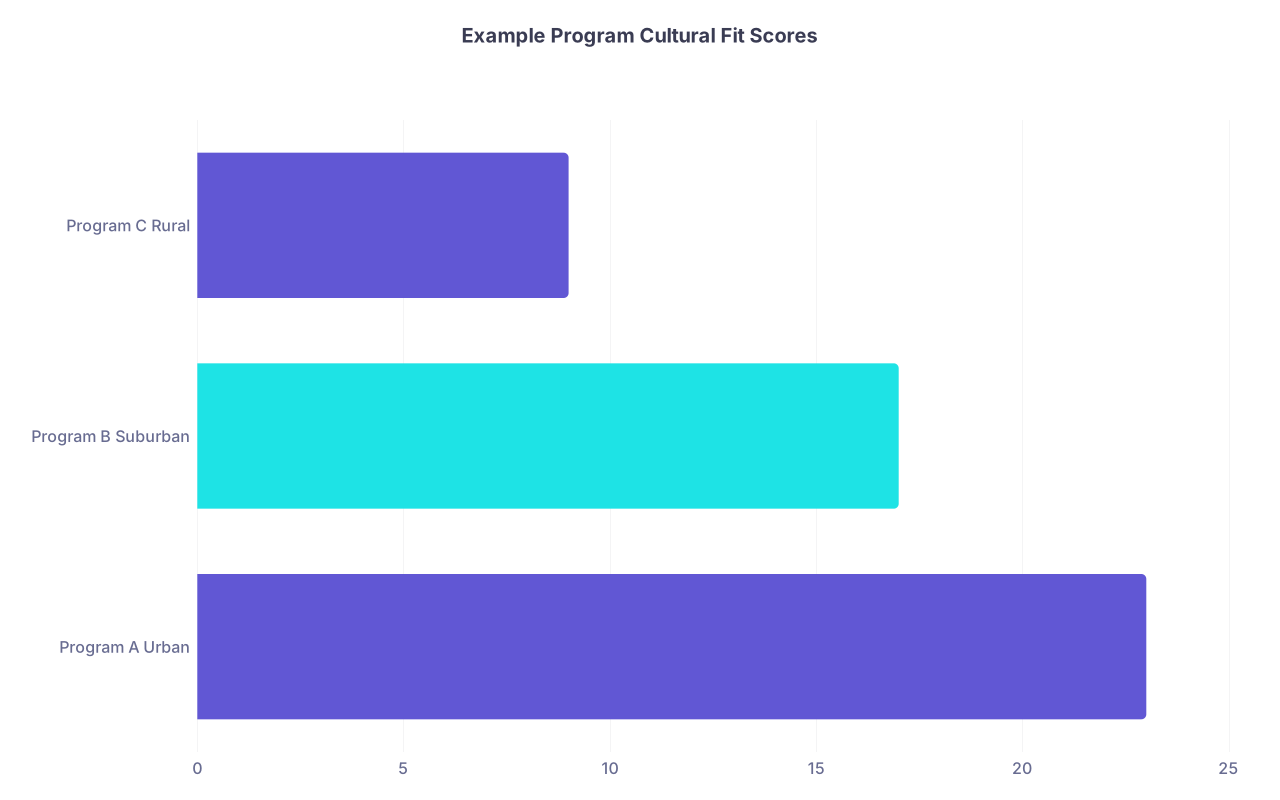
Create a simple grid for your top 8–10 programs. Score from 1–5:
- Access to worship spaces (distance, options)
- Cultural community presence
- Food compatibility (halal, kosher, vegetarian, etc.)
- Program openness to accommodations
- Personal safety/comfort in region
Then look at how those scores line up with program quality, training fit, and your career goals.
| Category | Value |
|---|---|
| Program A Urban | 23 |
| Program B Suburban | 17 |
| Program C Rural | 9 |
If your top ranked “name brand” program has a cultural fit score of 6 and your second‑tier but still solid program has a 22, you need to stare at that and ask: am I really okay with this for the next several years?
Quick Reality Checks by Situation
A few concrete scenarios and what I’d tell you in each:
You’re a devout Muslim applicant
You wear hijab or have a visible beard, you fast in Ramadan, you want at least occasional Jumu’ah in person.
- Strongly favor large metro areas with established Muslim communities: NYC, Chicago, Houston, Dallas, Detroit, LA, DC, Atlanta.
- During interviews, explicitly ask if they’ve had Muslim residents recently and how Ramadan scheduling worked.
- If a program is in a rural or heavily non‑Muslim area, downgrade it unless the training is absolutely unique for your goals.
You’re an observant Jew needing Shabbat and Yom Tov considerations
- Look for eruv maps, synagogues of your denomination, and walkable neighborhoods close to both shul and hospital if you don’t use transport on Shabbat.
- Ask about home call vs in‑house call on weekends and how residents manage Sabbath observance practically.
- Programs in NYC, New Jersey, Boston, Baltimore, Philly, parts of LA and South Florida are generally more navigable for you than truly rural settings.
You’re Hindu, Sikh, Buddhist, or from a smaller diaspora community
- Major metros are your friend; you want at least one temple or gurdwara nearby.
- Focus on whether there’s any visible South Asian/East Asian or diaspora community in the city, even if not large.
- Understand that some holidays may be less familiar to coordinators; you’ll be doing more explaining and planning ahead.
You’re Christian but in a very secular city
- Your needs may be easier to accommodate formally, but the cultural vibe might feel dismissive of overt religious practice.
- You’ll probably find a wide range of churches; your question is mostly about fit and commute time.
- Watch out for programs with unspoken expectations of constant “optional” social events on Sunday mornings.
FAQs
1. Is it okay to bring up religious needs before I match, or will it hurt my chances?
You can and should bring them up, but strategically. Residents are the safest people to ask detailed questions. With program leadership, keep it general: “How has the program supported residents with specific religious observances or holidays in the past?” You’re evaluating culture, not demanding exceptions on the spot. If a program reacts badly to a basic question, that’s useful data, and honestly, you probably do not want to train there.
2. Can I ask for specific holidays off during residency?
You can request, but you cannot assume. Most programs try to distribute major holidays “fairly,” and they may not treat your holidays as special by default. The practical path: talk early with co‑residents about swapping, submit requests far in advance, and be prepared to work some of your holidays in exchange for colleagues covering others. Formal policies exist in some places, but the real system is often peer‑to‑peer swaps.
3. How much should I let religious and cultural fit affect my rank list compared to program prestige?
If your religious or cultural life is central to who you are, it’s not a minor factor; it’s foundational. I’d put it on the same tier as training quality and career goals. A slightly less prestigious program where you can actually sustain your spiritual and cultural life will usually serve you better than a big‑name program that grinds down your core identity for years. Only choose the tougher environment if you’re very clear‑eyed about the trade‑off and have strong support.
4. What if my family wants one region for cultural reasons but my best programs are elsewhere?
This is where you have to separate desire from reality and be blunt with everyone involved. Map out: training quality, fellowship opportunities, visa/job realities, plus religious/cultural environment for both options. Then have an adult conversation: “Here’s what I gain and lose if I prioritize being near family/community vs. training at X program.” There’s no universal right answer, but pretending the conflict doesn’t exist leads to resentment later.
5. I matched into a region with almost no community for me. Is it worth trying to transfer programs?
Maybe, but don’t make that your first move. First 6–12 months: build micro‑community, talk to GME about formal accommodations, find at least one local religious or cultural anchor, and see if things become tolerable or even surprisingly okay. If, after that, you’re still miserable, your mental health is deteriorating, and the program isn’t receptive, then talk to trusted faculty or mentors about the logistics and politics of transferring. It’s possible but delicate—you want a clear, documented pattern, not just “I don’t like it here.”
Bottom line:
- Treat religious and cultural fit as a core residency decision factor, not an afterthought.
- Do real, specific homework on regions and programs before you fall in love with any name.
- On interview days, test reality—ask residents how things actually work, and listen closely to what they do not say.