The residency move will break your kid’s routine. Pretending it will not is how families end up with panicked school nights and tears in the parking lot.
You can absolutely do this, but you cannot wing it. The system is not set up for resident families; you’re going to have to drive this yourself.
Here’s how to manage kids and schooling when you’re moving to a new residency region—step by step, in the order I’d actually do it.
1. Start With Reality: Program First, Kid a Very Close Second
Residency isn’t flexible. Your kid’s school is, comparatively, more flexible than your call schedule.
That means your priorities are:
- Don’t destroy your ability to function at work
- Minimize chaos for your kid
- Optimize everything else (commute, cost, activities) after that
The biggest mistake I see: people choose the “best” school district on paper, then realize they’ve signed up for a 45–60 minute commute each way with Q4 call and no family nearby. By October, everyone is exhausted and brittle.
Think in this order:
- Where is the hospital? (Main site, not the satellite clinic)
- What neighborhoods within 20–30 minutes of the hospital are safe and livable?
- Within those, what school options are workable, not perfect?
That “good enough and sane” mindset will save you.
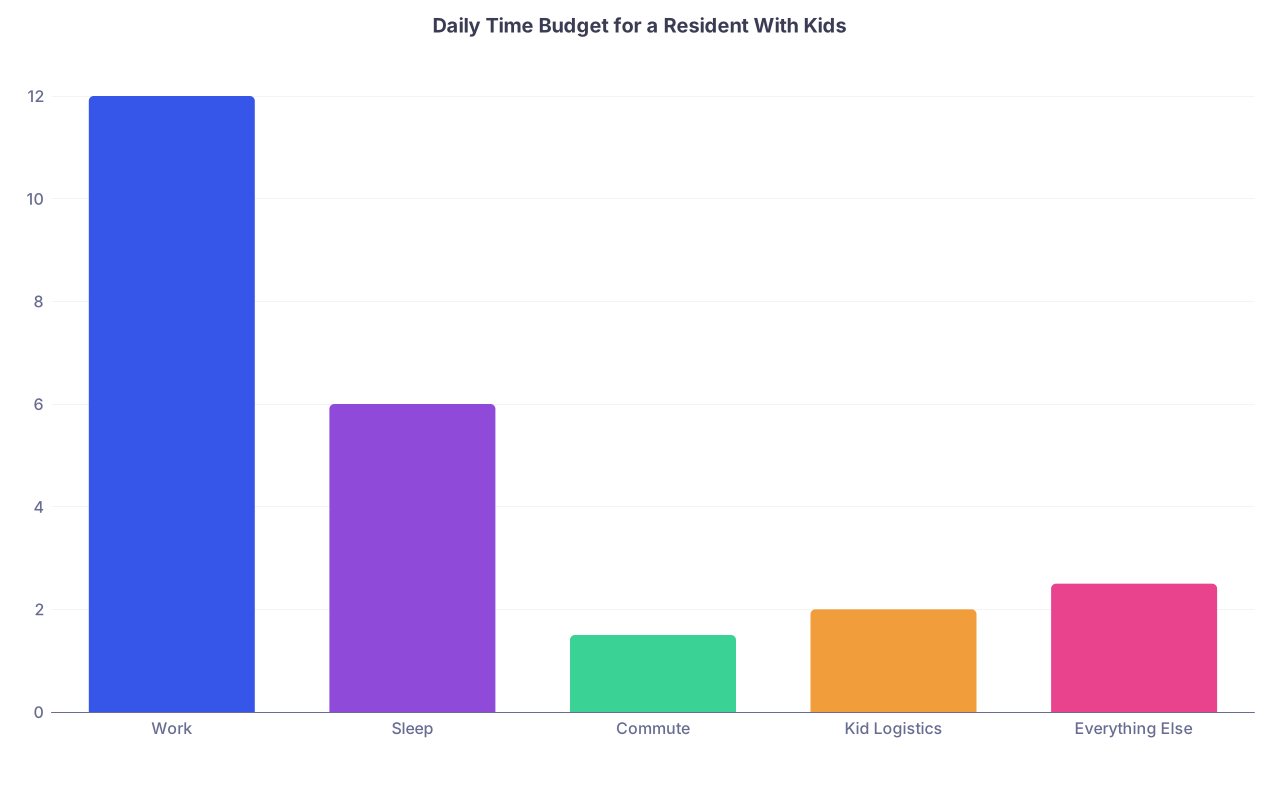
| Category | Value |
|---|---|
| Work | 12 |
| Sleep | 6 |
| Commute | 1.5 |
| Kid Logistics | 2 |
| Everything Else | 2.5 |
Notice what’s tiny: “everything else.” School choices that eat into commute and kid logistics will eat your sanity.
2. Two Parallel Timelines: Match Season vs. School Calendars
The residency calendar and school calendar do not care about each other. You have to bridge them.
Typical pattern:
- Match Day: mid-March
- Lease pressure in competitive areas: April–May
- School registration windows: often Jan–April, with late enrollment possible but messy
- First residency day / orientation: late June–July
- School year: late Aug–Sept start (US), earlier in some regions
What to do as soon as you know your match
Within 72 hours of matching:
- Search “[city] public school enrollment” and bookmark the district’s official site. Ignore random blogs for now.
- Call the central enrollment office. Literally call. Ask:
- “If we’re moving in July with a school-age child, how do we enroll?”
- “Do you assign by address or can we choose schools?”
- “What are the proof-of-residency requirements for families moving from out of state?”
- Ask directly about late movers:
- “If we don’t have a lease until late May/June, are we going to miss anything critical?”
Write down names, dates, and exact requirements. These offices lose emails; they remember phone calls.
And yes—call even if you don’t know where you’re living yet. You’re gathering constraints.
3. Correct Order of Decisions: Hospital → Commute Radius → School Options
Do not do what people on Reddit do: find “best school districts in [state]” and then try to reverse-engineer your life around them.
Here’s the actual workflow that works.
Step 1: Draw your commute circle
Pull up Google Maps.
- Drop a pin at the main hospital.
- Use “Measure distance” roughly or just visually:
- City: target 20–30 minutes during rush hour, not on a Sunday afternoon
- Suburban / smaller city: 30–35 minutes max
Remember: call nights, post-call haze, winter weather if applicable. That “fun neighborhood” that’s 45 minutes away? Absolutely not worth it with kids and 28-hour calls.
Step 2: List school districts / zones inside that circle
Now:
- Identify which school district(s) cover that radius
- In many cities, you’ll have:
- A main city district (sometimes rough, sometimes fine)
- Surrounding suburban districts (often higher-rated but higher rent and longer commute)
- Charter or magnet options scattered in between
Make a short list—3 to 5 options max.
Step 3: Decide type of schooling you’re aiming for
This is where people overcomplicate it. Your realistic menu during residency:
- Neighborhood public school (most common, simplest logistics)
- Magnet/charter public school (sometimes better programs, but may require lotteries and driving)
- Private/parochial school (more control, expensive, often more rigid schedules)
- Homeschool / hybrid (only viable if another adult has flexible work and actually wants this)
For 90% of resident families, the best balance is:
Neighborhood public school in a safe area, within 20–25 minutes of the hospital.
Is it always the top-rated academically? No. Does it give your kid stability and you a survivable commute? Yes. That matters more.
4. Doing Fast, Real School Recon (From a Different State)
School ratings sites (GreatSchools, Niche, etc.) only tell you so much. They’re heavily test-score and demographics driven. You’re not writing a think-piece; you’re deciding whether your kid will be okay there.
Here’s how to get actual signal in about a week.
Use ratings as a filter, not gospel
Quick red flags:
- Consistent 1–3/10 with reviews mentioning safety, fights, or chaotic admin
- Very high turnover in principals/administration if you can find it
- Parent reviews mentioning bullying that gets ignored
But don’t freak out if:
- The school is 5–7/10 in a mixed-income area with okay reviews
- Test scores are low but parents talk about “caring teachers” and “supportive community”
That’s often a school where your kid will do fine, especially if you’re involved at a basic level.
Talk to real humans
Yes, you’re tired. Call anyway:
- Call the school office: ask about class size, aftercare, how they handle new students mid-year
- Ask: “If my child starts in August coming from out of state, what does that usually look like?”
- Email or ask to be connected with:
- PTA/PTO president
- School counselor
People will tell you flat out: “We have a lot of new families, it’s usually smooth,” or “We’re overcrowded and sometimes kids are in portables.”
That’s the kind of thing data sites will never show you.
Use resident + local parenting intel
- Search “[city] moms group Facebook”, “[city] parents group”, “[city] PTA Facebook”
- On the residency side: email chief residents or current residents with kids:
- “We’re moving with a 3rd grader. Where do most residents with kids live? Any schools you’d pick again / avoid?”
You’re looking for patterns, not one crank’s opinion.
5. Documents and Bureaucracy: Start a “School Packet” Now
Every district has slightly different requirements, but they almost all want some version of:
- Birth certificate
- Immunization record (bring a printed copy, not just portal access)
- Previous school records / report cards / standardized test scores
- Proof of residency (lease, utility bill, sometimes both)
- Parent ID
- Sometimes: custody documents, IEP/504 plans, medical forms
Create a digital and physical “School Packet”:
- Scan everything into a single PDF labeled “ChildName_School_Enrollment_[Year]”
- Carry physical copies in a folder during the move
This matters because:
- Your internet might be spotty when you’re trying to upload forms
- School offices close randomly in summer; when they open, you’ll want to be ready to pounce
For special education / accommodations (IEP, 504, gifted services):
- Get copies of the entire plan, recent evaluations, and any specialist letters
- Email the new district’s special education office in advance:
- “We’re moving from [state], my child has an IEP for [services]. What’s the process to maintain services without long gaps?”
If you wait until September, you can lose months of services while they “evaluate.”
6. Synchronizing the Actual Move With School Start
The timing of your move relative to the school year can make things either manageable or sadistic.
Best case
- Move: late June or early July
- Kids: get 6–8 weeks to explore, see their new school from the outside, visit a playground, meet a neighbor
- Parent in residency: you’re starting but not in full-blown winter-scary mode yet
If you can swing visiting the school office in August:
- Drive by the school with your kid while it’s empty
- Walk around the building if allowed
- Show them: entrance, playground, where you’ll drop off/pick up
Simple exposure kills anxiety.
If you have to move right before or after school starts
It happens. This is how you handle it:
- Email the school: “We’re moving from out of state and my work start date is [date]. Is there a way to do as much enrollment as possible electronically before we arrive?”
- Ask if your kid can start a few days after the official first day if your move date is brutal—it’s often fine, and better than throwing them in on day 2 while they’re jet-lagged and exhausted
- Prepare your kid with a simple script:
- “You’re starting a little after everyone else. The teacher knows you’re coming and will help you catch up.”
Do not schedule a big social outing the night before their first day. You and they need sleep more than they need a “fun distraction.”
7. Daily Logistics: The Part Everyone Underestimates
The question is not “Is this a good school?”
The question is “Can our family survive this school’s schedule + my call schedule without disintegrating?”
Here’s what to look at closely:
| Factor | What To Ask / Check |
|---|---|
| Start / end times | Will I ever be home for drop-off/pickup? |
| Aftercare options | Is there on-site, waitlist, or nothing? |
| Transportation | Bus eligibility and stops vs. car commute |
| Distance from home | Actual drive time at 7:30–8:00am |
| School calendar | Half days, breaks, teacher workdays |
Aftercare is not optional for most residents
If both adults work clinical schedules (or you’re solo), plan as if:
- You will not reliably be available before 6 pm
- Calls and late admissions will nuke “I’ll be there by 5:15 some days”
So:
- Ask very bluntly:
- “What time does aftercare run until?”
- “Is there a waitlist? How long?”
- If there’s a waitlist, get on it the day registration opens. Not after you move. Now.
If there’s no aftercare:
- Look at:
- Nearby YMCA / Boys & Girls Club
- Faith-based programs that pick up from school
- Hiring a shared sitter with another resident family (expensive but sometimes the only sane option)
You do not want to be stress-texting co-residents for coverage because the bus was late and your partner is scrubbed into a case.
Transportation: bus vs. car vs. walking
In some cities, buses are limited or only for kids living a certain distance away.
Check:
- “Is my address eligible for a bus?”
- “Where is the bus stop, exactly?” (Corner of two busy roads at 6:45am may be a no-go for a 7-year-old.)
- “How often are buses late and what happens if I’m stuck at work?”
If you’re relying on a car:
- Practice the route at real times
- Identify backup options:
- Neighbor who can grab your kid in an emergency
- Another parent from class you trust (this takes time to build—plan for it)
8. Helping Your Kid Land Socially (While You’re Half-Dead From Residency)
You won’t be the Pinterest parent. You’ll be the “showed up in mostly clean clothes” parent. That’s fine. Your kid still needs a social foothold.
Before school starts
- Join the school’s PTA/PTO Facebook group or WhatsApp if they have one
- Post a low-key intro:
- “Hi, we’re new to [school]. Our daughter will be in 2nd grade. We just moved for medical residency and don’t know anyone yet. Any summer meetups / park days we could join?”
You’d be surprised how many people respond with “We were the new family last year, happy to connect.”
If there’s a class list or “room parent” email, reply early. Not to volunteer for every event (you can’t), but so your name isn’t completely unknown.
After school starts
Pick 1–2 moves that fit your energy:
- Let your kid choose one activity (soccer, art, scouts, whatever) that meets once a week, not four times
- Say yes to the first one or two reasonable playdate invites, even if you’re tired
- Send one invitation yourself:
- Saturday afternoon, 2 hours, park or your place, simple snacks
You’re not building a huge social calendar; you’re trying to give your kid 1–3 “anchors.” That’s enough.
9. Handling Curriculum Gaps and Academic Changes
State standards vary. A third grader in one state might be way ahead or behind a third grader in another.
Signs your kid is mismatched:
- They come home saying they’re bored and “we already did this last year” every day
- Or they’re crying over homework nightly because they’ve never seen this math method / reading level
Here’s what to do that doesn’t require you to moonlight as a full-time tutor.
If they’re ahead
- Talk to the teacher:
- “We just moved from [state]. She’s seen some of this content before. Are there extension options or higher-level groups?”
- Ask about:
- In-class differentiation
- Library access, independent reading
- Occasional enrichment pull-outs or flexible grouping
Do not ask for grade-skipping in the first month. Let the teacher see your kid in context first.
If they’re behind
- Keep it simple:
- 10–20 minutes a night of focused help, not a 90-minute war
- Use structured resources:
- Khan Academy, IXL, simple workbooks that align with their grade
- Tell the teacher reality:
- “We moved mid-summer, we’re still settling in. We can do 15–20 minutes of extra practice nightly, but more than that becomes meltdown territory.”
If there are signs of a learning difference and you haven’t evaluated before, document everything and request assessment in writing. Schools move faster when there’s a written request.
10. Special Cases: Toddlers, Teens, and Multiple Kids
Not all kids react the same way.
Toddlers / preschool age
These kids care about:
- One or two predictable caregivers
- A familiar routine (snacks, naps, play)
- Safe, warm adults
For daycare / preschool:
- Proximity beats perfection. A solid, warm center or home daycare near home or the hospital is usually better than “the fanciest” center you’ll never reach on time.
- Ask about:
- Extended hours
- Sick policies
- How they handle late pickups (there will be some)
Teens
They care less about the reputation of the school and more about:
- Sports, arts, clubs they can keep doing
- Social acceptance
- Some control over their world
Involve them directly:
- Show them 2–3 realistic school options, not 12 fantasies
- Have them look at:
- Specific classes (AP, honors, electives)
- Clubs they care about
- Sports teams, band, theater, whatever their thing is
If the move is during high school, pay attention to graduation requirements. States differ. Talk to the school counselor early to avoid “surprise” missing credits in senior year.
Multiple kids in different schools
This is where logistics can break you.
Before you commit, write this down on paper:
- Kid A: drop-off/pickup times + location
- Kid B: same
- Your resident schedule windows
- Your partner’s or childcare’s windows
If the grid doesn’t fit without magic, fix it before you move:
- Try to align schools (same campus / district)
- Prioritize aftercare at the school with the earlier dismissal
- Be realistic: you may need paid help during the first year, even if you’ve never needed it before
11. Your Kid’s Mental Health (and Yours)
Moves plus residency stress are a strong combo. Kids absorb your stress even when you think you’re hiding it.
Watch for:
- Sleep changes, stomach aches, school refusal
- Sudden big changes in mood or behavior
- Younger kids regressing (bedwetting, clinginess)
Simple supports that help:
- “Family check-in” once a week, even if it’s 10 minutes over pizza:
- “What was one hard thing this week? One good thing?”
- Naming the reality out loud:
- “This is a big change for all of us. It makes sense if you feel weird or upset sometimes.”
If you have access to behavioral health through your hospital, consider a few sessions just for preventive support—for your kid or for you. You’re not weak; you’re smart.
12. If It Really Isn’t Working
Sometimes, despite all the planning, the school fit is wrong:
- Unsafe environment
- Bullying that the school brushes off
- Administration that’s consistently unresponsive
You’re allowed to pivot, even during residency.
Order of options:
- Try another school within the same district (intradistrict transfer)
- Look at nearby charter / magnet options
- If all else fails and the environment is truly bad, consider:
- Moving mid-year (yes, exhausting, but sometimes necessary)
- Temporary homeschool/hybrid if there’s another adult available
You do not get points for martyring your kid to avoid paperwork.
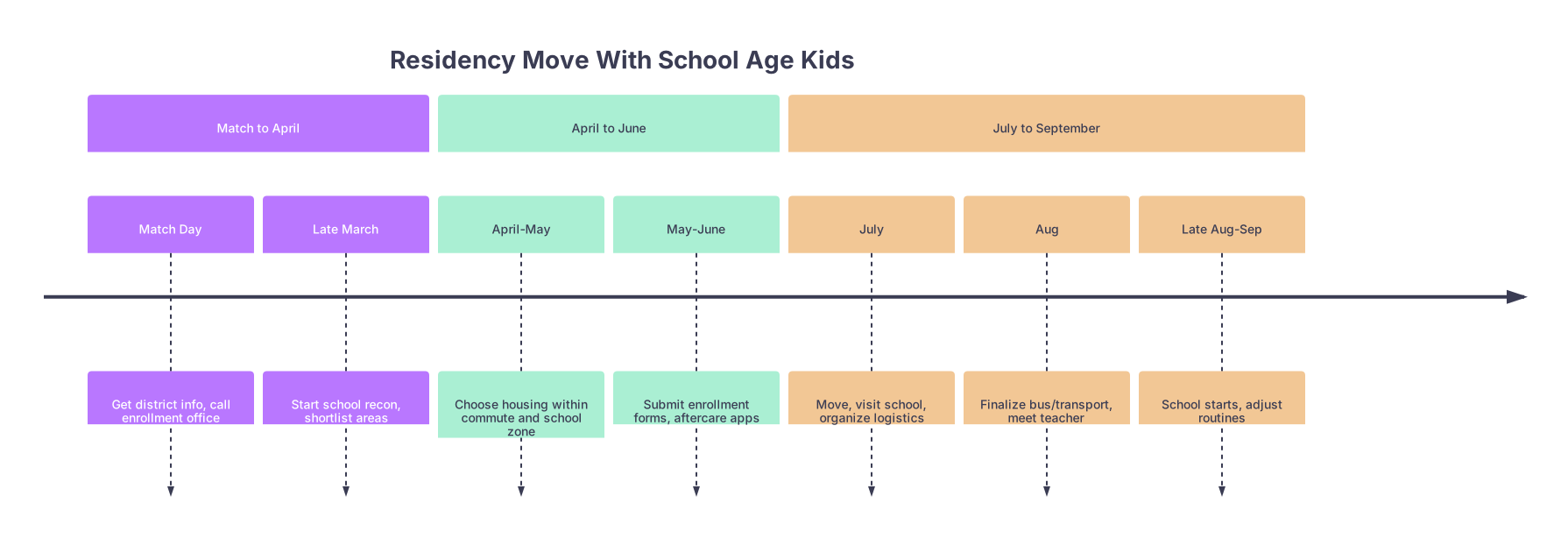
| Period | Event |
|---|---|
| Match to April - Match Day | Get district info, call enrollment office |
| Match to April - Late March | Start school recon, shortlist areas |
| April to June - April-May | Choose housing within commute and school zone |
| April to June - May-June | Submit enrollment forms, aftercare apps |
| July to September - July | Move, visit school, organize logistics |
| July to September - Aug | Finalize bus/transport, meet teacher |
| July to September - Late Aug-Sep | School starts, adjust routines |
FAQ (Exactly 5 Questions)
1. Should I prioritize the absolute best-rated school district even if it means a long commute to the hospital?
Usually no. A 45–60 minute commute with resident hours and kids is a slow-motion disaster. Aim for a good-enough school in a safe area within 20–30 minutes of the hospital. Your kid needs a functional parent more than a top-decile rating.
2. We will not have a signed lease until June. How do we enroll our child if the district requires proof of address earlier?
Call the district enrollment office and explain you’re relocating for medical residency with a fixed start date. Many districts will: accept conditional enrollment with a letter from your employer, let you pre-enroll and submit the lease later, or at least tell you the moment you must have proof. Get names, dates, and instructions in writing.
3. Is it a bad idea to move my high schooler during residency?
It’s not ideal, but sometimes you have no choice. If you must move a high schooler, get their full transcript and talk to the new school counselor before the move about credit transfer and graduation requirements. Involve your teen in selecting the school and in planning how they’ll keep or rebuild their activities and social life.
4. What if aftercare is full or not available at our chosen school?
Treat that as a serious problem, not a small annoyance. Options: join the waitlist immediately, look for external programs (YMCA, community centers, faith-based groups) that pick up from the school, or coordinate a shared sitter with another family. If none of that is workable, you may need to revisit either the school choice or your housing location.
5. My child is really anxious about changing schools. What can I do in the weeks before school starts to help?
Give them concrete familiarity. Show photos of the school, drive or walk by it, play at the nearest park, and if possible, attend any summer meetups or open houses. Practice the morning routine a few times. Teach them a simple intro script (“Hi, I’m [name]. I just moved here from [place].”) and reassure them that feeling nervous is normal and temporary.
Key points:
Keep the commute sane, even if that means choosing a “good enough” school over a “perfect” one.
Handle school admin like a second job for a few weeks—documents, calls, aftercare, and transportation—so the rest of the year is survivable.
Your kid does not need a flawless transition; they need a stable, mostly predictable life and at least one adult who isn’t running on fumes every minute.