How Northeast Residency Rank Meetings Really Work Behind Closed Doors
It’s a Thursday night in late January in Boston. Snow half-melted on the curb, residents still finishing sign-out upstairs. Down in a windowless conference room, your entire future is on a projector screen as a line of text: Lastname, Firstname – Home MD – Step 2 252 – “Strong”.
This is the rank meeting. The real one. Not what they describe on “How We Select Residents” slides. This is where people roll their eyes at your personal statement, fight over whether you’re #4 or #24, and casually end someone’s shot at an interview-to-match conversion.
You want to know how it actually plays out in Northeast programs? I’ll walk you through what I’ve watched happen in Boston, NYC, Philly, smaller New England community programs, and the “prestige” places that pretend they’re above the usual games.
Let’s pull the door shut and sit at the table.
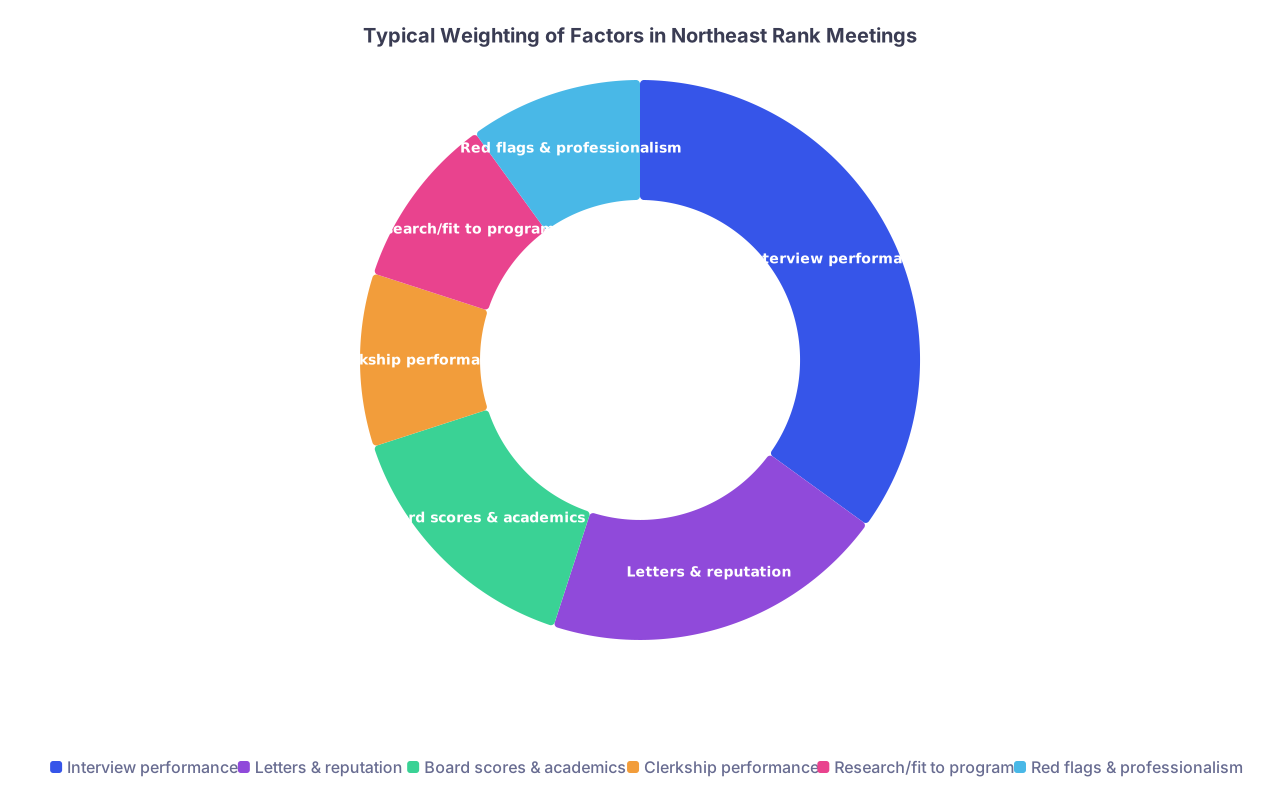
| Category | Value |
|---|---|
| Interview performance | 35 |
| Letters & reputation | 20 |
| Board scores & academics | 15 |
| Clerkship performance | 10 |
| Research/fit to program | 10 |
| Red flags & professionalism | 10 |
Who Is Actually In The Room (And Who Really Has Power)
The fairy tale is “the committee decides collectively.” That’s half-true at best.
The consistent pattern across Northeast programs:
- One or two people have disproportionate power.
- Everyone else talks a lot but moves the needle very little.
At a typical medium-to-large Northeast academic program, here’s the cast.
Program Director: The Quiet Veto
The PD rarely leads with strong opinions on every candidate. But watch body language. A PD who leans back, crosses arms, and says, “I didn’t really connect with them,” just dropped you 20 spots. No yelling. No drama. Just a mood shift.
The PD usually:
- Sets the ceiling: how high someone can reasonably go.
- Controls who gets rescued from the middle or lower tier.
- Enforces institutional priorities: diversity, home students, couples, visa issues.
If a PD in the Northeast says, “This person will thrive here,” you’re safe. If they say, “I’m not sure they understand what this program is,” you’re dead.
Associate PDs: The Heavy Talkers
APDs do most of the talking, especially at large Northeast academic centers. They:
- Defend “their” applicants (people they interviewed or met on away rotations).
- Control the structure of the list: breaking into tiers, suggesting ranges.
- Push pet priorities: research, education, underserved care, sub-specialty interests.
In New York and Boston especially, APDs tend to be the ones who care most about narrative: “They had a rough first year, bounced back, strong upward trajectory.” That narrative sometimes saves applicants who don’t look great on paper.
Chief Residents: Your Only Real Advocate Sometimes
At good programs, the chiefs are the only people who actually remember which resident liked you on interview day and who thought you were weird.
Chiefs in the Northeast:
- Bring real-world clinical perspective: “They’d fit well on our wards.”
- Kill borderline applicants with one sentence: “Honestly, this felt like a 2 AM sign-out liability.”
- Champion “under-the-radar” folks: “Not flashy, but residents loved working with them on the virtual social.”
At some NYC programs, I’ve seen chiefs walk into the meeting with a printed short list: “People we’d actually want to work nights with.” That list mattered a lot more than anyone admits publicly.
Faculty Interviewers: Selectively Powerful
Most faculty are there so the PD can call it a “committee.” Their influence depends entirely on personality and status.
The ranking goes something like:
- Division chiefs / big researchers at major Northeast hubs (MGH, Penn, Columbia): can push 2–3 research-heavy applicants way up.
- Longtime “workhorse” clinicians: trusted on character and work ethic.
- Random attending who interviewed you once: usually has 2–3 sentences entered in the applicant tracking system and that’s it.
If a famous name in the department says, “I want this one in my lab,” you climb. If they say, “Fine candidate, nothing special,” you drop into the generic middle.
The Invisible People Not in the Room
You know who’s missing?
- GME administrators: they pre-filtered before this meeting, you’ll never see their hand.
- Residents who actually worked with you on an away: their formal feedback gets reduced to one line in a spreadsheet.
- The dean who wrote your MSPE: irrelevant now. They had influence at the interview-offer stage, not the rank.
The rank list meeting is usually 6–12 people. That’s it. A tiny, biased slice of the institution.

The Actual Mechanics: How The Meeting Runs
Strip away the formality. It’s not mystical. It’s a messy, time-pressured, politically constrained sorting exercise.
Most Northeast programs follow some version of this sequence.
Step 1: The “Pre-List” That You Never See
Before everyone sits down, there’s already a draft list. PD and APDs built it from:
- Interview score averages.
- Categorical vs prelim needs.
- Internal “must rank” buckets (home students, faculty children, strategic recruits).
- Screening flags: ties to region, step scores, visa status, diversity goals.
This pre-list is not neutral. If you started in the top 20, you’re hard to dislodge. If you started in the bottom third, it takes a minor miracle to climb.
Step 2: Bucketing, Not Micro-Ranking
They’re not actually ranking #1 vs #2 vs #3 with precision. They’re sorting into tiers:
- Tier 1: “We’d be thrilled if they matched here.”
- Tier 2: “Solid, would be happy.”
- Tier 3: “Fine, serviceable interns, not inspiring.”
- Tier 4: “Rank only if needed to fill.”
- Do Not Rank: self-explanatory.
Some programs in the Northeast (especially larger ones) explicitly do this on the projector: green, yellow, gray, red highlights. The PD then roughly orders within tiers based on strategic factors.
Everyone at the table pretends they’re debating “exact ranks.” They’re really fighting about tier boundaries. That’s where your fate shifts from “likely to match” to “will need a lot of luck.”
Step 3: The Rapid-Fire Comments Phase
They project your one-page summary. Someone (usually an APD or chief) reads out:
“Applicant 47. MD from Rutgers. Step 1 P, Step 2 247. Honors in medicine and surgery. LORs from home chair and our faculty from away. Interview scores: mostly 3s and 4s. Any major concerns?”
Then:
- Interviewers give 1–2 lines each. No one has time for more.
- PD scans for red flags: professionalism comments, weird gaps, bad narrative.
- Chiefs might add “Resident impressions” from pre/post-interview socials.
If no one speaks strongly for or against you, you stay near your pre-meeting position. Silence hurts. In these rooms, the loudest advocate wins.
Step 4: The “We Need To Talk About This One” Cases
Certain files trigger deeper discussion:
- Stellar but “cold” interview: high stats, low warmth.
- Average stats, phenomenal story: first-gen, non-traditional, big adversity.
- Internal politics: child of a faculty member, former research assistant, local med school standout.
- Borderline professionalism issues: failed course, remediation, questionable LOR comments.
These applicants can move 20–40 spots with a 5-minute argument. I’ve watched someone go from “middle of the pack” to “top 5” because an APD said, “We need more residents like this one—mature, grounded, knows exactly why they want this city and this specialty.”
And I’ve watched someone with a 260+ Step 2 get quietly pushed down 30 places because the PD said, “I don’t trust them at 3 AM.”
| Factor | Public Messaging Importance | Real Rank Meeting Impact |
|---|---|---|
| Interview performance | High | Very High |
| Step 2 / exam performance | High | Moderate-High |
| Research | High | Low-High (program-dependent) |
| Personal statement | Moderate | Low (unless extreme) |
| Letters of recommendation | High | Very High from known names |
| Fit with program culture | High | Very High |
| Geographic ties to Northeast | Low-Moderate | Moderate |
What Actually Moves You Up (Or Down) In Northeast Programs
Here’s where the myths and reality really diverge.
Interview Performance: The True King
In Northeast programs—especially the big academic centers—the interview is everything. Not because they “get to know you deeply.” They don’t. But because:
- They’re terrified of problem residents.
- They’ve been burned by “perfect on paper” disasters.
- They equate likeability + clarity + calm with trainability.
The conversation sounds like:
- “They were… fine. Pleasant. Nothing extraordinary.” (You’re middle third.)
- “Super awkward. Took a long time to answer questions. Could be a challenge with patients.” (You free-fall.)
- “I’d work a night float month with them. Easy.” (You move up.)
The Northeast bias: blunt, efficient communication is valued. Meandering, overly rehearsed answers? Death. They want you to sound like someone who can present on rounds in three sentences, not TED Talk your life story.
Letters From Known People: Rocket Fuel
This is the dirtiest open secret.
In the Northeast, networks run deep. If your letter writer is:
- A known subspecialist at a partner institution.
- An alum of the program.
- A name who publishes with people there.
Then behind closed doors you’ll hear:
- “I know her—if she says this student is outstanding, that means something.”
- “This is from our former chief. He’s very picky. That’s a strong endorsement.”
A generic glowing letter from “Big Name at Random Institution” does less than a very strong, specific letter from someone in the local Northeast ecosystem.
If you rotated at a Northeast program and got a detailed letter from a respected attending there? Massive boost.
Home Institution & Regional Ties
Let’s be blunt: Northeast programs like Northeast people. Not exclusively. But there’s comfort in:
- “They already know this weather, this cost of living, this pace.”
- “They have family nearby – lower flight risk for transferring out.”
At rank meetings I’ve heard:
- “They’re from UConn, did well there, solid rotation here—they’ll stay.”
- “West Coast everything, no articulated reason for moving here—are we just being a stepping stone?”
You don’t have to be from the Northeast. But if you aren’t, and you never convincingly explained why this region, you will lose tiebreaks.
Culture Fit: More Important Than They’ll Ever Admit
Nobody writes “culture fit” in official documents, because it’s hard to define and easy to abuse. But behind closed doors, it’s constant:
- “We’re a very team-oriented, resident-run service. Do they get that?”
- “They seemed more into research brand name than actually working here.”
- “They gave off an ‘I’m too good for community medicine’ vibe.”
Northeast programs vary:
- Boston / NYC academic powerhouses: skew toward high-achievers comfortable with intensity and hierarchy.
- Philly and mid-size New England university programs: more emphasis on being teachable and not insufferable.
- Community programs: they want reliable worker-bees who won’t quit when schedules are tight and ancillary support is thin.
If you telegraphed “I’m applying here for prestige, not because I like how you work,” you got quietly punished.
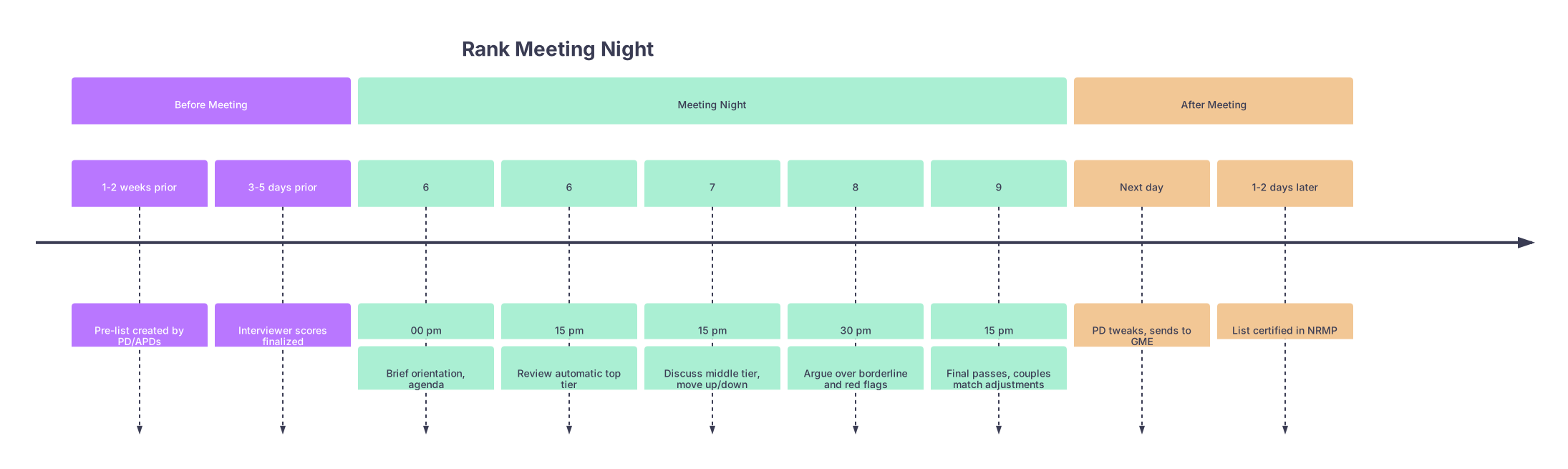
| Period | Event |
|---|---|
| Before Meeting - 1-2 weeks prior | Pre-list created by PD/APDs |
| Before Meeting - 3-5 days prior | Interviewer scores finalized |
| Meeting Night - 6 | 00 pm |
| Meeting Night - 6 | 15 pm |
| Meeting Night - 7 | 15 pm |
| Meeting Night - 8 | 30 pm |
| Meeting Night - 9 | 15 pm |
| After Meeting - Next day | PD tweaks, sends to GME |
| After Meeting - 1-2 days later | List certified in NRMP |
The Quiet Killers: What Drops You On The List
Most people are not destroyed by a single huge red flag. They’re slowly pushed down by murmurs and faint praise.
“Fine, But Unmemorable”
The most common quiet killer.
You interviewed at 15 places. You were polite, professional, answered questions decently. But you didn’t leave a single distinctive impression.
By rank meeting time in January/February, here’s harsh reality: nobody remembers you. They’re staring at “Interview: 3, 3, 3” and a short generic comment like “Nice candidate, good fit.”
You end up in the big bland middle. And in the Northeast, with heavy applicant volume, that middle is crowded.
Vague or Concerning Professionalism Whispers
This doesn’t mean you did something terrible. It can be as soft as:
- “Seemed a bit entitled.”
- “Response to feedback felt defensive.”
- “Hard to read, not sure how they’ll handle stress.”
The nuance: programs have been burned by one bad personality poisoning a whole class. Northeast PDs, especially at places with strong unionized housestaff and high-volume services, are paranoid about this.
One vague “I got a weird vibe” from a respected interviewer can shove you far down.
Perceived Lack of Interest
You might think your interview went well. But did you:
- Ask generic questions you clearly Googled?
- Fail to send any post-interview follow-up to your top places?
- Never mention any specific faculty, rotations, or program features?
At the meeting, someone asks, “Did anyone get the sense they were really interested in us?” If the room is silent, you lose to the person where the chief says, “They emailed me after, clearly bumped us to first on their list.”
Northeast programs know you’re interviewing broadly. But they absolutely rank higher the people they think are actually likely to come.
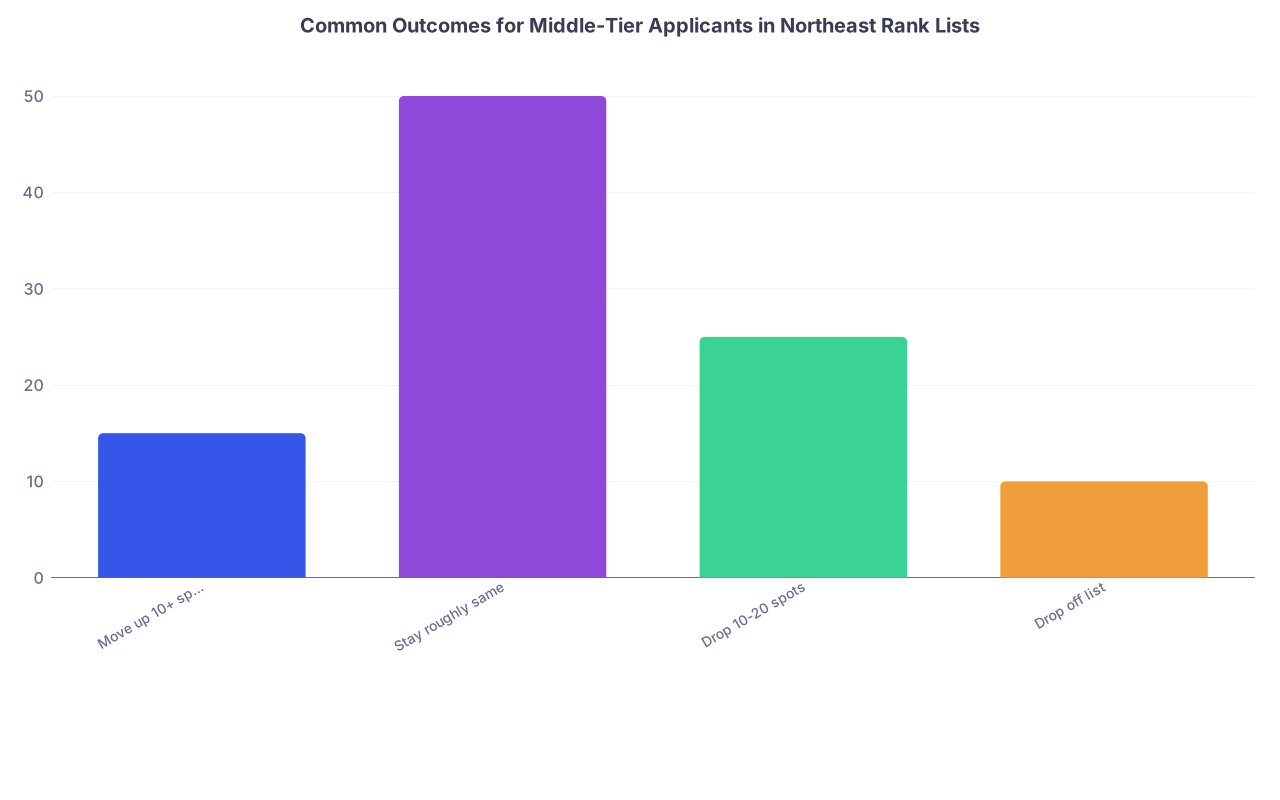
| Category | Value |
|---|---|
| Move up 10+ spots | 15 |
| Stay roughly same | 50 |
| Drop 10-20 spots | 25 |
| Drop off list | 10 |
Special Games: Couples, “Must Gets,” and Politics
Here’s the part people rarely tell applicants.
Couples Match: You Become a Puzzle Piece
In big Northeast cities with multiple programs (NYC, Boston, Philly), the conversation about couples is almost always logistical, not personal.
You’ll hear:
- “Their partner ranked us high; we like both—bump them a tier up so we have a shot at landing both.”
- “If we rank them too low, we risk splitting the couple and losing both entirely.”
If a PD likes your partner more than you, you get dragged upward. If your partner’s program doesn’t care about you, you might get sacrificed.
Programs absolutely work the phones with each other in the same city: “We’re putting them high, are you doing the same?” No one will admit exact ranks, but the dance is real.
“Must Get” Candidates
Every Northeast program has a handful of applicants leadership is obsessed with:
- The superstar away rotator.
- The research phenom everyone wants to brag about.
- The diversity candidate that fits institutional goals perfectly.
- The legacy applicant with deep ties to the hospital.
For these people, the rank meeting is theater. They were top 5 before the meeting started.
You’ll hear: “We’re putting them #1, right?” and maybe a polite nod rather than debate.
Politics You Do Not Control
Resentments, departmental politics, PD succession planning—it all leaks into rank decisions.
Concrete examples I’ve seen:
- A program trying to rebuild a weak research reputation aggressively overweighted applicants with serious scholarly potential, even if clinically they were less polished.
- A new PD trying to reshape “old guard” culture prioritized applicants who fit their vision, not the current residents’ preferences.
- A department burned by a visa-related departure became quietly more conservative with international applicants, pushing them down despite good metrics.
None of this shows up on websites. But it absolutely happens in these rooms.
The Last Pass: How The Final List Actually Gets Locked
By the end of the meeting, everyone’s tired. Coffee’s cold. Someone’s checking Epic messages between discussions.
The last 30–45 minutes:
- They skim through the list one more time.
- PD makes small adjustments: “Move this one just above those two.” “Swap these.”
- They circle back to a few controversial names: either commit to ranking or dropping.
Then, crucially, after the meeting, the PD typically:
- Sits with the APD or program coordinator.
- Does a quiet “sanity pass” for fill safety: making sure they’re not overranking candidates clearly unlikely to come while under-ranking solid “likely to match” folks.
- Resolves any informal agreements (e.g., about couples or cross-institution coordination).
By the time the list goes into NRMP, there’s one person who fully owns it: the PD. The committee “helped.” But the PD’s adjustments—not recorded in any minutes—have more influence than any single hour-long debate.
What This Means For You (And What To Do Differently)
You can’t control the politics. You can’t control who’s friends with whom in the Northeast academic network. But you can control what they’re actually going to say about you in that room.
The points that consistently matter most:
Interview like someone they want at 3 AM, not at grand rounds.
Concise, clear, non-dramatic. Don’t oversell. Don’t read from your brain’s script. Sound like a capable colleague.Make someone in that room care enough to speak up.
One engaged faculty, one chief, one PD who thinks, “I really want them here.” Being “fine” is a long walk to rank #80.Explain your Northeast story clearly.
Why this city, why this region, why you will stay. Not vague flattery—specific personal or professional reasons.
If you do those three things well, you’re not just a name on a spreadsheet. You’re a person someone will fight for when everyone’s tired and ready to go home.