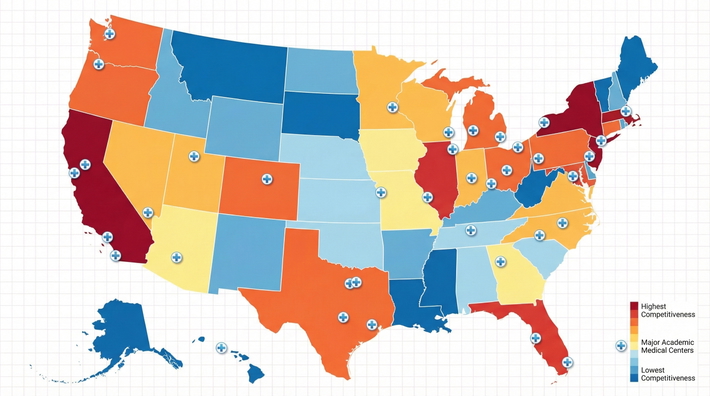
The pecking order between New York, Boston, and Philly residencies is real—and it quietly runs half of East Coast academic medicine.
Everyone pretends it’s all about “fit” and “training environment.” Behind closed doors, program directors talk in a different language: pedigree, brand, fellowship pull, “is this a Harvard kid or a Bronx kid,” “Penn-level,” “Columbia-caliber.” I’ve sat in those rooms. I’ve heard the way names of cities and institutions get used as shorthand for your entire career trajectory.
Let me walk you through what actually happens when an ICU attending at MGH looks at your application from a NYC program. Or when a Penn fellowship director compares a Beth Israel Deaconess resident to a Jefferson one. Or when a smaller community program in Jersey screens your app and sees “Harvard,” “Cornell,” or “Temple.”
It’s not fair. It’s not purely meritocratic. But there is a pattern.
The Unspoken Regional Brand Ladder
There’s a hierarchy, and it’s not just “Harvard > everything.” It’s a layered, regional status game that plays out like this:
At the top of the East Coast academic prestige pyramid, Boston and certain NYC programs sit almost side by side, with Philly just behind but more consistent than people realize.
Inside the game, people often mentally sort programs into bands. Not official. But real.
| Band | NYC Examples | Boston Examples | Philly Examples |
|---|---|---|---|
| Elite Flagship | Columbia, Cornell, NYU, Sinai | MGH, BWH, Beth Israel Deaconess | Penn |
| Strong Academic | Montefiore, Northwell, NYU Langone Brooklyn | BU, Tufts | Jefferson, Temple, Penn-affiliates |
| Solid Regional | NewYork-Presbyterian Queens/Brooklyn, Downstate | Lahey, UMass | Cooper, Drexel-affiliated |
| Safety/Utility | Many community NYC programs | Community Boston suburbs | Community Philly/South Jersey |
Is this perfectly accurate? No. Would PDs publicly endorse this? Absolutely not. But versions of this table sit in people’s heads when:
- Fellowship directors scan ERAS
- Chairs pick chief residents
- Hospital systems decide who to recruit as junior faculty
What city you train in—and which hospital in that city—changes how easily doors open.
Boston: Small City, Loud Signal
Boston punches above its weight in a way most students only half understand.
When a fellowship director in cardiology, GI, or heme-onc glances at an application and sees: “Internal Medicine – MGH” or “BWH,” the reaction is visceral. “Okay, serious applicant.” They might not say it, but everyone in the room feels it.
Here’s how Boston quietly runs the table.
The Harvard/MGH–BWH Effect
MGH and Brigham are treated as “default top tier” in almost every competitive subspecialty. In discussions, faculty will say things like:
- “She’s an MGH grad, so the floor is high.”
- “He’s from Brigham; he’ll be used to heavy volume and high expectations.”
There’s an assumption baked in: if you matched there, you already survived a high bar twice—getting into a strong med school, then landing a Harvard residency. That halo effect follows you.
Beth Israel Deaconess is interesting. Historically slightly below MGH/BWH in perceived prestige, but in certain fields (cards, GI, critical care, anesthesiology), it’s treated as essentially equivalent. I’ve seen BID grads outcompete applicants from “bigger name” places because BID faculty are very plugged into subspecialty leadership networks.
BU, Tufts, and the “Boston Bump”
The second layer in Boston—BU, Tufts, UMass—benefits from geography and narrative. They’re not Harvard, but they’re still “Boston.”
Fellowship directors will literally say things like:
- “He trained in Boston; research infrastructure should be good.”
- “BU IM, they see everything, lots of pathology.”
Is BU better than every NYC second-tier academic program? Not necessarily. But the brand of Boston carries an assumption of rigor and academic environment, even when individual programs are variable.
The Hidden Boston Downside
Here’s what applicants do not see.
Boston is relatively small. Academic positions and high-end fellowships can be politically crowded. People know each other very well. Word gets around.
If you’re not a standout at a Boston program, you may actually get less attention than a star from a slightly lower-tier program in Philly or NYC, simply because there are too many stars clustered in one place. I’ve seen mid-pack MGH/BWH grads lose spots to top residents from Penn, Columbia, or Jefferson for exactly this reason.
Boston gives you a higher floor. It does not guarantee the ceiling.
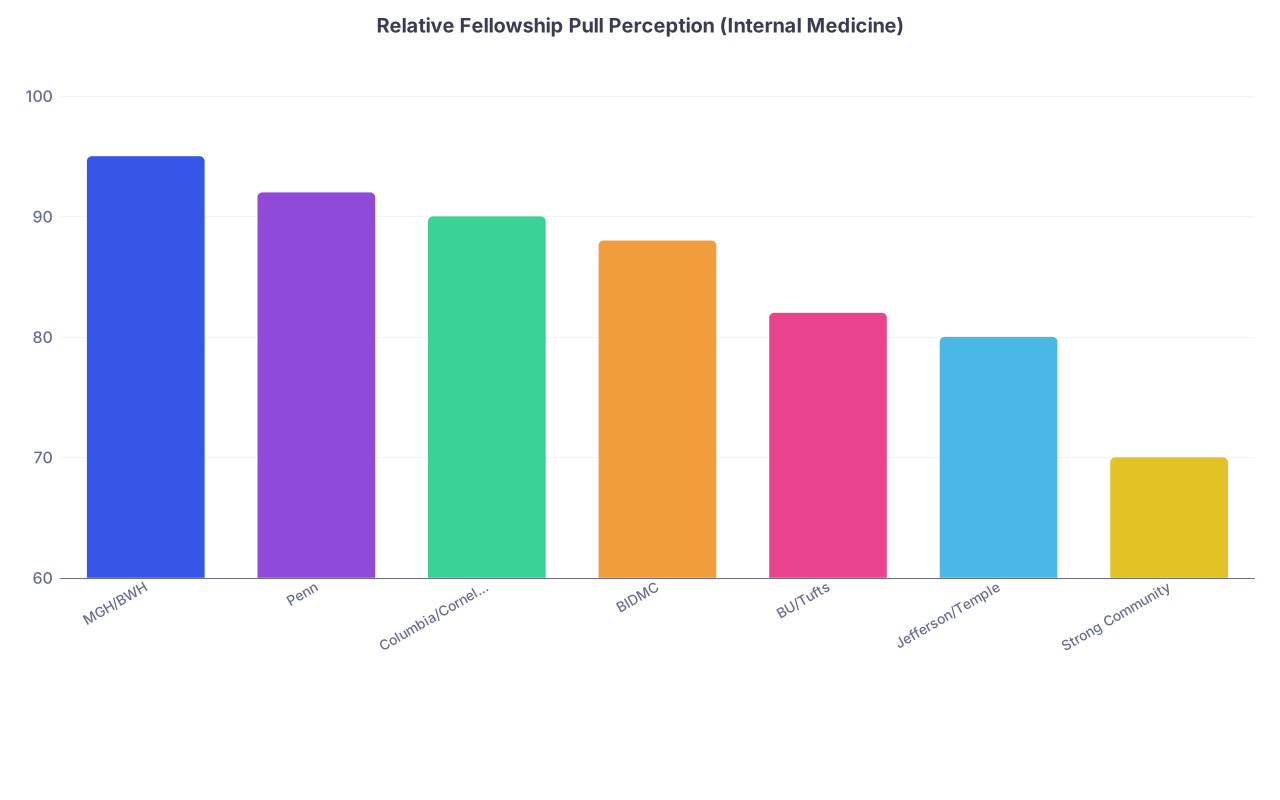
| Category | Value |
|---|---|
| MGH/BWH | 95 |
| Penn | 92 |
| Columbia/Cornell/NYU | 90 |
| BIDMC | 88 |
| BU/Tufts | 82 |
| Jefferson/Temple | 80 |
| Strong Community | 70 |
(Those numbers are not real data, but they’re an honest approximation of how people talk in fellowship committees.)
NYC: Huge Ecosystem, Wild Variability
New York is chaos. And that chaos works for and against you.
On one hand, there’s unmatched clinical volume, diversity, and sheer number of programs. On the other, the prestige signal is far more fragmented than students realize.
The Big Three(+): Columbia, Cornell, NYU, and Sinai
The Manhattan academic heavyweights—Columbia, Cornell, NYU, Mount Sinai—are usually viewed in the same conversation as Penn and just a hair behind MGH/BWH for most subspecialties. Inside fellowship selection meetings, you’ll hear phrases like:
- “She’s Columbia IM; she’ll be fine clinically and likely has research.”
- “Cornell plus decent letters? Bring him to interview.”
- “NYU neurology—strong training, good case mix.”
- “Sinai psych or IM? Very solid, they put out good fellows.”
There’s mild intra-city snobbery (and plenty of rivalry), but in terms of external perception, these are your NYC flagships.
Now here’s the ugly truth: if your program name doesn’t immediately trigger this reflex in readers’ minds, you don’t get the same instant benefit of the doubt.
The Bronx, Brooklyn, Queens Reality
Programs like Montefiore (Bronx), Northwell (Long Island/Queens), Downstate (Brooklyn), and others are clinically intense, often under-resourced, and produce extremely capable clinicians. But on paper, they don’t carry the same automatic halo in fellowship selection.
What evaluators often think:
- “Montefiore IM—high pathology, tough training.”
- “Northwell has good subspecialty exposure, but letters matter a lot.”
- “Downstate—hardworking residents, but need evidence of academic output.”
So you’re fighting a different battle: prove you’re not just a workhorse, but also academic material. The residents who win from these programs usually have:
- 1–2 serious research projects with strong letters
- Visible advocacy or leadership in some meaningful way
- Strong Step/board performance to back the story
I’ve seen Montefiore or Downstate residents match elite fellowships at places like Penn, MGH, and Columbia—but almost never by accident. They’re visible in ways their peers are not.
The NYC Problem: Too Many Programs, Too Little Clarity
Outside the region, many faculty can’t keep all the NYC programs straight.
I’ve heard conversations like:
“Is that the Manhattan NYP site or one of the borough hospitals?”
“Is this Mount Sinai main, or one of their affiliates?”
They don’t want to admit it, but they get confused.
That split—“main academic flagship” vs “affiliate/community site”—matters much more in New York than in Boston or Philly simply because the ecosystem is larger and more branded.
Your job, if you’re not at one of the clear flagships, is to make your personal brand louder than your program’s ambiguity.
Philly: Underrated, Surprisingly Consistent
Philadelphia is quieter on Twitter and less dramatic than NYC or Boston. But inside graduate medical education, Philly carries more weight than students give it credit for.
Penn: The Single-Name Powerhouse
Say “Penn IM” or “Penn neurology” or “Penn EM,” and every fellowship director in the Northeast understands exactly what that means. Top-tier. High expectations. Real research options.
In some circles, Penn is considered equal to or ahead of individual New York flagships because the brand is more unified and less fragmented. Fewer affiliates, clearer identity, strong across multiple departments.
I’ve watched committees say:
- “We should probably take a look; Penn usually sends strong people.”
The “usually” is doing work there. That’s the advantage of a cleaner, less chaotic academic ecosystem.
Jefferson, Temple, and the Solid Middle
Jefferson and Temple sit in an interesting band. Not Penn. Not MGH/BWH. But absolutely respected as serious academic training environments.
The way people talk internally:
- “Jefferson IM—good clinicians, some research, solid fellows.”
- “Temple? Those residents work hard, see a ton of pathology.”
If you’re a top resident at Jefferson with a couple of good publications and strong letters, you’re in direct competition with mid-pack Columbia/NYU or BU/Tufts people for fellowships across the East Coast.
Same with Temple, especially in fields that value gritty clinical training (cards, pulm/crit, EM). Temple’s pathology and volume are eye-opening. That reputation does seep into fellowship and job discussions.
The Philly Advantage: Less Noise
Here’s what Philly gives you that NYC doesn’t: clarity.
People know the main players: Penn, Jefferson, Temple, Cooper, sometimes Drexel-affiliated programs. There’s less confusion about “which site is this” and “is this the main hospital or a peripheral affiliate.”
If you perform, you stand out more relative to your cohort simply because the ecosystem is smaller and more legible to outsiders.
How Program Directors Actually Compare These Cities
Let me tell you what really happens when a Boston PD, a NYC PD, and a Penn fellowship director are informally comparing applicants.
They’re not saying, “Which city is better?” They’re silently weighing three things:
- Baseline selectivity of the residency
- Clinical grind and pathology exposure
- Plug-in to research/fellowship networks
Then they compress that into a mental shorthand:
- “Boston-Harvard” → baseline elite, high expectations
- “Penn/Columbia/Cornell/NYU/Sinai” → just below that, but still highly competitive
- “BU/Tufts/Jefferson/Temple/Montefiore/Northwell etc.” → strong, need to look at individual performance
Here’s the rough translation many insiders use, even if they never say it on record:
| Signal Band | Typical Interpretation | Example Programs |
|---|---|---|
| Tier 1+ | Assume strong across board | MGH, BWH, Penn |
| Tier 1 | Strong, high ceiling | Columbia, Cornell, NYU, Sinai, BIDMC |
| Tier 2A | Solid academic, case-by-case | BU, Tufts, Jefferson, Temple, Montefiore, Northwell |
| Tier 2B | Good clinicians, proof needed for academic potential | Many NYC/Philly community or affiliate sites |
When Philly Makes Sense
Philly is often the smartest move if:
- You want real academic opportunities but don’t care about the Boston/NYC vanity game
- You like a mid-sized city with lower cost than Boston/NYC but still a strong hospital ecosystem
- You prefer a system where your program’s reputation is easy to understand nationally (Penn, Jefferson, Temple)
Philly quietly combines a lot of Boston’s clarity with some of NYC’s pathology and grittiness, without the same overwhelming noise.
What This Means For Fellowships and Jobs
Here’s the uncomfortable truth: for the most competitive fellowships (cards, GI, heme-onc, some surgical subspecialties), being at a recognized flagship in any of these cities helps more than almost anything else you can control after med school.
But within that:
- A top resident at Jefferson, Temple, BU, or Montefiore with research and strong letters can absolutely beat a mid-resident from Columbia or NYU. I’ve seen it.
- A Penn or MGH resident with mediocre performance and no academic footprint doesn’t magically leap to the front of the line. The brand buys them a second look, not a free pass.
- For community jobs and non-academic careers, the city matters far less than your references and reputation. In many community settings, they barely distinguish between “Columbia” and “Cornell” versus “Jefferson” and “Temple.” They just see “big city teaching hospital” and move on.
The hierarchy is most violent at the academic extreme. The further you move from that edge, the more it softens.
How To Play The Hierarchy Instead Of Being Crushed By It
You can’t change that Boston, NYC, and Philly have a pecking order. You can decide how much you let it define you.
If you’re already in training:
- At a top Boston/NYC/Philly flagship: stop coasting. Your brand gets you in the door; your work determines whether you actually get the spot. Faculty are jaded to names. They care about who actually produced something.
- At a second-tier academic place (BU, Tufts, Jefferson, Temple, Montefiore, Northwell): your upside is huge if you become “the name” in your cohort. People know these programs produce both workhorses and stars. Be the star.
- At a less-known affiliate or community spot: your mission is clarity. Strong letters from recognizable names, tangible output (papers, QI projects, regional presentations), and a coherent story that explains your path. I’ve watched residents from modest programs land in shockingly competitive fellowships by executing that plan.
If you’re still applying:
- Stop splitting hairs between MGH vs Columbia vs Penn unless you’re choosing between them. Most applicants are not.
- Look at where graduates of that specific program actually go—for fellowships and jobs. The pipeline tells you more than the city.
- Ask faculty bluntly (off the record) how their program is perceived within the region. The answers are revealing when they trust you.
The game is rigged, but it’s not random. Once you see the pattern, you can make smarter moves.