The most dangerous thing about residency interview season isn’t rejection. It’s not knowing when you should start worrying.
Let’s fix that.
This is your August–October guide to tracking interview invites by region, knowing what’s normal, and knowing when to hit the panic button. Or at least the “apply to more programs” button.
Big Picture: How Invite Season Actually Unfolds
By August 1st, you should understand this basic reality: programs are not synchronized, but they do have patterns. And they’re different by region.
Here’s how I want you to think about it:
- August: Silence is normal
- September: Signal starts, but uneven by region
- October: The “truth-telling” month. Your trajectory is obvious.
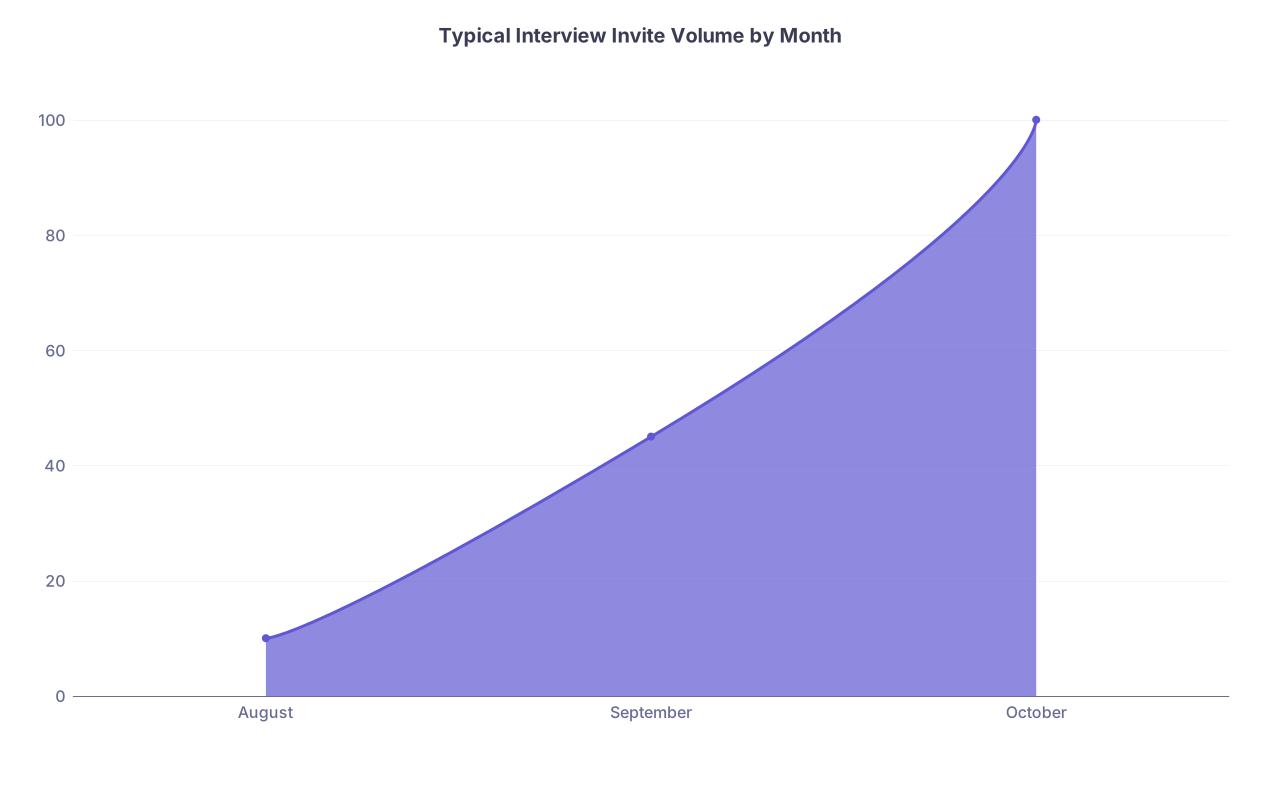
| Category | Value |
|---|---|
| August | 10 |
| September | 45 |
| October | 100 |
If you try to judge your chances too early, you’ll panic for no reason. If you wait too long, you’ll run out of options.
So we’ll walk through this month-by-month, then region-by-region, then I’ll give you concrete “if X by date Y, do Z” rules.
August: Set Up Your System (Not Your Anxiety)
By the first week of August, you should stop guessing and start tracking. Most people skip this step and then wonder why they feel lost by October.
Week 1 (Aug 1–7): Build Your Tracking Infrastructure
At this point you should:
Create a master spreadsheet or tracker with:
- Program name
- City, state
- Region (you define: Northeast, Midwest, South, West, etc.)
- Program type (academic vs community)
- Date you applied / ERAS submitted
- Date of invite (blank for now)
- Outcome: Invite / Rejection / Ghosted (by January you’ll know)
Group programs by region, not just by competitiveness.
Why? Because regions move at different speeds and use different invite patterns.Example regional buckets:
- Northeast (NY, MA, PA, NJ, CT, RI, etc.)
- Midwest (IL, OH, MI, MN, WI, IA, IN, MO, etc.)
- South (TX, FL, GA, NC, SC, VA, AL, LA, TN, etc.)
- West (CA, WA, OR, AZ, CO, UT, NM, NV, etc.)
-
- One check in the morning
- One in the evening
That’s it. No obsessive every-10-min refresh. That just creates fake urgency.
| Region | First Meaningful Wave | Peak Invite Period | Slower Tail Starts |
|---|---|---|---|
| Northeast | Early–mid September | Late Sep – mid October | Late October |
| Midwest | Mid–late September | Early–late October | Early November |
| South | Mid August – mid Sep | Mid Sep – mid October | Late October |
| West | Late September | Early–late October | Early November |
Weeks 2–4 (Aug 8–31): Expect Almost Nothing
By mid-August, for most core specialties (IM, FM, Peds, Psych, EM, etc.):
- 0 invites = totally normal
- 1–2 invites = lucky programs that move early
- More than 3 invites = your specialty or region is unusually early
The exception: some Southern and smaller community programs in all regions start earlier. They don’t like sitting on applications.
At this point you should:
- Log every invite with the exact send time and region.
Programs in the same region often move in similar weeks, even across specialties. - Start paying attention to when your school classmates get invites by region. Make a quick shared list if possible.
What you should not do in August:
- Don’t add 40 more programs because you have no invites yet.
- Don’t email coordinators “just checking on my status.” It’s too early and looks needy.
September: The Regional Patterns Start to Show
September is when you finally get information. Not complete information, but enough to see where you’re lagging.
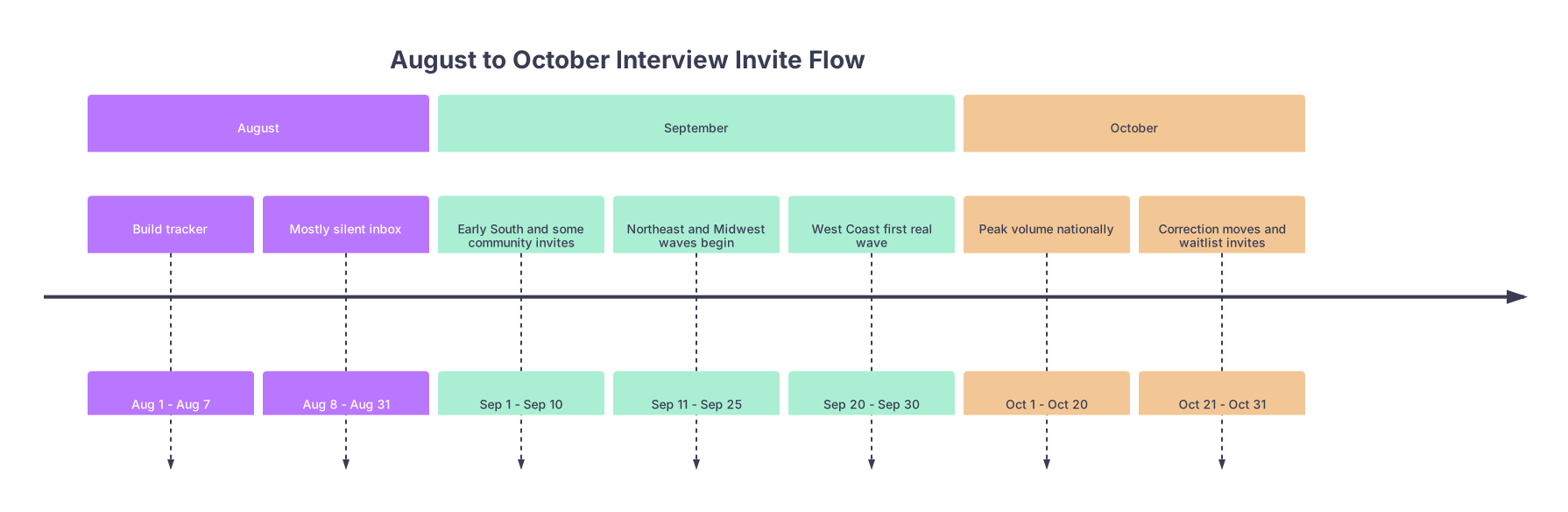
| Period | Event |
|---|---|
| August - Build tracker | Aug 1 - Aug 7 |
| August - Mostly silent inbox | Aug 8 - Aug 31 |
| September - Early South and some community invites | Sep 1 - Sep 10 |
| September - Northeast and Midwest waves begin | Sep 11 - Sep 25 |
| September - West Coast first real wave | Sep 20 - Sep 30 |
| October - Peak volume nationally | Oct 1 - Oct 20 |
| October - Correction moves and waitlist invites | Oct 21 - Oct 31 |
Early September (Sep 1–10): Southern and Community Programs Blink First
By about September 10:
- You may see:
- A few Southern programs sending early invites
- Some Midwest community sites also moving
- Northeast and West are often quiet or just starting to trickle.
At this point you should:
- For each region, write down:
- Total applied in that region
- Number of invites from that region
If you applied to, say, 15 Southern programs and by Sept 10 you have 0 invites anywhere, I don’t care yet. Still early.
Where I start raising an eyebrow:
- If classmates with similar stats are getting multiple invites from the same region and you’re at zero there.
You’re not panicking yet. You’re watching for asymmetry: one region dead silent while others slowly move.
Mid September (Sep 11–20): Northeast & Midwest Join the Party
This is when your inbox should wake up.
By September 20, for a reasonably competitive candidate (let’s say solid passes, decent letters, no red flags) in a moderately competitive specialty:
Typical pattern:
- Some invites from the South (if you applied there)
- At least a few from Midwest community or mid-tier academic
- Maybe 1–3 Northeast invites, especially for primary care–leaning specialties
At this point you should:
- Calculate your invite rate per region:
- Example: 20 Midwest programs, 3 invites = 15%
- 18 Northeast, 0 invites = 0%
Write it down. Do not “feel” it. Numbers only.
Here’s a simple mental rule:
- If every region = 0 by Sept 20, that’s concerning and you should start thinking about:
- Did you over-reach in program list?
- Are there red flags? (CS failure, visa, big gap, etc.)
- Should you add a small batch (5–10) of more safety/community programs now?
Late September (Sep 21–30): West Coast Finally Wakes Up
West Coast academic programs (especially California) notoriously move later and slower.
By September 30:
- If you applied heavily to the West and have 0 invites there, that’s not necessarily a death sentence yet.
- But if you have 0 invites from all regions, we’re out of “normal slow” and solidly in “this might not correct on its own.”
At this point you should:
- Look region by region and ask:
- Do I have at least 1–2 invites from ANY region?
- Do I have any region performing decently, even if others are quiet?
If the answer is:
- Yes, I have 2–4 total invites from at least two regions → You’re likely in the game; just on the slower side.
- No, I have 0–1 total invites everywhere → Time to act (we’ll talk specific moves in the October section, but you should add programs now, not later).
October: The Month When You Should Start Worrying (If Needed)
October is when the invite season tells the truth. You stop guessing. The numbers are what they are.
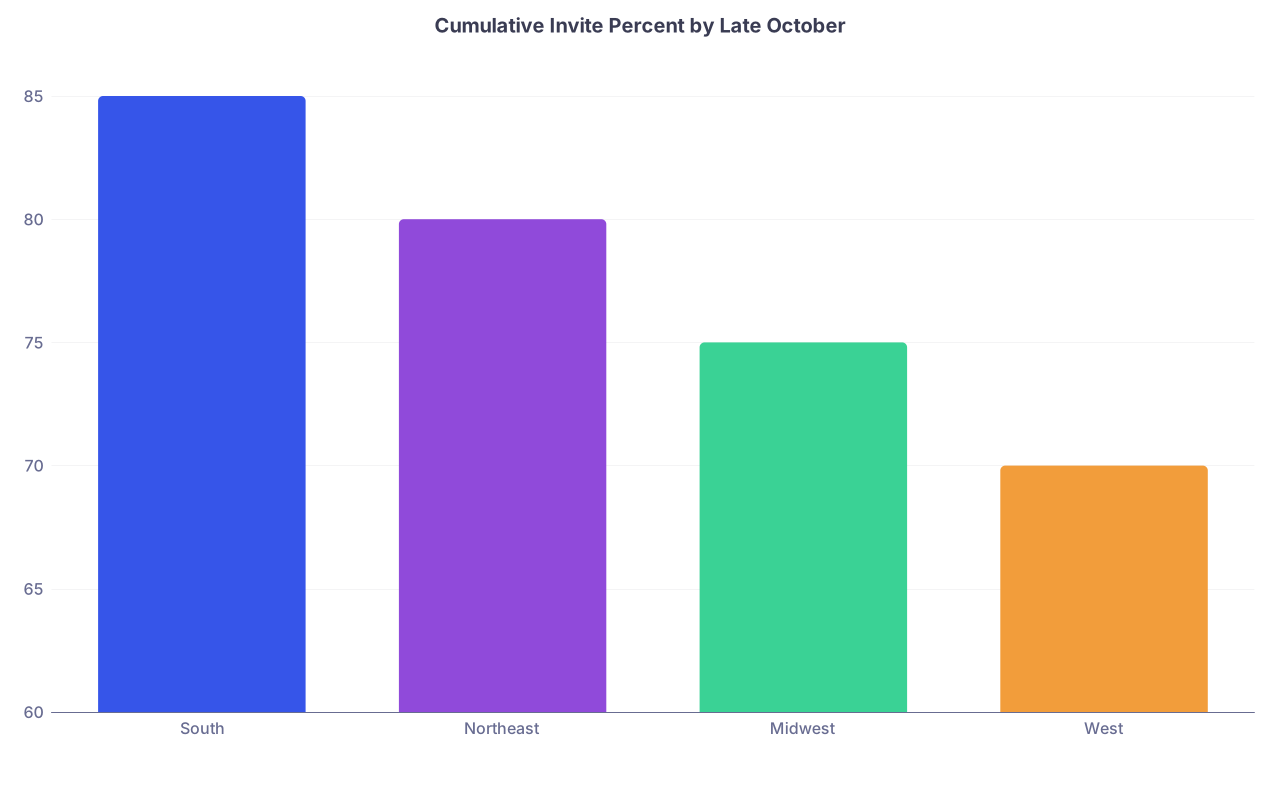
| Category | Value |
|---|---|
| South | 85 |
| Northeast | 80 |
| Midwest | 75 |
| West | 70 |
By October 1–20, most regions hit their peak invite activity.
Early October (Oct 1–10): This Is Your Reality Check
By October 10, most strong-to-average applicants in non-ultra-competitive specialties will have a reasonable sense of where they stand.
At this point you should:
- Count total invites
- Count invites by region
Then compare to this rough reality check (for core specialties like IM/FM/Peds/Psych/EM):
- 0–2 invites total → This is bad. Time-critical.
- 3–5 invites total → Weak but salvageable if you play smart.
- 6–10 invites total → You’re probably fine, even if it doesn’t feel like it.
- 10+ invites → You’re worrying for sport, not for data.
Regionally:
- If you applied:
- 15+ programs in a region and have 0 invites there by Oct 10 → That region is effectively dead for you except for rare late movement.
- 10–15 programs and have 1 invite → That region is marginal but not hopeless.
At this point, if you’re low on invites, you should:
- Add programs in regions that are still moving
- South and Midwest usually give you the best late-add return.
- West and Northeast are less forgiving this late, but community programs can still surprise you.
- Focus on:
- Less competitive locations
- Community and hybrid-community programs
- Places that historically interview more broadly (ask upperclassmen or advisors)
Mid–Late October (Oct 11–31): Correction Waves and Waitlist Invites
This is the phase where programs realize:
- “Our top picks booked too many days elsewhere.”
- “We have empty interview slots left.”
- “We need to dip lower on our list.”
So yes, late October invites are real. I’ve watched people go from 3 invites to 8 in these two weeks. But you don’t plan on that. You treat them as bonus rescue waves.
At this point you should:
- Track any late invites by:
- Region
- Program type (academic vs community)
If you’re sitting at:
0–2 invites by October 20 → You should seriously:
- Talk to your dean’s office that week
- Ask explicitly about:
- SOAP risk
- Applying to a second specialty
- Aggressively adding more community programs if still open
3–5 invites by October 31:
- That’s the gray zone. People match from here, but it’s not comfortable.
- You should:
- Overprepare for every single interview
- Limit unnecessary interview cancellations
- Strongly consider broadening geographically if any programs are still accepting apps
How Different Regions Behave (And When to Worry in Each)
Now let’s tighten the regional lens. This is where tracking by region actually pays off.

Northeast
Pattern:
- Heavier academic density
- Many programs move in mid–late September, then a big chunk in early October
- Some highly selective programs send very early and very late rounds
When to worry here:
- Applied to 15+ Northeast programs
- By Sept 30: 0 invites → mild concern
- By Oct 10: 0 invites → this region is likely done for you
- If you’re >0 but <2 invites by Oct 20 from the Northeast, stop counting on this region to rescue your season.
Midwest
Pattern:
- Mix of academic and strong community
- Often a bit more forgiving than Northeast/West
- Starts mid–late September, solid through most of October
When to worry:
- Applied to 15+ programs in Midwest:
- By Oct 1: 0 invites → you’re behind
- By Oct 15: 0–1 invites → reconsider relying on this region
Midwest is a good region to add late programs in early October if they’re still reviewing.
South
Pattern:
- Often the earliest starter
- Many programs, especially community, move in late August–September
- Still active in early October, but peak may be slightly earlier than Northeast/West
When to worry:
- Applied to 10–15 Southern programs:
- By Sept 20: 0 invites → raise an eyebrow
- By Oct 1: 0 invites → that’s a major red flag
- By Oct 10: If South is 0 but other regions are showing invites, you’re probably not in their preferred pool
West
Pattern:
- Often later, especially for academic-heavy states like California
- High demand, limited slots → invites can be more selective
- Real waves: late September through mid-October
When to worry:
- Applied to 10–15 West Coast programs:
- By Oct 10: 0 invites → not shocking but not great
- By Oct 20: 0 invites → assume West will not be a significant part of your match list
West is not your best bet for late rescue applications.
Daily & Weekly Habits: What You Should Actually Do
Let’s put this into a real schedule so you’re not just staring at your inbox.
Weekly (Aug–Oct)
Every Sunday, you should:
- Update your tracker:
- Total invites per region
- Total rejections (yes, track these too)
- Write a one-sentence reality check:
- “Midwest OK, South weak, Northeast dead, West not moving yet.”
- Start seeing the pattern, not the chaos.
Daily (Mon–Fri in Peak Season: mid Sep – late Oct)
At this point you should:
Morning:
- Check:
- Email (including spam)
- ERAS communication tab
- Log:
- Any new invites with time, region, program type
Evening:
- Quick scan:
- Any classmates report major invite waves from programs you applied to?
- Did a big regional cluster move today? (e.g., several NYC programs all sent invites)
If you notice multiple programs in one region sending invites while you get nothing:
- Don’t email them the same day.
- Wait and see if you’re in a second wave 48–72 hours later.
- If after a full week and multiple classmates got invites there, you can politely signal interest to 1–3 of your top programs—if your school approves.
When to Actually Panic vs. When to Just Adjust
Here’s the blunt version.
You should start to worry (and act) when:
- It’s Sept 30 and:
- Total invites: 0–1
- Every region: 0 or 1
- It’s Oct 10 and:
- Total invites: 0–2, regardless of region
- It’s Oct 20 and:
- Total invites: 0–3
At each of these points, your move should escalate:
Sept 30:
- Add 5–10 additional community programs, especially in South/Midwest if appropriate.
- Meet with an advisor to sanity-check your list.
Oct 10:
- Have a serious talk about:
- Backup specialty (if still possible)
- Whether to double down on lower-competitive programs
- Consider program emails for strong interest (chosen carefully, not spammed).
- Have a serious talk about:
Oct 20:
- You should be having a SOAP-preparation conversation.
- That does not mean you will SOAP, but ignoring that possibility at this point is irresponsible.

The Future: How Regional Patterns Are Shifting
One last thing: this landscape is not frozen.
Trends I’ve seen recently:
- More programs clustering invites into sharp waves rather than slow drips
- Slightly earlier movement overall in some regions as virtual interviews make scheduling easier
- Some high-demand regions (especially West Coast) leaning into even more selectivity up front, with fewer “courtesy” interviews
What that means for you:
- Tracking by region isn’t optional; it’s your early-warning system.
- The applicant who calmly logs patterns from August and adjusts in late September always beats the one who wakes up in late October and suddenly realizes they’re at 2 invites.