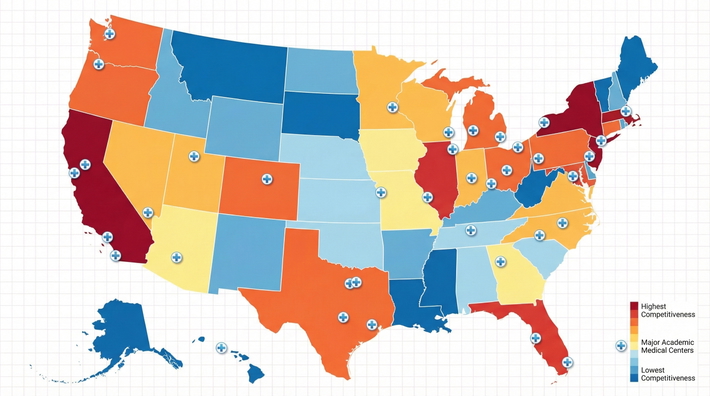
You are here
It is late June of MS4. Step 2 is either done or looming. ERAS is not open yet, but you can see the countdown clock in your head. You keep refreshing your email, waiting for something to happen.
Nothing is happening.
Except this is the month where people who match where they actually want to live stop drifting and start aiming. MS4 summer is where regional connections get built, quietly, in emails, calendars, and hallway conversations.
You want a specific region. Midwest academic centers. Or Pacific Northwest community programs. Or “within 2 hours of my partner’s job in Atlanta.” Whatever it is, the clock has started.
Here is how to use MS4 summer, week by week, to build real regional connections before ERAS opens.
Late June (Weeks -10 to -8): Pick Your Region and Map the Terrain
At this point you should stop saying “I am open to anywhere” if that is not actually true. Regions matter. Programs know it. Pretending otherwise is how you end up with 60 applications and no coherent story.
Step 1: Define your regional target(s) – 2–3 max
By the last week of June, you should have:
- 1 primary region (example: “Mid-Atlantic – Philly, Baltimore, D.C. corridor”)
- 0–2 secondary regions that are defensible (family, partner, prior schooling)
If you are vague, your emails and personal statement will also be vague. And vague applicants do not rise to the top of rank meetings.
Step 2: Build a regional program list spreadsheet
You are not guessing; you are building a working map.
| Column | Example Entry |
|---|---|
| Region | Pacific Northwest |
| Program Name | Oregon Health & Science Univ (OHSU) |
| City / State | Portland, OR |
| Type | Academic |
| Connection Type | None / Weak / Moderate / Strong |
| Known Contact | Dr. Smith (alum, IM attending) |
| Step 2 Policy | Required for interview / for ranking |
By the end of June, you should have:
- 15–25 programs in your primary region
- 10–20 total in any secondary region(s)
- At least a rough “connection” rating, even if it is just “None – yet”
Step 3: Audit your existing regional ties
Sit down and actually list:
- Where you grew up / went to high school / college
- Family locations (parents, siblings, spouse / partner)
- Prior work or volunteer history in a region
- Faculty at your school with training history in your target region
You are looking for things that can plausibly go into:
- Personal statement regional paragraph
- A short line in emails (“I grew up in Spokane and plan to build my career in the Northwest”)
- Application geographic preferences if the specialty uses them
This is the raw material. You will polish it later.
Early July (Weeks -8 to -6): Start Quiet Outreach and Align Your Rotations
By the first week of July, you should be doing two things in parallel: (1) lining up away or “home-adjacent” rotations that reinforce your region, and (2) beginning low-stakes contact with the region.
Rotation strategy for regional signaling
If your schedule is still flexible for Aug–Oct:
- Prioritize:
- One away or “visiting” elective in your primary region, if possible
- A home rotation that is clearly aligned with the type of program you want (academic vs community, safety-net vs private)
- Avoid:
- Random electives in far-flung places with no coherent story
- Stacking all your strongest rotations in regions you do not actually want to live
If away rotations are closed or full, you still have options:
- Regional tele-rotations or virtual electives
- Being the best possible student for regional faculty at your home institution who have trained/worked where you want to go
First round of emails: faculty and alumni, not programs
At this point you should not be cold-emailing program directors with “I love your program” novels. That comes later, targeted. Now you:
Identify 5–10 faculty with ties to your region:
- Trained there (residency or fellowship)
- Former faculty there
- Co-authored with people there
Send short, specific emails. Example:
- Subject: “MS4 seeking advice on [Region] programs in [Specialty]”
- 4–6 sentences:
- Who you are
- Region you are targeting
- Quick CV highlights (Step 2, key experiences)
- One clear ask: “Could I get 10–15 minutes of your advice about programs in [region] and whether there is anyone you would suggest I speak with?”
Do not ask for a letter in this first contact. Ask for advice and names. The letters and calls come later.
Mid–Late July (Weeks -6 to -4): Convert Advice into Introductions
By mid-July, you should be getting replies. Some will be useless: “Apply broadly. You will be fine.” Ignore these. Others will contain gold: “I know the PD at [X]. I can reach out.”
Here is what you do, week by week.
Week -6: Track every name and connection
You now maintain a live “regional connections” tab (separate from your program map):
| Contact | Role | Region | Strength | Last Contact | Next Step |
|---|---|---|---|---|---|
| Dr. Lee | Alum, IM at OHSU | Pacific NW | Weak | 7/12 email | Send CV, 7/20 |
| Dr. Patel | PD friend at Penn | Mid-Atlantic | Moderate | 7/14 Zoom | PD intro August |
| Dr. Johnson | Associate PD, local IM | Southeast | Strong | 7/10 mtg | Ask for call |
If you do not track, you will lose threads. And people do not like being asked for the same thing twice.
Week -5: Ask explicitly for regional insight
In your short Zoom or hallway conversations, you should ask very targeted questions, for example:
- “Which 3–5 programs in [region] seriously care about ties to the area?”
- “Which ones are realistic with my Step 2 and CV, and which are stretch?”
- “If I had to prioritize 5 programs for extra outreach, which would you choose?”
Then the follow-up line that matters:
- “If you know anyone at those specific programs, I would be grateful for an introduction closer to ERAS opening.”
You are planting that seed early, so it does not feel abrupt in late August when you circle back.
Inline timeline view
Here is roughly what your July should look like:
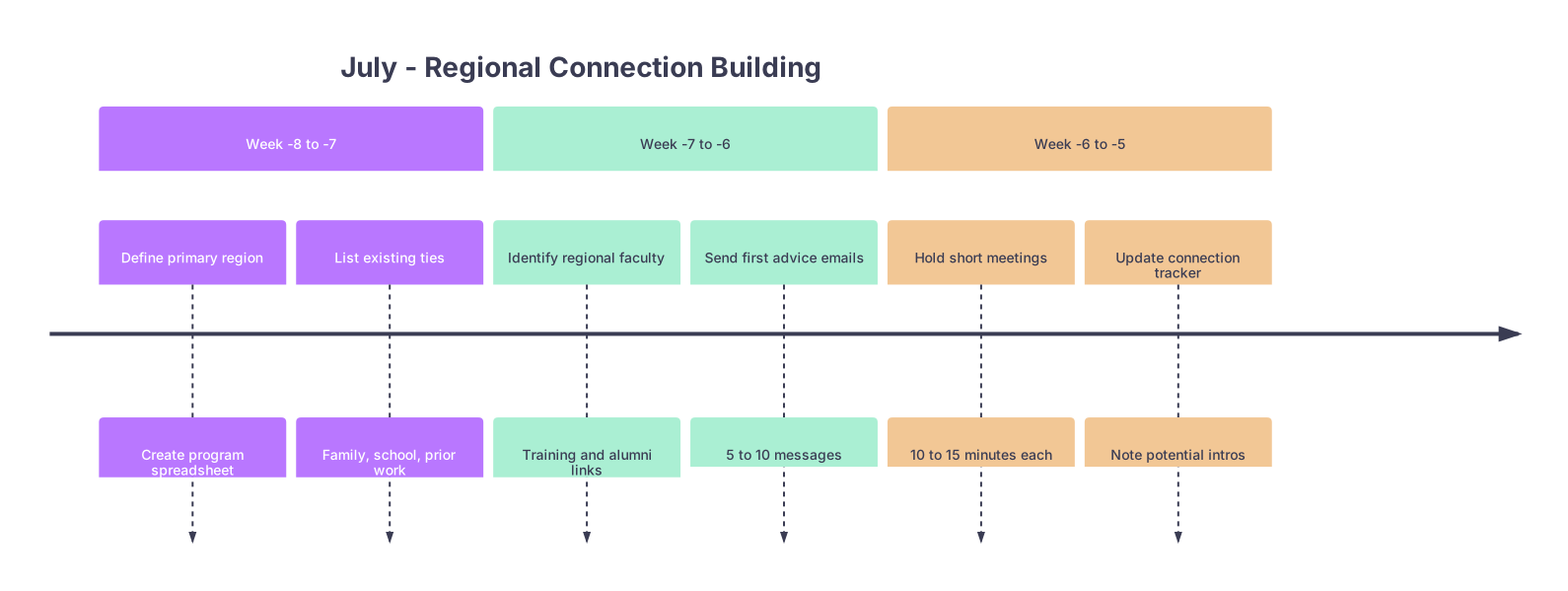
| Period | Event |
|---|---|
| Week -8 to -7 - Define primary region | Create program spreadsheet |
| Week -8 to -7 - List existing ties | Family, school, prior work |
| Week -7 to -6 - Identify regional faculty | Training and alumni links |
| Week -7 to -6 - Send first advice emails | 5 to 10 messages |
| Week -6 to -5 - Hold short meetings | 10 to 15 minutes each |
| Week -6 to -5 - Update connection tracker | Note potential intros |
Early August (Weeks -4 to -2): Shift from Planning to Presence
ERAS opening is close. Programs are thinking about interview season. At this point you should be visible in your target region in at least one concrete way.
If you have an away rotation in your region (ideal scenario)
During the first 1–2 weeks of that rotation:
- Show up early, do good clinical work. Obvious, but still neglected.
- Identify:
- The APD(s)
- Chief residents
- Any faculty who seem to “run things” informally
By the end of week 2 you should:
- Have asked the chiefs: “If I am seriously interested in this region, how do applicants show that in a way that is meaningful to the program?”
- Attend any resident conferences, happy hours, or informal teaching sessions
- Ask for a brief meeting with a faculty member who is known to be involved in selection (APD, core faculty). Keep it 10–15 minutes, framed as “I am interested in this region and would value any advice.”
You are not asking for an interview. You are asking for advice and explicitly flagging regional interest.
If you do not have an away rotation in-region
You can still project presence. Use:
- Virtual info sessions / open houses
- Email plus Zoom with regional faculty
- Alumni who are current residents
By early August you should have attended at least 2–3:
- Regional program webinars
- Resident panels
- Specialty society “meet the program” sessions focused on your region
You do not just log in and lurk. You:
- Ask one intelligent question with your name visible
- Follow up later if it makes sense (“I appreciated your comments on X… I am very interested in practicing in [region]…”)
Regional signal in your personal materials (draft phase)
By week -3, you should have a draft personal statement and CV that actually reflect your regional story. That means:
- One short paragraph (2–3 sentences) in your personal statement about:
- Why that region
- How your life/values/family/career align with it
- CV updated with:
- Region-connected experiences not buried in random sections
- Address, if you have a relevant one (for example, parents’ address in the region if you genuinely plan to return there and can explain it)
Late August (Week -2 to 0): ERAS Opens – Deploy Targeted Regional Outreach
This is where a lot of people panic and blast 100 programs with generic “I love your program” messages. Do not do that. You are surgical here.
Right as ERAS opens (or just before submission)
By this point you should have:
- Finalized your program list with:
- A core group of 8–12 top-priority programs in your primary region
- 5–10 “would be happy here” programs in that region
- A short, honest regional paragraph in your personal statement
- Your geographic preferences on ERAS (if your specialty uses them) aligned with what you have been saying for two months
Who you email, and when
Use a tiered approach:
Tier 1 – Programs where you have a human connection
- Someone has said: “I know the PD/APD there” or “I can mention your name”
- Action:
- Email your local contact: “ERAS is now open; I submitted my application today. I ended up applying to [Program X, Program Y] in [region]. If you still feel comfortable doing so, I would be very grateful for any introduction or brief note to colleagues there.”
- Then, if appropriate, separately email the program contact after your mentor has reached out.
Tier 2 – Programs in your primary region without a connection but high interest
- 5–8 programs max
- Short, specific email to PD or APD, sent around or just after submission. Example skeleton:
- Who you are (name, MS4, medical school)
- Clear regional tie (family, prior life there, spouse job, long-term plan)
- One or two quick fit points (research interest, community focus)
- Statement that you have already applied through ERAS and are very interested in training and staying in that region
Do not attach your full application. They can pull it from ERAS. Attach CV only if someone specifically asked for it previously.
Chart: How you should be spending “regional effort” over time
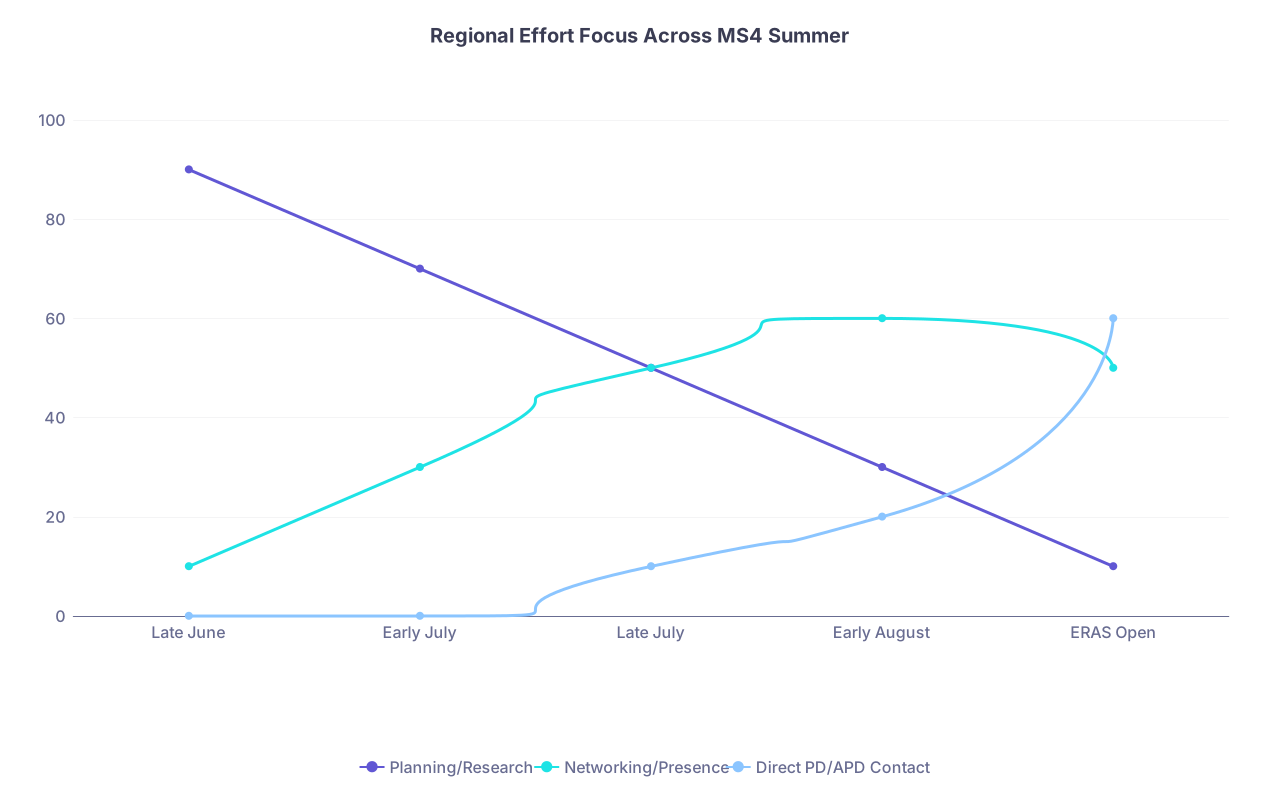
| Category | Planning/Research | Networking/Presence | Direct PD/APD Contact |
|---|---|---|---|
| Late June | 90 | 10 | 0 |
| Early July | 70 | 30 | 0 |
| Late July | 50 | 50 | 10 |
| Early August | 30 | 60 | 20 |
| ERAS Open | 10 | 50 | 60 |
The point: early summer is planning-heavy. Late summer is contact-heavy.
Early September (Weeks +1 to +3): Reinforce, Do Not Harass
At this point you should have submitted ERAS. Now the temptation is to keep emailing programs every 5 days. Resist it.
Your goal in early September is to:
- Stay gently visible in your region
- Avoid becoming the name everyone rolls their eyes at in the selection meeting
What you do in these weeks
On-service behavior in your region
- If you are on a rotation in or near your target region:
- Be the student residents want to work with
- Show consistent interest in the local health system, population, and training environment
- You do not have to say “I love this region” every day. Your questions and engagement will give it away.
- If you are on a rotation in or near your target region:
Program events and follow-up
- Attend any additional open houses, Q&A sessions, or specialty/regional fairs
- If you spoke to someone there previously, you can send a short follow-up note:
- “It was great hearing more about [X aspect] yesterday. I remain very excited about the possibility of training in [region], and especially at [program]. Thank you again for your time.”
Ask mentors strategically for a second push
- If you still have no interview movement from a top regional program by late September and you have a strong relationship with a mentor:
- A single, targeted “checking in” note from them to their contact can help
- You do not ask for this for 10 programs. Pick 1–3 where your story fits well and where you already have a connection.
- If you still have no interview movement from a top regional program by late September and you have a strong relationship with a mentor:
Mid–Late September (Weeks +4 to +6): Reality Check and Course Correction
By this point, some specialties are already sending interview invites. Others are slower. But you will have some data.
At this point you should sit down with your spreadsheet and look at:
- How many interviews you have in your target region
- Whether there is a pattern:
- Only small community programs interested?
- Only academic centers?
- Only programs where you had a human connection?
If regional interest is weaker than hoped
You may need to:
- Expand the radius:
- From “only city X” to “city X plus 2–3 neighboring cities”
- From a single metro area to the full state or adjacent states
- Ask blunt questions to trusted faculty:
- “Given my current interview numbers, am I overconcentrated in this region?”
- “Should I be more flexible geographically this cycle?”
Sometimes the honest answer is: your scores, letters, or CV do not support a tight regional lock. Better to hear it in late September than in March.
Visual: Regional interview distribution
If you actually track your invites by region (you should), you get a quick view like:
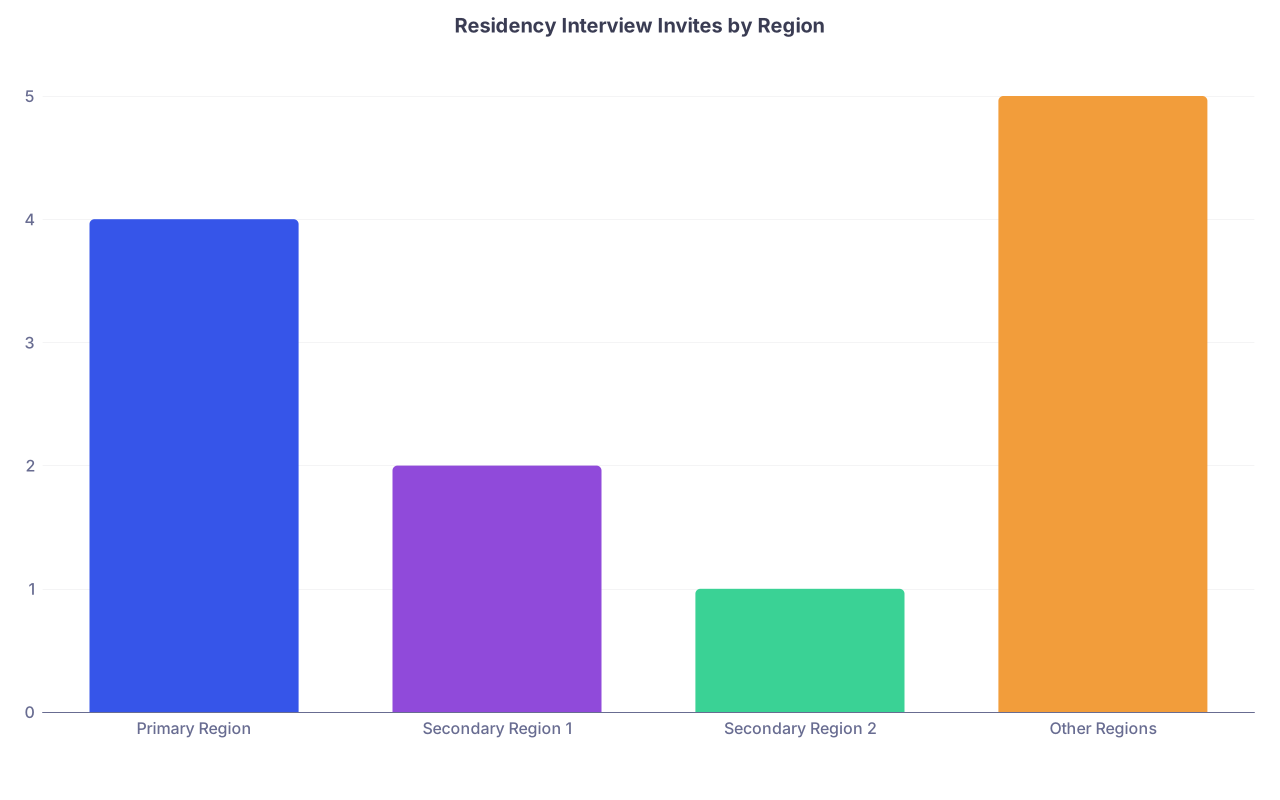
| Category | Value |
|---|---|
| Primary Region | 4 |
| Secondary Region 1 | 2 |
| Secondary Region 2 | 1 |
| Other Regions | 5 |
If “Primary Region” is at zero and “Other Regions” is high, your story and signals did not land. That matters for future steps, but MS4 summer gave you the best shot.
Common Mistakes in MS4 Summer Regional Strategy
Let me be blunt about what I see every year.
“I will just say I am flexible” while actually caring deeply about one region.
- Programs can tell when your story is generic.
- You end up with a scattered list and no narrative.
Emailing PDs too often and too early.
- Random June/early July “I love your program” emails get ignored or forgotten.
- Better: build the network first, let introductions flow closer to ERAS opening.
Not looping faculty back in once ERAS opens.
- If someone gave you advice in July, they expect a quick follow-up in August:
- “Thank you again for your guidance. I ended up applying to [X, Y, Z] programs in [region] as you recommended.”
- This is how you stay in their working memory when they chat with colleagues.
- If someone gave you advice in July, they expect a quick follow-up in August:
Telling different stories to different regions and getting caught.
- Do not tell Region A, “I am committed to staying here long-term” and Region B the same thing if they are clearly incompatible.
- Word travels. PDs talk.
Quick Gantt: Your MS4 Summer Regional Plan
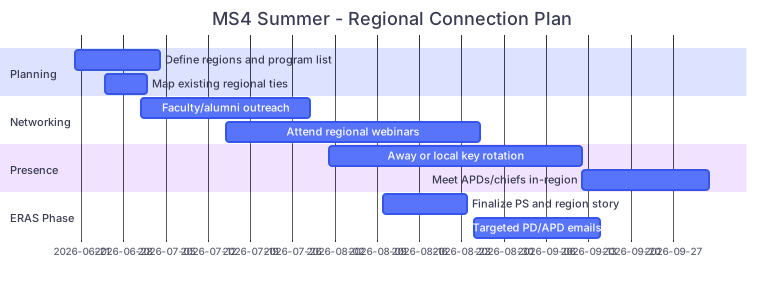
| Task | Details |
|---|---|
| Planning: Define regions and program list | a1, 2026-06-20, 2w |
| Planning: Map existing regional ties | a2, 2026-06-25, 1w |
| Networking: Faculty/alumni outreach | b1, 2026-07-01, 4w |
| Networking: Attend regional webinars | b2, 2026-07-15, 6w |
| Presence: Away or local key rotation | c1, 2026-08-01, 6w |
| Presence: Meet APDs/chiefs in-region | c2, after c1, 3w |
| ERAS Phase: Finalize PS and region story | d1, 2026-08-10, 2w |
| ERAS Phase: Targeted PD/APD emails | d2, 2026-08-25, 3w |
Three things to remember
- By the end of June, you should have picked your region and built a real program map, not just vibes.
- July and early August are for building human connections and presence in that region, not spamming PDs.
- When ERAS opens, you should already have a coherent regional story, a short list of high-priority programs, and a few mentors ready to quietly vouch for you where it actually matters.