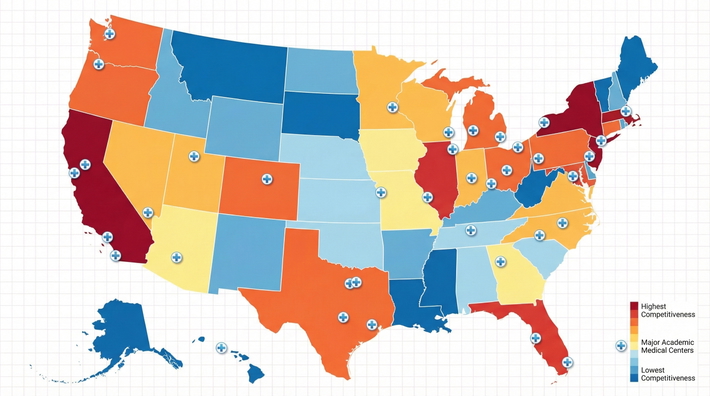
The biggest mistake MS3s make in spring is letting rotations “just happen” instead of weaponizing them for their target region.
You are not choosing random clerkships anymore. You are building a regional résumé. Here is the month‑by‑month, week‑by‑week way to lock in rotations that actually move you toward residency in the place you want to live.
Big Picture: Your Regional Strategy Check (Early March)
At this point you should stop thinking “specialty first, region second.” For MS3 spring, flip it:
- Region.
- Network.
- Then specialty nuance.
If you ignore region now, you will be the MS4 scrambling for last‑minute aways in places that have already filled.
First 1–2 weeks of March: Clarify your regional target
Block out one evening. No notes. Just you, a map, and brutal honesty.
You need clear answers to:
Primary region (one of these should be explicit):
- Single metro (for example: “Boston area”)
- Multi‑state region (for example: “Upper Midwest – MN/WI/IL”)
- State‑locked (for example: “I must end up in Texas”)
Flex regions:
- “I prefer Pacific Northwest, but I would be okay with California academic centers”
- “Northeast core, but I will accept DC/Baltimore as ‘adjacent’”
Then, at this point you should:
- Write down 8–12 residency programs in or near your target region.
- Mark them as:
- “Dream”
- “Realistic”
- “Safety / geographic foothold”
Now, convert that list into clinical rotation targets.
| Program Priority | Rotation Goal | Type of Experience |
|---|---|---|
| Dream | Audition/away rotation | Sub-I / Acting Internship |
| Realistic | Home rotation with known faculty | Core or early sub-I |
| Safety | Community affiliate rotation | Elective or sub-I |
At this point you should understand: Every open slot you have from July–January is either helping or hurting your ability to end up in that region. There is no neutral rotation.
March: Map Your School’s Rotation System Onto Your Region Goals
Schools vary. Some are rigid; some are chaos. You need to know which game you are actually playing.
Week 2–3 of March: Decode your rotation structure
At this point you should:
Pull:
- Your clerkship calendar (MS3 and early MS4 if available)
- Away rotation policies
- VSLO/VSAS timeline information
- Any “must be in town” teaching blocks or capstones
Identify:
- Months that must be at your home hospital
- Months with any flexibility (community sites, affiliates, electives)
- True open electives (gold)
You want a one‑page grid that looks roughly like this:
| Month | Status | Flexibility |
|---|---|---|
| Jul | Core IM | Home only |
| Aug | Core Surg | Home + 1 affiliate |
| Sep | Elective | Open (away allowed) |
| Oct | Sub-I | Home or outside |
| Nov | Elective | Open (away allowed) |
Now overlay your region plan on this grid.
Late March: Timing Your Region‑Focused Rotations
The timing of your region‑aligned rotations is not random. It affects letters, interviews, and how programs perceive your interest.
At this point you should understand the rough ERAS reality:
- ERAS opens to programs mid‑September.
- Programs start reviewing heavily late September–October.
- Audition rotations July–September are prime for early impressions and letters.
- October–November aways can still help, but mostly for:
- Late letters
- Showing regional seriousness
- Backup or secondary specialties
So, by the last week of March you should:
Choose your primary region‑tied months:
- Ideal away/sub‑I months: July, August, September.
- Acceptable: October.
- Late / mostly signaling: November.
Decide your letter strategy:
- One strong home sub‑I letter (anchor).
- One strong away letter in target region.
- One additional core/specialty letter as needed.
Now your calendar should have 2–3 months circled in red: these are your region‑critical rotations.
Early April: Build Your Regional Rotation Shortlist
This is the part most students skip. They jump into VSLO blind. Do not.
Week 1–2 of April: Program and hospital scouting
At this point you should:
For each target region, list:
- 3–5 academic centers
- 2–4 strong community programs
- Any major affiliates of your home school
For each, answer:
- Do they take visiting students?
- Through VSLO or their own portal?
- Which rotations are available in your target specialty?
- Do they have “sub‑I / acting internship” options labeled?
- Are there “regional pipeline” electives (rural track, community track, etc.)?
You are looking for rotations that prove two things:
- You can function at that program’s level.
- You are genuinely interested in their city/region.
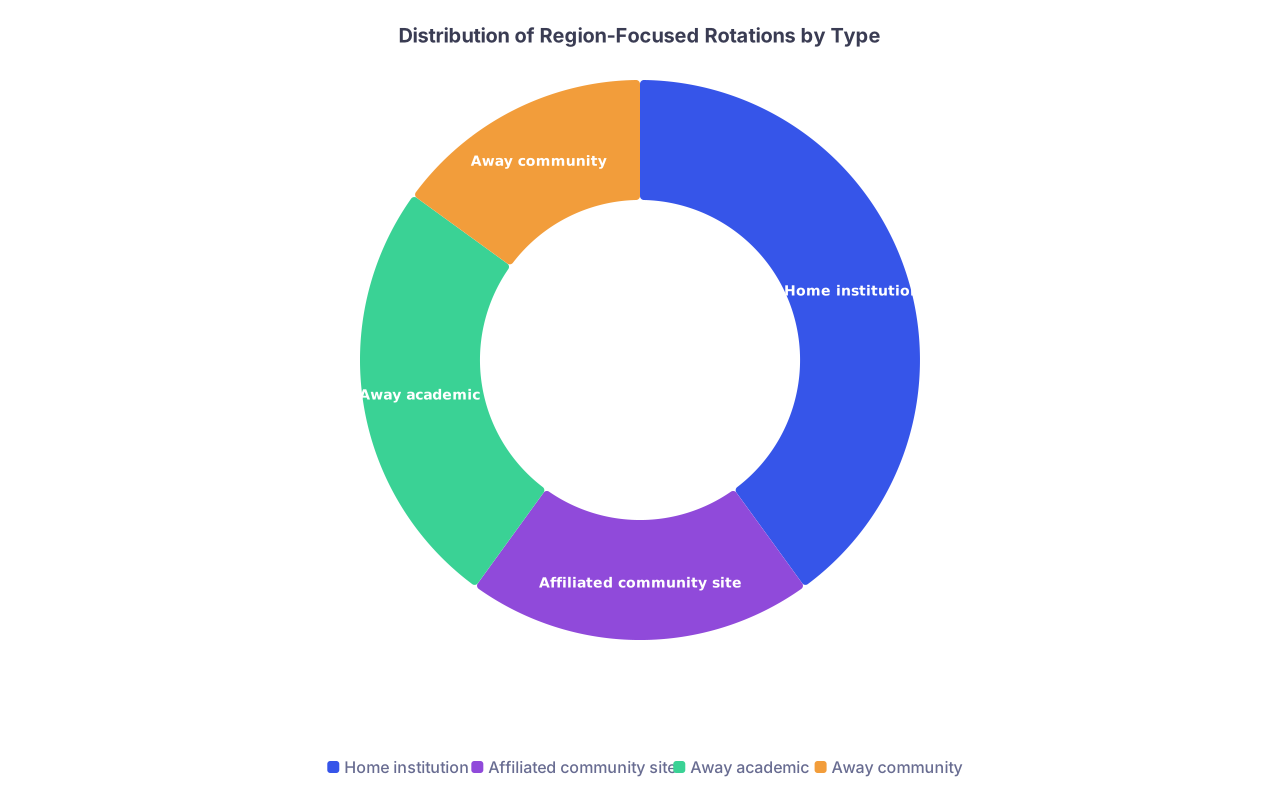
| Category | Value |
|---|---|
| Home institution | 40 |
| Affiliated community site | 20 |
| Away academic | 25 |
| Away community | 15 |
Week 3–4 of April: Prioritize by strategic value
Rank potential rotations using three questions:
- Will this rotation directly expose me to faculty who sit on the residency selection committee?
- Will this rotation create a letter that programs in this region respect?
- Will this rotation prove regional commitment? (Same state, same metro, or historically connected pipeline.)
At this point you should ruthlessly cut:
- Rotations with minimal resident contact.
- Pure “observer” or research‑only months that do not yield clinical letters.
- Random electives in your target region that have zero link to your specialty or desired programs.
You want 4–6 serious options for away/sub‑I slots that actually matter.
Late April – Early May: Application and Paperwork Phase
This is the boring, bureaucratic month. Skip it and you lose your spot.
Week 1 of May: Lock home and affiliate rotations first
Before you go chasing aways across the country, fix your home schedule.
At this point you should:
- Confirm:
- When your home sub‑I in your chosen specialty can happen.
- Which affiliates in your target region are available (some schools have satellites in your desired state—those are gold).
- Submit any internal scheduling forms for:
- Early sub‑Is (July–September).
- Region‑adjacent electives (like a community hospital rotation in the state next to your target city).
Week 2–4 of May: Submit away applications intelligently
This is where timing wins or loses.
Most away programs:
- Open VSLO late spring.
- Fill July–August spots quickly.
- Use “demonstrated interest in region/program” as a soft filter.
At this point you should:
Prepare a region‑aware personal statement blurb for VSLO:
- Not “I just love your program.”
- Instead: clear geographic and life reasons.
- Example: “My partner and extended family are in the Pacific Northwest, and I intend to build my career in this region. Training at a program that serves this patient population long term is a priority for me.”
Apply in tiers:
- Tier 1 (dream / high‑value programs) – apply as soon as portals open.
- Tier 2 (realistic, still strong) – one week later.
- Tier 3 (safety / back‑up aways) – after you see early responses.
Do not throw 20 random apps at the wall. That looks unfocused and drains money.
June: Confirmations, Contingencies, and Fine‑Tuning
By early June, some away decisions start trickling in. Others are silent. This is where people panic and make dumb choices. Do not.
Week 1–2 of June: Triage your responses
At this point you should:
Sort away responses into:
- Accepted (with month offered).
- Waitlisted.
- No response / pending.
- Denied.
For accepted rotations:
- Check whether the month conflicts with:
- Home sub‑I.
- Required in‑person exams or OSCEs.
- Any “must attend” school activities.
- Check whether the month conflicts with:
If a high‑value region rotation conflicts with a movable home elective, you move the elective. Not the other way around.
Week 3–4 of June: Build a contingency map
You need a backup regional plan. People get sick. Schedules change. Programs ghost.
At this point you should:
Have:
- 1–2 confirmed away/sub‑I rotations in or very near your target region.
- 1 home sub‑I in your specialty.
- 1–2 electives that can pivot regionally if an away opens late.
Create a “if X falls through, then Y” list:
- If July away cancels → Move August home sub‑I into July; fill August with a late‑cycle away if possible.
- If I do not get any aways in my top metro → Add a community affiliate or in‑state program to maintain regional story.
This is not paranoia. I have seen schools cancel external electives two weeks before start because of housing or preceptor issues. The students who had contingencies survived.
July–September: Executing Region‑Critical Rotations
Now you are on the ground. This is where you prove that you are not just region‑interested but region‑ready.
During each region‑aligned rotation, by week
Week 1: Establish your story locally
At this point you should:
- Tell your residents and attendings early:
- “I am hoping to match in this region and would really like to understand how training and practice look here.”
- Ask a senior resident directly:
- “Who here is really involved in the residency selection process that students should get to know?”
Your goal by the end of week 1:
- One attending who knows your name and your regional goal.
- One resident who is informally mentoring you.
Week 2–3: Perform at letter‑earning level
You are not just “doing a rotation.” You are auditioning for a regional letter.
At this point you should:
- Aim to work most closely with 1–2 key faculty (not 10 people superficially).
- Ask for feedback mid‑rotation:
- “I am hoping to get a letter that supports my application to programs in this region. What can I do over the next two weeks to be at that level?”
If they hesitate or are lukewarm, you adjust. Or you shift your letter hopes to another faculty member.
Week 4 (or final week): Lock the letter and the signal
Before you leave, at this point you should:
- Ask for a letter while they can still picture you on the team.
- Explicitly mention your regional goal again:
- “I am targeting residency programs in this region and would be grateful for a letter that speaks to both my clinical work and my fit for training here.”
Also:
- Ask about local program culture:
- “If I apply here, what matters most to the selection committee?”
- Ask if they would be comfortable with you emailing them in the fall after ERAS submission. Most will say yes.
October–December: Region Signaling and Late Adjustments
By mid‑fall, your rotations are largely set. The regional game shifts to signaling and polishing.
October: Align your ERAS story with your rotations
At this point you should:
- Make sure your ERAS application clearly reflects:
- Region‑aligned rotations listed prominently.
- Any region‑specific volunteering or work.
- Personal section that connects your story to the region (without sounding desperate).
If you did more than one rotation in your target region, highlight that cluster. Programs notice geographic patterns.
November–December: Backup regional threads
Not everyone will land in their first‑choice city. You need a broader regional footprint that still feels coherent.
At this point you should:
- Use remaining electives for:
- In‑state community programs.
- Adjacent metro areas that share fellowship networks or referral patterns with your target city.
- Keep emailing key regional mentors:
- Updates when you submit ERAS.
- A brief note if you will be in town for an interview and want to stop by a conference or grand rounds.
You are playing the long game here. Even if you match slightly outside your dream metro, a strong regional footprint makes later fellowship or job movement easier.
Visual: Year Overview for Region‑Focused MS3/MS4 Planning
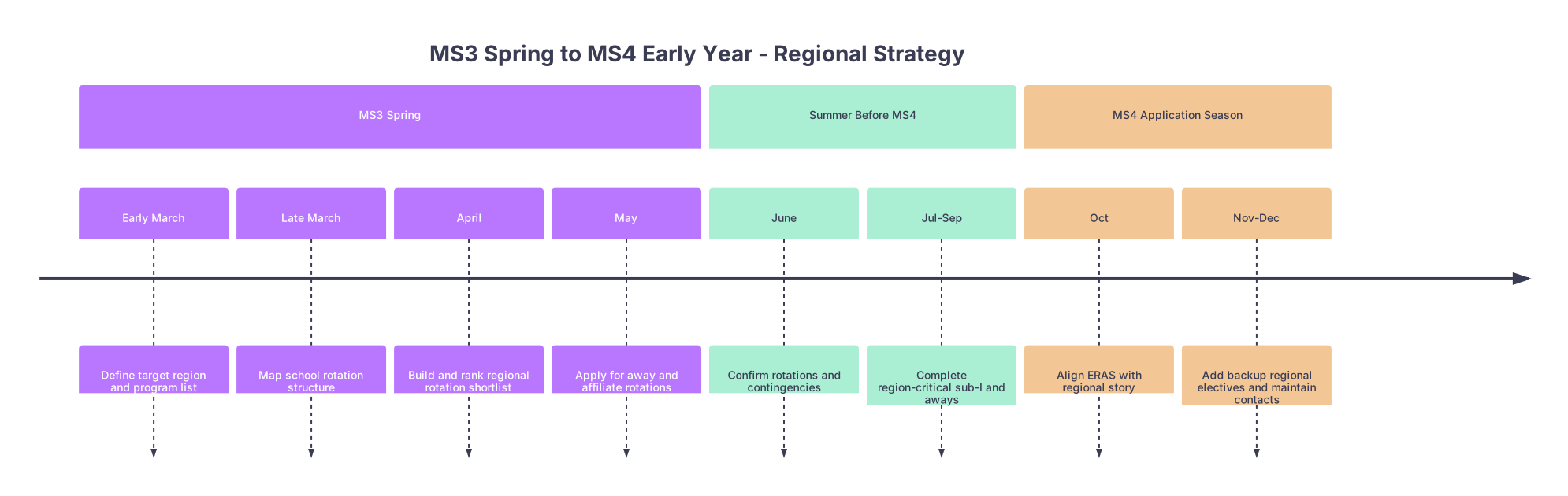
| Period | Event |
|---|---|
| MS3 Spring - Early March | Define target region and program list |
| MS3 Spring - Late March | Map school rotation structure |
| MS3 Spring - April | Build and rank regional rotation shortlist |
| MS3 Spring - May | Apply for away and affiliate rotations |
| Summer Before MS4 - June | Confirm rotations and contingencies |
| Summer Before MS4 - Jul-Sep | Complete region-critical sub-I and aways |
| MS4 Application Season - Oct | Align ERAS with regional story |
| MS4 Application Season - Nov-Dec | Add backup regional electives and maintain contacts |
Quick Comparison: Weak vs Strong Regional Rotation Strategy
| Aspect | Weak Approach | Strong Approach |
|---|---|---|
| Region definition | “Coasts or big cities” | Clear primary metro/region |
| Away timing | Random October elective | July–September sub-I in target region |
| Site selection | Wherever had open spots | Programs with real residency influence |
| Letters | All from home, generic | At least one strong letter from region |
FAQ (Exactly 4 Questions)
1. What if my school does not allow away rotations before October?
Then your home and affiliate rotations become even more critical. At that point you should lock in:
- A sub‑I at your home institution that has existing ties to your target region (graduates who match there, faculty who trained there).
- Any satellite or affiliate sites physically located in or near your target region. You can still do later aways for signaling, but your letters will likely come from July–September home rotations, so choose those services wisely.
2. How many region‑aligned rotations do I actually need?
Two is usually enough if they are high quality:
- One home sub‑I with a strong letter.
- One away or affiliate in the target region. A third can help if you are switching specialties late or aiming for an ultra‑competitive field, but beyond that you hit diminishing returns. The quality of your performance and letters matters more than the raw count of region‑marked months.
3. Should I prioritize a famous program outside my region over a mid‑tier program inside my region?
If your top priority is geography, you usually pick the mid‑tier program inside your target region. Programs care more that you are serious about their city and patient population than that you rotated at a brand‑name place in a different time zone. A strong letter and visible performance at a realistic in‑region program will do more for your regional match odds than a tourist month at a name‑brand coastal hospital.
4. How obvious should I be about wanting to stay in a specific city?
Reasonably obvious. At this point you should be direct but not clingy. It is fine—even smart—to say on rotation:
- “I am aiming to train in this region long term.”
- “My family is here and I see my career here.” Programs like people who are likely to stay. Just avoid sounding like you will resent them if they do not rank you first. Confident interest, not desperation.
Key points:
- By MS3 spring, every open month on your schedule is a regional asset or a missed opportunity—treat it that way.
- Prioritize early (July–September) sub‑Is and aways in your target region, and use them to generate strong, region‑specific letters.
- Keep a contingency plan and a coherent regional story that runs through your rotations, your letters, and your ERAS application.