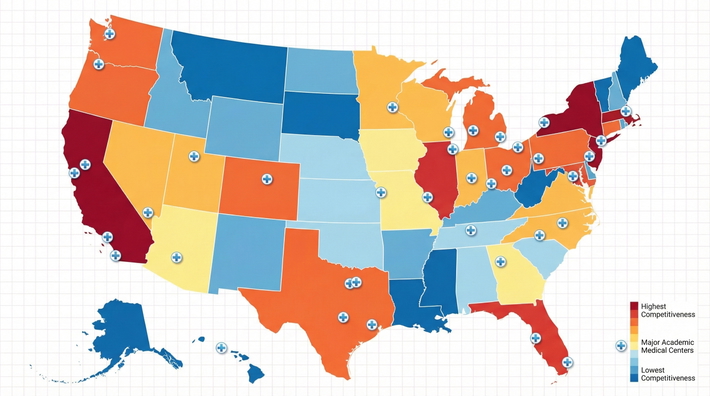
The worst time to decide whether to leave your region for fellowship is after ERAS opens.
You need to start that decision a full year earlier—quietly, deliberately—before everyone else starts freaking out about letters and case logs.
Here’s your timeline.
18–24 Months Before Fellowship Start: Quiet Reality Check
At this point you’re PGY-1 or very early PGY-2 in most specialties.
You do not need a perfect plan. You do need a working compass.
At this point you should:
- Decide if you’re even open to leaving your current region.
- Get brutally honest about your competitiveness.
- Start mapping where your specialty actually trains people.
Week-by-week (first 2–3 months of thinking about it)
Week 1–2: Clarify your priorities before geography blinds you.
Answer these in writing, not in your head:
- Top 3 career goals after fellowship
- Example: Be academic cardiology faculty; high-volume private practice; hybrid community + teaching.
- Non-negotiables
- Partner’s career? Kids in school? Need to be within X hours of family?
- Lifestyle tolerances
- Could you realistically live in:
- A very cold place?
- A very expensive coastal city?
- A politically/culturally different region?
- Could you realistically live in:
Do this now, before a shiny big-name program in a city you hate seduces you.
Week 3–4: Understand your specialty’s geography reality.
Some specialties are region-locked by default. Others are national free-for-alls.
Look at recent match data and where people train from your residency. You’ll usually see patterns:
- Cards, GI, Heme/Onc — strong regional clustering but national movement is common for top applicants.
- Surgical fellowships — heavy “home court” advantage but people move coasts all the time for volume/brand.
- Peds subspecialties — more dispersed; you may have to leave if your region has few programs.
- Niche fellowships (advanced IBD, structural heart, epilepsy surgery) — often limited centers; staying local might not even be an option.
At this point you should:
- Make a simple 3-column list:
- “Would love to be here”
- “Could live here”
- “Nope”
- Fill it with regions, not specific cities yet:
- Northeast corridor, Mid-Atlantic, Deep South, Mountain West, Pacific Northwest, etc.
You’re not committing to anything. You’re just being honest.
15–18 Months Before Fellowship Start: Data, Not Vibes
Now you’re late PGY-1 or early-to-mid PGY-2. This is when casual thoughts about “Maybe I’ll leave” become actual strategy.
At this point you should:
- See if your CV matches the places you romantically want to live.
- Look at how far prior grads actually moved.
- Start testing your partner/family’s real tolerance for moving.
Month-by-month breakdown
Month 1: Look at your numbers vs programs.
Pull up 10–15 fellowship programs you think you’d want. Check:
- Do they take people from your region or mostly from their own backyard?
- Do you see graduates from programs like yours (academic vs community, top-tier vs mid-tier)?
- Are there patterns in research (basic/translational vs clinical/quality) that match what you’re doing?
Create a simple table like this for yourself:
| Program Region | Takes Outside Region? | Your CV Matches? | Alumni From Your Type of Residency? |
|---|---|---|---|
| Northeast | Frequently | Partial | Yes |
| West Coast | Rarely | Weak | No |
| Midwest | Often | Strong | Yes |
| South | Sometimes | Strong | Mixed |
You’ll quickly see which regions are genuinely open to outsiders and which are fortress-like.
Month 2: Dissect your residency’s history.
Ask your program coordinator or PD for:
- Last 5 years of fellowship matches
- Where people went for your specific field
- Who left the region and how strong they were
You’ll probably hear comments like:
- “People who did heavy research went to the coasts.”
- “Most stay within 2–3 states unless they’re dead set on leaving.”
- “We have a pipeline to X region for Y specialty.”
At this point you should:
- Mark which regions are realistic for you vs purely aspirational.
- Identify 1–2 grads who successfully left the region and ask them how they pulled it off.
Month 3: Have the hard conversation at home.
This is where residents screw it up. They fantasize about leaving but never align expectations with their partner/family.
Sit down and run through:
- A “we stay in-region” scenario
- A “we move anywhere for 1–2 years but return after” scenario
- A “we may move and actually like it more there” scenario
You are not promising anything. You are pressure-testing reality.
At this point you should:
- Decide if you’re willing to rank programs that make returning to your current region difficult.
- Clarify whether “must return after fellowship” is a true rule or a vague comfort idea.
12–15 Months Before Fellowship Start: Pre-ERAS Positioning
Now you’re solidly PGY-2 (for 3-year residencies) or later for longer ones. This is where leaving your region stops being theoretical.
Your research, electives, and networking need to align with geography strategy.
At this point you should:
- Choose between “stay regionally anchored” vs “market yourself nationally.”
- Decide which other regions to seriously target.
- Start building a presence that makes sense to programs in those regions.
Month-by-month
Month 1: Pick your default path and backup path.
You need a clear structure like:
- Primary plan: Stay in current region, maximize local/regional connections.
- Secondary plan: If not competitive locally, be flexible to Midwest/South.
or
- Primary plan: Go national, with priority for West Coast + Mountain West.
- Secondary plan: If that fails, anchor in home region as safety.
You cannot half-commit to 5 different regions and expect coherent letters and networking.
At this point you should:
- Circle 2–3 priority regions total (including your current one). More than that is usually dilution.
Month 2–3: Align your CV with your geographic story.
If you want to leave your region, your file has to tell a consistent narrative. Programs can smell random geographic flailing.
Examples:
- You grew up in the Midwest, trained in the South, now want to return to Chicago:
- Emphasize “returning home,” family support, long-term roots, understanding of Midwest practice patterns.
- You’ve only ever been in California but want New York:
- Highlight interest in dense urban medicine, specific academic centers, research collaborators there.
- You want to pivot from community-heavy region to academic East Coast:
- Start stacking academic signals now (posters, manuscripts, national meetings).
Also: target electives.
If your specialty allows away electives or “visiting resident” experiences, this is where they matter. Especially if you’re coming from:
- A smaller community program trying to break into a big academic region
- A different part of the country from where you ultimately want to settle
9–12 Months Before Fellowship Start: The Decision Point
This is pre-ERAS but close. Late PGY-2 / early PGY-3 (for IM, Peds), or equivalent in longer programs.
At this point you should:
- Decide, in principle, whether you're willing to move far for the right fellowship.
- Start building your actual program list with geography in mind.
- Lock in letter writers who understand—and support—your regional strategy.
Month 1: Build a first-pass program list by region
Do not start with “Top 20.” Start with a realistic, region-structured list:
| Region | Reach Programs | Target Programs | Safer Programs |
|---|---|---|---|
| Current region | 2–4 | 3–5 | 2–3 |
| Region A | 1–3 | 2–4 | 1–2 |
| Region B | 1–2 | 2–3 | 1–2 |
At this point you should:
- Decide which region you’d actually move to without resentment if you matched there.
- Remove any city you secretly know you’d hate enough to rank low no matter the program quality.
Because ranking somewhere you would never actually go is pointless. You’re not collecting interview invitations as trophies.
Month 2: Talk to your PD explicitly about leaving vs staying.
Do not be vague with leadership. Say it outright:
- “I’m strongly considering leaving the region for fellowship, especially X and Y regions. Where do you see realistic fits for me?”
- “If I stayed local vs left, how would that change my chances and future career options?”
You want concrete feedback like:
- “You’re competitive enough to go national in the Midwest and South, but the top coasts may be tougher.”
- “If you stay here, we can strongly support you for our affiliated fellowship.”
- “People from your profile have historically matched best in [these regions].”
At this point you should:
- Adjust your regional list up or down based on actual faculty input.
- Ask who they know at specific out-of-region programs you’re considering.
Month 3: Engage mentors in target regions.
If you’re serious about leaving your region, you need someone outside your zip code who knows your name.
- Reach out to people you’ve met at conferences or via shared publications.
- Have your PD or division chief send an email introduction to faculty at target programs.
This is not game-playing. This is how people actually move regions.
6–9 Months Before Fellowship Start: ERAS Season and Geographic Strategy
You’re now building and submitting your ERAS. This is where “Should I leave my region?” becomes “Here’s how I’m messaging relocation.”
At this point you should:
- Make your regional intentions crystal clear in your personal statement and interviews.
- Calibrate how widely you apply by geography vs competitiveness.
- Avoid sending mixed signals to local programs.
ERAS Application Month (around July)
In your application, your geographic choices are saying something whether you intend them to or not.
At this point you should:
Use your personal statement to explain geography—briefly.
- If leaving: one clean sentence about why you’re open to or seeking training in X/Y region.
- If staying: a concise note about regional ties and long-term plans there.
Avoid the “I’m open to anywhere” lie if it is not true.
Programs know most people have some constraints. Universal flexibility sounds fake.Balance local vs far-away programs intelligently.
Here’s how applicants typically distribute geographic choices by competitiveness level:
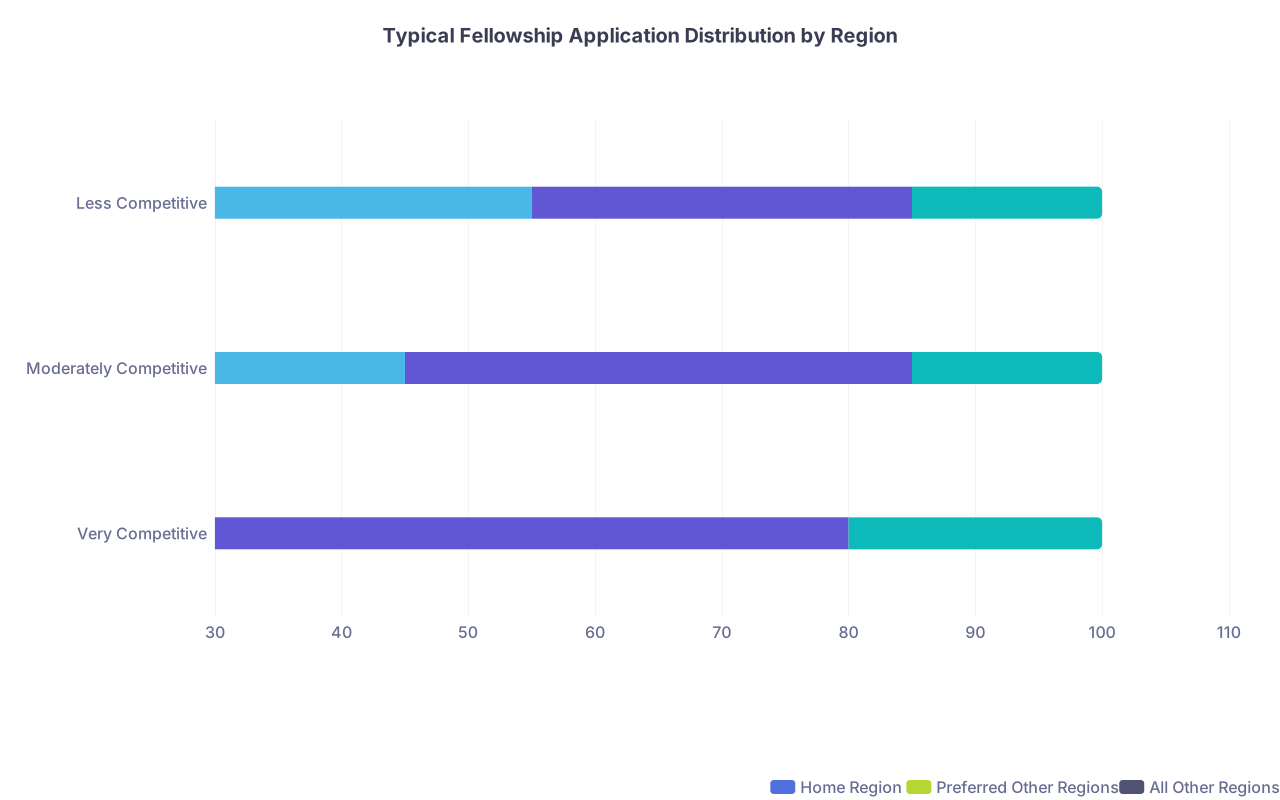
| Category | Home Region | Preferred Other Regions | All Other Regions |
|---|---|---|---|
| Very Competitive | 30 | 50 | 20 |
| Moderately Competitive | 45 | 40 | 15 |
| Less Competitive | 55 | 30 | 15 |
If you’re average-competitive and only apply to superstar coastal programs far away, you’re not “brave.” You’re just sabotaging yourself.
3–6 Months Before Fellowship Start: Interview Season Geography Triage
Now the fantasy meets reality. You see where you’re actually getting interviews.
At this point you should:
- Reassess how serious you are about leaving as invitations arrive.
- Read regional signals in how programs talk to you.
- Start forming a rank-list framework using geography as a major weight.
As interviews roll in (weeks to months)
Watch patterns:
- Do you get more love from your current region?
- Are certain other regions surprisingly receptive?
- Does one coast ignore you entirely while the other invites you enthusiastically?
At this point you should:
- Split interviews by geography:
- “Places I’d genuinely be excited to move”
- “Places I’d tolerate for 1–2 years”
- “Places I’d need an extraordinary program to justify”
On interview day: test for regional fit.
Ask specific questions that expose how they think about:
- Trainees from outside their region
- Long-term job placement (do they keep people locally? send them elsewhere?)
- Culture shock support (yes, that’s a thing)
You’re looking for cues like:
- “We love having people from different regions; half our fellows aren’t from here.” → Green light.
- “Most of our fellows stay in-state long term.” → Great if you want that; bad if you want to return home.
1–3 Months Before Fellowship Start: Rank List & Final Regional Call
This is when you stop theory-crafting and commit.
At this point you should:
- Decide whether leaving your region is a top-level priority or just another factor.
- Structure your rank list so you won’t resent your future self.
Step-by-step rank list building with geography
- First pass: rank by training quality only (case volume, match outcomes, mentorship).
- Second pass: adjust by geography reality:
- Family situation
- Cost of living
- Partner job options
- Childcare / schools
- Third pass: test every rank with this question:
- “If I matched here, would I be relieved, content, or devastated?”
At this point you should:
- Be honest if your supposed “dream coastal program” would actually make your life miserable.
- Put at the top only places you’d truly be okay moving to—even if they’re out of your comfort zone.
When You Absolutely Should Consider Leaving Your Region
Let me be blunt. There are clear triggers where staying put is the wrong move.
You should seriously consider leaving if:
- Your current region has weak or limited options in your subspecialty.
- You want a high-acuity or ultra-specialized practice that doesn’t exist where you are.
- Your long-term goal is academic leadership and your region is mostly community-based.
- There’s visible toxic politics around local fellowship selection that you’re on the wrong side of.
- You need a reset from a damaged reputation or complicated interpersonal history (it happens).
And you should be cautious about leaving solely because:
- “Everyone says I should leave.”
- “I’m bored of this city” (during residency burnout, which will follow you anywhere).
- “The big names are all on the coasts” (not always true, and not always relevant to your goals).
Big-Picture Timeline Snapshot
Here’s your process visually:
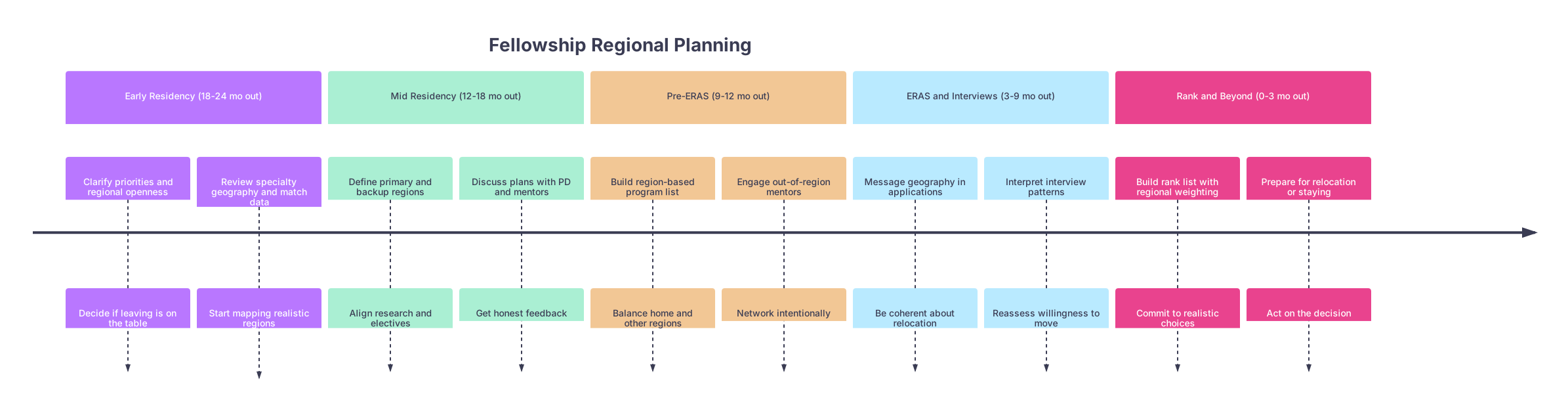
| Period | Event |
|---|---|
| Early Residency (18-24 mo out) - Clarify priorities and regional openness | Decide if leaving is on the table |
| Early Residency (18-24 mo out) - Review specialty geography and match data | Start mapping realistic regions |
| Mid Residency (12-18 mo out) - Define primary and backup regions | Align research and electives |
| Mid Residency (12-18 mo out) - Discuss plans with PD and mentors | Get honest feedback |
| Pre-ERAS (9-12 mo out) - Build region-based program list | Balance home and other regions |
| Pre-ERAS (9-12 mo out) - Engage out-of-region mentors | Network intentionally |
| ERAS and Interviews (3-9 mo out) - Message geography in applications | Be coherent about relocation |
| ERAS and Interviews (3-9 mo out) - Interpret interview patterns | Reassess willingness to move |
| Rank and Beyond (0-3 mo out) - Build rank list with regional weighting | Commit to realistic choices |
| Rank and Beyond (0-3 mo out) - Prepare for relocation or staying | Act on the decision |
Today, take one concrete step: open a blank page and write down your top three non-negotiables for fellowship life (training, family, geography). Once they’re on paper, circle the one you’d sacrifice last—training, location, or personal life. That single circle should drive every regional decision you make from this point forward.