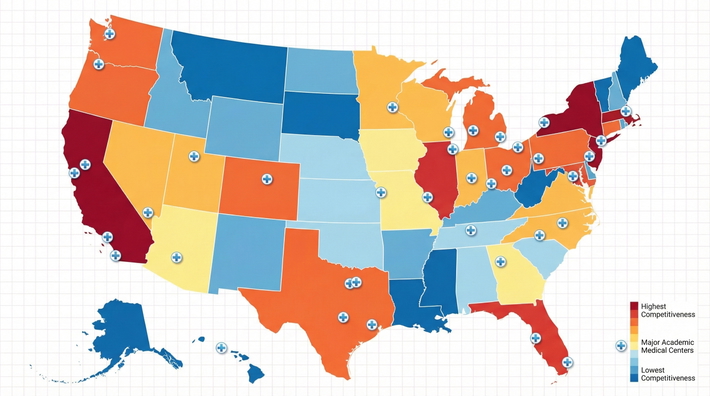
The residency system was not built for people who cannot move.
If family care obligations are tying you to one metro area, you are playing this game on hard mode. Not impossible mode. Hard mode. Different strategy.
(See also: Two-Body Problem: Coordinating Couples Match Across Regions for more.)
Let me walk you through what actually works when you must stay local—because a lot of standard “apply broadly, be flexible” advice becomes useless the second you have a parent on dialysis, a disabled sibling, a partner bound to a specific job, or a child whose stability is non‑negotiable.
Step 1: Get brutally clear on how “tied” you really are
“Single metro area” means different things in real life. You need to define your actual geographic box, in miles and minutes, not vibes and hope.
Ask yourself:
- What is your maximum commute time in bad traffic? Not ideal traffic. Worst case on a Tuesday at 5 p.m.
- Is it about daily proximity (you must physically be there every day) or rapid access (you can be 60–90 minutes away but must be able to respond in a few hours)?
- Is this obligation fixed (permanent disability of a parent) or time‑limited (a relative getting through chemo for 6–18 months)?
- Is remote support + paid help partially realistic, or truly off the table?
Write this down. Literally on paper. Because your whole strategy flows from this, and vague thinking will wreck your planning.
Think in distances attached to programs. For most people in this situation, here’s how it tends to fall:
| Constraint Type | Practical Residency Radius |
|---|---|
| Daily hands-on care (you’re the only caregiver) | Same city, ideally ≤30–40 min commute |
| Shared caregiver role with siblings/partner | Same metro area, ≤60–75 min commute |
| Rapid response (emergencies, weekly visits) | Same metro or nearby city ≤90–120 min |
| Primarily emotional/financial support | Wider region, but frequent flights/drives possible |
If your situation is in the first row—daily hands-on care and you’re the main person—the rest of this article is still relevant, but I’m not going to lie: the number of viable programs might be in the single digits. We plan accordingly.
Step 2: Map every single program in your orbit
You cannot afford to “generally know” the programs in your city. You need a map and a list.
Do this:
- Pull up Google Maps.
- Put in the address of the person you care for (or your home if that’s fixed).
- Draw mental (or literal) circles for 30, 45, 60, 90 minutes in rush‑hour conditions.
- Inside those circles, identify:
- All major academic centers
- Community hospitals
- Osteopathic programs (if relevant)
- Any satellite campuses or affiliated sites
Then build a table. Something like:
| Program | Specialty Breadth | Program Type | Commute (rush hour) |
|---|---|---|---|
| Metro University Hospital | Most specialties | Academic | 25–35 min |
| City Community Medical Center | IM, FM, Psych | Community | 15–20 min |
| Regional DO Hospital | FM, IM | Osteopathic | 45–55 min |
| Children’s Hospital | Peds, Med-Peds | Academic | 35–50 min |
You should know:
- Which specialties are actually available within your realistic radius
- Which institutions offer multiple residencies (IM, FM, psych, transitional year, prelim medicine, etc.)
- Which ones are historically IMG‑friendly or non‑traditional‑friendly if that applies to you
If you’re early (M1–M2 or premed), this list might heavily influence your specialty choice. Harsh truth: if your city has four family medicine programs and zero derm, ENT, or neurosurgery programs, you have to be very sure you want to fight that uphill battle and possibly blow up your family obligations for a long‑shot specialty.
Step 3: Decide how much you’re willing to bend on specialty
Here’s the tradeoff nobody says out loud:
If you are geographically inflexible, you often need to be more specialty‑flexible.
Not always. But often.
Basic reality:
- Competitive specialties + one metro area = extremely high risk.
- Broad specialties (FM, IM, peds, psych, prelim/TY) + one metro area = tough but manageable with the right strategy.
If you’re early in training and your family tie is long‑term or permanent, seriously weigh:
- Could you be happy in two or three different specialties?
- Are there “paths within a broad field” that hit your interests?
Example:- Love cardiology? Internal medicine then cards fellowship locally.
- Love kids but also adults? Med‑peds or peds then combined clinics.
- Love women’s health but OB/GYN is too limited locally? FM with women’s health focus.
If you’re already locked on a competitive field and your metro only has 1–2 programs in it, your situation calls for an “A plan” and “B plan”:
- A plan: apply to your dream specialty, but only to programs within your radius plus maybe 1–2 realistic regional backups.
- B plan: dual apply to a broader specialty that exists robustly in your city (e.g., IM or FM), and be ready to commit to it.
Do not let pride force you into an all‑or‑nothing scenario when lives (yours and your family’s) are involved.
Step 4: Build a narrative that justifies staying put—without sounding needy
Programs get hundreds of applicants who “like the city.” That is meaningless.
Your story needs to do three things:
- Explain clearly but succinctly why you’re tied to the area.
- Show that this constraint has made you more resilient and organized, not flaky.
- Reassure them that you won’t crumble under pressure or become a constant time‑off problem.
You do not need to bare your soul in graphic detail. You do need to be honest enough that the priority makes sense.
A tight version for your personal statement or supplemental:
“My parents immigrated here in their forties and my father’s progressive neurologic condition now limits his independence. I share primary caregiving responsibilities with my mother and brother, which are realistically only compatible with training in this metro area. Balancing clinical rotations with these responsibilities has forced me to be methodical with my time and extremely reliable for both my patients and my family.”
Notice what that does:
- Specific, but not melodramatic.
- Names the constraint.
- Immediately flips it into a competence signal.
You can then subtly echo this in:
- Your ERAS geographic preference signals (“I have strong ties to [Metro], where my immediate family and caregiving responsibilities are based.”)
- Interview answers when asked “Why here?” → You answer both “why this program” and “why this city” and tie in family support.
What you should avoid:
- Sounding like you expect constant schedule exceptions.
- Threatening tone (“I can only come here so you have to rank me.”)
- Oversharing private medical details about your family.
Step 5: Leverage every local connection like it’s your job
If you’re forcing the system to work in one metro, you don’t get to be casual about networking.
You need deep local roots, not just “I live here.”
Tactics that actually move the needle:
Rotate locally whenever humanly possible.
Sub‑I’s, electives, away rotations—spend them at the hospitals in your metro. Be the student whose name faculty remember when they’re in the rank meeting.Find a local mentor who has real pull.
Not just “nice attending I rounded with once.” A core faculty member, PD, or APD who can say in a meeting, “I’ve worked with this person, they’re rock solid, and they have a real reason to stay here.”Join department projects tied to your city.
Community health, QI projects, local clinic initiatives. You want to look like someone already invested in the community, not a random applicant flying in.Show up repeatedly.
Department grand rounds, resident noon conference if allowed, interest group events, local specialty society meetings. When people see you 3–5 times over a year, you go from stranger to “Oh yeah, I know them.”

If you’re an IMG or non‑traditional applicant, this local presence is your lifeline. Programs will take a local known quantity over an unknown, slightly stronger-on-paper distant applicant all the time.
Step 6: Design an application strategy that over-weights your metro
You cannot do the usual “80 programs scattered nationwide” if you truly must stay put. You have to front‑load your metro and immediate region with intensity.
Think tiers:
Tier 1: Programs inside your acceptable radius.
These get maximum effort: tailored ERAS, targeted emails, away rotations, every signal you can send.Tier 2: Programs 60–120 minutes away that you could realistically commute to or stay near on weekdays.
These are your emergency options if Tier 1 doesn’t bite.Tier 3: Remote programs only if your situation might loosen or you’re protecting against complete non‑match.
For some, Tier 3 is purely theoretical; for others, it’s a backup if family circumstances change or if they’re willing to temporarily break the local rule rather than not match at all.
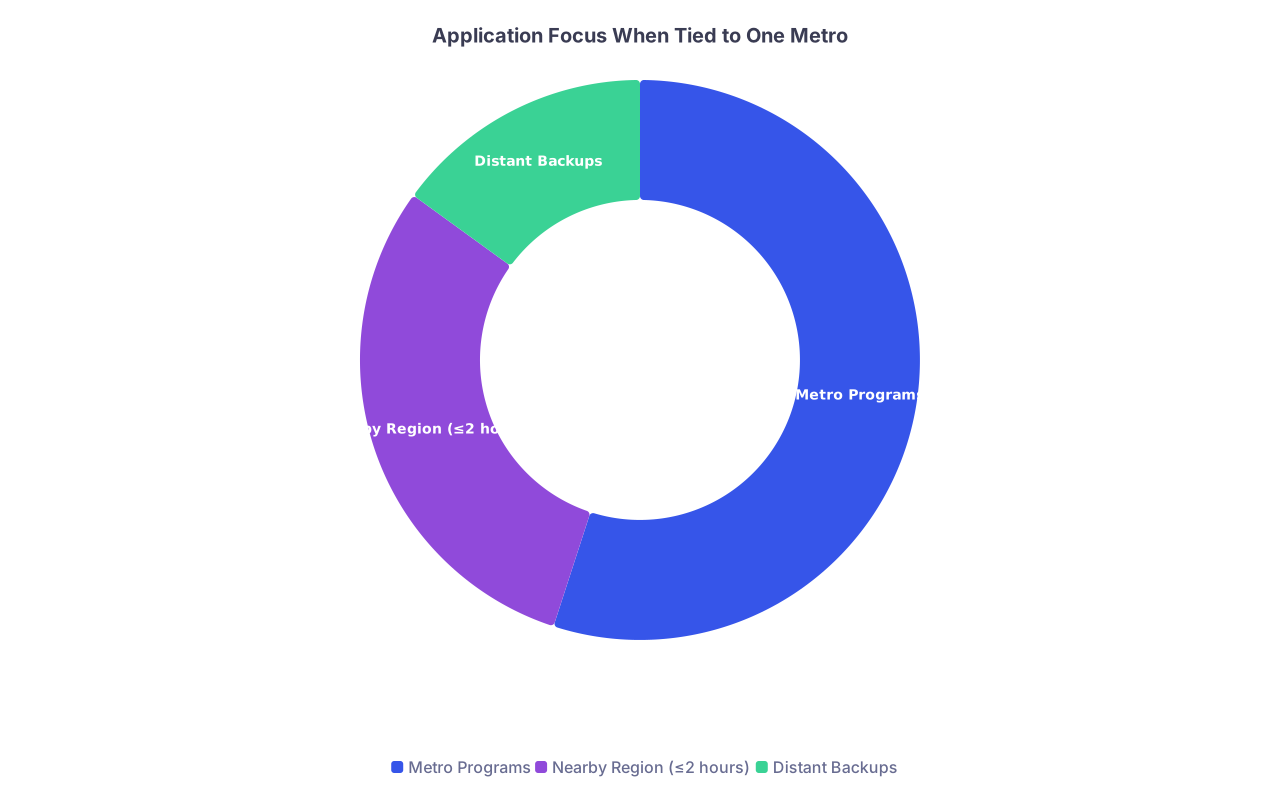
To visualize your risk, something like this is helpful:
| Category | Value |
|---|---|
| Metro Programs | 55 |
| Nearby Region (≤2 hours) | 30 |
| Distant Backups | 15 |
You can adjust the percentages, but you get the idea: heavy, heavy focus on where you can actually live and care for your family.
If you have preference signals (like ERAS geographic preference, supplemental application signals, etc.), do not waste them on fantasy programs. Aim them like a sniper rifle at your realistic metro and short‑radius region.
Step 7: Get ahead of schedule and coverage realities
Residency is not 9–5, and programs know that people tied tightly to a location may struggle with:
- Nights and 28‑hour calls
- 6‑day stretches
- Rotations at distant affiliates within the system
You need a pre‑emptive logistics plan before they even ask.
Things to map out:
- Who covers your family member when you’re on call or nights?
- What happens if they have a medical emergency while you’re scrubbed in or cross‑covering 60 patients?
- How will you handle rotations that are 45–60 minutes away?
You don’t need to present this as a slide deck. Just have a clear, confident answer if it comes up:
“I’ve already discussed coverage with my siblings and we have a schedule for my ICU and night rotations. We’ve identified a paid home aide we can bring in if needed. I understand residency hours and I would never ask for special treatment—my goal has been to set things up so that my family is cared for without affecting my responsibilities here.”
That kind of answer reassures them you’re not going to be constantly negotiating call schedules around personal crises.
Step 8: Consider extreme commutes and split-week living—carefully
Some people in your situation pull off creative but exhausting solutions:
- Live near the hospital during the week (cheap room, resident housing, friend’s couch), go home on days off.
- Accept a program 60–90 minutes away and do long‑commute weeks with careful sleep planning.
- Cluster caregiver duties on post‑call days and golden weekends.
Is it ideal? No. But if the alternative is either abandoning your family or not training at all, it can be worth considering.
If you do this, you must be dead serious about:
- Sleep safety (no 90‑minute drive home post‑call; sleep locally first).
- Backup transportation in winter or bad weather.
- Clear agreements with family about who does what and when, so your few free hours aren’t spent in chaos.
This is where some people use:
- A local studio/room at the hospital city.
- Carpooling with co‑residents on distant rotations.
- Occasional paid caregiving help timed to your worst schedule blocks.
| Category | Value |
|---|---|
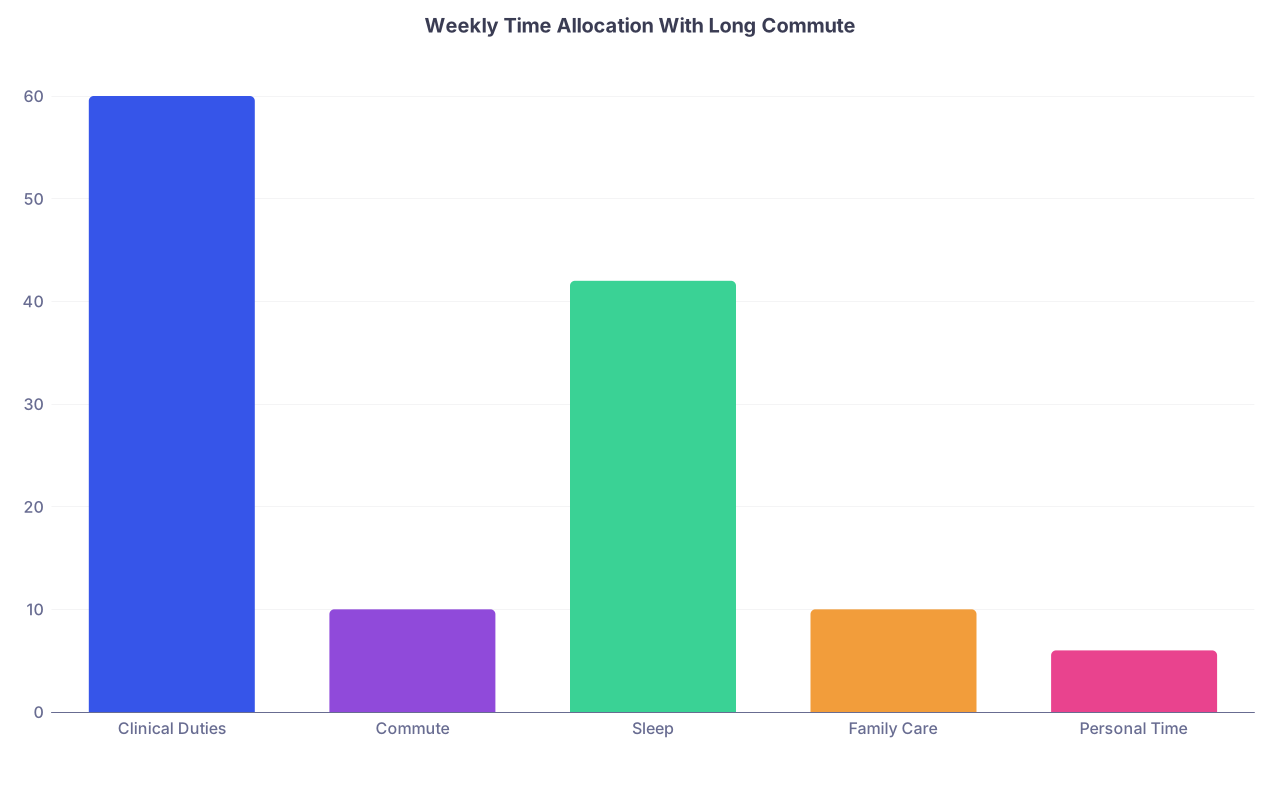
| Clinical Duties | 60 |
| Commute | 10 |
| Sleep | 42 |
| Family Care | 10 |
| Personal Time | 6 |
That kind of week is punishing. Do not romanticize it. But if you go this route, go in with your eyes open and your systems tight.
Step 9: Think beyond residency—this is a 7–10 year problem, not 3
A lot of people only plan for residency. But if your family member’s condition is chronic or progressive, your constraint doesn’t magically vanish as a PGY‑3.
You should be asking:
- Does this metro have fellowships in my likely field?
- Are there hospitalist or attending jobs locally in my specialty?
- Does this city support long‑term careers for my partner if that’s also part of the tie?
If there is no fellowship locally and you’re thinking “I’ll just figure that out later,” pause. Either:
- Choose a field where you can be happy as a generalist locally.
- Or accept the eventual cost of leaving for a 1–3 year fellowship and returning.
For some people, the smartest move is:
- Broad specialty in the local metro (FM, IM, psych, peds).
- Extra local training, certificates, or niche clinics instead of a formal distant fellowship.
- Long‑term attending job in the same region to keep family stability.

| Step | Description |
|---|---|
| Step 1 | MS1 in Local City |
| Step 2 | Local Clinical Rotations |
| Step 3 | Residency at Metro Program |
| Step 4 | Local Fellowship |
| Step 5 | Stay Generalist Locally |
| Step 6 | Attendingship in Same Metro |
| Step 7 | Fellowship Local? |
The point: do not walk into a dead end where you finish residency and suddenly every career‑advancing step requires leaving the only place you can live.
Step 10: If you’re pre‑med or early: pick your school with this in mind
If you’re still pre‑med or M1/M2 and already know your life is anchored to one city, your choice of medical school and clinical campus is a weapon, not a detail.
Better scenario:
- You attend medical school in the same metro where you’ll apply for residency.
- You rotate in the same hospitals where you want to match.
- Faculty already know you. Your name is not coming from a random ERAS line; it’s coming from their clerkship evals.
Worse scenario (but still salvageable):
- You attend school elsewhere but start building local ties early: summers, electives, research projects with your home city, etc.
If you’re still at the “choosing schools” phase and your family tie is definite and long‑term, I would prioritize:
- Schools with strong home residency programs in multiple fields in your metro.
- Schools whose graduates are heavily absorbed by local residencies.
- Cost and support structures that let you stay physically near your family.
When you should consider stepping away from medicine altogether
Harsh but real: there are a few situations where the math may not work.
If all of these are true:
- Your metro has one or zero residencies in any field you’d consider.
- You are the sole caregiver for someone whose needs are constant and unpredictable (advanced dementia without backup, ventilator‑dependent child with no other adult support, etc.).
- You cannot safely commute even 30–45 minutes away, even intermittently.
- You are not willing to loosen either specialty choice or geography.
Then you might be trying to force medicine into a life where it genuinely does not fit right now. That doesn’t mean “never.” It might mean:
- Delay application.
- Complete a different degree or job for a few years.
- Wait until your family situation changes—after a transplant, a relative’s recovery, siblings becoming adults, etc.
I’ve seen people destroy themselves trying to hold onto an image of “the doctor life” that simply didn’t match their actual caregiving reality. There’s no glory in that. Being the responsible adult who times their career around real humans is not weakness.
(See also: Managing Kids and Schooling While Moving to a New Residency Region for more.)
Final grounding moves
Let me pull this out of the weeds.
If family care obligations tie you to a single metro area, your playbook is:
- Define your true geographic radius in minutes, not feelings.
- Build deep local capital: rotations, mentors, projects, connections in every program within that circle.
- Adjust specialty flexibility and career timeline to match your reality, not your fantasy.
You’re not asking for an easy path. You’re asking how to make a hard path survivable and real. That’s doable—if you plan like your life actually looks, not like a brochure.