You wake up to a text that changes everything.
“Dad’s in the ICU. They don’t think he should be alone after discharge.”
Or your partner gets a job offer across the country that they cannot turn down. Or a childcare meltdown happens. A visa issue. A health diagnosis. Divorce papers.
And now you’re staring at your rank list—or your in-progress ERAS draft—realizing the plan you built for the last two years just exploded. The region you thought you’d train in no longer works. You have to pivot. Hard. And late.
I’m going to walk you through what to do specifically if life forces a last-minute regional pivot for residency. Not theory. Not “self-care”. Actual sequences of moves: who to email, when to call, how to talk about it without sounding chaotic, and how to avoid shooting yourself in the foot.
Step 1: Define Your New Non‑Negotiables (In Hours, Not Weeks)
You do not have time for a big reflective retreat. You need a working decision framework by tonight.
Grab a piece of paper or an open note. Write three headings:
- Region(s) I must be in (or close to)
- Region(s) that are still acceptable if Plan A fails
- Regions that are now impossible
Then answer these questions bluntly:
- Who am I trying to be near, and what distance actually works?
“Near my parents” is vague. “Within 1.5 hours driving of Boston” is usable. - How urgent/permanent is this situation?
Dad having surgery this month vs a parent with progressive dementia are different timelines. - What’s my priority stack now?
Is it: 1) geographic, 2) program quality, 3) specialty fit? Or does something else jump ahead (visa, kids’ custody schedule, partner’s job)?
You’re going to use this to justify changes to advisors and programs. If you cannot explain to yourself in two sentences why you must be in X region, you will not explain it well to a PD.
Write your two-sentence “reality statement”:
“My mother was diagnosed with metastatic cancer in December and is starting treatment in [city]. I need to be within driving distance to provide regular support and coordinate her care.”
or
“My partner’s company is closing their other office and consolidating everyone to [city] in July. For immigration and financial reasons, I need to be in the same metro area.”
That becomes the spine of your communication going forward.
Step 2: Identify What Phase You’re In (The Rules Change Dramatically)
“Last-minute” means something different in July than in February. The playbook depends on where you are in the residency cycle.
| Phase | Where You Are | Main Lever |
|---|---|---|
| Pre‑ERAS | Before apps submit | Change target list hard |
| Post‑Submit, Pre‑Interviews | September–October | Geographic signaling + emails |
| Interview Season | November–January | Rebalancing invites + advocacy |
| Rank List Finalization | February | Targeted communication + list reshuffle |
| Post‑Match | After Match Day | SOAP (if unmatched) or transfer planning |
A quick decision map

| Step | Description |
|---|---|
| Step 1 | Life event |
| Step 2 | Redo target list |
| Step 3 | Signal region and email |
| Step 4 | Shift invites and explain |
| Step 5 | Targeted PD communication |
| Step 6 | SOAP or transfer route |
| Step 7 | Where in cycle |
Find your box. That’s the lane we’ll play in.
Step 3: Rebuild Your Region Strategy Fast (Program Lists that Actually Match Reality)
You probably built your original list around reputation, friends’ opinions, and “what sounds cool.” Now you have to build around geography first, then fit.
You need three kinds of programs in your new primary region(s):
- A few reaches where you’d be thrilled
- A heavy middle of realistic-to-likely programs
- Some true safeties that still meet your geographic needs
And you must do this fast but not stupidly.
How to rebuild a regional list under pressure
Do this in a single aggressive 2–3 hour block:
Pull up FREIDA or EMRA/AAIM guides for your specialty.
Filter by state(s)/city radius that now matter.
For each program, do a 30–60 second scan:
- Community vs university
- Size of program (small 4–6 residents vs big 20+)
- Reputation for being IMG-friendly or US‑grad focused (if relevant)
- Any clear reason it’s a bad match (malignant, massive commute, bad call structure you know you cannot handle with your outside obligations)
Create three tabs in a sheet: Reach / Core / Safety. Drop programs in as you go.
Force yourself to fill the middle category the most. People in crisis drift toward extremes (all dream places or all panic safeties). Do not.
Now rank within each category by “if this were my only option in this region, how okay would I be?”
You’ve just built a salvageable region-centric application map instead of a fantasy map that ignores your life.
Step 4: How to Tell People Without Sounding Unstable
This is where people screw it up. They over-share. Or under-share and seem random. Or sound like they’re begging.
You need three versions of your story:
- Advisor version (full context)
- Program version (professional, focused)
- Peer version (you can vent here, not elsewhere)
Advisor version
With your dean’s office, home PD, or trusted mentor, don’t sanitize too much. They can only help if they understand the stakes.
Be concrete:
“I know this is late and chaotic. My spouse just got notice their visa will expire if they’re not based in [city] by August. I need to move my priority region there. I’ve already rebuilt my list. I need help figuring out how to communicate this to programs and whether to add more community sites in that area.”
Ask directly for two things:
- Honest feedback if your new plan is realistic
- Names/emails of people they can contact in your new target region
If you’re in a school with strong regional ties (say, Midwest med school, now pivoting to New England), expect some friction. Some faculty are very parochial. You are not asking for their blessing. You are asking for intel and introductions.
Program version
Here’s the rule: programs need the medical version of your situation, not the whole diary.
Good program email structure:
- Who you are (name, school, specialty)
- Why this region/program matters now (tie to the life event, 1–2 sentences max)
- What stands out about them (1 specific feature)
- What you’re asking for (consideration for an interview / to remain high on their radar / acknowledgment of your regional commitment)
Example:
Dear Dr. Smith,
My name is Alex Chen, a fourth-year at UMass applying to Internal Medicine. I wanted to share a recent update that has focused my residency plans on the [Region] area.
My father was hospitalized in November with complications from advanced heart failure and will require ongoing support in [City]. I am now committed to training within driving distance so I can be involved in his care.
I’m particularly interested in [Program Name] because of your strong cardiology service and the structured ambulatory curriculum. I believe it would allow me to grow as a physician while still fulfilling my family responsibilities.
I know this is a very busy time for you, but I wanted to make you aware of my strong geographic interest in [Program]. Thank you for your consideration.
Sincerely,
Alex Chen
Direct, professional, and not drama.
Step 5: Specific Plays by Application Phase
Let’s drill down phase-by-phase. This is where the “what do I do this week” gets real.
A. Before ERAS Submission (You Just Got Hit With This)
Your advantage: nothing is locked yet. Your disadvantage: you’re emotionally rattled while doing the most important planning work of your application.
Here’s what you do over 5–7 days:
Day 1–2:
- Write your two-sentence reality statement.
- Meet (or email) your dean’s office / specialty advisor: “I need to change my geographic plan. Can we meet this week?”
Day 2–4:
- Completely rebuild your program list around the new region(s).
- Use your advisor to sanity-check: “With my Step score and grades, is [X region] realistic if I apply to [Y number] of programs?”
Day 4–7:
- Edit personal statement only if your regional reason is central to your narrative. Do not rewrite your entire life story to cram in this event if it just happened last week. You can address specifics later in interviews.
- Prepare a short, consistent way to mention your regional focus in ERAS experiences or “geographic preferences” fields where available.
Do not:
- Keep a bunch of old regions “just in case” and spray applications everywhere. Programs can tell when your story is incoherent.
- Oversell your new region if your ties are thin. Better to say, “Family recently relocated there and I need to be nearby” than fabricate long-standing roots.
B. After Submission, Before Interviews
You already sent your apps. The pivot just hit. You can’t change where you applied, but you can change how visible your regional preference is.
Here’s what you do:
- Identify programs in your new must-have region that you already applied to.
- Send a concise interest email (like the example above) to:
- PD
- Program coordinator (cc only, so it doesn’t get lost)
- If your specialty uses signaling/Goldilocks/priority tokens and they’re not final, redirect any you still control toward the new region.
Then look at where you didn’t apply in that region. You have to decide: do you submit late apps?
- Competitive specialty with few spots (Derm, Ortho, ENT)? Late apps are weak, but a few targeted ones in your new region can still be worth it if things are dire.
- Less competitive specialty (FM, Psych, Peds, even IM in many regions)? Late regional apps can absolutely still convert.
Signal clearly in those late apps via email: “I am submitting my ERAS application to your program today after a recent change in family circumstances focused my search on [Region].”
C. During Interview Season
This is where the pivot can be salvaged or buried.
You’re now facing three categories of invites:
- Old-region invites that no longer make sense
- New-region invites (maybe fewer than you want)
- Programs in the new region that have not invited you
Your job is to rebalance without playing games.
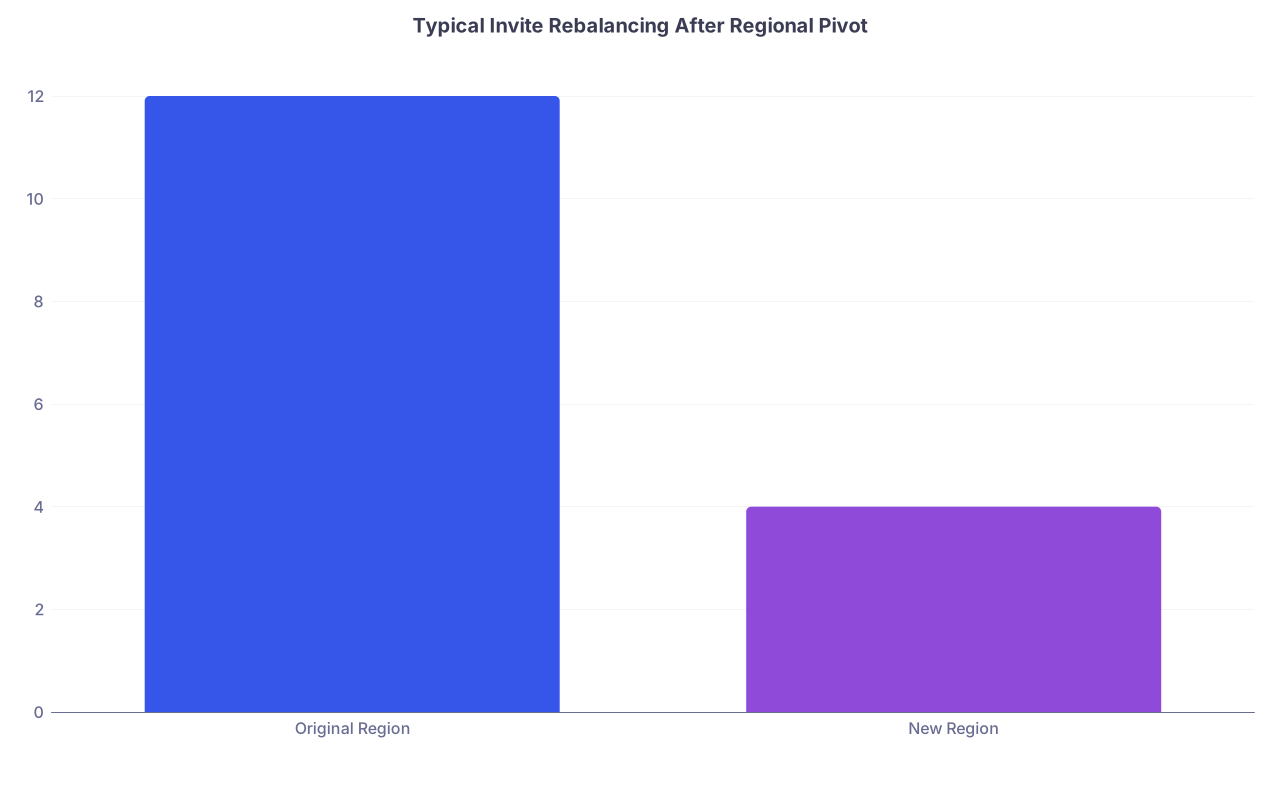
| Category | Value |
|---|---|
| Original Region | 12 |
| New Region | 4 |
Imagine you started with 12 interviews in the old region and 4 in the new. After your pivot, your target should be to tilt that as much as possible toward the new region while not suiciding your match chances.
Concrete moves:
- Do not instantly cancel all old-region interviews. That’s panic.
- Start by:
- Accepting every reasonable invite in your new region.
- Keeping a solid base of old-region interviews in case your pivot region underperforms.
On interview day in the new region, you must clearly and calmly explain why you’re re-centered there now:
“Earlier in the season I cast a broader geographic net, but in November my grandmother’s health changed significantly and I’ve committed to staying within driving distance of [City]. It’s refocused my priorities, and I’d be genuinely thrilled to be here.”
Do not:
- Trash talk other regions or imply you “don’t care” about the places you already interviewed. PDs talk.
You can also have your dean or home PD send a short note to key programs in your new region:
“Alex had a significant family development that shifted their geographic focus to [Region]. They’re a strong candidate and I’d be happy to answer any questions about them.”
This kind of faculty-to-faculty nudge sometimes matters more than your own emails.
D. Rank List Time (You Pivoted Late and You’re Scared)
Now you have a pile of interviews, some aligned with your new life, some not.
You have to face a hard question:
Is it worse to be in the “wrong” region with a training spot, or unmatched but geographically pure?
In almost every case, being unmatched is worse. You cannot help your family more effectively by sitting in an unpaid gap year, unless your situation is extremely extreme (citizenship, custody, or similar).
So your rank list strategy becomes:
- Rank all the programs in your new must-have region in true preference order, even the ones that are less shiny.
- Then rank your old-region programs after that, ordered by where you’d actually go if you didn’t match in your new region.
- Only push a program down or off the list if you genuinely would rather not be matched than be there. Be honest with yourself.
If there are 1–3 programs in the new region that you’d absolutely choose above all others, you can send a very limited number of “you are my top choice” or “very highly ranked” messages. But do not lie to multiple programs. PDs are not naïve, and some of them compare notes.
Step 6: If the Pivot Happens Post‑Match (Or You Don’t Match)
Worst-case scenario: life blows up after the Match. Or you went all-in on a regional pivot and did not match.
Two very different paths:
A. You Matched, then Life Exploded
Options are limited, but not zero.
Talk to your matched program PD immediately and honestly.
- “This health crisis just happened in my family in [city]. I am committed to my training and to your program, but I need to understand any feasible options, including possible transfers later or accommodations in scheduling early on.”
Ask your dean to quietly feel out PDs in your target region for:
- PGY‑2 transfer possibilities in a year
- Rare PGY‑1 swaps (not common, but I’ve seen them happen within states)
Accept that your first year might not align with your new geography. Your long game is a transfer or fellowship in the new region. Keep your record spotless so people want to help you move later.
B. You Did Not Match (Or SOAPed into the Wrong Region)
This is brutal, but a forced regional pivot at least gives you a focus:
- If you SOAP, you might have to choose between:
- A spot in the wrong region now
- Waiting a year to try to match closer to home
If your life event is absolutely non-negotiable geographically, you may lean toward the gap year with a heavily region-targeted re-application plan.
During the gap year:
- Get involved clinically or in research in the region you want (local hospital, academic center, even community clinics).
- Build real regional ties—employment, addresses, mentors—so next cycle your “pivot” is not abstract, it’s backed by evidence.
Step 7: Managing the Emotional and Practical Fallout Without Torching Your Career
You’re not just moving pins on a map. You’re grieving the plan you had.
Here’s what matters from a career standpoint:
Don’t let panic make you sloppy.
Last-minute regional pivots lead to half-finished personal statements, typo-filled emails, and missed interview deadlines. Slow down enough to not look careless.Keep your story consistent everywhere.
What you say to:- Your dean
- A PD
- An interviewer
- A letter writer should all rhyme. Different depth, same core reason.
Don’t use your crisis as a shield against performance.
Yes, your life just imploded. But programs still need to believe you can show up, work nights, pass boards. When you talk about your situation, also talk about what support you have and what you’ve already put in place to manage it.
Step 8: The Future Medicine Angle — Why This Will Happen More, Not Less
You’re not unlucky. You’re just early.
Residents are older now. More dual‑career couples. More dependents. More complex visas. More chronic illness. That means more people will be forced into late regional pivots as medicine continues to pretend everyone is a single 26‑year‑old with no attachments.
I’ve watched programs slowly evolve:
- Some are starting to ask about geographic constraints openly and not penalize you for them.
- Others quietly prefer candidates who are clearly tied to their region, because they’re more likely to stay as faculty.
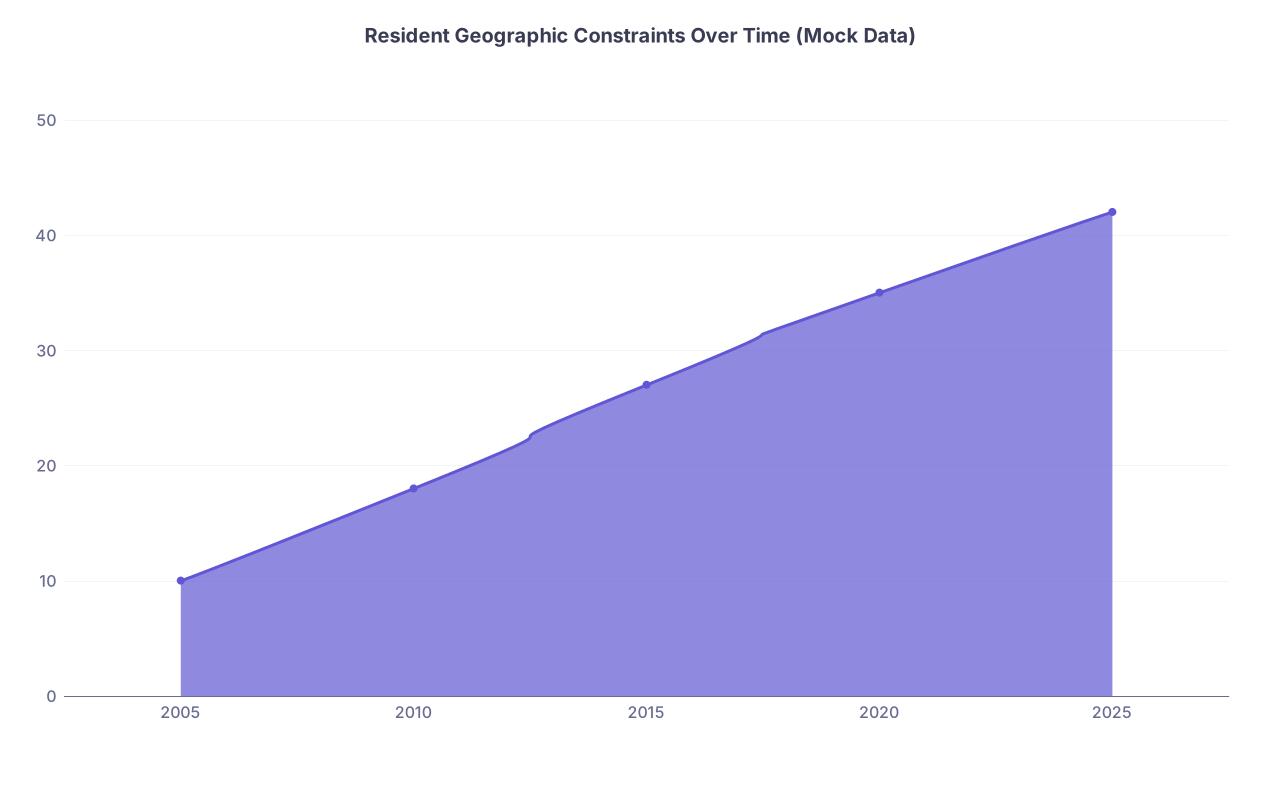
| Category | Value |
|---|---|
| 2005 | 10 |
| 2010 | 18 |
| 2015 | 27 |
| 2020 | 35 |
| 2025 | 42 |
The trend is obvious: more constraints, more pivots.
Your job isn’t to be the perfect, flexible ghost applicant anymore. It’s to be a real person with a real life who can still function at a high level. Programs that cannot tolerate that are going to have a harder time recruiting as the years go on.
A Concrete 7‑Day Survival Plan If This Just Happened
Let’s compress this into something you can actually follow this week.

Day 1:
- Write your two-sentence reality statement.
- Decide your new primary region(s) in concrete terms (states/cities, not vibes).
Day 2:
- Meet or email your dean/specialty advisor.
- Tell 1–2 trusted people the real story so you are not alone in this.
Day 3–4:
- Rebuild your program list for the new region (reach/core/safety).
- Start targeted emails to PDs in your new region if apps are already submitted.
Day 5–6:
- Adjust any remaining application levers: signals, late applications, updates.
- Draft a consistent, concise explanation of your pivot for interviews.
Day 7:
- Reassess: what invitations, replies, or new info came back?
- Update your “if X happens, I do Y” plan for the next 2–3 weeks.

You don’t fix the entire situation in a week. You drag it from chaos into a structured problem. That’s enough for now.
Looking Ahead
Right now you’re in crisis-management mode—reacting to a life event that didn’t care about your ERAS timeline. Eventually this settles. Either you train where you hoped to, or you don’t, but the chaos phase ends.
The next phase of your journey is about turning wherever you land into something that still serves your long-term goals: fellowships in your target region, strategic transfers, or building the exact life you wanted in a place you never planned on.
That’s the longer game—how to use whatever residency you end up in as a launchpad back toward the geography and life you actually want. Once you get through this immediate pivot and Match outcome, that’s where your attention will need to go. But first, get through this week with a clear head and a coherent plan.