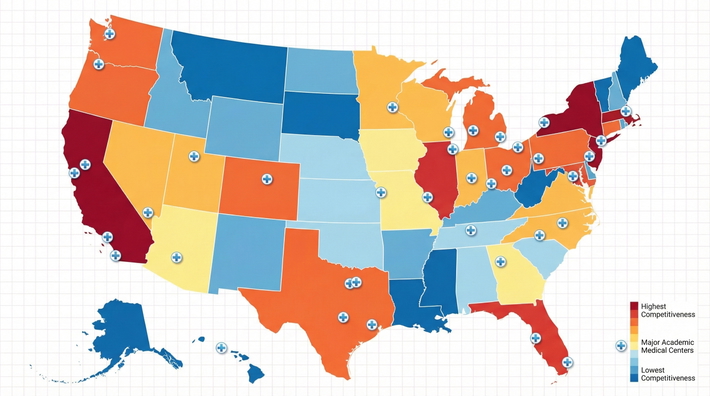
Last week I spoke with an IMG who’d built her whole plan around training in California because that’s where her family lives. Then she discovered the majority of programs she liked either didn’t sponsor visas or only took J‑1, and she was hoping for H‑1B. She wasn't just frustrated. She was stuck.
If you’re in that kind of bind—visa-dependent, with a very specific region in mind—you’re up against two hard walls at once: immigration law and geographic constraints. Here’s how to handle it without blowing an application cycle or wasting years in limbo.
Step 1: Get Brutally Clear on Your Non‑Negotiables
Before you touch ERAS or email a single program, you need to decide what actually matters most. Because you probably will not get everything.
There are four main variables in this game:
- Visa type (J‑1 vs H‑1B, or needing no visa)
- Region (e.g., NYC only, or “within 2 hours of my spouse’s job”)
- Specialty (e.g., Derm vs FM vs IM)
- Timeline (this year vs willing to wait 1–2 years to re‑apply)
You can’t treat all four as non‑negotiable if you also have visa constraints. That’s fantasy.
So sit down and rank them, ruthlessly:
- “I must be in the Northeast close to family; I’m flexible on specialty.”
- “I must match this year; I can loosen my region from Chicago-only to Midwest.”
- “I must get H‑1B; I will expand region nationally and consider less competitive specialties.”
Write it down. Literally, on paper. Because later, when anxiety is screaming at you to apply only to 12 H‑1B IM programs in one city, you’ll need to remember what you decided when you were thinking clearly.
Step 2: Understand What Your Region Actually Supports Visa‑Wise
People say “the West Coast doesn’t sponsor H‑1B” or “the South is easier for visas.” That’s lazy and half-true at best.
You need data, not rumors.
How to actually check programs
- Use FREIDA and program websites.
- For each program on your wish list, check:
- Do they accept IMGs?
- Do they sponsor J‑1?
- Do they sponsor H‑1B for categorical positions (not just prelim)?
- Any USMLE score or attempt limits tied to visa sponsorship?
Make your own little database. A simple spreadsheet is enough.
| Program (Example) | Region | J‑1? | H‑1B? | Score Cutoff |
|---|---|---|---|---|
| Beth Israel Deaconess IM | Northeast | Yes | Yes | 230+ |
| NYU Brooklyn IM | Northeast | Yes | No | 220+ |
| UCSF Fresno IM | West Coast | Yes | Rare | 225+ |
| Henry Ford IM (Detroit) | Midwest | Yes | Yes | 220+ |
| University of Miami/Jackson | Southeast | Yes | Yes | 225+ |
This is illustrative, not exact. But this is the level of detail you want.
Once you do this honestly, three things usually happen:
- Your “preferred region” shrinks once you cross off non‑sponsoring programs.
- You realize some nearby regions are much more visa-friendly.
- You stop wasting time dreaming about programs that won't touch your file.
Step 3: Decide Between J‑1 and H‑1B Based on Reality, Not Reddit
This is where a lot of applicants get stuck in fantasy land.
Here’s the blunt breakdown.
J‑1: What it really means
Pros:
- Much more widely sponsored, especially for IM, Peds, FM, Psych.
- Straightforward for most academic and community programs.
- Easier to match this year if you’re region‑ and specialty‑flexible.
Cons:
- Two‑year home country physical presence requirement after training (unless you get a waiver).
- Waiver jobs are usually in underserved / rural areas, not NYC or LA.
- Adds one extra layer of uncertainty post‑residency.
H‑1B: What it really means
Pros:
- No 2‑year home return requirement.
- Easier (not easy, but easier) to stay in the same region post‑residency.
- Attractive if you already have a long‑term plan in the US and don’t want the J‑1 waiver mess.
Cons:
- Fewer programs sponsor it, especially in competitive regions.
- Often require:
- All USMLE Steps passed on first attempt.
- Step 3 passed before Rank List deadline or start of residency.
- Some programs say they support H‑1B but only do it selectively for top candidates.
So if you’re saying: “I want NYC only and H‑1B only and IM only,” you’re voluntarily making the funnel absurdly tight.
If your scores are average, your attempts aren’t clean, and you’re visa‑dependent, I’m going to be direct: J‑1 is usually your realistic ticket into the US system. H‑1B is Plan B if and when your application is strong enough and your geography is flexible enough.
Step 4: Map Out Your “Region + Visa” Strategy
Now combine what you’ve learned into an actual plan.
I like to have people build three zones:
- Core region (where you truly want to be)
- Adjacent region (where you’d accept living but don’t love)
- Safety region(s) (where your chances are best given visa + scores)
Then overlay visa options on top of that. Example:
- Core: NYC / NJ / Philly
- Reality: Mostly J‑1; H‑1B at a handful of competitive IM programs
- Adjacent: New England, Pennsylvania outside Philly
- Reality: Mixed J‑1 and H‑1B, more community programs
- Safety: Midwest (Ohio, Michigan, Missouri, etc.)
- Reality: Many J‑1, some H‑1B with lower competition
You can visualize it like this:
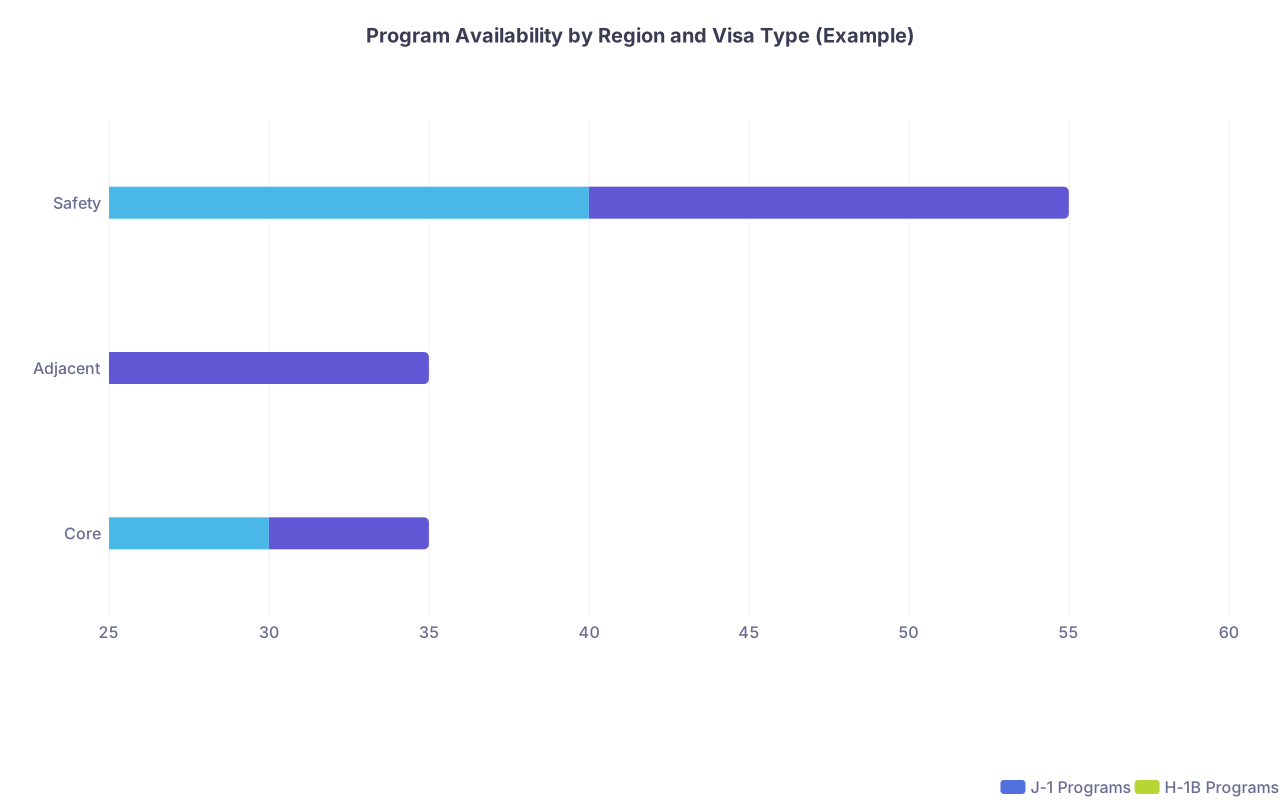
| Category | J-1 Programs | H-1B Programs |
|---|---|---|
| Core | 30 | 5 |
| Adjacent | 25 | 10 |
| Safety | 40 | 15 |
Again, these numbers are illustrative. But you get the idea.
When you see that your core region has 4 viable H‑1B programs you’re competitive for, and your safety region has 15, it becomes much easier to make sane decisions.
Step 5: If Your Preferred Region Is Truly Visa‑Hostile
Sometimes, the truth hurts: the exact place you want (say, Bay Area, or specific metro areas) is just not friendly to your visa situation.
I’ve seen this most in:
- West Coast for H‑1B, especially in competitive specialties
- Certain wealthy metro areas where programs are flooded with US grads
- Niche specialties (Derm, Rad Onc, Ortho, ENT) basically anywhere
If that’s your situation, here are your paths:
Path A: Region now, ideal visa later
Example: You want New York. Programs there mostly offer J‑1.
Plan:
- Aim for J‑1 positions in your preferred region.
- Finish residency where you want to live (huge benefit socially and professionally).
- Then accept you’ll likely need to:
- Take a J‑1 waiver job in an underserved area for a few years,
- Or later find another route back (fellowship, employer‑sponsored green card, etc.).
You get geographic preference in training, sacrifice some flexibility after.
Path B: Ideal visa now, region later
Example: You strongly prefer H‑1B.
Plan:
- Apply widely across the country to H‑1B‑sponsoring programs.
- Accept that residency might be in the Midwest, South, or smaller city.
- Use residency (and maybe fellowship) to build leverage later for a job in your preferred region.
You give up location early, to protect long‑term immigration stability.
Path C: Rebuild and re‑apply stronger
If your profile is weak and you’re trying to be picky about both region and visa, that’s not a “strategy,” that’s wishful thinking.
Options to spend 1–2 years strengthening:
- US clinical experience (proper hands‑on, not just observerships, if possible)
- Research in your target region (helps with networking and LORs)
- Improve language and communication skills to stand out in interviews
- Pass Step 3 early if you’re chasing H‑1B
This is painful but can turn an almost‑zero chance into a realistic shot.
Step 6: Use Direct Program Communication—But Do It Right
If you have visa constraints and regional limits, you cannot afford to guess based on old spreadsheets and anonymous forums. Program policies change.
Emailing programs is not optional. It’s required.
How to ask without sounding desperate
Bad email:
“Do you sponsor visas? I really want to be in your program because my family is in your city and I cannot move.”
Good email:
Dear Dr. Smith,
I’m an IMG planning to apply to your Internal Medicine program this cycle. I’ve reviewed your website and FREIDA, but could not find recent information on visa sponsorship.
Could you please confirm whether your program sponsors J‑1 and/or H‑1B visas for categorical residents, and whether there are any USMLE score or attempt requirements specific to visa candidates?
Thank you for your time,
[Name], MD
ECFMG certified
Short. Professional. Focused.
If they reply with “We sponsor only J‑1” or “We consider H‑1B on a case‑by‑case basis,” you log that and move on. Don’t argue. Don’t send a follow‑up essay about your situation.
Step 7: Adjust Your Application List Like a Grown‑Up
Once you have real data, build your list. Not emotionally. Mathematically.
For most visa‑dependent IMGs with regional preferences, I recommend something like:
- 30–40% programs in core/adjacent regions that fit your visa reality
- 60–70% programs in more flexible regions where:
- They actively take IMGs,
- They clearly sponsor your visa type,
- Your scores/LORs are at or above their usual IMG level.
If you’re dead set on H‑1B:
- Expect to apply to more programs overall.
- Consider loosening region substantially.
- Make sure Step 3 timing is aligned with program requirements.
If you’re okay with J‑1:
- Focus heavily on programs with a solid history of taking J‑1 IMGs in your specialty.
- Use region as a secondary filter, not the primary one.

| Step | Description |
|---|---|
| Step 1 | Start - Need Visa and Region |
| Step 2 | Focus on J-1 Programs |
| Step 3 | Check H-1B Friendly Regions |
| Step 4 | Prioritize Visa-Friendly Regions |
| Step 5 | Apply Heavy in Core Region + Safety Regions |
| Step 6 | Build Broad List |
| Step 7 | Email Programs to Confirm Policies |
| Step 8 | Finalize Application List |
| Step 9 | Visa Type Fixed? |
| Step 10 | Region Flexible? |
You’re not trying to impress anyone with how “loyal” you are to a city. You’re trying to match. Then build your life from there.
Step 8: If Your Life Circumstances Truly Lock You to One Area
Sometimes it’s not just preference. It’s reality.
- Spouse has a non‑mobile job or immigration status.
- You’re the primary caregiver for a sick parent.
- You’re tied to a child’s custody arrangement.
In that case, your strategy is different. More constrained, more local, and sometimes more creative.
Here’s what I tell people in this bind:
Maximize every program in commuting range
Academic, community, small, large, even prelim if it strategically helps. You cannot be picky.Network like your life depends on it (because it kind of does)
Local observerships, research positions, volunteer work. Anything that puts your face in front of faculty who can say, “We know this person, they show up, they work hard.”Consider stepping‑stone roles
- Research fellow/associate in your target hospital.
- Non‑ACGME fellowships that can turn into residency opportunities.
- Hospitalist roles after some training elsewhere (for later years).
Accept that you might have to compromise on visa type
If the one program in your city only sponsors J‑1 and you’ve been holding out for H‑1B… you either expand your geography or you accept J‑1. There’s no magic third option.
Step 9: Talk to an Actual Immigration Lawyer Before You Lock In
Not your cousin’s friend. Not Telegram. A real immigration attorney who does physician visas.
You do this especially if:
- You’re married to a US citizen or green card holder.
- You’re already in the US on another visa (F‑1, H‑4, etc.).
- You might be eligible for other pathways (O‑1 for research, etc.).
- You’re weighing long‑term consequences of J‑1 vs H‑1B vs going home.
That 1‑hour consult can stop you from making a choice that looks smart now but destroys your options 5 years later.
Key Takeaways
- You can’t fix immigration law or program policy. You can control how honestly you face your constraints and how broadly and strategically you apply.
- If your preferred region is visa‑limited, decide what you’re sacrificing: region, visa type, specialty, or timeline. You do not get all four.
- Data beats rumors. Build your own list, contact programs directly, and—if your life is locked to one area—use networking and stepping‑stone roles aggressively.