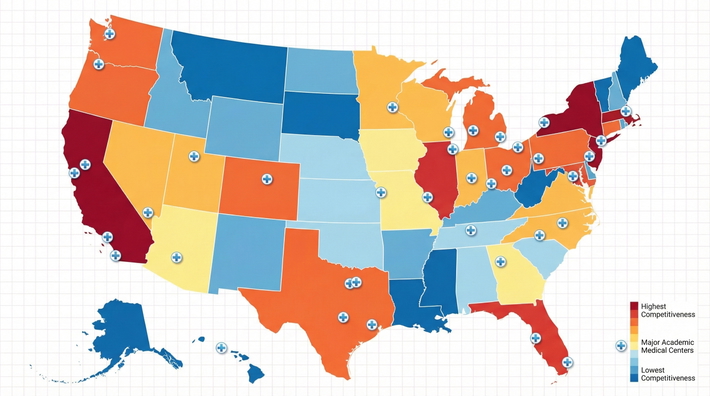
How Many Regions Should You Seriously Target in One Match Cycle?
How many regions can you actually target in one match cycle before your application turns into expensive noise instead of a real strategy?
Let me give you the blunt answer first, then we’ll unpack it.
If you’re a typical US MD/DO applying to a moderately competitive specialty, you should seriously target 2–3 primary regions, with a few “reach” programs outside those regions. That’s it.
Not 7. Not “the whole country.” Not “every program that will take my money on ERAS.”
But that number flexes based on who you are, your specialty, and your risk tolerance. The problem is most people pick regions emotionally (“I like the Pacific Northwest vibes”) instead of strategically (“Where do I have a documented advantage?”).
Let’s make this concrete.
First: What Does “Seriously Target” Even Mean?
You can technically click 80 programs across 6 regions. That doesn’t mean you’re seriously targeting 6 regions.
You’re seriously targeting a region if you’re doing all of this:
- You have clear ties or a persuasive story for being there (grew up, family, trained nearby, long-term partner there, etc.).
- Your personal statement, experiences, and interviews consistently reinforce that interest.
- You’re applying to enough programs in that region to be competitive for interview volume.
- You’re willing to rank and actually go there if you match.
If you’re just tossing 2 random programs from the Pacific Northwest on your list because “Seattle would be cool,” that’s not a targeted region. That’s wishful thinking.
The Real Constraint: Your Story Has to Make Sense
Program directors hate one thing more than low Step scores: incoherent intent.
If your application says:
- Born and raised in Florida
- Med school in Miami
- Almost all experiences clustered in the Southeast
- Every “Why us?” answer talks about staying close to family
…but your program list has 4 in Boston, 5 in Seattle, 3 in California, 2 in Chicago, 6 in Texas, plus scattered East Coast and Midwest?
They read that as:
“This person has no idea what they actually want, or they’re just spraying apps without any targeted interest in us.”
You don’t want that.
Your regions need to line up with:
- Your life story (geographic history, family, etc.)
- Your application narrative (personal statement, activities, LORs)
- Your real constraints (partner, kids, visa, finances)
The more regions you stack, the harder it is to keep that story coherent.
Typical Ranges: How Many Regions Make Sense for You?
Here’s the honest breakdown.
| Applicant Type | Primary Regions | Extra Reach Regions |
|---|---|---|
| Strong US MD, non-ultra-competitive | 2 | 1–2 |
| Average US MD/DO, common specialty | 2–3 | 1–2 |
| Below-average applicant / red flags | 3 | 1–3 |
| International Medical Graduate (IMG) | 2–3 | 1–2 |
| Ultra-competitive specialty (e.g. Derm) | 1–2 (very dense) | 2–3 |
That means most people land in the 2–3 serious regions camp, plus some scattered reach programs elsewhere.
More than 3 primary regions? Your story usually starts to fall apart unless you have a very unusual background.
How Regions Actually Work in the Match
Regions aren’t just “places” — they’re markets.
Each region has:
- Different competitiveness
- Different program density
- Different IMG-friendliness
- Different Step score expectations
- Different culture and lifestyle expectations
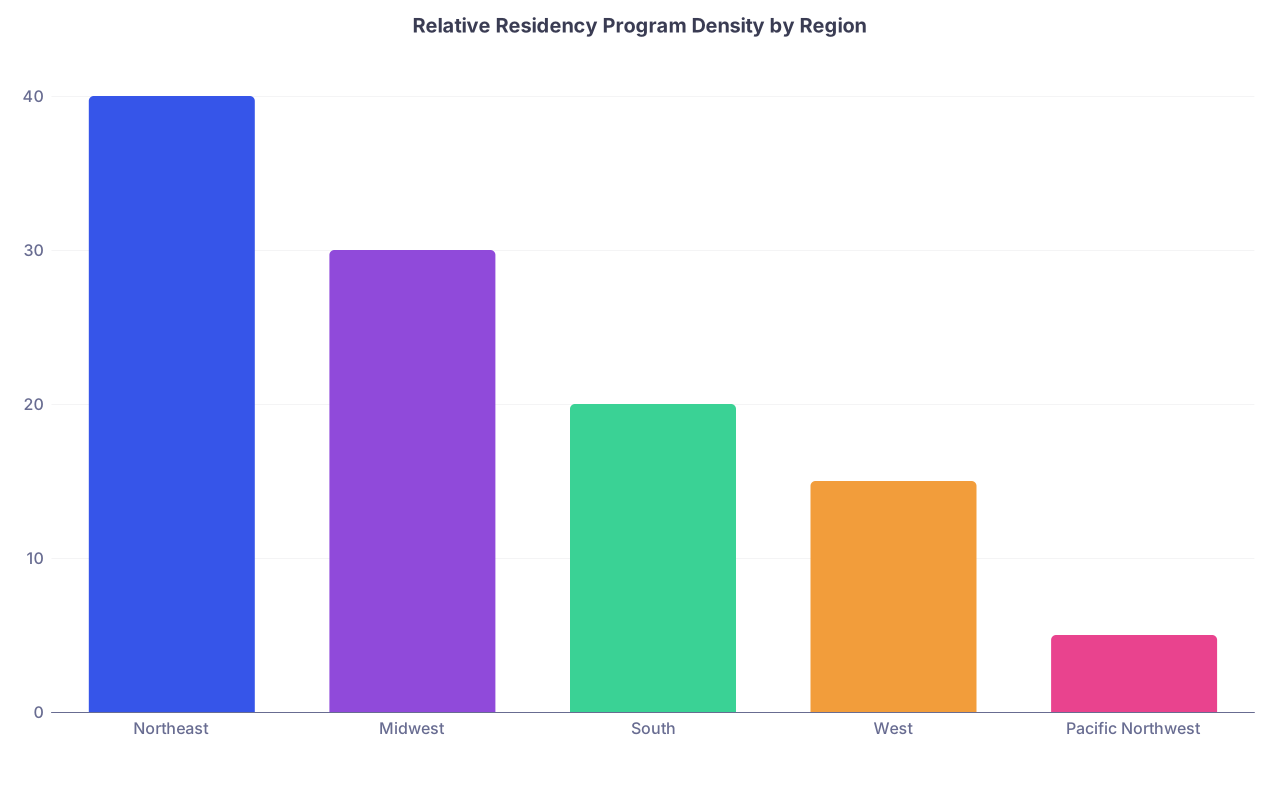
You can’t treat “Northeast” and “Pacific Northwest” as equal. One is a dense cluster with tons of programs within a few hours of each other. The other is sparsely populated and heavily self-selected.
Here’s a simplified look:
| Category | Value |
|---|---|
| Northeast | 40 |
| Midwest | 30 |
| South | 20 |
| West | 15 |
| Pacific Northwest | 5 |
That’s why a single dense region (e.g., Northeast or Midwest) can almost be its own entire strategy. While something like “Mountain West” often has too few programs to be the only region you bank on.
The Big Trade-Off: Depth vs. Breadth
You’re fighting two opposing forces:
- Depth – Fewer regions, more coherent story and visible commitment.
- Breadth – More regions, more total programs, but thinner narrative.
Where people screw this up:
- They overestimate how much programs care about “national interest.”
- They underestimate how much programs care about “local/effective interest.”
Here’s what I’ve watched PDs actually say in meetings:
- “We always get burned ranking people who have no ties here. They leave after PGY-1.”
- “This person has zero connection to the Midwest and applied to 3 programs here and 20 in California. Pass.”
- “I don’t believe they’ll actually come here. Don’t waste an interview.”
If you spread across 6 regions, every one of them is thinking, “We’re a backup. They won’t come.” So you added cost without real opportunity.
So… How Do You Pick Your Regions?
Use this in order. Not vibes. Not Instagram.
1. Region of strongest ties (usually #1 region)
Ask: Where can I most convincingly say: “I’m likely to stay here long term”?
That could be:
- Where you grew up
- Where your family lives
- Where your partner’s family is
- Where you went to med school or college
- Where you’ve done extended rotations or research
That region should nearly always be one of your core 1–2 regions.
2. Region that matches your competitiveness
You don’t target SF Bay Area and Manhattan as your core regions if:
- You’re mid-tier US MD/DO with average or slightly below-average scores
- You’re an IMG without strong US-based support
- You have red flags (attempts, gap years with no strong explanation)
You stack your odds where:
- There’s program density
- There are community and academic-community programs
- Programs historically match applicants with your profile
For many people, that means the Midwest or South becomes a serious region, even if your dream is the West Coast. Dreams don’t match you. Programs do.
Special Situations: When You Might Need More Regions
There are times when 3 primary regions is actually smart. But it should be intentional.
You might stretch to 3 regions if:
- You have weak ties anywhere (moved a lot, no deep roots)
- You’re below-average for your specialty and need more total programs
- You’re an IMG and must cast a wider net to reach IMG-friendly programs
- You’re applying in something that’s geographically clumpy (like certain surgical subspecialties)
Even then, I’d structure it like this:
- Region 1 – Strongest connection, most programs.
- Region 2 – Secondary ties or at least believable story (rotations, partner, etc.).
- Region 3 – Pragmatic region: program density, IMG-friendly, or realistic safety.
And outside those, you sprinkle:
- 3–8 “reach” programs in aspirational areas (West Coast, big-name coastal programs, etc.).
But those are dessert. Not the main course.
Couples Match: Different Game, Same Principle
Couples Match tempts people into chaos.
You think, “If we apply everywhere, we’ll match somewhere.” So you both apply to:
- East Coast
- Midwest
- South
- West
- Random single programs in fun cities
Then your rank list becomes this monstrous, stress-inducing mess of combinations.
You’re better off:
- Picking 2–3 anchor regions where both of your specialties have a decent spread of programs.
- Then adding a small number of high-priority out-of-region exceptions (family city, dream city, etc.).
More regions in Couples Match = more logistical nightmare without proportionally better odds. The key is overlapping regions where both partners have enough options.
IMGs: How Many Regions Should You Target?
IMGs (US citizen or non-US) aren’t playing the same game as a US MD at a coastal school.
For IMGs, regions matter differently:
- Some regions/programs essentially don’t touch IMGs.
- Others are reliably IMG-friendly nurseries year after year.
Your priority isn’t “where do I want to live?” It’s:
- “Where are programs actually matching people like me?”
- “Where is visa support robust?”
- “Where can I stack enough IMG-friendly programs to generate interviews?”
That often pushes you toward:
- Midwest and South as primary regions
- Selected community programs elsewhere with a history of IMGs
For IMGs, 2–3 serious regions is still right. But your filtering is data-driven (historical match lists), not lifestyle-based.
The Future: Are Regions Getting More or Less Important?
People love to say, “Residency is getting more national. Everyone applies everywhere.”
That’s half true and half fantasy.
What’s actually happening:
- Yes, applications are more national. Everyone clicks more programs.
- No, interview offers and rank lists are not truly national. Programs still heavily favor:
- Local med schools
- In-state applicants
- Those with clear regional ties
And with virtual interviews more common, something else has happened:
Applicants now over-apply to distant regions even more because travel is no longer the limiter. But programs? They’re still thinking locally: “Who’s actually likely to come and stay?”
So regional strategy is more important, not less, because noise has increased. The applicants who show genuine, consistent, plausible regional interest stand out even more.
A Simple Decision Framework: How Many Regions for You?
Use this like a checklist.

| Step | Description |
|---|---|
| Step 1 | Start |
| Step 2 | Make that Region 1 |
| Step 3 | Pick dense, realistic region as Region 1 |
| Step 4 | Add Region 2 based on ties or density |
| Step 5 | Add safer region as Region 2 |
| Step 6 | Add Region 3 for safety and volume |
| Step 7 | Keep 2 regions, add few reach programs |
| Step 8 | Finish - 2 to 3 regions |
| Step 9 | Any strong regional ties? |
| Step 10 | Competitive for your specialty? |
| Step 11 | Below average or red flags? |
If you walk through that and end up at 4+ regions as “primary”, you’re probably compensating for anxiety, not logic.
Quick Reality Checks Before You Lock Regions
Ask yourself:
- “Can I write a short, believable paragraph about why I want each region on my list?”
- “Do my geographic choices line up with what I’ve already told programs in my personal statement?”
- “If a PD asks, ‘Why here and not your home region?’ do I have a real, specific answer?”
- “Am I applying to some regions only because they sound cool on TikTok?”
If you’re embarrassed to say the answer out loud to a PD, that region probably isn’t “serious” for you.
Bottom Line
Most applicants do best when they:
- Seriously target 2–3 regions that:
- Align with their history or
- Match their competitiveness and program density
- Add a handful of reach programs outside those regions
- Keep their narrative consistent: “This is where I’ve been, and this is where I’m going.”
More regions doesn’t automatically mean more safety. Often it just means more money, more noise, and less believable interest.
Open up your current (or future) program list and do this today:
Group every program by region and mark each region as either Core, Reach, or Random. If you have more than 3 “Core” regions, cut until your story would actually make sense to a skeptical program director.