What Academic vs Community PDs in the South Expect on Day One
It’s July 1st in the Deep South. Heat index over 100, humidity at 90%, and you’re standing in a too-big short white coat at 6:30 a.m. in a hospital you barely know.
On your left: the big university academic center downtown, badge readers everywhere, residents with badge reels from conferences, and a PGY‑3 explaining Epic dot phrases like it’s a second language.
On your right: the community program in the suburbs, mostly locals on staff, the EMR is “kinda clunky but it works,” and the PD already knows your spouse’s name and where you went to church last Sunday. Or at least they asked.
You matched one of these. Academic or community. Both in the South. And here’s the part nobody really tells you:
What those two PDs expect from you on Day One is not the same thing.
I’m going to walk you through what’s actually going through their heads, what they’re looking for, and the unspoken rules they’ll absolutely judge you on in week one—because I’ve sat in on those meetings, heard the off‑the‑record comments, and watched interns get quietly labeled “solid” or “liability” before they’ve even figured out where the bathrooms are.
The Southern Context: Same Region, Different Worlds
Let me start with the regional reality, because it colors everything.
Program directors in the South—academic and community—tend to share a few baseline expectations:
They expect you to be:
- Polite and non-confrontational in public.
- Respectful to nurses and staff out loud, even if you’re frustrated.
- Usable in a high-volume, often under-resourced environment with very sick patients.
But how they prioritize things on day one? Very different.
At an academic center in the South—think UAB, UT Southwestern, Emory, Vanderbilt, UNC, MUSC—the PD is thinking about:
- How you’ll function in a massive system.
- How fast you learn complex workflows.
- Whether you’ll embarrass them on rounds, with consultants, or in front of fellows.
- Whether you look like “future chief material” or “keep them on a short leash.”
At a Southern community program—think a 200–400 bed hospital in Alabama, Mississippi, Georgia, the Carolinas, Texas, Louisiana—the PD is thinking about:
- Can you safely manage bread‑and‑butter pathology on night float without melting down.
- Are you going to piss off the nurses or respiratory or the old-school cardiologist who’s been there 30 years.
- Are you likely to stick around and be local staff in three years.
Same region. Very different scorecards.
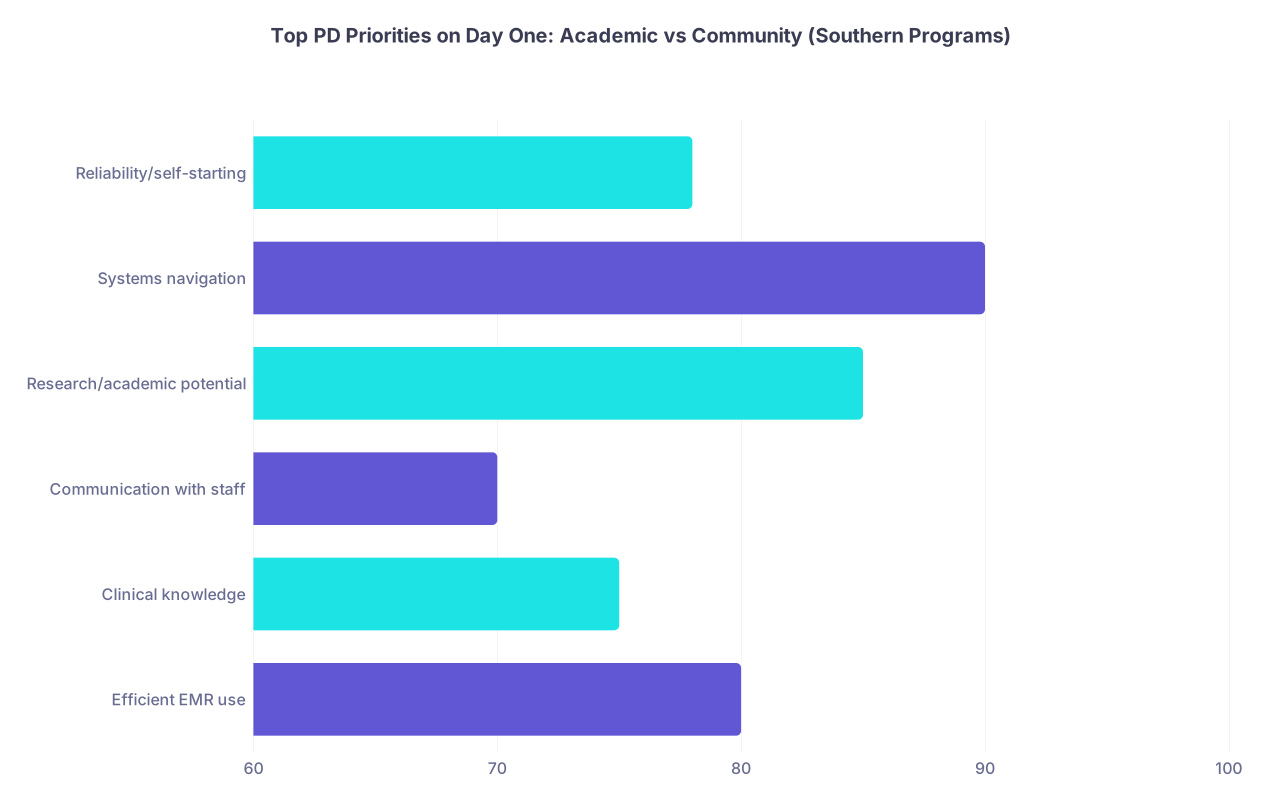
| Category | Value |
|---|---|
| Efficient EMR use | 80 |
| Clinical knowledge | 75 |
| Communication with staff | 70 |
| Research/academic potential | 85 |
| Systems navigation | 90 |
| Reliability/self-starting | 78 |
(Think of that chart as the academic mindset. Community PDs would flip a few of those bars.)
What Academic PDs in the South Expect on Day One
Let’s start with the ivory tower version. This is the big Southern academic center where you matched because of “exposure,” “research,” and “fellowship opportunities.” Here’s what the PD and core faculty expect silently by 9 a.m. of your first real day.
1. You’re Not Dumb, So Don’t Act Helpless
Academic PDs in the South assume:
- You’ve passed Step 1/2.
- You’ve rotated at big centers or at least seen volume.
- You know how to look things up.
On day one, they are not expecting you to know how to manage a complicated vasculitis case. But they absolutely expect:
- You can quickly open UpToDate or a guideline without being prompted.
- You don’t freeze when asked basic pathophys.
- You say “I’m not sure, but here’s what I think and what I’d check next,” not just “I don’t know.”
Behind closed doors, the comment that kills an intern early at an academic Southern program is:
“They’re very… passive. I don’t feel like they’re thinking.”
You can be wrong. They forgive that. Being mentally absent? They do not.
2. You Can Swim in Their System Without Drowning
At a big Southern academic center, the “system” is 50% of the job.
Day one, they’re watching:
- How fast you learn the EMR order sets.
- Whether you understand there’s a protocol for everything—sepsis bundles, stroke alerts, insulin order sets, transplant patients, anticoagulation “rules.”
- Whether you ask smart workflow questions versus obvious ones you could figure out by scanning the orders.
I’ve heard attendings say at 3 p.m. on July 1st:
“That new intern? They’re already building notes correctly, they found the anticoag pharmacy protocol, and they sent a clear message to consults. They’ll be fine.”
You know what that translates to? You just got mentally sorted into the “doesn’t need a babysitter” bucket.
Conversely, if you’re still asking, “Uh, how do I put in a CBC?” at 3 p.m.—you’ve branded yourself, and it’s not in a good way.
3. You Respect the Hierarchy (But Don’t Wait to Be Hand-Fed)
Academic Southern programs are weird hybrids: formal hierarchy wrapped in “we’re all a family” language.
Expectations on day one:
- You communicate up the chain first. Run things by your senior before you go to the attending or call a consultant.
- You do not argue with fellows on day one. You can clarify. You don’t go toe-to-toe.
- You ask for help before a patient crumps, not after the RRT is called.
But here’s the nuance: PDs hate interns who need to be spoon-fed every micro-decision.
There’s a phrase you’ll never see printed in a handbook but gets said constantly:
“I need interns who are safely aggressive, not paralyzed.”
That means:
- You page the senior with, “I’m worried about Ms. Jones—BP 82/48, lactate pending, I’ve already bolused 1L and ordered cultures and broad-spectrum antibiotics. Can you come see her with me?” instead of:
- “Hey, Ms. Jones doesn’t look good, what should I do?”
Same patient. Two very different impressions.

| Step | Description |
|---|---|
| Step 1 | New Intern Arrives |
| Step 2 | Early concern label |
| Step 3 | Seen as passive |
| Step 4 | Future chief material talk |
| Step 5 | Solid but not standout |
| Step 6 | Basic EMR competence? |
| Step 7 | Communicates through senior? |
| Step 8 | Shows active thinking? |
4. You Show Some Intellectual Curiosity—Without Being Annoying
Academic PDs in the South still care, deeply, about how you think.
Day one, they notice:
- Did you read up on your patients the night before? Or are you seeing them fresh?
- When the attending mentions a trial or guideline, do you write it down or just nod?
- Do you ask one or two thoughtful questions, or none, or ten?
Pattern they like:
- You present a new admission and briefly say, “I reviewed last year’s hospitalization for DKA; this looks similar, but now they have AKI, so I’m concerned about fluid balance and insulin dosing. I was planning to start with…”
- After rounds, you quietly ask, “You mentioned SGLT2 inhibitors being controversial in this scenario—do you have a favorite review or trial I should read?”
Pattern they hate:
- You ask theoretical questions in the middle of busy table rounds while three consults are waiting and there are six new admissions.
- Or you never ask anything and look dead behind the eyes.
Academic PDs are sorting interns into:
- “Teachable and engaged.”
- Versus “Going through the motions.”
On day one.
5. They’re Already Clocking Your “Brand”
Here’s the dirty little secret: within 48–72 hours, a rough narrative forms about you. It changes, but it sticks.
At Southern academic centers, I’ve heard:
- “She’s sharp but anxious.”
- “He’s slow but very careful—good for nights.”
- “Very bright, bit arrogant, we’ll see.”
- “Quiet, but I think there’s a lot going on upstairs.”
That narrative starts on day one with:
- How prepared you seem.
- How you talk to nurses.
- Whether you show up 15–20 minutes early or slide in at 6:59 looking dazed and disorganized.
You’re not being judged on polish. You are being judged on trajectory. Are you someone who will grow fast, or someone we’ll be dragging for a year?
What Community PDs in the South Expect on Day One
Now shift to the community side.
You’re at a hospital in, say, rural Georgia or East Texas. The cafeteria closes at 7 p.m., the ED is chaos, and half your patient list has no PCP and a hemoglobin A1C that looks like a bad lab error.
The PD here cares about different things on day one. A lot more practical. A little more old-school.
1. You Can Function Safely With Limited Back-Up
Community PDs in the South know this: you’ll be more alone earlier in residency than your academic peers. It’s just reality.
So on day one, they’re asking themselves:
- Does this intern seem like someone who will call for help early on a crashing patient?
- Are they reckless? Or overly timid?
- Will night float with this person be a disaster?
I’ve sat in PD offices after the first week and heard:
“They’re green, but they’re careful and they feel patients. I trust them to call.”
Translation: you don’t have to be the smartest; you have to be safe and humble.
Day one behaviors that earn trust:
- You introduce yourself to the night senior and explicitly say, “If I’m on the fence about someone, I’ll reach out early.”
- When you’re worried about a patient, you document it, you let the nurse know, and you escalate.
- You don’t fake confidence on something you’ve never done.
2. You Respect the Nurses and Long-Timers, For Real
Community hospitals in the South often run on the backs of nurses and respiratory therapists who’ve worked there longer than you’ve been alive. They know the system. They know every doc. They know every trick.
Community PDs are watching one thing viciously on day one:
How do you talk to their people?
Not just attendings. But:
- The ward clerk.
- The charge nurse.
- The respiratory therapist being called for a 3 a.m. BiPAP.
- The radiology tech who you’re begging to squeeze in a CT.
If nursing says by 5 p.m. on day one:
- “We like that new intern. They listen. They say thank you.” You’re golden.
If nursing says:
- “They’re dismissive. Rolled their eyes. Talked over me when I was explaining something about the patient.” You just made your life 100x harder.
PDs in these hospitals listen to nursing more than you think. I’ve seen rotations changed, letters cooled, and promotions delayed because “nurses don’t like working with them.”
3. You Can Do Bread-and-Butter Medicine Without Drama
Community PDs are not looking for a future NEJM first author on day one. They want someone who can:
- Manage uncomplicated pneumonia without reinventing the wheel.
- Get a basic CHF exacerbation stable.
- Not send every borderline patient to the ICU out of fear.
Expectations day one:
- You know the first-line antibiotics for CAP.
- You can write a reasonable insulin regimen or at least say, “I’m going to copy this existing regimen and adjust.”
- You don’t panic-order every test in the hospital “just in case.”
I once watched a community PD raise an eyebrow at an intern who ordered rheumatology serologies, a full vasculitis panel, and a CT chest angiogram for a garden-variety COPD flair with clear story and exam.
His comment later:
“I need people who can treat real-world patients, not audition for grand rounds with every order.”
Community medicine in the South is high acuity but low tolerance for nonsense. Keep it simple and safe.
(See also: Top Relocation Mistakes Residents Regret After Moving to the South for things to avoid.)
4. You Understand You’re Part of the Town, Not Just the Hospital
Here’s the cultural piece that academic people underestimate.
In many Southern community programs, you’re not just joining a hospital. You’re joining a community that blends:
- Medicine
- Local politics
- Social networks
- Churches, schools, civic groups
On day one, they clock:
- Are you obviously “too good” for this place? Do you act like you would rather be at Duke or Baylor and this was beneath you?
- Do you show any curiosity about the town, the patient population, the social realities?
PDs talk about this more than you’d think. They want residents who might stay, who might be future partners, who appreciate the reality that their patient panel is mostly uninsured, underinsured, and not reading JAMA.
If you show up day one making jokes about “middle-of-nowhere medicine,” don’t expect glowing support for your cardiology fellowship in three years.

Key Differences: How Academic vs Community PDs Judge You in Week One
Let me put the contrast on the table in a way PDs would never publish on their website.
| Dimension | Academic Southern PD | Community Southern PD |
|---|---|---|
| Main concern | Systems competence and growth trajectory | Safety, reliability, and bedside practicality |
| EMR / protocol use | Must adapt fast, minimal hand-holding | Important, but secondary to patient safety |
| Intellectual curiosity | Expected and noticed early | Appreciated, but must not interfere with workflow |
| Nurse/staff interactions | Important, but secondary to faculty impressions | Critical; nursing feedback heavily shapes your rep |
| Future role they imagine | Fellow, academic track, possible chief resident | Local attending, dependable clinician, team player |
You’re being measured on slightly different scales.
At an academic center, missteps they’ll forgive early:
- Clunky presentations.
- Needing a second walkthrough of an order set.
- Asking too many content questions.
Missteps they won’t forgive easily:
- Not reading about your patients.
- Being sloppy or late on notes and orders.
- Acting like the EMR and protocols are beneath you.
At a community program, missteps they’ll forgive early:
- Not knowing some obscure guideline nuance.
- Being slow on pre-rounds initially.
- Asking senior for help a lot.
Missteps they will absolutely not forgive:
- Being rude or dismissive to staff.
- Failing to escalate when worried.
- Behavior that looks lazy—wandering off, disappearing, avoiding admissions.
What All Southern PDs Expect on Day One (That Nobody Says Out Loud)
Let me strip the labels off for a second. Academic, community—there are a few constants in the South.
1. They Expect Professionalism Without Hand-Holding
Show up early. Be dressed like you care. Don’t complain about hours on day one. If you’re offered food, say thank you. If someone pronounces a patient’s name for you, remember it.
PDs notice the tiny things:
- Whether you stand up when a patient’s family walks in.
- How you introduce yourself: “I’m Dr. Smith, the intern working with Dr. Jones,” not “I’m just the intern.”
- Whether you pick up a ringing phone at the workstation or let it blare.
Nobody will teach you this formally. But it absolutely influences how people advocate for you later.
2. They Expect You to Own Your Patients (At Your Level)
You’ll hear this phrase: “Own your patients.” It does not mean act like you’re an attending. It means:
- You know every active problem.
- You know the latest vitals and labs without digging through the chart for 5 minutes.
- If someone asks, “Why is this patient still here?” you have an answer.
PDs in the South tend to be harsher on interns who:
- Blame the system, the senior, or the nurse for things they should have tracked. versus
- Say, “That’s on me—I missed that lab, but here’s what I’m doing now.”
Day one, they’re not expecting mastery. They’re expecting signs of ownership.
3. They Expect You to Recover From Mistakes the Right Way
You will screw something up within the first week. Everyone does.
What PDs and attendings remember:
- Did you hide it?
- Did you get defensive?
- Or did you say, “I ordered the wrong dose. I caught it, here’s what I did to fix it and how I’ll prevent it.”
In the South, where culture can be indirect on the surface, PDs actually respect blunt accountability.
The intern who says, “I messed that up. I’m learning,” gets mentored. The intern who always has a story… stops getting trusted.
How to Prepare Yourself for Day One – Academic vs Community
No fluff here. If you want to walk in not looking lost, here’s how to play this.
For Academic Southern Programs
Before day one:
- Learn the EMR basics if possible. If they use Epic or Cerner and you’ve never touched it, watch tutorials, ask upperclassmen for screenshots of order screens, note templates, admission order sets.
- Pick 3–4 bread-and-butter conditions you’ll see everywhere: CHF, COPD exacerbation, DKA, sepsis. Know the first 3 steps of management cold.
- Practice a focused, concise H&P presentation out loud. Academic attendings care about structure.
On day one:
- Ask your senior, “What’s your preferred way for me to update you—text, page, in-person?”
- Take notes on every “how we do it here” rule. Don’t ask the same logistic question three times.
- Volunteer for at least one annoying but visible task: “I’ll call the family and update them,” or “I’ll gather all the outside records.”
For Community Southern Programs
Before day one:
- Read up on real-world management, not just board answers. They care that you know how to manage uncontrolled diabetes, COPD, CHF, cirrhosis, cellulitis, not rare zebras.
- Talk to a resident at that program about their night coverage reality. What genuinely freaks out the interns? Think about those situations in advance.
On day one:
- Introduce yourself to the charge nurse and ward clerk. Yes, explicitly. “I’m the new intern, I’m really glad to be working with y’all.”
- Ask, “What’s the best way to reach you if I’m worried about a patient?” to the senior and the charge nurse.
- Do not fake skills. If you’ve never done a paracentesis, say so. You’ll actually get taught.
FAQs
1. I’m an introvert and not naturally “big personality.” Will that hurt me on day one?
No. Both academic and community PDs in the South care much more about reliability than extroversion. Quiet but prepared, kind, and responsive beats loud and disorganized every single time. If you speak clearly on rounds, answer when spoken to, and follow through on tasks, you’ll be labeled “steady.” That’s a compliment.
2. How much does it matter if I mess up presentations in the first week?
Almost not at all—if you improve quickly. Academic programs expect you to be rough; they watch how fast you clean it up. Community programs care more about your decisions than your speech. What will hurt you is sounding the same on day 10 as day 1. Ask a senior for a structure, copy it, and iterate.
3. Is it bad to tell my community PD I want a competitive fellowship?
Not inherently. What irritates them is acting like the program and town are just a stepping stone you look down on. If you frame it as, “I want to be excellent for my future patients, wherever I practice, and this training is the right place to start,” most PDs will support you. Just don’t trash-talk community practice in front of the people who built that program.
4. What single behavior gets interns labeled “problematic” fastest in the South?
At academic centers: passive disengagement—looking uninterested, not reading, not following up, always needing to be chased. At community programs: disrespect or unreliability—blowing off nurses, disappearing, or failing to escalate concerns. If you’re engaged, humble, and visible, you’ll avoid the “problem” label almost everywhere.
If you strip all the noise away, here’s the bottom line:
On day one, academic Southern PDs want to see a thinking brain that can plug into a complex system. Community Southern PDs want a safe, respectful clinician who can grow into someone they’d trust on nights and maybe hire. Be prepared, be accountable, and treat staff like gold. The rest you can learn.