It is 7:45 a.m. in a conference room in Birmingham. You are at a pre-interview breakfast, holding a Styrofoam cup of very mediocre coffee, surrounded by residents chatting easily. Someone asks where you are from. You casually reply, “Oh, I am from up North. I have never really spent time in the South… I have heard it is pretty backward, but this hospital seems nice.”
The room goes quiet. A chief glances at another chief. The coordinator suddenly becomes “busy” with her email. You will not see it in your ERAS portal, but your application just took a serious hit.
You did not bomb the interview because of your Step score, or your lack of research. You did it with one sentence that told them, clearly: “I do not respect where you live, your patients, or your culture.”
This is what I want you to avoid.
People talk a lot about “fit” in residency, but they rarely translate that into concrete behavioral landmines, especially regionally. The American South—Texas, the Deep South, the Carolinas, Tennessee, Arkansas, Oklahoma, even large parts of Florida—has its own cultural ecosystem. You can thrive in it, even if you did not grow up there. But if you walk in culturally tone-deaf, you will quietly get filtered out.
Let me walk you through the common mistakes I have seen applicants make again and again when applying to Southern residencies—and how not to be one of them.
Mistake #1: Treating the South as a Punchline
The fastest way to get written off in a Southern residency? Make it clear you see the South as “less than.”
I have heard versions of these actual quotes from applicants:
- “I really want to see what it is like practicing medicine in a place with more… pathology and less education.”
- “Everyone in my class said, ‘You are brave for going to the South.’”
- “I am sure there will be a lot of, like, conspiracy-theory patients, right?”
They think they are being edgy or honest. The faculty hears: “I think your patients are ignorant, your community is backwards, and I am coming to fix you.”
Do not make that mistake.
Here is what is actually true: Southern programs are proud of their communities. They know the health inequities. They know the politics. They also know they are caring for families who have trusted that hospital for three generations. If your entire vibe is “I am parachuting in to rescue these poor uneducated people,” you are done.
What not to do:
- Do not use the word “backwards.” Ever. Even as a joke.
- Do not act surprised that the hospital is modern, academic, and busy.
- Do not say, “I just wanted to see something totally different” in a way that sounds like “I wanted to try living in a zoo for three years.”
What to say instead (if you are from another region):
- “Most of my training has been in the Northeast; I am intentionally looking at the South because I want to train where there is a strong sense of community and continuity of care.”
- “I know the South has some of the highest burden of chronic disease. I want to be somewhere that takes that head on, long-term, not just for a year or two.”
You can acknowledge regional differences and challenges without making the region your punchline.
Mistake #2: Misreading “Polite” as “Weak” or “Unserious”
Another big misstep: confusing Southern politeness with lack of rigor.
A lot of Southern programs (even large academic ones in places like Houston, Nashville, or Chapel Hill) have a softer conversational style. Faculty say “sir” and “ma’am” to patients. Residents might say “yes, ma’am” to a nurse who has been there 25 years. People smile. They chat.
The hidden danger: an applicant thinks, “This place is chill; I can be more casual, less prepared, a little looser.” Wrong.
Behind the hospitality, the expectations are not lower. They are often higher, just expressed differently.
I have seen applicants:
- Interrupt a polite, slow-talking PD because they assume the pause is an opening.
- Talk over a senior nurse at a pre-interview social.
- Respond to an attending’s “Tell me more about that” with a half-answer because they misread it as small talk.
You need to understand that:
- Deliberate pacing ≠ lack of intensity
- Warmth ≠ softness
- Politeness ≠ unwillingness to fail you
They will fail you. They will also do it without raising their voice.
How to avoid this mistake:
- Do not interrupt. Let people finish, even if the pause feels long to you.
- Match their level of formality, not the other way around.
- When they ask follow-up questions, treat them like serious queries, not filler.
You can be yourself, but if your default tone is aggressive, sarcastic, or hyper-casual, dial it down a notch.
Mistake #3: Being Tone-Deaf About Religion and Values
You do not have to be religious to match in the South. You do have to not be careless about religion.
Religion, especially Christianity, is deeply woven into life in many Southern communities. That shows up in residency in places you may not expect:
- Patients mention church as part of their social support.
- Ob/Gyn and family medicine may have more conversations framed in moral language.
- Morning report might occasionally touch on faith and coping.
Where applicants get themselves in trouble:
- Making fun of religion or religious patients in front of residents.
- Bragging about refusing to work with “religious” colleagues or institutions.
- Reacting visibly when someone mentions church or prayer in a neutral context.
No, you do not have to pretend to be religious. No one is asking you to fake faith. But rolling your eyes when a resident mentions “my church did a health fair with our clinic” signals that you are going to clash badly with the community.
Bad moves I have actually seen:
- Applicant at a dinner: “I cannot stand patients who bring God into everything; it just makes them noncompliant.”
- Applicant in an interview: “I would never work at a hospital that has any kind of religious affiliation; that is all politics.” (Said at a program embedded in a religiously founded system.)
If you are asked anything about values, ethics, or end-of-life care, answer like you will actually be dealing with patients who lean heavily on faith. Because you will.
Better approach:
- Emphasize respect for patient beliefs, even when you disagree.
- Focus on shared decision-making and cultural humility.
- Keep your personal critiques of organized religion off the table during this process.
You are not being censored. You are being strategic.
Mistake #4: Ignoring Local Politics… or Performing Them
You do not have to have a position on every Southern political issue. But if you apply to the South and act totally oblivious to the political landscape, you look either naïve or disingenuous.
Common mistakes:
- Acting shocked that reproductive health laws, transgender care, or public health policy are different from your home state—in front of faculty who have been fighting and adapting to those changes for years.
- Coming in hot with activist slogans or anti-South rants, assuming everyone on the interview day shares your exact political stance.
- Demanding yes/no litmus-test answers from PDs on hot-button issues in a way that feels accusatory rather than curious.
Programs in conservative states are used to these conversations. They are also tired of being treated as caricatures by applicants from the coasts.
The worst approach is performative outrage: loudly condemning “the South” as if the very people interviewing you are not working under those same laws, trying to protect patients with the tools they have.
How to ask about serious issues without stepping on a landmine:
- “How has recent state legislation affected how you provide reproductive health care, and how do you support residents navigating that?”
- “I care a lot about transgender patient care. How is that handled here, given state regulations?”
- “What kind of advocacy or community partnership work are residents involved with in this political climate?”
Those questions acknowledge reality, show your values, and respect that they live there every day.
Do not lecture them about their state. They already know.
Mistake #5: Underestimating Community Ties and “Place”
If you grew up in a big coastal city or trained in a major academic center, you might be used to a certain level of transience. People come and go. Few trainees stay long term.
In many Southern programs—especially in smaller cities or rural-affiliated hospitals—place matters more. People are from there. Their families are from there. They coach Little League there.
The mistake: signaling that you would never, under any circumstances, stay in the region long term, and that you view this as a three-year transaction before you “go back to real life.”
Common red flags:
- “I am definitely going back to New York/California after residency; this is just to get good training.”
- “I could not live here long term; it is too slow/too conservative/too small.”
- “My partner absolutely refuses to move here, so we will be long distance no matter what.”
You do not have to promise to stay forever. But if your entire storyline screams “I will never identify with this place,” you will lose out to someone who at least sees the region as a real option.
If you are genuinely open to staying, say so. If you are not, at minimum avoid trashing the idea.
What programs in the South want to hear:
- That you understand and respect the community they serve.
- That you see training there as valuable for the kind of physician you want to be.
- That, if the fit is right, you could imagine building a life there—or at least not running away from it.
Mistake #6: Mocking or Exoticizing Accents, Food, or Traditions
Yes, the South has accents. Yes, there will be food you did not grow up eating. And yes, there will be local sports obsessions, college rivalries, and cultural traditions that are very serious to people who live there.
Your job is not to perform anthropologist. Your job is to show that you can fit into a team without making everyone feel like specimens.
Things I have heard applicants say that instantly damaged their chances:
- “I cannot understand half of what my patients say here, it is like another language.” (Said proudly, like a joke.)
- “Fried food is disgusting; I do not know how people live on this stuff.”
- “People are way too into college football here, it seems shallow.”
You think it is harmless teasing. They hear: “I think I am better than you and your patients.”
Curiosity is fine. Sneering is not.
Better way to handle differences:
- Treat accents as a communication challenge, not a joke. “I know it can take time to adjust to different regional accents. I try to listen closely and repeat back to confirm I understood.”
- You do not need to declare your hatred for barbecue. Just eat what you can, politely decline what you cannot, and move on.
- If people care about local sports, let them. You do not need to insult it to prove you read books.
Mistake #7: Assuming Every Southern Program Is the Same
Do not lump “the South” together like one large monolith. A program in New Orleans is not the same as one in suburban Georgia. Houston is not rural Alabama. Chapel Hill is not Jackson, Mississippi.
I have seen applicants walk into:
- UT Southwestern talking like it is a small-town community program.
- A rural Mississippi family medicine residency talking like they are applying to Mass General.
- A religiously affiliated program without realizing it from the website, then melting down mid-interview.
This is just laziness.
You should know the basics before you walk in:
- Academic vs community
- Urban vs suburban vs rural
- State political climate and major recent health legislation
- Any clear religious affiliation
- Major patient population characteristics
| Program Example | Setting | Type |
|---|---|---|
| UAB (Birmingham) | Urban | Academic |
| UT Southwestern (Dallas) | Urban | Academic |
| East Carolina (Greenville, NC) | Small city | Academic/Community |
| Rural FM in Mississippi | Rural | Community |
| Baylor (Houston) | Urban | Academic |
Show that you at least read enough to know where you are interviewing. Otherwise, you look like you just spammed the entire South and hope something sticks.
Mistake #8: Overlooking Family, Community, and Work-Life Signals
In many Southern programs, people will talk about their lives outside the hospital more openly: church, kids, college football, community events, local festivals. They are not necessarily telling you “this is a lifestyle program.” They are telling you what they value.
This is a subtle trap for applicants who feel compelled to persuade everyone that they are 100% work, 0% life.
I have seen applicants react badly when:
- Residents proudly talk about making it to their kid’s soccer games.
- An attending mentions prioritizing Sunday morning with family.
- A PD highlights community involvement alongside board pass rates.
Common misstep: sneering at “work-life balance” signals as weakness.
You do not have to pretend you want kids or care about football. But rolling your eyes at anything not about CV-building will not play well at a program where people actually live in the community.
Smarter move:
- Frame your goals in a way that respects their balance. For example: “I am serious about academic medicine, but I also know I function best in a place where people are allowed to be humans outside the hospital.”
- If they ask about family or support systems, you can answer at a normal human level without oversharing or acting put out.
Mistake #9: Sloppy Communication and “Yes, Sir/Ma’am” Overcorrection
Formality is different in the South. You will hear “yes, sir,” “no, ma’am,” “Mr. Jones,” “Ms. Smith” far more often. The error is on both ends of the spectrum: either being too casual… or forcing fake Southern politeness that sounds ridiculous.
Bad end #1 – Too casual:
- Calling every attending by their first name without being invited.
- Emailing program leadership with “Hey guys” or no greeting.
- Using slang or profanity freely around faculty you just met.
Bad end #2 – Cringe overcorrection:
- Sprinkling “sir/ma’am” into every sentence in a way that is clearly unnatural for you.
- Talking like a stereotype from a movie because you think that is what they want.
You are not auditioning for a role as “Southern extra #3.” You are trying to show professional respect.
Use titles: Dr. X, Ms./Mr. Y. Be polite. Listen. Speak clearly. If “sir” and “ma’am” are part of your natural speech, fine. If they are not, you do not need to force them every other word. Forced politeness reads as condescension.
Mistake #10: Being Clueless About Regional Logistics and Lifestyle
Final big one: showing up to interviews in the South having no idea what living there actually means.
Typical rookie errors:
- Assuming you will not need a car in a mid-sized Southern city because you survived med school without one in Boston.
- Being visibly horrified at the summer heat or humidity like it never occurred to you.
- Asking, in a slightly disgusted tone, “So… what do people even do here for fun?”
You do not need to fake enthusiasm for humidity. But do not make it sound like you are being exiled to Mars.
Programs know not everyone has lived in the South. What they want to see is that you are realistic and adaptable, not perpetually shocked that Alabama is not Brooklyn.
Do your homework:
- Look up cost of living, transportation, and major lifestyle factors before you interview.
- Know whether the city has major sports, music, outdoor activities, or cultural scenes.
- If you ask about “things to do,” ask like someone who might actually try them, not like a tourist writing a Yelp review.
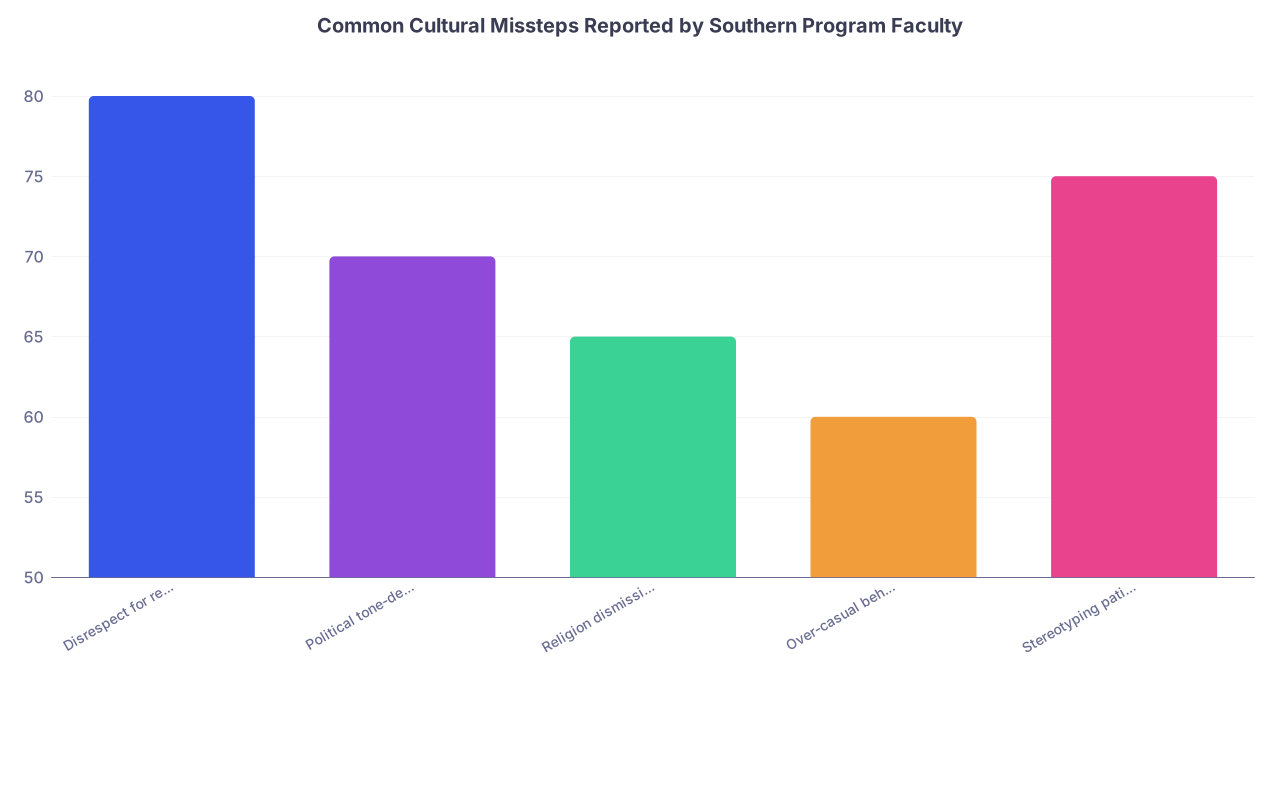
| Category | Value |
|---|---|
| Disrespect for region | 80 |
| Political tone-deafness | 70 |
| Religion dismissiveness | 65 |
| Over-casual behavior | 60 |
| Stereotyping patients | 75 |

| Step | Description |
|---|---|
| Step 1 | Interested in Southern programs |
| Step 2 | High risk for faux pas |
| Step 3 | Good cultural fit signal |
| Step 4 | Likely red flags in interviews |
| Step 5 | Stronger match chances |
| Step 6 | Quietly dropped from rank list |
| Step 7 | Researched region and program |
| Step 8 | Respect local culture and patients |

How to Actually Show Cultural Respect Without Faking It
Let me be clear: you do not need to reinvent your personality to apply to Southern residencies. You do need to avoid acting like you are auditioning for a satire of “coastal elite meets small town America.”
A few simple habits will keep you out of trouble:
- Assume the patients are worthy of your full respect—even if their politics, religion, or lifestyle do not match yours. Because they will not.
- Assume the faculty and residents know more about their community than you do. Ask, do not lecture.
- Assume you are being evaluated in the hallway, at dinner, in the elevator, and at breakfast. The offhand comments are what sink people.
And if you screw up once? Recover. “I realize that comment came out wrong; I have a lot to learn about this area, and I want to do that respectfully.” That honesty will go further than doubling down.

The 3 Things You Must Not Forget
Keep it simple:
- Do not insult the region, the culture, or the patients—directly or through jokes.
- Do not confuse Southern politeness with softness; match their respect, not their accent.
- Do your homework on the specific program and state, then ask questions like someone who actually plans to live and work there, not just pass through.