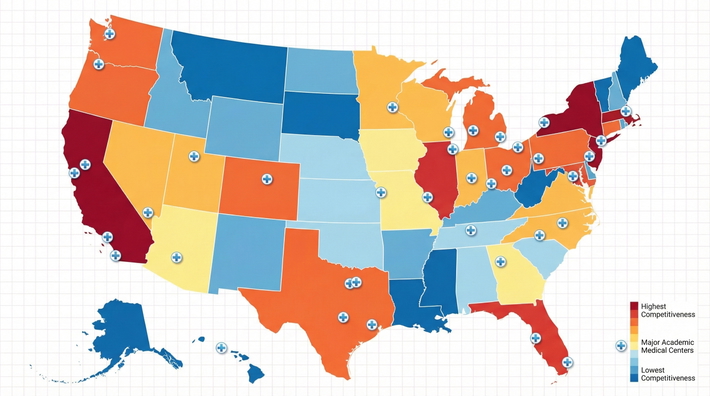
Ignoring State Licensing Rules Will Wreck Your Plans Faster Than a Bad Step Score
You can have a 270 on Step 2, glowing letters, and a gold-plated CV. Ignore state licensing rules, and a clerk in a state medical board office can quietly end your career plans with a two-line email.
Most applicants do not take this seriously enough. They obsess over program reputations and forget a simple fact: residency is pointless if the state will not let you hold a training license or a full license later. Programs care about this. State boards care about this. You need to care about this.
Let me walk you through the landmines I see over and over again.
The Silent Gatekeepers: State Boards vs. Programs
Residency programs do not grant you the right to practice medicine. State medical boards do. That distinction matters more than you think.
Every state has its own rules about:
- What counts as an acceptable medical school
- Required exams (USMLE/COMLEX combinations, attempt limits, time limits)
- Number of training years needed before full licensure
- Rules for international medical graduates (IMGs and FMGs)
- Background issues: criminal history, gaps, professionalism problems
Programs can love you. But if the state board cannot license you, they have a big problem. Some will screen for this. Others are careless and assume you will “figure it out.” That is how people end up unmatched, unlicensed, or stuck after PGY-1 with nowhere to go.
Here is the key mistake: treating all states as basically the same. They are not.
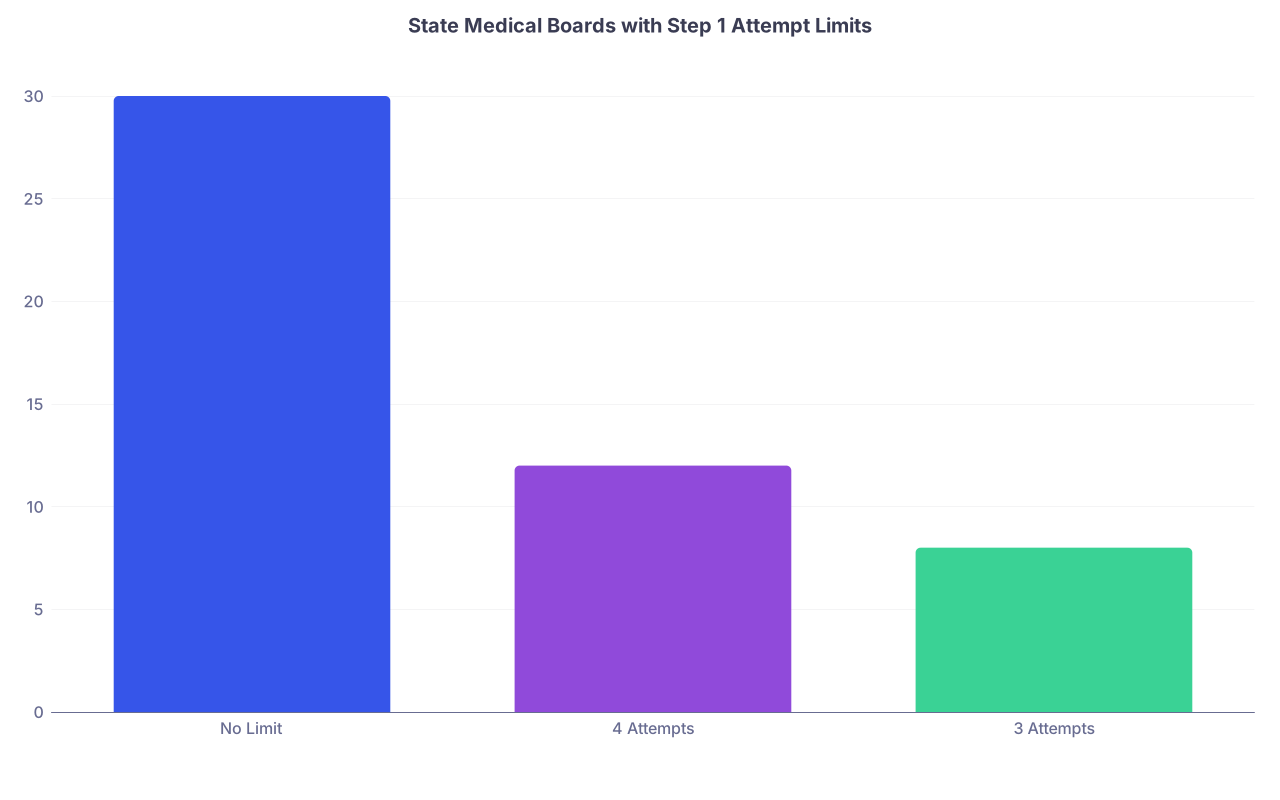
| Category | Value |
|---|---|
| No Limit | 30 |
| 4 Attempts | 12 |
| 3 Attempts | 8 |
That little chart is not hypothetical. Several states still have low attempt limits, or old rules still floating around in their statutes that they enforce inconsistently. You do not want to find out about them after you have already matched.
Major Licensing Pitfalls by Region You Cannot Ignore
I will not list every state’s detailed rules. You should look them up yourself. But you need to understand the patterns and traps by region.
1. West Coast: Prestige + Bureaucracy = Hidden Traps
States like California and Oregon look shiny from the outside. Beautiful cities, strong academic centers, competitive programs. Their licensing systems? Not always user-friendly.
Common pitfalls:
California’s obsession with medical schools
If you are an IMG or from a lesser-known school, you absolutely must check whether your school is recognized/approved by the California Medical Board. If it is not, you can match but never get a license there. I have seen people match, do multiple years, then discover they cannot stay in-state long term.Old rules that linger in PDFs
Some Western states have legacy rules about USMLE attempt limits or completion time windows (e.g., must pass all Steps within 7 years). Miss that window? You might still match into a California or Oregon program, but you will hit a wall when you apply for full licensure.Training license vs. full license confusion
You might get a training license for residency even though you will never qualify for a full license in that state. Programs sometimes “forget” to mention that. You need to check both — what is required for a training license, and separately, what is required for full licensure after training.
Do not assume because “everyone wants California” that the rules are forgiving. They are not.
2. Northeast: Tough on Paperwork, Tougher on Timing
The Northeast is dense with big-name hospitals. It is also dense with old, picky licensing boards.
Frequent mistakes:
Assuming your exam history is fine everywhere
A state that will give you a residency training license is not always the same as a state that will give you a full, unrestricted license. Several northeastern boards look very hard at:- Number of USMLE/COMLEX attempts per step
- Gaps between steps
- Whether steps were completed within a set number of years
Not planning for sub-specialty training
Want fellowship in New York, then practice in New Jersey, or vice versa? Good. Now go read both boards’ licensing requirements, including the fine print about foreign schools, Step attempts, and postgraduate training.Assuming “big academic center” = they will handle everything
I have watched residents in Boston discover mid-PGY3 that, with their exam timeline, a neighboring state board would not issue full licenses. That killed job offers before they even made it to contract stage.
If you want the Northeast long term, you must think early about where you will actually be able to practice, not just where you want to train.
3. South: Attractive For IMGs, But Not A Free Pass
Many Southern states are more IMG-friendly. That does not mean “no rules.”
Common traps:
Foreign medical school approval lists
Some states maintain their own lists or use international directories. If your school is not on the accepted list, you are effectively blocked. I have seen Caribbean grads blocked in specific Southern states, even with US residency training, because their original school did not meet some arcane requirement.USMLE/COMLEX attempt and time limits
A number of Southern states are sticklers for:- No more than 3 attempts per Step
- Complete all Steps within 7 years
- No mixed pathway confusion (e.g., MD with only COMLEX, DO with partial USMLE)
Criminal history and professionalism red flags
Several Southern boards are especially aggressive about DUIs, academic misconduct, or prior disciplinary actions. They will not just “rubber stamp” a training license because a program wants you.
If you are an IMG leaning heavily on Southern programs, you must cross-check your school, exam path, and timeline against at least the 3–4 states where you are most likely to match or eventually work.
4. Midwest: Training Requirements Will Bite You If You Ignore Them
The Midwest often looks like a safe, “less complicated” region. Less competitive programs, lower cost of living. Do not confuse that with lenient licensing.
Frequent mistakes:
Not checking minimum postgraduate training years
Many Midwestern states require a certain number of ACGME-accredited training years before they will grant a full license. Sometimes it is 1 year. Sometimes 2 or 3. If you plan early exit from training, moonlighting, or locums, these requirements matter.Assuming osteopathic pathways are interchangeable
Some states still have quirks about COMLEX-only applicants, particularly if you are trying to transition between DO and MD-heavy environments or apply for certain fellowships. There is less chaos now post-Step 1 pass/fail, but the old culture and requirements have not completely vanished.Underestimating how conservative some boards are
Midwest boards can be quietly strict about gaps, failed attempts, or nontraditional pathways. They do not advertise this with big red text on their website. You will find it in PDF policy manuals and board minutes.
If you want flexibility after residency (moonlighting across state lines, working rural locums, doing telemedicine), Midwest licensing rules can either be your best friend or kill half your options.
5. Mountain West & Rural States: Great Opportunity, Weird Rules
States like Wyoming, Montana, Idaho, and the Dakotas are desperate for physicians. That desperation does not mean you can ignore their rules.
Common pitfalls:
Underestimating how small boards operate
A board with a small staff can take months to process applications. If you submit late, you may not be cleared in time to start residency or moonlight.Unique local rules on supervision and scope
For residents, this can affect what you are actually allowed to do on a training license. For attendings, it can affect telemedicine, emergency coverage, and cross-border work.Unexpected restrictions on IMGs
Some rural states have “helpful” fast-track rules for J-1 waiver or underserved work — but strong restrictions for certain types of medical schools, online coursework periods, or lack of in-person clinical training.
Great opportunities exist in these areas, especially if you want independence and broad scope. You simply cannot treat their boards as an afterthought.
IMGs and Nontraditional Paths: Double Vulnerability
If you are an IMG, FMG, or nontraditional applicant, you are playing this game on “hard mode.” The biggest mistake is assuming that once you match, the system will carry you.
Here is how people get burned:
- They check ECFMG certification and assume that means every state will accept their school. Wrong.
- They pass all USMLE Steps but did so with multiple attempts or over >7 years, then discover that a particular state board will not license them.
- They complete residency in one state, fellowship in another, then apply for a license in a third state that has stricter rules than both.
You must track:
- Your school’s status with multiple state boards (start with states where you are applying + where you may want to live later)
- Your exam attempt count and time span
- Any prior disciplinary, academic, or criminal issues in every jurisdiction where you have been
State boards talk to each other more than you think. Gaps and omissions will surface.
Concrete Red Flags You Need To Check Before You Rank
Do not overcomplicate this. Before you rank programs — not after you match — you should answer some very specific questions.
| Risk Area | What To Verify Early |
|---|---|
| Exam Attempts | Max attempts per Step / COMLEX level |
| Time Limits | Years allowed to complete all exams |
| Med School Status | Board acceptance / approved school lists |
| Training Requirements | Minimum GME years for full license |
| Background Issues | Board policies on DUIs / discipline |
If any of these are shaky for you in a particular state, think twice before ranking programs there highly. You might match and then discover you can never practice independently in that state.
Future-of-Medicine Trap: Telemedicine, Multi-State Practice, and Compact Licenses
Here is where a lot of “future-oriented” applicants get fooled.
You hear about:
- Interstate Medical Licensure Compact (IMLC)
- Telemedicine across state lines
- Remote work from anywhere
And you assume, “I will just get a compact license and work in multiple states, no problem.”
Reality is uglier:
The compact has eligibility standards
If your home state license is not squeaky clean and your training history does not meet specific requirements, you may never qualify for IMLC eligibility. One old probation, one late exam attempt, or a less-than-perfect record can lock you out.Telemedicine still requires state licensure
If you see patients in 10 states via telehealth, you usually need 10 licenses. That means 10 background checks, 10 different rule sets, and 10 ways for your past to be re-examined.Boards can and do change rules
COVID-era flexibilities ended. Some states tightened telehealth rules again. Do not build your future strategy on “I will just do telemedicine everywhere” without understanding the licensing burden.
If you care about flexibility, you should favor training in states with:
- Reasonable exam rules (few attempt restrictions, no absurd time limits)
- Clear, modern board websites and compact participation (if you qualify)
- Predictable attitudes toward telemedicine and multi-state work
Training in the “wrong” state does not doom you, but it can make your life far harder when you want to expand later.
A Simple, Boring Process That Will Save You From Pain
Let me be blunt: the people who avoid licensing disasters do not do anything magical. They just do the boring work early.
Use this process:
List your realistic states
Not your fantasy map. The 5–10 states where you are actually applying heavily, plus 2–3 where you might want to live long term.Pull each state board’s rules yourself
Use the state medical board website, not blogs, Reddit, or random forums. Download the licensing requirements for:- Initial training license
- Full, unrestricted license
Cross-check your specifics
For each state, ask:- Is my medical school explicitly accepted?
- Do my exam attempts and timelines meet their rules?
- Do I meet their minimum training years for full licensure?
- Do I have any background issues that would trigger extra scrutiny?
Talk to someone who has actually done it
Email or call the GME office or licensing coordinator at programs in that state. They are the ones who watch residents get delayed or blocked every year. They often know the “unwritten” rules.Adjust your rank list accordingly
If a state looks marginal for you, do not anchor your entire future there. Rank more heavily in states whose boards clearly accept your pathway.
This is not paranoia. It is damage control.

| Step | Description |
|---|---|
| Step 1 | Make State Shortlist |
| Step 2 | Check Board Websites |
| Step 3 | Compare With Your School and Exams |
| Step 4 | Lower Rank for Risky States |
| Step 5 | Keep States High on List |
| Step 6 | Confirm With GME Offices |
| Step 7 | Finalize Rank List |
| Step 8 | Any Serious Conflicts? |
The Biggest Mental Mistake: “I’ll Worry About It Later”
This is the single most dangerous thought in this entire topic.
“I will look into licensing once I match.”
“I am sure programs would not rank me if there were a problem.”
“My friend from the same school matched there, so I am fine.”
No.
Programs are not the final authority. They can be wrong. They can be sloppy. They can assume the board will “probably” accept someone with your profile because they have not personally seen it go badly yet.
I have watched residents:
- Delay their start date because of missing or denied training licenses
- Lose moonlighting income because they could not get a license in the neighboring state
- Decline dream job offers because a particular state refused full licensure over old exam attempts or school issues
- Get stuck in visa and J-1 waiver nightmares because a state board would not recognize their path
All of this could have been prevented with 2–3 hours of serious research, six months earlier.
FAQs
1. I passed all my Steps but had multiple attempts. Should I just avoid strict states entirely?
Not necessarily, but you must be realistic. Identify which states have clear attempt limits (e.g., max 3 attempts per Step). If your history exceeds those, do not rank programs there highly. If you are borderline, talk directly to the state board or a licensing specialist. Blind optimism is what gets people burned.
2. I am an IMG with ECFMG certification. Does that mean every state will license me?
Absolutely not. ECFMG certification is necessary, not sufficient. Some states maintain their own school lists or impose extra requirements on IMGs: specific clinical training, in-person coursework, or school recognition. Look at your top target states’ explicit language on international schools, not just the generic ECFMG line.
3. Do I really need to worry about full licensure rules before residency if I just want to match somewhere?
Yes, if you care about staying in that state after training or doing telemedicine/multi-state practice later. You might get a training license now and only discover 5–7 years later that full licensure is blocked. Planning only for PGY-1 is shortsighted. You are building a 30-year career, not a 1-year rotation.
4. Who can actually help me interpret confusing state rules?
Start with:
- GME offices and licensing coordinators at programs in that state
- State medical board licensing staff (by phone or email)
They see these issues daily. If your situation is complicated (serious legal issues, prior board actions, very unusual training path), an attorney who specializes in medical licensing is worth the cost. Do not rely solely on Reddit, classmates, or generic advisors for this level of risk.
Key things to remember:
State medical boards, not residency programs, control your ability to practice.
Your exam history, medical school, and background will look very different from one state’s rulebook to another.
If you ignore licensing details before you match, you are gambling your entire future on bureaucracy you have never read.