The culture clash between California and Pacific Northwest residencies is real—and it blindsides more applicants than anyone admits.
You see the same mistake every season: students rank UCSF and UW right next to each other, or OHSU and Stanford, thinking “West Coast is West Coast, vibes will be similar.” Then they show up intern year and realize they’ve essentially moved to a different country in terms of expectations, hierarchy, and lifestyle.
I’ve watched this play out in real time on rank committees, in closed-door faculty meetings, and during those “let’s talk honestly” chief debriefs. So let me pull back the curtain on what actually changes when you cross that invisible line between California and the Pacific Northwest.
The Core Personality Difference: Performance vs Deliberation
Here’s the blunt version:
California residencies are performance cultures.
Pacific Northwest residencies are deliberative cultures.
Not every program, not every department. But as a regional pattern, it holds.
In California—especially at the big academic centers—you’re walking into an ecosystem obsessed with visibility, prestige, and output. Residents know who’s on which NIH grant, who’s publishing in JAMA, who’s going to Stanford vs UCLA fellowship. There’s a scoreboard mentality. Polite on the surface, but everyone is tracking where they stand.
In the Pacific Northwest, the dominant mode is slower, more reflective, more procedural in decision making. People sit with problems. There’s more consensus-building, more meetings, more “let’s think about how this affects the team long term.” Less performative, more process-oriented. When a UW or OHSU attending says, “Let’s circle back to this,” they actually mean it.
The friction happens when someone trained in performance culture lands in a deliberative culture—or vice versa.
I’ve seen:
- A Stanford prelim going to a Seattle IM program “because I love outdoors” who then melts down because nobody seems impressed that they have three first-author papers and a 260+.
- A UW med grad matching at a big LA academic hospital, shocked that speaking up aggressively in M&M is rewarded, not seen as “disruptive to team harmony.”
Nobody explains this to you on interview day. They’re all busy telling you about wellness committees and hiking.
Clinical Expectations: How the Work Actually Feels Different
People always ask about hours. That’s the wrong question. The better question: What does a busy day feel like here? Because California-busy and PNW-busy are not the same thing.
California: Fast, Fragmented, and Image-Conscious
At places like UCLA, UCSD, UCSF, Stanford, and their mid-tier imitators, the pace is brisk and attention is divided. There are three layers of pressure:
- Service demands in huge, high-acuity tertiary centers
- Research/academic output expectations
- Constant looking over your shoulder at who’s watching your performance
You’ll hear phrases like:
- “You need to look sharp on rounds.”
- “Faculty are really paying attention to how you present.”
- “That’s going to come up in your fellowship letter.”
Rounds are theater. Residents know which attending expects powerpoints for journal club, which one docked the last intern for not knowing the latest trial, which subspecialty fellow is tight with the PD. The emotional tone: alert, slightly anxious, always “on.”
You can have a good day clinically and still go home annoyed because you stumbled in front of the “wrong” attending.
Pacific Northwest: Slower, Systems-Heavy, Deep-Dive
At the major PNW centers—UW, OHSU, Swedish, Virginia Mason, Legacy—the day often feels less like performance and more like a never-ending committee meeting plus patient care.
That doesn’t mean easier. I’ve seen PNW residents just as exhausted as their California peers. But they’re drained from:
- Long, nuanced family conversations
- Detailed goals-of-care discussions on every complex patient
- Negotiating with risk management, ethics, social work
- Sitting through legitimately long multidisciplinary rounds
They’re not worried that their admission note looked less polished than their co-intern’s. They’re worried that Mrs. X’s POLST isn’t aligned with her daughter’s expectations and that ethics wants a formal consult.
You’ll hear:
- “Let’s make sure we’re looping palliative in early.”
- “We should talk through the social piece more before we discharge.”
- “Can we get everyone on the same page about this plan?”
This is the region where “systems-based practice” isn’t just a milestone on paper. It’s how they work.
Hierarchy and How People Talk to Each Other
This part surprises people the most.
California: Flatter on the Surface, Hierarchical Underneath
West Coast, tech-adjacent, “call me by my first name” culture. That’s what you see.
Attendings often say, “I’m Sarah, not Dr. Johnson,” and everyone jokes around on rounds. But under that informality sits a very rigid mental hierarchy, driven by prestige and achievements. The PGY-3 eyeing GI fellowship at UCSF and the intern from a Caribbean school are not on the same social footing, even if everyone pretends otherwise.
Feedback can be sharp but couched in “supportive” language:
- “I think you’re very capable, but at our level we expect…”
- “For someone aiming for cards, you’ll really need to be stronger at…”
Behind closed doors in CCC meetings, they are absolutely ranking people—formally and informally. I’ve literally seen spreadsheets where chiefs quietly track “top fellowship candidates” months before ERAS opens. That’s the game.
Pacific Northwest: Friendlier Face, Stronger Norms
In the PNW, it feels more collegial. People linger to talk. Attendings will chat about climbing routes and ski passes. Nurses will talk to you like a person, not a cog.
But there’s a very strong cultural expectation about behavior: do not be a jerk, do not grandstand, do not make yourself “bigger than the team.” When someone violates that, they get socially iced out faster than in California.
The unwritten rules:
- Speak up, but don’t dominate.
- Advocate, but don’t bulldoze.
- Be ambitious, but not visibly hungry.
I’ve seen brilliant California transplants get quietly labeled “abrasive” because they pushed as hard in Seattle as they did in LA. Nobody confronts them directly. Instead, they just stop being invited to certain opportunities. That’s how the system enforces norms.
Lifestyle: What “Work-Life Balance” Actually Means
Everyone sells “West Coast lifestyle.” They’re not lying; they’re just editing.
California: Maximize Everything
In California, the off-hours pattern is: squeeze every ounce out of your limited time. Residents stack:
- Research meetings
- Side projects
- Commutes that are longer than they admitted on interview day
- A social life that keeps up with a hyper-active city
People brag about how much they’re doing:
- “I’m chief, doing a QI project, plus I picked up moonlighting at Kaiser.”
- “I’m on days, but I’ll swing up to SF this weekend and back Sunday night.”
There’s a real “do it all” mentality. If you’re not careful, burnout isn’t a risk; it’s the default.
Pacific Northwest: Protect the Off Switch
PNW programs like to actually talk about boundaries. Not in a brochure way—more in an “I’m TURNING OFF my pager and going off-grid this weekend” way.
People leave early on post-call to catch good weather. They plan around ski season, or summer hiking, or climbing season. It is culturally acceptable to say, “I’m offline,” and mean it. Faculty model it too. I’ve heard attendings at UW and OHSU tell teams directly, “If I email after 6 pm, answer it tomorrow. I’m just clearing my inbox.”
Work is still intense. But there’s less guilt attached to wanting a real life. In California, saying no to a research opportunity for your sanity? That’s unusual. In the PNW, it’s not a scandal.
Academic vs Community: Regional Flavors
Both regions have academic powerhouses and community-heavy programs. But even within those categories, the flavor shifts.
| Aspect | California Academic Centers | PNW Academic Centers |
|---|---|---|
| Research Pressure | High, early, explicit | Moderate, more optional |
| Prestige Signaling | Constant, visible | Subtle, background |
| Rounds Style | Performative, brisk | Deliberate, discursive |
| Reputation Sensitivity | Very high | High but less neurotic |
| Lifestyle Fit | Hustle plus outdoors | Outdoors first mindset |
California Academic Programs
Think of UCSF, UCLA, Stanford, UCSD, UC Davis. These are pipeline machines to fellowship and academia. The PDs know which residents they can “place” at MGH, Penn, or back into their own subspecialty departments. They track this obsessively.
What you do:
- Start research early or you’ll quietly fall out of the “top tier” funnel.
- Present well. The big names notice.
- Recognize that some spots are informally earmarked long before match.
You will learn a ton. You will also feel like you’re always in an audition.
PNW Academic Programs
UW and OHSU are the obviousflagships here, with Swedish/Virginia Mason/Legacy carrying significant weight in certain specialties.
Their identity is more:
- “We’re the referral center for a huge, underserved geographic region.”
- “We take care of incredibly complex, rural, and marginalized populations.”
- “We train people who can handle real-world mess.”
Research is available and can be very strong (UW especially). But the selling point internally is more about clinical maturity, systems savvy, and the ability to manage complex cases across fragmented healthcare structures.
The Hidden Culture Clash for Couples and Families
This doesn’t show up on program websites, but it shapes a lot of resident satisfaction.
Cost of Living and How Programs React to It
California programs know they’re underpaying you for the housing market. They also know prestige carries weight, so the institutional attitude is often: “Yes, it’s expensive, but you’re at [UCSF/Stanford/UCLA].”
You’ll occasionally get wellness stipends, housing lotteries, maybe some food subsidies. But at many places there’s a quiet expectation that residents either:
- Have financial help from family, or
- Live far away and accept brutal commutes, or
- Take on significant debt/credit reliance
In the PNW, cost has exploded too, especially in Seattle and Portland. But the tone is different. There’s more collective complaining, more union activity, more push for actual structural change. I’ve seen residents at PNW programs far more willing to:
- Organize around pay and benefits
- Confront leadership about unsustainable schedules
- Demand transparency in how GME dollars get used
California residents talk about “surviving the cost.” PNW residents talk about “changing the system.” Not always successfully, but the instinct is different.
Family and Parenthood Culture
I’ve sat in rank meetings where someone asked, “Do we think she’ll want part-time for kids?” Yes, that question still gets asked, quietly.
California: Programs say they support parents. And many do, to a point. But the subtext at high-powered academic centers is: Don’t let your family life interfere with your academic trajectory. Being very visibly “family-first” sometimes gets read as “less serious.”
PNW: There’s still bias, but the cultural default values family time more publicly. I’ve watched PNW chiefs design schedules around child care constraints in a way I do not see as often in California. Taking parental leave is less career-defining drama and more “ok, how long and when?”
Personality Fit: Who Thrives Where
This is the part you need to be brutally honest about with yourself.
You’ll Likely Fit Better in California If:
- You are energized by competition and visible excellence.
- You want a clear fellowship or academic path and you want to be surrounded by people who care about that as much as you do.
- You don’t mind always having something to prove.
- You can tolerate (or even enjoy) a bit of prestige obsession and name-dropping.
- You can handle financial stress and/or long commutes without spiraling.
You’ll be miserable in California if you deeply resent people playing the game, but you still want the outcomes of the game. That contradiction eats residents alive.
You’ll Likely Fit Better in the PNW If:
- You care a lot about quality of life and actually intend to protect it.
- You’re attracted to thoughtful, slower decision-making rather than sharp, high-velocity performance.
- You value team cohesion more than personal spotlight.
- You can handle gray zones, vague expectations, and lots of discussion before action.
- You genuinely like the idea of disappearing into mountains/forests/water on your days off.
You’ll struggle if you need constant explicit praise or fast-moving feedback loops. PNW feedback culture can be maddeningly indirect and slow.
What Program Directors Think and Say Behind Closed Doors
Here’s the part nobody tells you.
How California PDs Talk About PNW-Trained Applicants
I’ve heard variations of these lines in fellowship selection meetings in California:
- “Solid training, but I wonder if they’ll keep up with the pace here.”
- “They seem great, but will they buy into our academic productivity expectations?”
- “PNW folks are usually very grounded, good team players. Might need some pushing.”
Basically: they respect the clinical and humanistic training, but quietly worry about intensity and drive—especially for competitive fellowships.
How PNW PDs Talk About California-Trained Applicants
Flip side, from the PNW side:
- “Very strong CV, but I worry about personality fit with our culture.”
- “Do they understand we’re not trying to be UCSF North?”
- “Will they be ok with our style, or are they going to try to turn everything into a brand-building opportunity?”
They respect the hustle, but they’re wary of ego and of people who treat every rotation as a stepping stone rather than a community.
How to Choose—and How to Prepare for the Culture You Pick
Do not pick based purely on name, geography, or “I like hiking and beaches.” That’s amateur hour.
Before You Rank
Talk to current residents one-on-one and ask questions that force them to reveal culture:
- “What kind of resident does best here?”
- “Who struggles? Why?”
- “If someone is very fellowship-focused, how are they perceived?”
- “How does the program react when people say no to extra things?”
- “What do your co-residents brag about most?”
Listen to the subtext. In California, they’ll brag about match lists, research awards, visiting profs. In the PNW, they’ll brag about wilderness stories, schedule flexibility, or “how supportive people were when X happened in my personal life.”

| Step | Description |
|---|---|
| Step 1 | Start - Considering West Coast |
| Step 2 | Lean California |
| Step 3 | Lean PNW |
| Step 4 | High fit California |
| Step 5 | Risk of burnout in CA |
| Step 6 | Risk of frustration in PNW |
| Step 7 | High fit PNW |
| Step 8 | Primary Priority |
| Step 9 | Personality |
| Step 10 | Needs structure and feedback |
If You’re Moving From One Culture to the Other
- California → PNW: Dial down the visible hustle by 20%. Ask more questions before pushing for change. Prove you care about the team, not just your CV.
- PNW → California: Thicken your skin. Learn to market your work. Accept that you’re in an environment where ambition is spoken out loud and often.
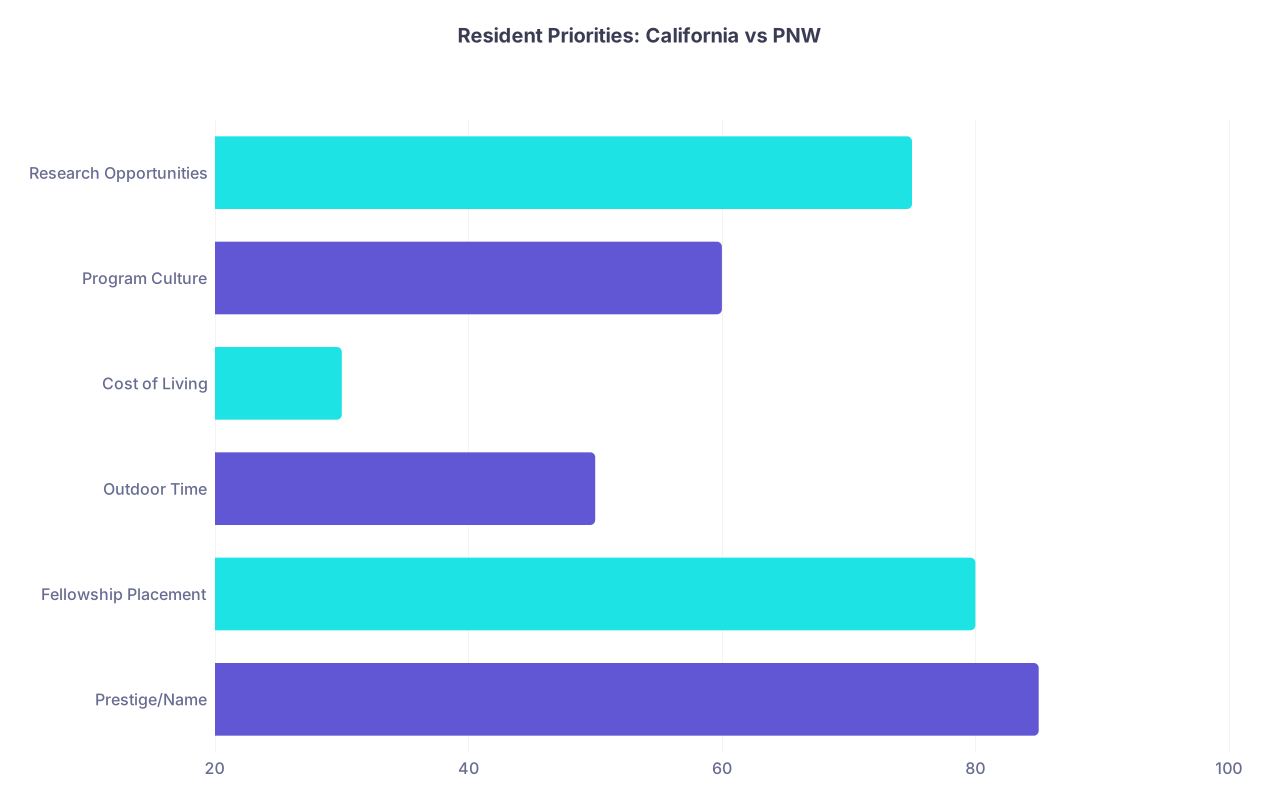
| Category | Value |
|---|---|
| Prestige/Name | 85 |
| Fellowship Placement | 80 |
| Outdoor Time | 50 |
| Cost of Living | 30 |
| Program Culture | 60 |
| Research Opportunities | 75 |
(Think of this as how heavily California academic residents act like they weight these things. In the PNW, that chart flips—outdoors and culture jump to the top; prestige quietly drops.)
FAQ: California vs Pacific Northwest Residency Culture
1. Will doing residency in the PNW hurt my chances at a competitive California fellowship?
Not automatically. I’ve seen UW, OHSU, and even strong community PNW grads match into top California fellowships. But you’ll have to be more intentional: get involved in research early, go to national conferences, and make sure your PD and letter writers explicitly state that you can thrive in a high-intensity, academic environment. California selection committees sometimes assume “chill program = chill resident” unless your file contradicts that.
2. Are California programs really that much more cutthroat?
Some absolutely are. Others just feel that way because the residents are more openly competitive and the prestige stakes are higher. The toxicity varies by department and by PD. But if you walk into a big UC or Stanford program expecting a slow-paced, vibe-heavy experience because “it’s the West Coast,” you’ll be in for a shock. The hustle is real.
3. Is the PNW actually better for “work-life balance,” or is that just marketing?
It’s better in attitude, not necessarily in raw hours. You’ll still work hard. But there’s more explicit support for boundaries and a stronger norm around using your time off for actual life, not just CV padding. The catch: if you’re someone who doesn’t protect your own time, no region will save you. PNW culture just makes it slightly easier.
4. How do PDs view switching regions for fellowship (California → PNW or vice versa)?
They like it more than they admit. Moving regions signals flexibility, broader exposure, and a willingness to adapt. California PDs sometimes see PNW-bound residents as “choosing sanity,” which they secretly respect. PNW PDs often see California-trained applicants as bringing strong academic chops—as long as they aren’t arrogant. The key is framing: your personal statement and interviews should show you understand and value the culture you’re entering, not that you’re trying to escape or “upgrade” from where you came from.
5. If I care about both outdoors and aggressive academic careers, where do I belong?
You’re the classic conflicted West Coast applicant. The honest answer: go where the people feel like your tribe. There are California programs where residents sneak out to surf post-call and crank out NEJM papers. There are PNW programs where people ski 40+ days a year and still match into top fellowships. On your interview days, ignore the slides and swag. Watch what the residents light up talking about when they forget the script. That’s the culture you’re signing up for.
With this mental framework, you’re not just choosing a coastline; you’re choosing a value system and a daily emotional climate. Get that match right, and you’ll have the reserves to tackle the rest of the profession’s nonsense. The next battle is how you use those years to shape your actual career—but that’s a story for another day.